To get rid of roaches in a car interior, strip the cabin of food and clutter, vacuum every seam and floor edge, place small dabs of bait in the cracks where you found signs, close off access points, and then watch those same spots for several weeks. The work itself takes an afternoon. Most people see fewer roaches within a few days and a clean cabin in two to four weeks, because the adults die fast and the hidden nymphs take longer.
Difficulty is low if you are willing to pull the floor mats and move the seats. It gets much harder if you expect a spray can to do the whole job, and the honest answer is that spraying alone is what turns a small problem into a months-long one. What follows is the order I would work in, on a car with the same problem.
Table of Contents
- What You Need
- Step-by-Step: How to Get Rid of Roaches in a Car Interior
- Step 1: Inspect the cabin and identify where roaches are hiding
- Step 2: Remove food, trash, clutter, and standing water
- Step 3: Vacuum and clean cracks, seams, and floor edges
- Step 4: Apply labeled bait in small, targeted placements
- Step 5: Seal gaps and keep the vehicle from getting reinfested
- Common Mistakes
- How to know if the roaches are gone
- Frequently Asked Questions
- Do foggers get rid of roaches in a car?
- Is it safe to use a bug bomb in a car interior?
- What should I do if my car is heavily infested with roaches?
- Does baking soda really kill roaches in a car?
- How long should I keep my car empty after treating it for roaches?
- How do I know if the roaches in my car are completely gone?
- Conclusion
What You Need
None of this is expensive and most of it you already own. Gather it before you start, because you will not want to stop halfway through a seat-rail cleanup to hunt for a flashlight.
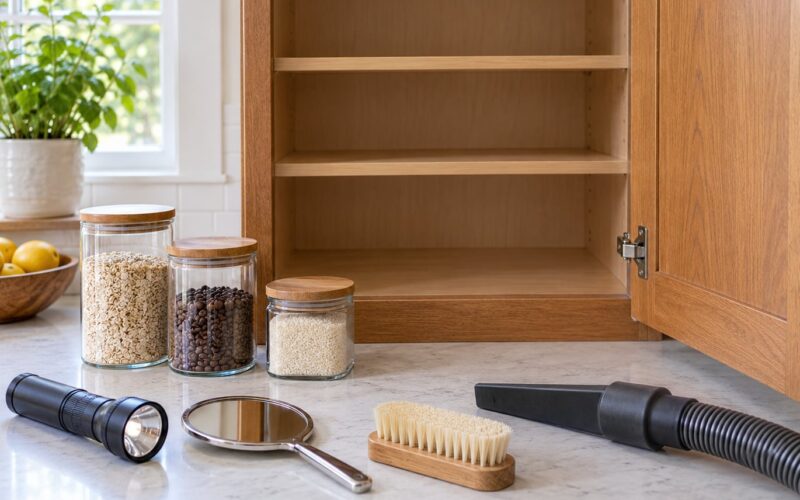
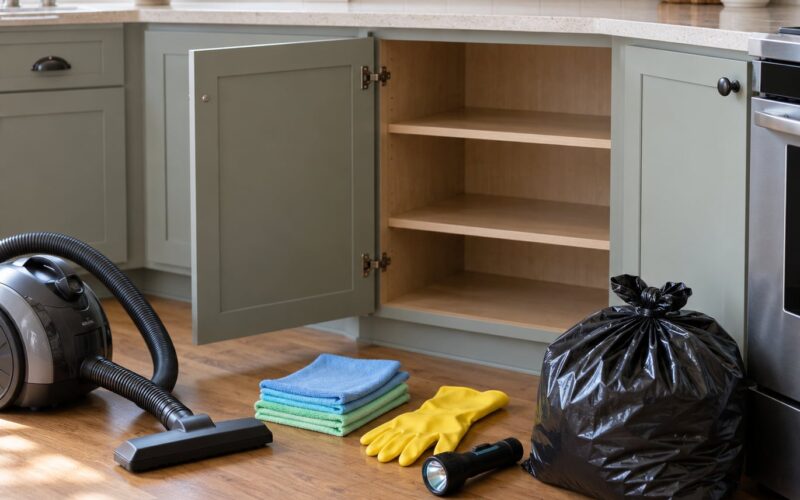
- Flashlight — a headlamp is better, since you need both hands under the seat.
- Phone camera with a macro or zoom lens — it beats a magnifying glass for reading droppings in a tight seam.
- Nitrile gloves — you will be handling droppings and dead roaches.
- Trash bags — for everything you pull out of the cabin, including crumbs and dead roaches.
- Vacuum with a crevice tool — a handheld vacuum for seat rails and the console gap.
- Stiff brush — a toothbrush or pastry brush for seams.
- Microfiber cloths and a mild interior cleaner — something mild is better than a heavy citrus cleaner that leaves a residue roaches can track.
- Silicone or automotive seam sealant — for trim gaps and weatherstrip edges, not for anything hot or moving.
- Roach bait or gel bait — a product labeled for the use you intend, plus sticky traps for monitoring.
Only add an insecticide labeled for automotive interiors, and only if the label permits use on the surfaces you plan to treat. If the vehicle owner’s manual says something about interior care or materials, the manual and the product label both take precedence over anything written here. Never spray a product onto upholstery, headliner, or a surface near the windshield without checking that the label allows it.
Step-by-Step: How to Get Rid of Roaches in a Car Interior
Step 1: Inspect the cabin and identify where roaches are hiding
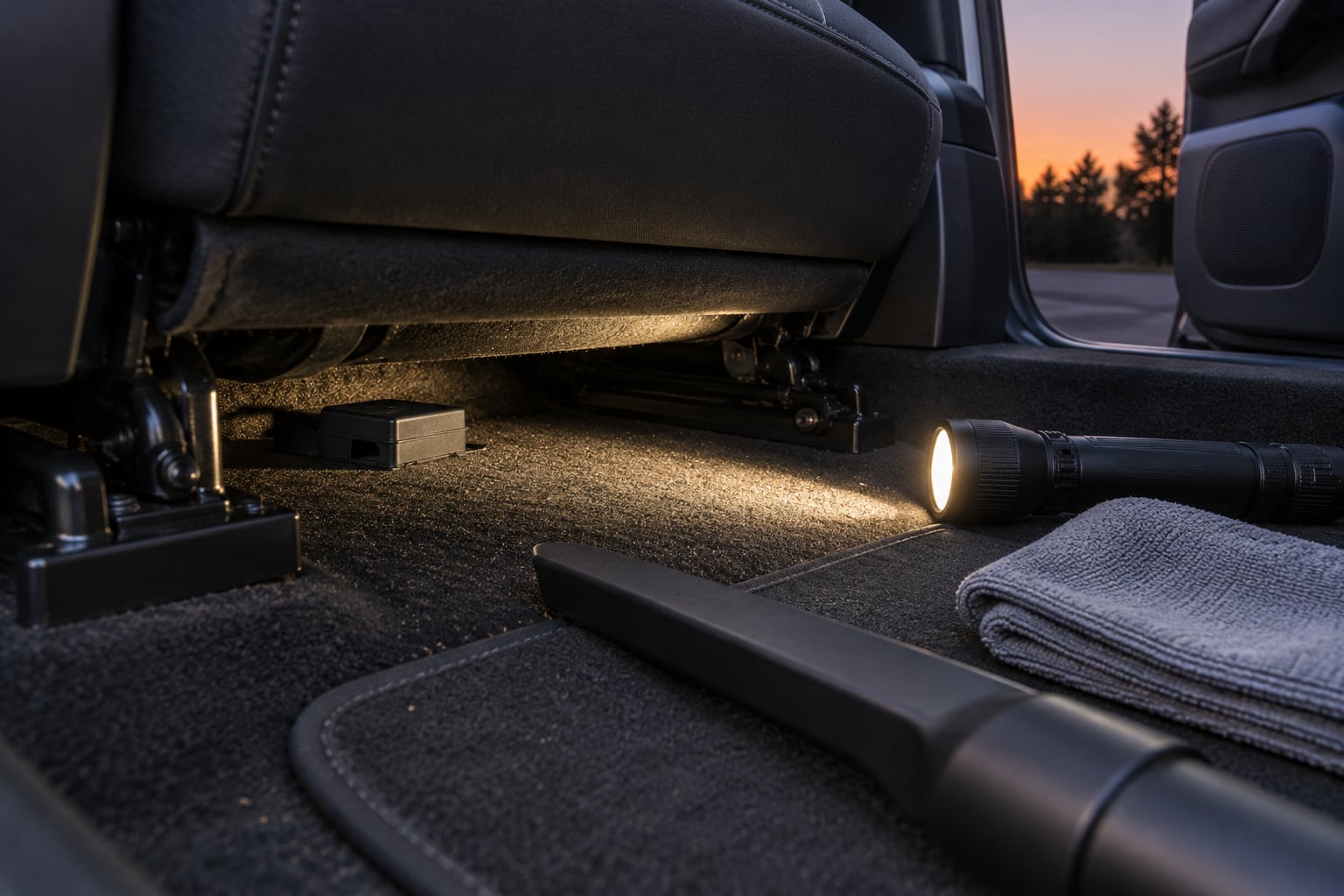
Start at night, park, close the doors, wait an hour, then get in with the flashlight. Cockroaches are nocturnal and they scatter from light, so anything you catch in the beam was not there an hour earlier either.
Work through the places people never look: under the seats, inside the seat rails on a track-type seat, beneath the floor mats, around the center console, behind the glove box, near the trunk, along the door seals, and behind the HVAC housing. With the keys turned on and the fan set to high, a roach scuttling in the vent area tells you the heating and air system is part of the problem.
Evidence looks different depending on the species. German cockroach droppings are small, dark and pepper-like, often with a brown stain halo. American cockroach droppings are larger and more irregular, and you may notice a strong ammonia-like odor from accumulated urine in a heavy infestation. Shed skins and empty brown egg cases, called ootheca, mean breeding has already happened inside the vehicle.
One stray roach is not proof of a full infestation. Roaches wander in from a parked neighbor or ride in on a grocery bag, and they often abandon a hot, dry car quickly. Several live roaches plus fresh droppings plus an egg case is a different situation, and that is the point where a car moves from a weekend cleanup to a two-to-six-week project.
Step 2: Remove food, trash, clutter, and standing water
Cockroaches are looking for three things in your car: food, water, and a dark sheltered gap to sleep in. Take away all three and the cabin stops being worth living in.
Empty every cup holder and every storage pocket. Take out the floor mats and the trunk liner and check underneath them, where spilled juice and dog food routinely dry into a paste. Wipe down cup holders, the center console tray, the door pockets, the seatback tray in front of a child seat, and the seam where the console meets the floor.
Pull trash out of the vehicle entirely rather than consolidating it into one bag, since a full bag parked in a car is just a larder with a lid. Check under the seats for fast-food wrappers and drink cups, and check the spare tire well, which is a classic hiding spot people never open.
Then deal with moisture. A dry car is a hard car for roaches, and condensation from a car wash or rain is often enough to sustain a small population under the carpet. Run the heater or air conditioner with the doors open for 20 to 30 minutes to bring the interior down, wipe any damp carpet or mat, and fix anything that leaks. If your weatherstrip is torn, that leak is also an entry point.
Step 3: Vacuum and clean cracks, seams, and floor edges
Cleaning is the step that decides whether treatment works. Baits kill roaches that come out to feed. A vacuum removes the ones you never see and the debris they are eating.
Vacuum the floor edges where the carpet meets the door sill and the firewall, the seat rails, the gap around the center console, the door pockets, the trunk seams, and under both front seats. Use the crevice tool with a slow pass, then go over the same lines with a stiff brush to loosen what is stuck in the fabric. Wear gloves and skip the beater brush on upholstery you care about.
One caution: eggs and droppings smear and spread when you scrub wet. Vacuum first, dispose of the contents in a sealed bag away from the house, and wash your hands. If a scavenger shows up later, ants are usually the reason — dead roach bodies are protein, and leaving them under a seat invites a second problem into a car you just cleaned.
Wipe hard surfaces with a mild cleaner and a microfiber cloth, one panel at a time so you are not chasing moisture around the cabin. Never mix cleaning products. Bleach, ammonia, and alcohol-based products together can produce dangerous fumes in a closed vehicle, and a soaked interior around electronics or the wiring beneath a trim panel is a repair bill, not a cleanup.
Step 4: Apply labeled bait in small, targeted placements
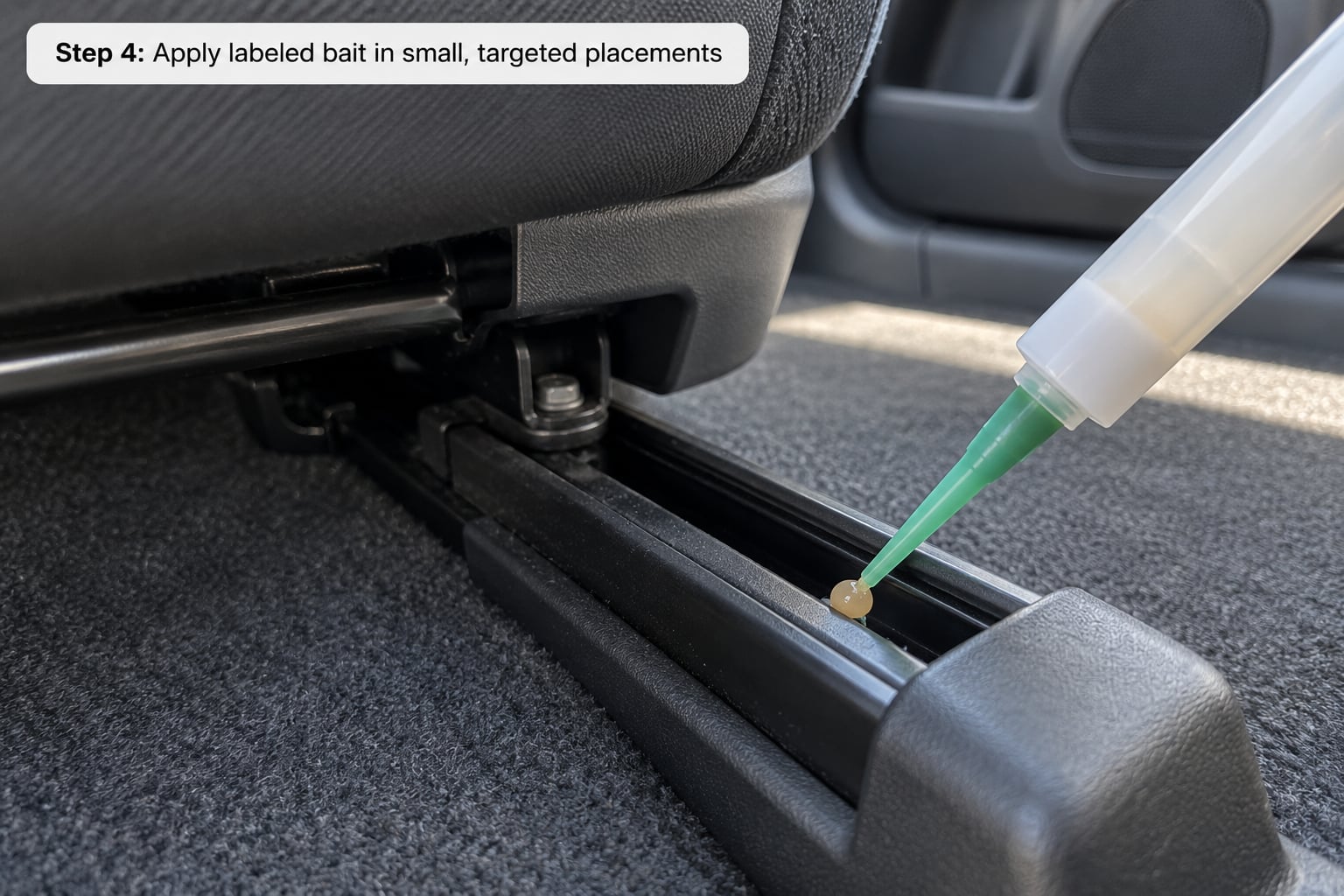
Non-repellent bait does the real work. Roaches eat it, and because grooming transfers it, killing one often kills others nearby. Place it in cracks, seams, under the seat edges, and along the floor edges where you found droppings, following the product label exactly.
A few practical rules I would not bend:
- Keep bait away from children, passengers, food, and pets. A stick-on bait station or a dab in a seam nobody touches beats an open dish in a console.
- Never spray insecticide near or over bait. Repellent sprays push roaches deeper into the trim and drive them away from the food you are trying to give them. Bait first, spray last, and preferably not at all.
- Use more bait placements than you think for a bad case. Owners dealing with German roaches in a car often place a dozen small stations — under seats, near the pedals, along the console, in the trunk — rather than three large ones.
- Expect the roaches to increase for a few days. They leave shelter to feed, so sightings rising briefly is not failure.
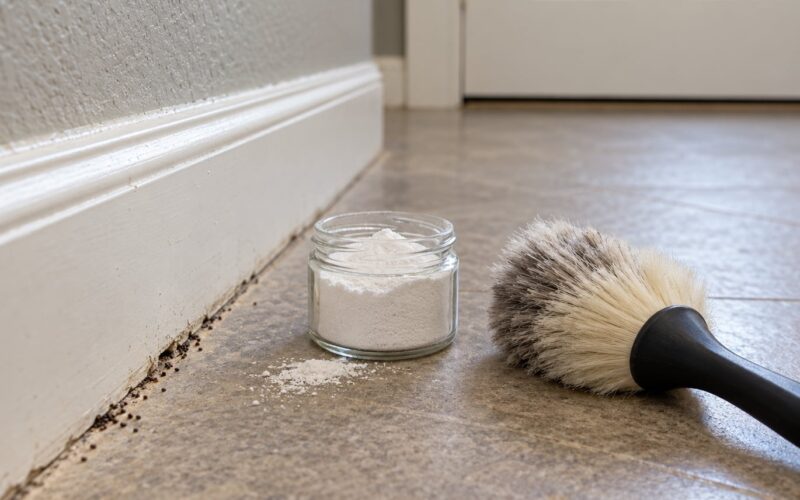
Boric acid or borax dusted thinly in cracks is a slower, secondary option that dries roaches out over roughly 72 hours, and boric acid is toxic to pets if ingested, so keep it out of reach. Diatomaceous earth works only where it stays dry, so it is a poor choice under a damp mat. If you want a natural option, be honest with yourself: peppermint and eucalyptus oils are pleasant in a car and barely bother a roach.
Skip foggers as your main treatment. A bug bomb in a vehicle means leaving the car sealed for hours, and the aerosol settles onto upholstery and carpet where people and pets sit, with residue that is unpleasant to breathe. It can kill a lot of visible roaches and still leave the source untouched. If you use one anyway, treat it as a supplement, ventilate fully before anyone rides, and vacuum the surfaces afterward.
Heat works too, and it costs nothing. Park in direct sun for a few hours with the cabin closed to raise interior temperatures, then place sticky traps overnight. It will not clear a heavy infestation, but it takes pressure off while the bait does its job.
Step 5: Seal gaps and keep the vehicle from getting reinfested
Roaches enter a car the same way they enter a home: through openings and in cargo. Work around the outside with a flashlight.
- Door seals and weatherstripping — look for torn, lifted, or hardened rubber that leaves a gap at the sill.
- The gap around the trunk latch and the hood seam at the firewall.
- Body openings near the underside of the vehicle and the cabin air inlet duct.
- HVAC intake and the area around the blower housing, where nymphs travel along ducts.
- Any hole around wiring or trim you can see through to the outside.
Seal only what the location allows. Silicone or automotive seam sealant fits trim gaps and seal edges. Anything tied to fuel lines, the exhaust, the engine bay, structural members, or wiring is not a DIY job — a technician handles those. If roaches keep appearing in the same spot after a month of baiting, that repeated pattern usually means something structural, like a duct gap or a body seam, and it is worth a shop visit rather than more bait.
Prevention is mostly habit. Check bags, backpacks, and cardboard boxes before they go in the car. Store food in sealed containers, not open wrappers. Vacuum the footwells weekly, wipe the console tray, and take the trash out every trip. If you park near garbage bins, firewood, mulch, or dense shrubs, move the car if you can, since the door and sill gaps are already sized to let a nymph through.
Common Mistakes
Spraying first, and spraying everywhere. Killer sprays are repellent. They scatter roaches into deeper hiding spots and drive them off your bait, which is why people see roaches for months after a heavy spraying. Fix: clean, then bait, and keep sprays away from bait placements entirely.
Treating a fogger as the solution. It kills what is out in the open, leaves residue where people sit, and does nothing about the source. Fix: use it at most as an addition, then vacuum and ventilate for a day before driving.
Cleaning before vacuuming, or vacuuming once and stopping. Wet scrubbing smears droppings and debris into the fibers. Fix: vacuum, brush, vacuum again, then wipe hard surfaces.
Ignoring the hidden areas. Seat rails, under the carpet, the spare tire well, behind the glove box and the trunk seams hold the population that survives. Fix: work the same inspection points every time you check.
Reading every speck as a roach dropping. Dirt and old rust freckles look similar in a photo. Fix: confirm with a live sighting, a shed skin, or an egg case, or by cleaning the spot and seeing fresh evidence return.
Mixing chemicals. Bleach plus ammonia in a closed cabin produces toxic gas, and alcohol-based products plus solvents are a bad combination around plastics and airbags. Fix: one product at a time, ventilated, following each label.
Putting open bait where hands and pets reach. Fix: stick-on stations and seam dabs only, never a dish or an open spoonful in a console.
Driving the car straight away. Fix: leave it parked and ventilated for the period the label states after any aerosol application, and vacuum the residue before anyone sits down.
How to know if the roaches are gone
Judge success on evidence, not on the last roach you killed. One roach scuttling out a week after baiting can be a resident that never found the bait, and it does not condemn the whole treatment.
Check the same points on a schedule: inspect under the seats, seat rails, console gap, and trunk seam at two days, one week, two weeks, and four weeks. Leave a few sticky traps where you saw the heaviest activity and note what they catch each time.
You are in good shape when the sightings stop, no fresh droppings or egg cases reappear in cleaned areas, and the traps stay empty through a full four-week window. Repeated live roaches, fresh pepper-like droppings, or a new egg case after a full monitoring period means the infestation persists. That is the point to call a licensed pest professional, and for German cockroaches especially, ask what they will do about nymphs and egg cases, since bait alone rarely reaches either.
Frequently Asked Questions
Do foggers get rid of roaches in a car?
A fogger can knock down a lot of visible roaches quickly, but it is a supplement, not a fix. It sprays the whole cabin, kills whatever is exposed, and leaves residue on seats, carpet and trim that is unpleasant to breathe. It does not reach roaches hiding in seat rails, the spare tire well or the HVAC housing, and the source usually survives. Use it only after cleaning, never near bait placements.
Is it safe to use a bug bomb in a car interior?
Only if the product label allows use in an enclosed vehicle, and only with the car parked and kept empty for the entire period the label requires, often several hours. Aerosol residue settles on upholstery and carpet where children and pets sit, and ventilation takes longer than most people allow. If you have pets or small children who ride in the vehicle, skip it and use targeted bait in sealed stations instead.
What should I do if my car is heavily infested with roaches?
Expect this to take time, not an afternoon. Strip the cabin, vacuum every seam, dry out any damp carpet, and place many small bait stations rather than a few large ones. Keep the car parked and recheck the same spots weekly for four to six weeks, because nymphs and egg cases outlast the adults. If you keep finding fresh droppings after a full cycle, call a licensed pest professional and ask about treating nymphs and egg cases.
Does baking soda really kill roaches in a car?
Baking soda is not reliable. It is a mild abrasive that dries a roach out only if it sticks to the exoskeleton, and in a car it is easily ground into the carpet and onto seats where it does nothing. Baking soda also leaves a residue across every surface you touch. If you want a non-spray option, boric acid or borax used thinly in cracks is the better choice, kept away from pets and children.
How long should I keep my car empty after treating it for roaches?
With bait only, you do not need to keep the car empty at all, since stations are placed in seams away from passengers. After an aerosol or fogger treatment, keep the car parked and sealed for the full period printed on the label, then air it out thoroughly and vacuum the seats, carpet and trim before anyone rides. A day of parked, open-door ventilation is a sensible minimum after any spraying.
How do I know if the roaches in my car are completely gone?
Watch for signs, not single sightings. Re-inspect under the seats, seat rails, console gap and trunk seam at two days, one week, two weeks and four weeks, and leave a few sticky traps in the areas with the heaviest activity. You are clear when roaches stop appearing, no fresh droppings or egg cases show up in cleaned areas, and the traps stay empty for a full four weeks. Fresh evidence after that means call a pest professional.
Conclusion
If you do one thing, make it the cleanup: take out the trash and the food, dry the cabin, and vacuum the seams and floor edges. Everything after that works better on a car with nothing for a roach to eat.
Then place labeled bait in the cracks you already found, seal the gaps you can reach safely, and check the same spots on a schedule for a month. Killing every visible roach matters far less than removing the reason they were in there.