Cockroaches die on their backs because their rounded, top-heavy bodies roll over once their legs stop working, and on a smooth indoor floor most of them cannot roll back upright. Weakness from age, injury, heat, dehydration or insecticide starts the flip, but the upside-down position is not always what kills the roach — dehydration and starvation usually do. The question of why cockroaches die on their backs is really a question about balance, muscle control and what surfaces a roach has to grip.
Here’s what the biology actually looks like, how to tell a dead roach from a stunned one, and what a single belly-up cockroach in your kitchen does or does not tell you about an infestation.
Table of Contents
- Why Cockroaches Die on Their Backs: What Triggers the Flip
- Do All Cockroaches Flip Over When They Die?
- What Weakens a Cockroach Before It Falls?
- Why the Back Position Can Become Fatal
- Does a Cockroach on Its Back Mean There Is an Infestation?
- How to Tell a Natural Death From a Pesticide Death
- What to Do After You Find a Cockroach on Its Back
- How to Prevent More Cockroaches Indoors
- Frequently Asked Questions
- What to Do First
Why Cockroaches Die on Their Backs: What Triggers the Flip
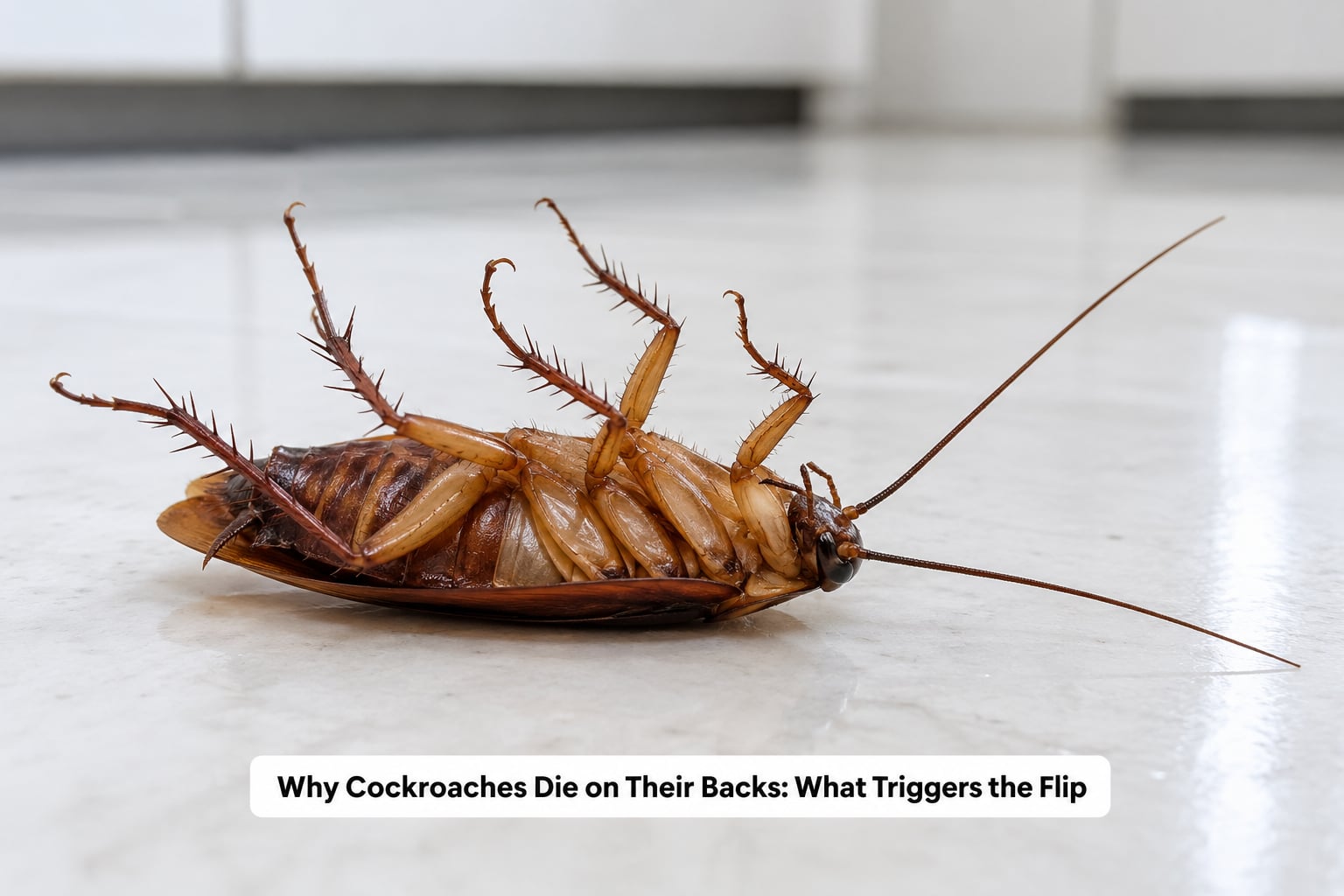
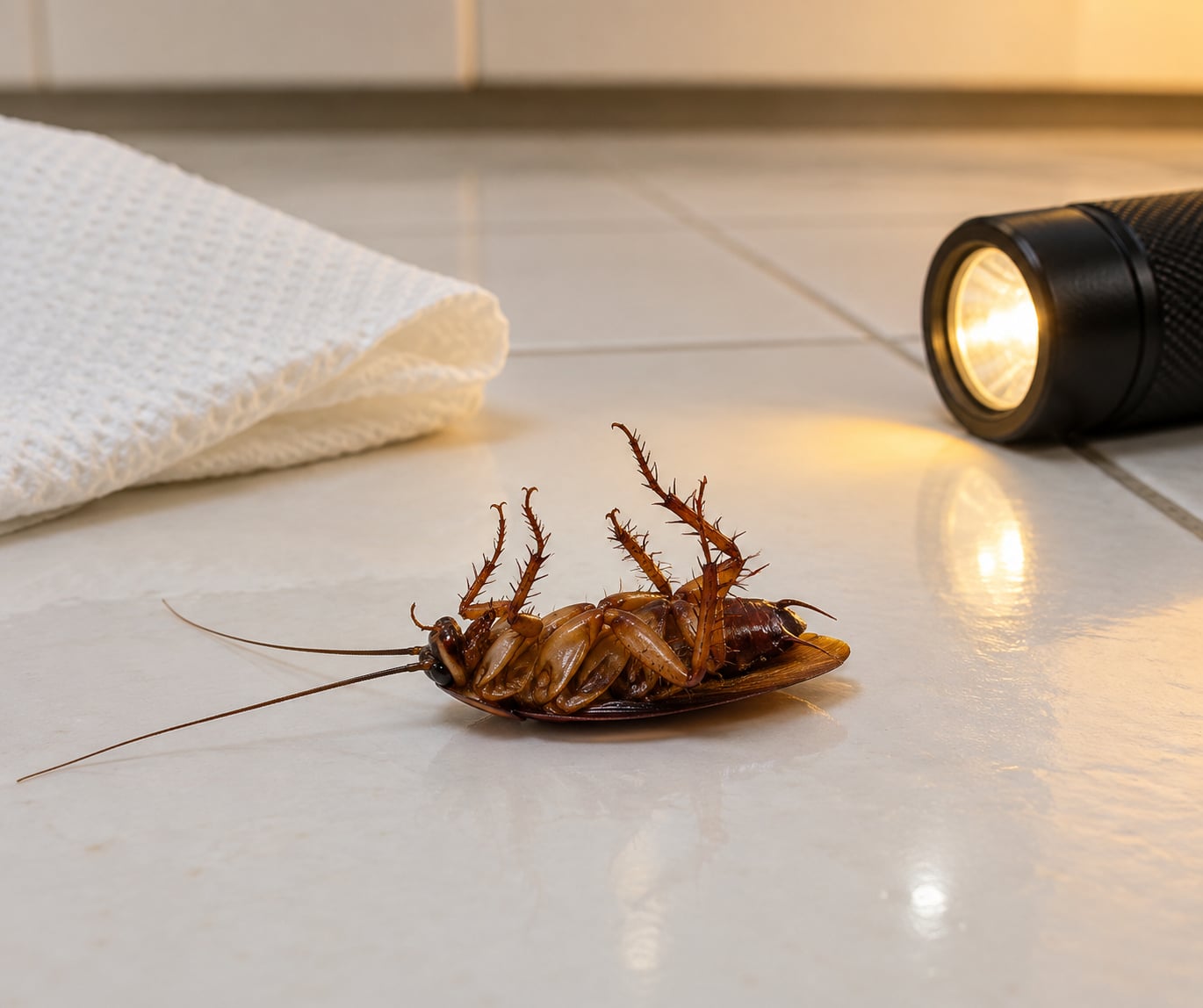
A cockroach flips onto its back when its body loses the muscle control to stay upright and the rounded shell rolls over. The high centre of gravity, six long legs raised above the body, and a smooth tile or laminate floor leave it stuck on its back with no grip to push off from. Most of the time it is already weak, injured or poisoned when the flip happens.
That is the short version. Four things usually have to line up, and the flip itself is the last step rather than the cause.
The Short Answer to Why Cockroaches Die on Their Backs
Think about how a roach is built. Its body is a flattened oval with a domed, glossy back sitting on six long, spindly legs that hold the shell well above the floor. That arrangement puts the bulk of the mass high up and slightly forward, and it works fine while the legs are pushing and gripping normally.
Now take away the muscle control. Insect legs extend using hydraulic fluid pressure combined with the muscles that flex them, so as the nervous system winds down the legs lose tension, twitch, and curl inward. A cockroach that falls onto a smooth floor with weak or splayed legs cannot get a toe behind itself to lever over, and the domed body acts like a rounded stone on a flat surface.
For why cockroaches die on their backs specifically, the short answer is: gravity finishes what weakness started. A healthy roach can flip itself over on most indoor surfaces. A weak, injured or poisoned one on a smooth floor often cannot, and it stays there until dehydration, starvation or the insecticide ends it.
Note that the flip is not a deliberate final act. Cockroaches do not roll onto their backs to die, and they are not suffocating from a full set of spiracles pressing into the floor. The position is a consequence of poor footing and failing muscles.
Do All Cockroaches Flip Over When They Die?
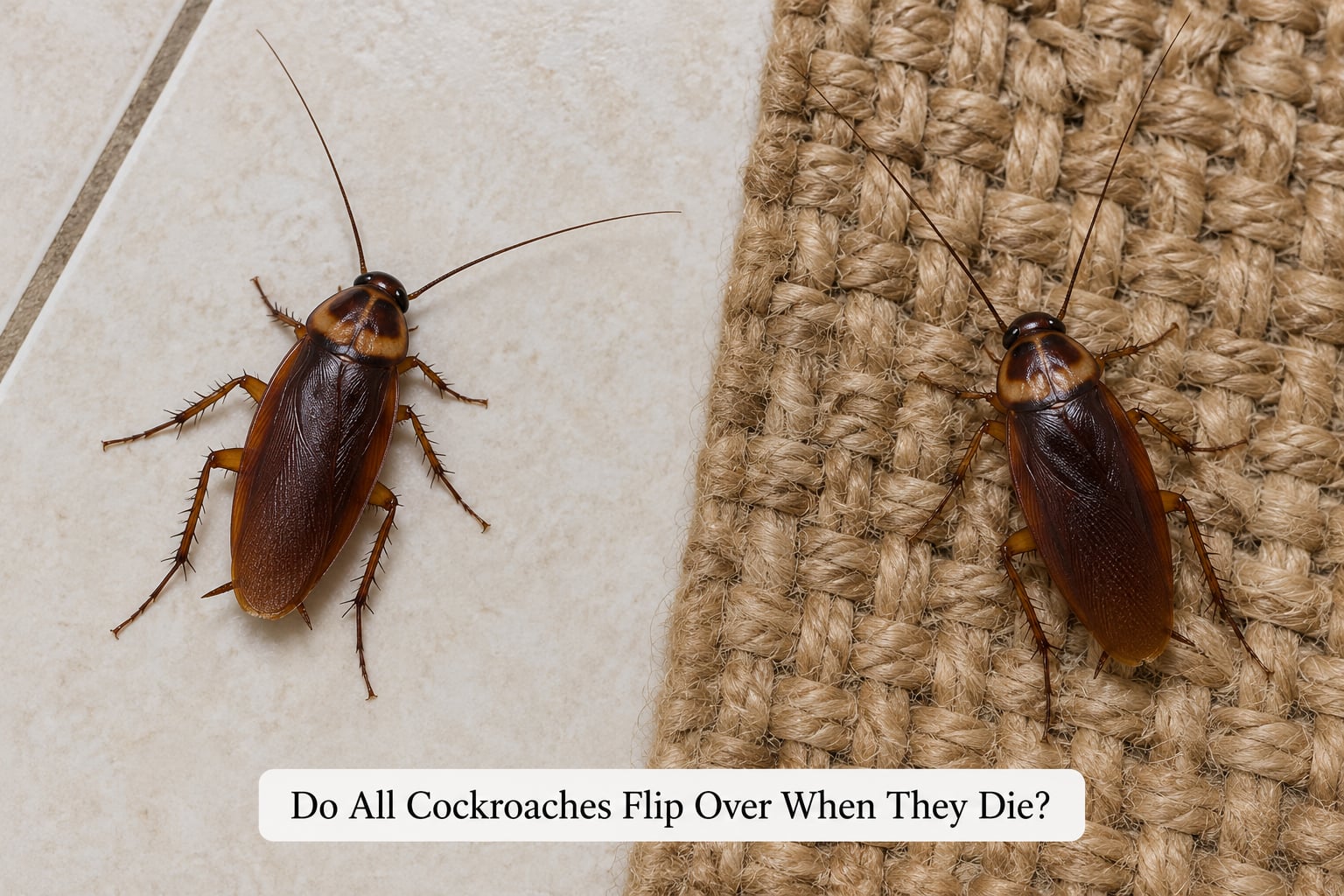
No. Plenty of roaches die on their sides, on their legs, or curled in a corner where they simply stopped moving. The upside-down posture is common and striking, but it is one outcome among several rather than a universal rule.
Body shape matters. Taller, bulkier species with a high domed back — the American cockroach is the classic indoor example — have further to roll when they topple. Smaller, flatter species such as the German cockroach sit lower and have more surface contact, so they tend to stay the right way up longer when they weaken.
So does the surface. Tile, glass, laminate and sealed counters give a roach nothing to catch a leg against. Carpet, rough concrete, wood edges, grass and leaf litter give it something to push off, which is why the same species that ends up stranded in a bathroom is often seen struggling upright in a yard.
The cause of death and the moments right before it also matter. A roach that runs into a wall in the dark, or that tumbles off a shelf, lands in a random orientation. A roach hit by spray may spasm and roll. A roach that simply runs out of energy in a wall void often stops where it stands.
What Weakens a Cockroach Before It Falls?
Any roach with poor coordination is a candidate for ending up on its back. The usual causes are physical, not mysterious.
Dehydration comes first for a lot of them. A roach that has been without water for a while moves slowly, reacts late, and loses the strength to recover from a stumble. The same applies to an old roach near the end of its life, which often has worn-down muscles and a slower recovery from a fall.
Starvation has a similar effect. A roach that has been living on crumbs and a thin film of grease is running on very little energy, so an escape attempt from a predator, a light, or a sticky surface is the event that puts it over.
Physical injury does the same. Losing even one leg changes the balance completely, because a roach needs its six legs arranged around the body to keep the shell level. A crushed leg, a slip on a smooth floor, or a fall from a counter is enough.
Heat speeds all of this up. A roach in a hot attic, a dryer, or a sunlit room works harder, loses water faster, and tires sooner, so a trip that a healthy roach shrugs off becomes the flip that ends it.
Disease and insecticide exposure work on the nervous system rather than the muscles. Pyrethroid and other neurotoxic products disrupt the signal flow that keeps the legs coordinated, so the roach twitches, flips, and loses the ability to correct itself. Resistance is common in some populations, so the same product can leave a lot of roaches alive and twitching rather than dead.
If you find a roach near a bait station, a sprayed surface, or any product you cannot identify, do not handle it. Follow the label on whatever product is in your home, wash exposed skin with soap and water, and contact a poison control center or a medical professional if anyone has had a reaction.
Why the Back Position Can Become Fatal
On its back, a cockroach cannot use its legs the way it uses them on its feet. Normally the legs come down to the surface, plant, and push the body over in a coordinated motion. Upside down, the legs point upward and have nothing to push against except air.
Its normal righting reflex depends on those legs finding a surface edge and gripping. A roach on smooth tile can thrash for a long time without ever catching the purchase it needs, and each attempt can flip it further or bounce it against a baseboard.
From there, the threat is not usually suffocation. Cockroaches breathe through spiracles along the sides of the abdomen, and the popular claim that a roach dies because its underside is pressed flat against the floor is not what entomologists generally accept. Water loss is the more immediate danger, followed by starvation, and then heat if the spot is warm.
How long that takes depends on the cause. A roach that is only knocked down by an insecticide can recover within hours if it manages to roll over, and many do, which is why people report seeing a “dead” roach walk off minutes later. A roach that is old, injured or genuinely poisoned is a different story, and recovery in a badly weakened animal is usually over within a day or two.
So the position is best thought of as a trap rather than a cause. It turns a weak roach into a stranded one, and stranding is what finishes the job.
Does a Cockroach on Its Back Mean There Is an Infestation?
One dead cockroach does not prove an infestation. Roaches wander in from neighbouring apartments, buildings and yards all the time, and a single body means almost nothing on its own. Repeated indoor sightings mean something quite different.
Watch for activity in the places that provide what they need: water, food and warmth. Kitchens, bathrooms, basements, utility rooms and laundry areas are the usual starting points. Roaches seen in daylight in a kitchen or living room are a stronger signal than one scuttling across a bathroom floor at midnight, because they are normally nocturnal and stay hidden when they can.
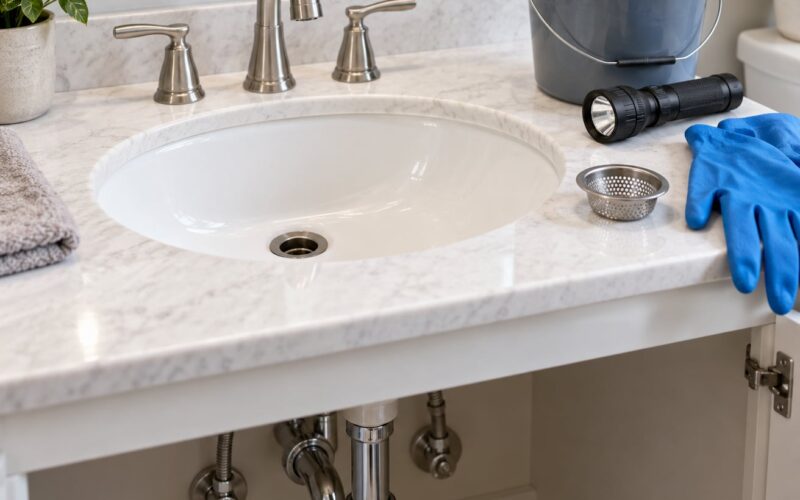
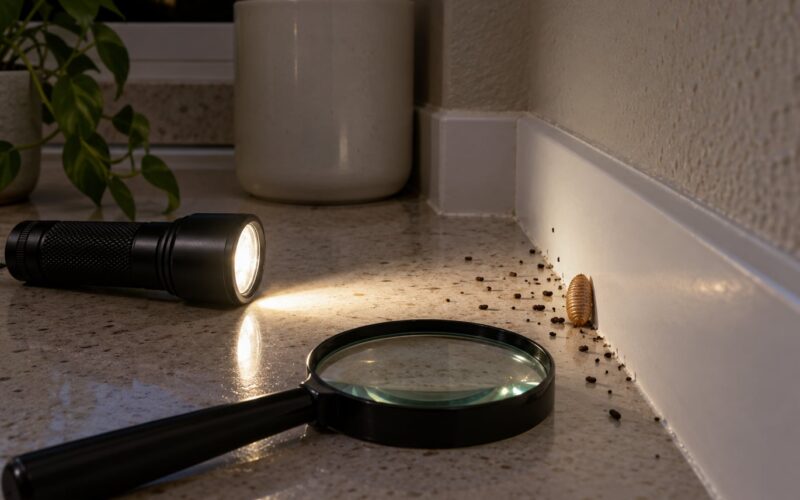
Other useful signs include droppings that look like coffee grounds or scattered black specks along wall edges and under sinks, egg cases (ootheca) that are small, brown and capsule-shaped, shed skins left near harborage, and a musty or oily smell in a closed room. Wall voids, voids under appliances, and gaps around pipes, baseboards and door sweeps are worth a flashlight.
The short answer to why cockroaches die on their backs matters here too, because the cause changes what the sighting means. A roach found on its back in the middle of an open floor with no spray in the house is more likely an older or weaker individual. Several belly-up roaches in a room where you also find droppings are a much stronger signal of an active population living nearby.
How to Tell a Natural Death From a Pesticide Death
Position alone tells you nothing useful. A naturally dying roach and a poisoned one can end up in the identical position, and only a history of what happened in that room can separate the two.
Use what you can observe instead.
Leg posture: a roach that has been dead for a while often has tightly curled, stiff legs held close to the body. A stunned roach is more likely to have legs splayed, twitching, or held out at odd angles.
Antennae: twitching or slow sweeping antennae mean there is still nerve activity. Many people assume a dead roach twitches, but movement from an antenna, a leg, or a slow abdominal contraction is a sign of a knockdown rather than a death.
Surface and heat: a cool, limp roach is different from a warm one. Warmth means circulation and metabolism are still going.
The wait test: leave it alone for ten minutes and walk away. If it changes position, it is alive. Do not poke it repeatedly — handling stresses an already weakened animal, and a roach that recovers on its own is better off than one you finish off.
Without that history or a lab test, you cannot confirm a pesticide death. What you can do is check for exposure sources: fresh spray residue, an open bait station, a recently used fogger, or a product stored nearby. If anyone in the home was exposed, follow the product label and call poison control or a clinician for advice specific to that product.
What to Do After You Find a Cockroach on Its Back
Start with the simplest safe move. Do not shake it, spray it again, or try to flip it upright, because a stunned roach that revives mid-handling will be fast and unpleasant. Instead, slide a cup or a piece of cardboard over it with a wall behind it, or vacuum it up, and seal it in a bag or flush it.
Clean the area where it landed. Cockroach bodies carry a greasy residue and shed material that can leave marks, so a damp wipe of the floor, the underside of nearby appliances and the wall edges makes the spot easier to watch in coming days.
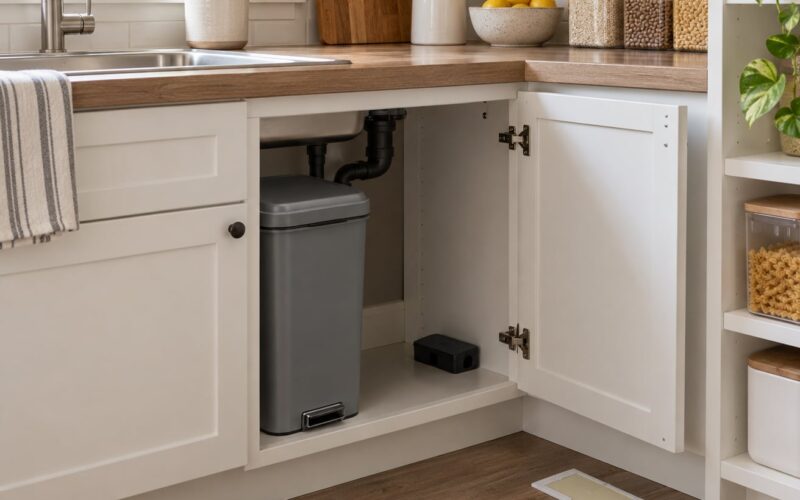
Then look for the conditions that brought it there. Check under the sink, behind the fridge, under the stove, and along baseboards for water, crumbs, spills and pet food. A roach rarely wanders far from moisture and food, and most of the ones you find are not travelling from another building.
Keep watching for a couple of weeks. Morning sightings in the same room, droppings appearing along the same wall, or more than one belly-up roach a week are all reasons to act rather than observe.
Call a pest professional when you see roaches moving in daylight, cannot find where they are coming in, or are still finding them after a few weeks of disciplined food storage, water control and gap sealing. If you are in a rental, your landlord is usually required to handle treatment, so tell them what you have found and where.
How to Prevent More Cockroaches Indoors
Most cockroach problems come down to food, water and entry points, and all three are things you control.
Food: store pantry items in sealed containers rather than open bags, wipe down counters and stovetops, take out trash daily, and clean under appliances. Pet food and standing bowls are a common and easily missed source.
Water: fix dripping taps, wipe standing water in sinks and tubs, empty humidifiers and dehumidifier tanks, and keep the bathroom dry. Roaches cannot survive long without accessible water, which is why a dripping faucet behind a wall can hold a population that bait alone never reaches.
Entry points: seal gaps around pipes where they enter walls, baseboard gaps, cracks by the sink and tub, and door sweeps. If you can see daylight under an exterior door, it is an open highway.
Monitoring: put out a few glue monitors or bait stations in the areas you suspect and check them weekly. Sticky monitors are useful because they show you where the activity is rather than how much you have killed.
On treatments, be clear-eyed about what they do. Sprays knock roaches down fast and give the visible impression of success, and they can also scatter a population into new rooms. Gel baits and dusts work slowly and are usually more effective indoors because roaches carry bait back to harborage. Killing the roaches you can see does not address the infestation, which is the frustration homeowners describe more than any other.
If you use any pesticide, choose one labeled for your situation, follow the label exactly, and keep it away from children and pets. Foggers rarely solve an indoor infestation and can be hazardous to pets and young children in the treated space.
Frequently Asked Questions
Can a healthy cockroach survive after landing on its back?
Usually yes. A healthy cockroach with working legs can right itself on most surfaces, and it will first try to get a leg against something it can grip. A smooth tile, glass or laminate floor is the worst case because there is nothing to catch. If it cannot get a purchase within a short time, dehydration and starvation become the real problem.
Is it true that all dying cockroaches end up on their backs?
No. Many die on their sides, on their legs, or in the corner where they ran out of energy. The belly-up posture is common because of the domed shell and the high centre of gravity, not because cockroaches roll over as a final act. Why cockroaches die on their backs is therefore a question about footing, body shape and muscle control rather than a death ritual.
How long can a cockroach remain upside down before it dies?
It depends entirely on the cause. A roach only knocked down by spray may recover within hours if it manages to roll over, and plenty do. One that is old, injured or genuinely poisoned is a different story, with a day or two about the usual limit for a badly weakened animal. Water loss, not lack of air, is what limits the time.
Should I be worried about one dead cockroach inside my home?
One dead roach on its own is not a sign of an infestation. Roaches enter from neighbouring units and yards regularly. Worry if you see more than one, if you see them in daylight in a kitchen or living room, or if you find droppings that look like coffee grounds, egg cases or shed skins in the same area.
Should I spray a cockroach that has flipped onto its back?
Usually not. A roach on its back is often already knocked down, and an extra spray adds exposure without helping the rest of the population. Cover it with a cup and a wall, vacuum it up, and seal it. If you do use a product, follow the label exactly, and if anyone is exposed, contact poison control or a medical professional.
What to Do First
Cover the roach with a cup and a wall, vacuum it up, seal it in the bag, and wipe the area it landed on. Then check under the sink, behind the fridge and along the baseboards for water, crumbs and droppings, and seal the gaps around pipes and doors you can see daylight through.
Keep an eye on the room for the next couple of weeks. Repeated sightings, daytime activity in living areas, or droppings appearing in the same spot mean there are living roaches nearby, and that is the moment to call a pest professional or your landlord rather than keep spraying single roaches.
Understanding the flip tells you how the roach died. Whether the infestation is real is the question worth spending your time on.