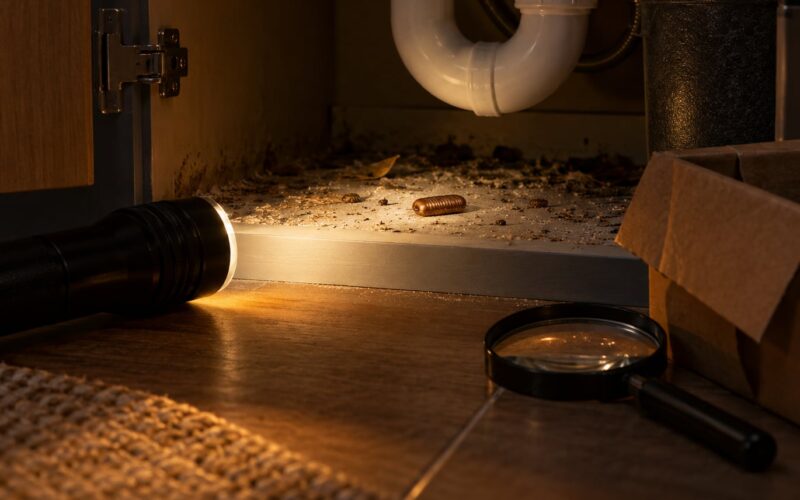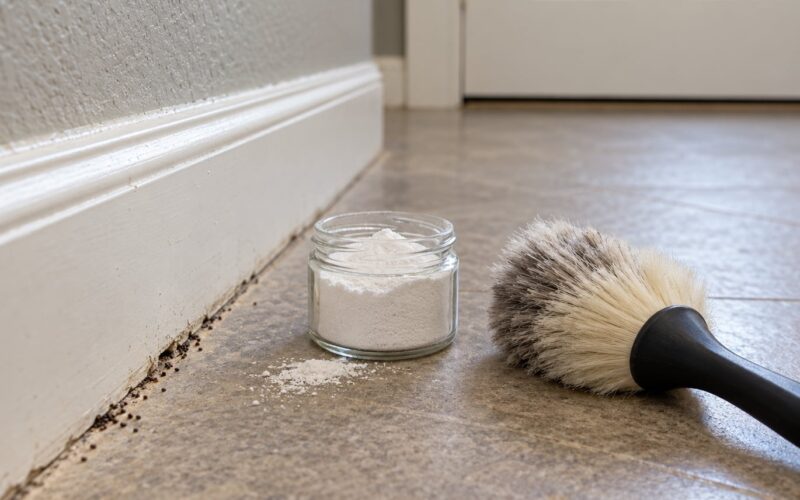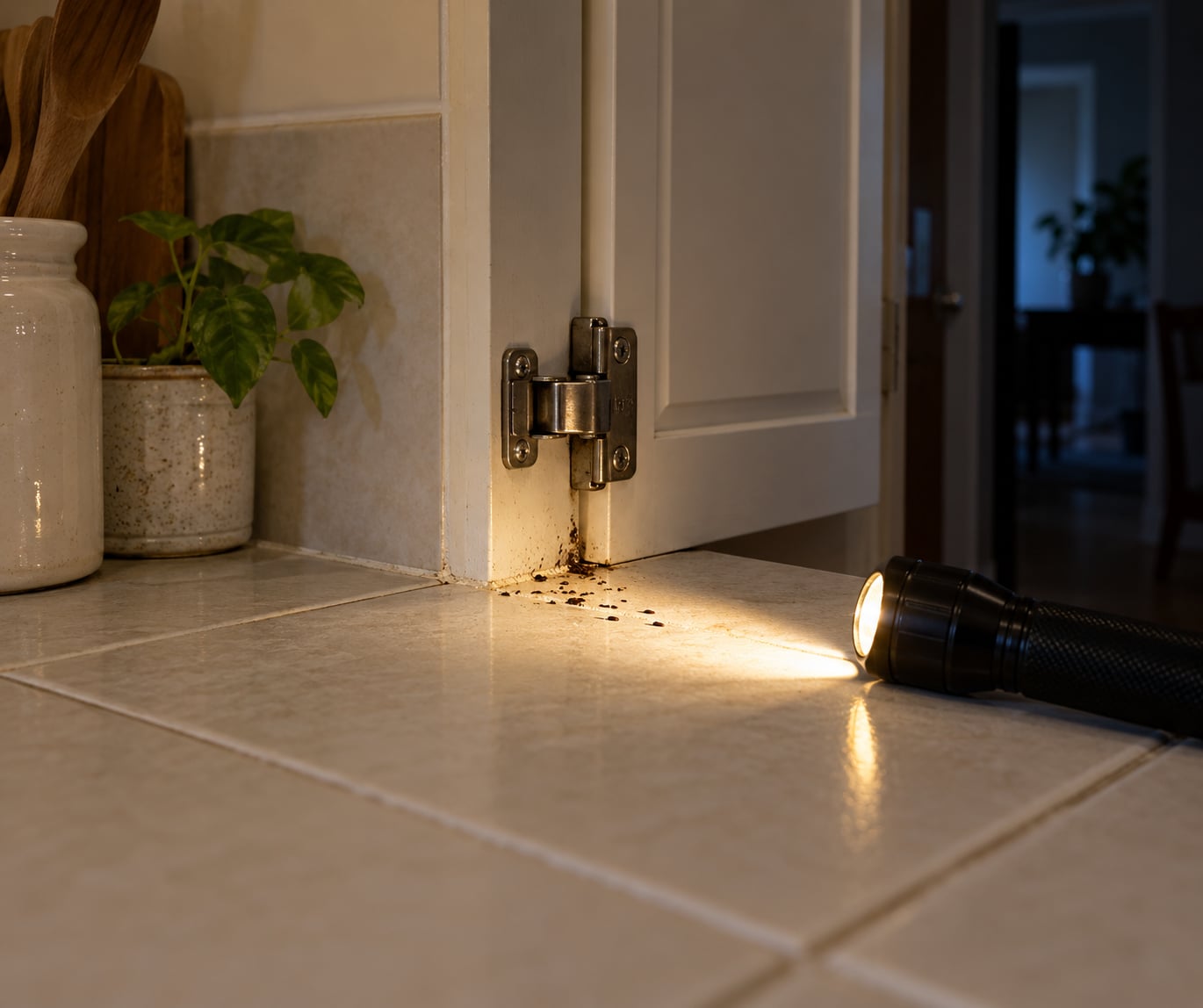
Cockroach infestation levels are graded by evidence, not by counting the roaches you kill: scattered droppings at one spot with no egg cases is a low problem, droppings at several spots plus egg cases and shed skins is moderate, multiple harbourage points with heavy droppings and a real smell is high, and roaches openly walking around in daylight across several rooms is extreme. Read the pattern of signs, not the count.
A single sighting tells you almost nothing. A dozen sightings in the same spot over two weeks tells you a lot, because the evidence roaches leave behind — frass, egg cases, cast skins, grease smears — accumulates where the population actually lives.
Most of the people I talk to about this are not asking whether they have roaches. They are asking whether the problem they have is the kind that cleaning will fix or the kind that is quietly getting worse behind an appliance. That is what the levels below are for. This guide was updated for 2026, and the science hasn’t moved much, but the response you need at each tier absolutely has.
Cockroach Infestation Levels and What Each One Looks Like
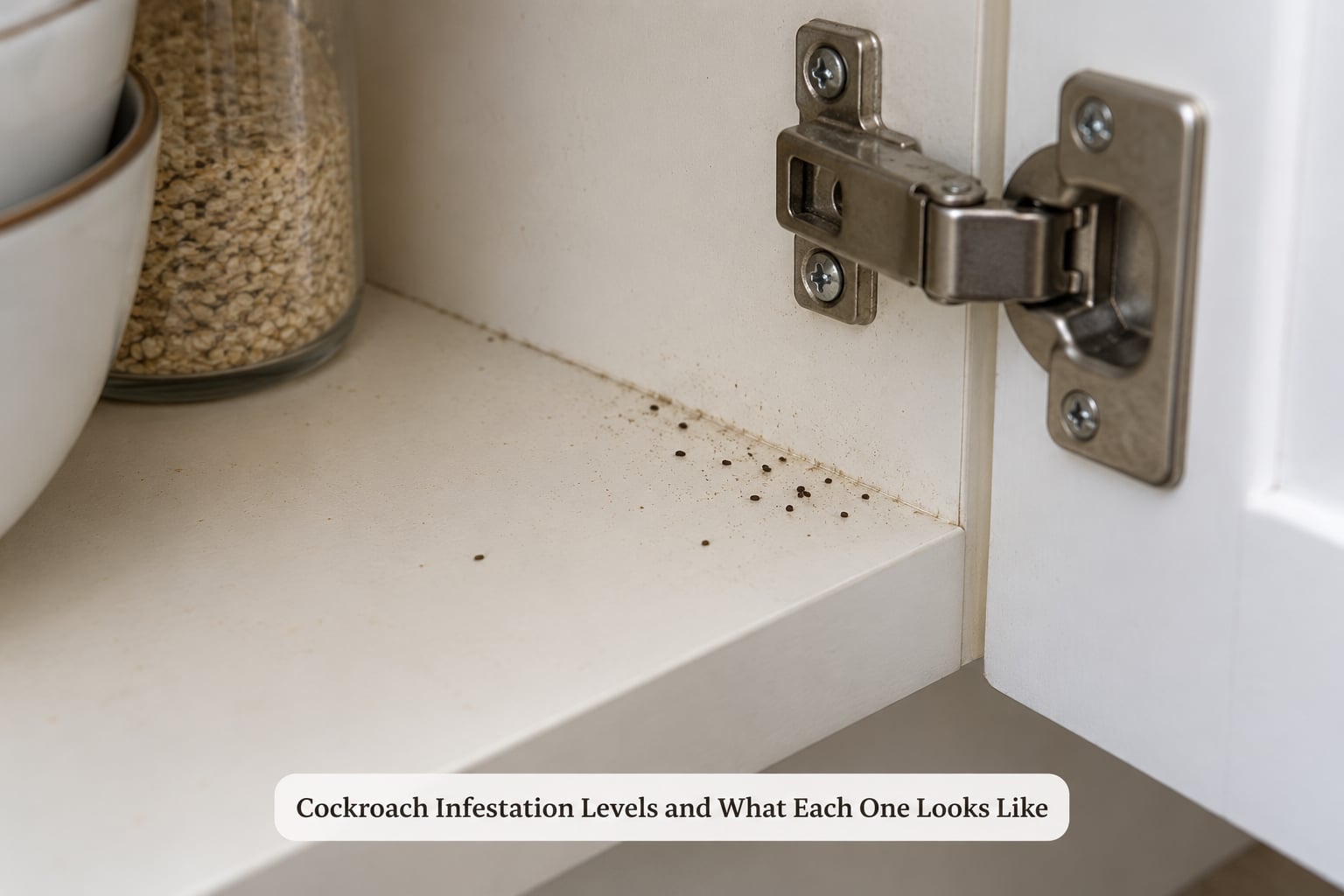
The scale below runs from Level 1 to Level 5, from a stray visitor to a problem that involves more than one apartment. Each level is defined by what you can observe, not by what a pest company tells you on the phone, because nobody can grade an infestation honestly without standing in the room.
| Level | What you see | Where you look | How urgent it is |
|---|---|---|---|
| Level 1 — Low | One or two roaches; no droppings found | Sinks, pet bowls, near the door or a window | Monitor for two weeks |
| Level 2 — Moderate | Repeated night sightings; first light droppings; one or two egg cases; a faint musky note | Under the sink, along the skirting board, inside a low cabinet | Start targeted work this week |
| Level 3 — High | Concentrated droppings at several edges and corners; shed skins in mixed sizes; gaps chewed through packaging; noticeable odour | Behind and under the fridge, dishwasher motor area, wall-floor junctions, bathroom duct | Book a professional inspection |
| Level 4 — Severe | Daytime sightings in the open; droppings several layers deep; strong smell across a room; egg cases in several rooms | Kitchen, bathroom, laundry, plus rooms that only contain a pipe or a wall | Same-week treatment |
| Level 5 — Extreme | Constant visible activity; harbourage inside walls or electrical areas; roaches appearing from neighbouring flats | Walls, ceilings, riser pipes, shared bin chutes, adjoining units | Coordinated building-wide response |
Two things skew the picture. Species changes everything downstream: a German cockroach population is smaller in numbers but breeds faster and carries a shorter internal clock, while an American cockroach is a single larger animal that can live in a wall void or a sewer line and produce far less visible evidence for what is actually a serious problem.
Building type matters too. In a ground-floor flat or a house, roaches are usually yours. In a multi-unit building, a steady low trickle of sightings that never increases no matter what you do is more likely drift from a neighbour than a colony of your own, and that changes the response completely.
Level 1: Occasional Sightings
At Level 1 you have seen one roach, maybe two, over a couple of weeks. Usually it appears in a kitchen or bathroom, near a sink, a pet bowl, a rubbish bin or an entry point, and it scatters when you switch the light on.
A single sighting is not an infestation. Roaches wander, and an adult can get in through a gap around a pipe or a window seal and head straight for food. What makes Level 1 worth paying attention to is the reason the roach found you in the first place: accessible food, a dry sink, or an unsealed route in.
At this stage the work is cheap and mostly unglamorous. Wipe down surfaces, take rubbish out daily, scrub the inside of cabinet doors, dry the sink before bed, and seal gaps around pipes where they meet the wall. Set a sticky trap under the sink and behind the fridge, note the date, and check it in a week. One trapped roach and no new sightings over two weeks means you interrupted something early. Traps keep catching fresh roaches and nothing changes, and you are already at Level 2.
Level 2: Repeated Activity and Early Hidden Signs
Level 2 is where a pattern starts. You see roaches more than once, or you see more than one at a time, or they show up in the same room repeatedly. Residents on pest forums describe the shift precisely: one stray, then nightly sightings, then daytime roaches in the kitchen. That sequence is the escalation path, and it usually takes weeks rather than months because roaches breed through their egg cases continuously through the warm season.
The physical evidence at this level is light and easy to miss. Look for a scatter of droppings that look like ground coffee or coarse black pepper, usually a few dozen, sitting on a shelf or along a wall edge rather than in the middle of the floor. Droppings land near where roaches travel and feed, so the edges of shelves and the corners of cabinets matter more than open surfaces.
You may also find one or two egg cases, small brown capsules with a ridged seam along one side, tucked in a crevice or against a wall. Cast skins, the translucent shells nymphs leave behind as they grow, start showing up around now. And in a closed room you might catch a faint musky or oily smell, which is a pheromone and aggregation signal rather than a smell roaches make themselves.
Everything at this level can still be hiding in a wall void or behind an appliance, which is why the search matters more than the smell. Techs on r/pestcontrol point at four zones first: the fridge compressor housing at the back, the dishwasher motor area and drain junction, the gap between the oven and the cabinet, and the lower back corners of the under-sink cabinet. Ten minutes with a torch in those four places tells you more than an hour of looking under furniture.
Level 3: Established Kitchen or Bathroom Infestation
At Level 3 the population has settled into several harbourage points rather than one, and the evidence stacks up. Droppings concentrate along edges, inside cabinet corners, along the wall-floor junction behind appliances and in the bathroom duct space, often deep enough that you cannot see the surface underneath. It looks like coarse pepper scattered in a line, and it smudges brown-black when you wipe it with a damp cloth.
You will start finding shed skins in more than one size, which is the giveaway that nymphs of different ages are living there. A single shed skin means an isolated wanderer grew up; skins at several instar sizes in the same hiding place means the room is producing roaches continuously.
Physical damage shows up at this level too. Chewed corners on cereal boxes and paper bags, gnawed labels on jars, fabric nibbled at seams. Roaches are omnivores and they are not fussy, so damaged packaging in a dry cupboard with no other obvious explanation is worth taking seriously.
Openings start appearing at the same time: gaps chewed or worn through the edge of a cabinet panel, a swollen door seal, a hole where a pipe meets plaster behind the washing machine. At this stage a surface spray is close to useless. It kills what it touches, scatters the rest, and the survivors move deeper into the structure where you are not spraying. Residents in r/Apartmentliving keep making the same point about household aerosol cans — not that the product is fake, but that it makes the problem look solved for a few days before it returns from somewhere new.
Level 4: Heavy and Rapidly Spreading Infestation
Level 4 is defined by one sign more than any other: roaches in the open during the day. Nocturnal behaviour breaks down when harbourage runs out of space and crowding gets extreme, so daytime activity means the population has outgrown the hiding places it has. That heuristic comes up again and again in r/pestcontrol threads and it is broadly right.
Alongside it you get droppings you can see from across the room, a smell you notice walking into the kitchen, and egg cases in several rooms rather than one. By now the kitchen and the bathroom or laundry are both involved, and sometimes a bedroom shows droppings on a skirting board even though nobody eats in there, because the pipe run connects it to the harbourage.
The pattern of spread matters for what happens next. Sightings that move room by room along a wall or pipe line point to an internal harbourage. Sightings that appear in a flat that has never had roaches, with droppings only near the door or a shared riser, point to drift from an adjoining unit. In a building, this is where landlord and tenant responsibility gets messy, and where residents on BiggerPockets and Apartmentliving forums end up arguing about whose problem it is while the population keeps growing.
Level 4 needs a professional inspection rather than more DIY effort. The reason is mechanical, not about credentials: the colony is inside the wall, the appliance cavity or the duct run, and no product you can buy reaches a nymph tucked into a service chase behind a bathroom wall.
Level 5: Severe, Structural, or Multi-Unit Infestation
At Level 5 the infestation has become part of the building’s fabric. Constant visible activity happens through the day, not just at night, and residents describe it as more roaches than roaches have space, which is how it feels. Contamination is extensive — heavy droppings and shed skins in multiple rooms, grease smears marking travel routes along walls and skirting, damaged books and paper, chewed wiring insulation in utility areas.
The harbourage is now structural. You find activity inside wall voids, above ceiling tiles, in the refrigerator compressor housing, in electrical panels and in the soil of a potted plant. In a multi-unit building, roaches appear from a neighbouring flat or from a shared riser pipe or bin chute, which means treating your own unit alone produces a predictable result: it comes back.
This is the level where people report that they have done everything and nothing works, and it is usually not their effort that failed. Without a coordinated response across the affected units plus sealing of the shared routes, reinfestation is the default outcome. In a restaurant or food business, the allergen and hygiene exposure at this level is also a regulatory problem, not just a comfort one.
How to Tell Which Cockroach Infestation Level You Have
Work through this in order, at night, with a torch. It takes about ten minutes and it puts you on a level rather than in a guessing loop.
- Do a night check. Come into the kitchen and bathroom with the lights off, then switch them on. Roaches that scatter back into gaps are nocturnal and behaving normally. Roaches still out and visible after the lights go on are at Level 4 or above.
- Count and size the droppings. A light scatter of coffee-ground-sized specks at one spot is Level 2. Lines of droppings several layers deep along edges and corners are Level 3 or above. Size also hints at species: German cockroach frass is small, close to black pepper grains, while American cockroach droppings are noticeably larger and look more like coffee grounds.
- Look for egg cases and cast skins. One or two oothecae suggests Level 2. Shells at several nymphal sizes in the same spot tell you the space is producing roaches, which is Level 3. German cockroach egg cases are small, about the length of a match head; American ones are several times bigger, closer to the length of a pencil eraser.
- Check the smell. A faint musky note in a closed cupboard is early. An oily, musty smell you notice on entering a room, and grease smears along the routes they travel, point to a well-established population.
- Map where sightings happen. One room is usually lower on the scale. Sighting in the kitchen, bathroom and laundry together pushes you up. A single flat seeing roaches with no droppings of its own suggests drift from a neighbour, which is a different problem with a different fix.
- Look for damage and season. Chewed packaging and paper point up the scale. In winter, a hidden population can shrink to a few individuals surviving in a warm appliance cavity and look lower than it is, so a mild winter is not proof of a mild infestation.
One more test people rarely run: check the dead ones. A roach found dead in a hiding place, where it did not spray itself to death, usually means something killed it there, which means something is living there. A dead roach lying in an open hallway is more likely drift from outside.
What to Do at Each Infestation Level
Match the response to the level, and the level is usually one step higher than your instinct suggests, because what you can see is a fraction of what is living.
- Level 1: Sanitize and monitor. Clean food surfaces, take bins out daily, fix the tap that drips, seal gaps around pipes, and place sticky traps in the two or three places most likely to hold activity. Re-check in two weeks.
- Level 2: Improve exclusion and start baiting. Seal food, remove cardboard and clutter, put gel bait or stations in the harbourage zones rather than spraying the open floor, and add an insect growth regulator to the water feed of plants if you have pets or small children in the room. Follow up in two to three weeks.
- Level 3: Combine sanitation, sealing, bait and professional advice. Sealing food sources matters more than any single product, and bait only works where roaches are already feeding. Get a professional to map the harbourage points, because at this level guessing at them wastes weeks.
- Levels 4 and 5: Arrange prompt pest management. Ask for a harbourage inspection rather than a spray visit, and ask whether adjacent units or shared risers need to be included in the plan. Anyone who quotes you a single visit with no follow-up is describing the wrong service.
Two safety points hold at every level. Never spray pesticide near food, dishes, a food preparation surface or a baby bottle, and follow the label exactly — these products are not harmless to people or pets. Keep baits and sprays out of reach of children and animals, and keep bait stations in place rather than letting children play with them.
And avoid the reflex to fog or drench the kitchen. Broad spraying scatters roaches and drives them into deeper harbourage, which is exactly how a Level 2 becomes a Level 4. The instinct feels productive because you can see dead roaches by evening; the results arrive a few weeks later in the form of a worse problem.
Frequently Asked Questions
How many roaches are considered a severe infestation?
There is no magic number, because what you see is only part of the population. People treat seeing three to five roaches a day in one area as their trigger to call a professional. The stronger signal is behaviour: roaches visible in daylight, droppings several layers deep along edges, egg cases in more than one room and a smell you notice walking in. On the cockroach infestation levels scale, those signs put you at Level 4 or higher regardless of the count.
Is one cockroach a sign of infestation?
No. A single roach usually means a gap in a door, window or pipe seal, or an adult that wandered in from a neighbouring unit and found food. Watch for a second sighting in the same area within a couple of weeks, and put sticky traps near the spot. One trapped roach and no further sightings means you closed it early. Repeated roaches in the same location mean the space is producing them, which is a real infestation starting.
Why do I only see cockroaches at night?
Cockroaches are nocturnal because daylight makes them easy prey for spiders and birds, so daytime hiding is normal behaviour rather than a sign of anything. Trouble is that hiding also means the population can grow well beyond what you ever see. Check the four highest-yield spots with a torch after dark: behind the fridge compressor housing, the dishwasher motor area and drain junction, the oven-to-cabinet gap, and the lower back corners of the under-sink cabinet.
Why do roaches come back after I spray them?
Surface spray kills the roaches it reaches and scatters the rest, and scattered roaches relocate deeper into the structure rather than leaving. You kill the visible portion and the population rebuilds from nymphs sheltered in wall voids, appliance cavities and duct runs. That is why serious infestations need a harbourage inspection with bait, sealing of food and water sources, and follow-up visits, rather than one more can of spray.
What is the hardest type of cockroach infestation to get rid of?
German cockroaches are usually the hardest, because they breed rapidly, carry an egg case internally, and can complete a generation in roughly six weeks in warm conditions. Their nymphs need a reliable water source, so leaks and dripping pipes sustain an infestation that bait alone will not finish. Smokybrown cockroaches are similar and even more water-dependent. American cockroaches are fewer in number but harder to locate, since they live in wall voids, drains and sewer lines.
Conclusion: Start With the Earliest Warning Signs
Cockroach infestation levels are judged by patterns, not by a single sighting, and the earliest useful evidence is usually a scatter of droppings at an edge rather than a roach in the middle of the floor. Start with a night inspection of the four high-yield zones, cut off food and water, seal the gaps around pipes and skirting, and set traps to see what happens next. If sightings spread between rooms, appear in daylight or keep coming back after you clean, get a professional to find the harbourage points before the problem reaches the neighbouring unit.