Roaches keep coming back after spraying because most aerosol insecticides are repellent, not population-killing. They kill the individuals they touch, drive the survivors into wall voids and neighbouring spaces, and never touch the hardened egg cases. The survivors hatch weeks later, and the cycle starts again.
That is the short answer, and it explains the pattern almost every reader in the forums describes: a spike in visible activity for the first few days, quiet for a while, then small pale nymphs appearing in the same kitchen. Repeating the same spray usually reproduces the same result.
Here is the useful part. Some post-treatment activity is normal and temporary. Some of it means the treatment missed where the roaches actually live. Telling those two situations apart is the difference between waiting out a working treatment and watching a failed one run for months. This guide walks through both, starting with the tools you need, then the causes, then a room-by-room fix and a prevention plan you can keep up after 2026.
Table of Contents
- What You Need
- Why Do Roaches Keep Coming Back After Spraying?
- 1. The spray is repellent, so it scatters the population
- 2. Egg cases survive the treatment
- 3. Nymphs and hidden adults were never exposed
- 4. There is a second nest you never treated
- 5. Food and water are still available
- 6. Cracks and entry points were never sealed
- 7. The wrong product, or the right product used wrong
- 8. Only one room was treated, and resistance is building
- How to Find Where the Roaches Are Hiding
- How to Stop Roaches from Coming Back
- 1. Cut off food and water first
- 2. Clean the harborage areas properly
- 3. Place monitoring traps before you treat
- 4. Use bait correctly, and do not spray over it
- 5. Seal every gap you can reach
- 6. Replace or discard infested material
- 7. Check the result against your trap counts
- Why Roaches Keep Coming Back After Spraying: What to Do
- How to Prevent a Repeat Infestation
- Common Mistakes
- When to Call a Pest Professional
- Frequently Asked Questions
- Conclusion
What You Need
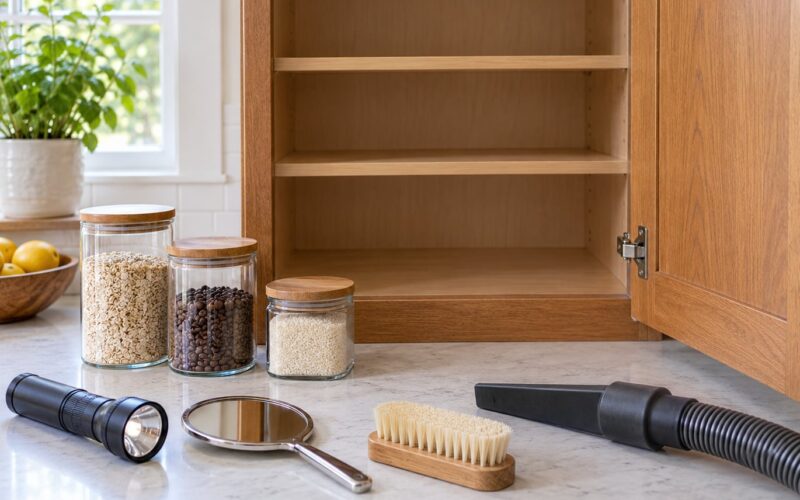
None of this needs a professional kit. Gather it before you start looking, because half of diagnosing an infestation happens before you spray anything.
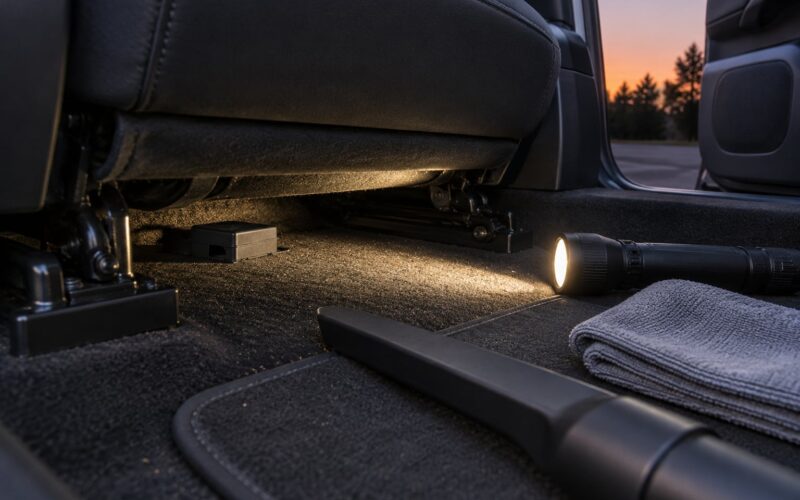
- A good flashlight. A headlamp frees your hands, which matters more than it sounds when you are behind a dishwasher with a flashlight in your teeth.
- A magnifying glass or your phone camera. Droppings, egg cases and shed skins are tiny. The camera zoom on a dark surface is often easier than trying to hold a lens in place.
- Gloves and a mask. You are going to be inside cabinetry and behind appliances where dust, old grease and rodent debris collect.
- Cleaning supplies. Degreasing cleaner, a stiff brush, a vacuum with a hose attachment and sealed bags for debris.
- Sticky monitoring traps. Cheap, flat glue boards. They are a diagnostic tool, not a treatment.
- Gel bait or insecticide bait stations registered for cockroaches, plus a labelled residual product if you choose one.
- Caulk and sealant for gaps around pipes, and copper mesh or fine mesh for openings larger than a pencil.
- Sealed storage containers so cardboard boxes stop doubling as roach apartments.
- A species guide. Knowing whether you are dealing with a German, American, Oriental or smokybrown cockroach changes the whole approach, and it takes two minutes to look up.
Why Do Roaches Keep Coming Back After Spraying?
The reason roaches keep coming back after spraying is almost never that the product stopped working. It is that the product was never aimed at where the population lives. Here are the causes, in the order they usually apply.
1. The spray is repellent, so it scatters the population
Most over-the-counter aerosols are pyrethroids. They kill by contact, and they also push roaches away from the treated surface. That repellence is why you see more roaches for a few days after spraying: survivors are flushed out of hiding and move across open floors where you can see them. They are not new arrivals. They are the same population, now living somewhere you are not looking.
2. Egg cases survive the treatment
The ootheca, the hardened egg case, is not something a contact spray penetrates. A single German cockroach ootheca can hold roughly 30 to 40 eggs, and the female carries it with her until the young are ready to hatch, which keeps a well-timed spray from catching a gravid female at all. Whatever the spray does to adults, the next generation is already committed. Eggs hatched two to four weeks later are the small pale nymphs people find and assume are stragglers.
3. Nymphs and hidden adults were never exposed
Roaches spend most of their time inside harborage: cabinet hinge recesses, the motor housing at the back of the refrigerator, the lip where the countertop meets the backsplash, under the sink, inside the dishwasher housing, in the utility closet. A spray applied to visible surfaces in an open room touches almost none of that. The adults that survive an afternoon in a wall void are unharmed and still breeding.
4. There is a second nest you never treated
A kitchen infestation is rarely one nest. It is usually a main harbouring site plus satellite populations in a bathroom, a laundry room or an adjacent unit. Treat one room properly and the rest of the building keeps feeding the survivors. In apartments, the plumbing chase behind a bathroom wall and the duct space above a ceiling are common shared routes, and a heavy infestation in one apartment often starts with roaches walking in through a drain line.
5. Food and water are still available
A cockroach can live on a few crumbs and a water source. A pet bowl down overnight, a slow drip under the sink, a damp rag in a mop bucket or a garbage can with a loose lid is enough to keep a residual population alive after treatment. Sanitation is not the optional extra that the treatment covers for you; it is the part that decides whether the population recovers or collapses.
6. Cracks and entry points were never sealed
A roach needs about the width of its body to move through a gap. Openings around supply lines, the gap under the exterior door, holes around electrical outlets and the rim where siding meets the foundation are all large enough. Sealing is what stops the re-infection after the last of the current population dies.
7. The wrong product, or the right product used wrong
Total release foggers, the kind often abandoned in rentals, are the classic mistake. A fogger fills the room with mist that settles on open horizontal surfaces and does essentially nothing inside wall voids, cabinetry or appliance housings, where the roaches are. Multiple users on r/pestcontrol describe the result as half-dead roaches scattered across the floor and contaminated surfaces. Foggers also leave a propellant ignition risk and do not address the harborage at all.
8. Only one room was treated, and resistance is building
Partial treatment produces exactly the pattern readers describe: the kitchen is quiet, the bathroom is now busy. The other half of the problem is chemical. German cockroach populations in buildings with a long history of aerosol use develop resistance, and repeating the same active ingredient selects for the most tolerant individuals each round. The third can of the same product can genuinely perform worse than the first.
How to Find Where the Roaches Are Hiding
Finding the harbourage is the step that turns this from spraying at random into a plan. Start with signs rather than sightings, because roaches are nocturnal and the ones that cross your kitchen floor are not the ones living there.
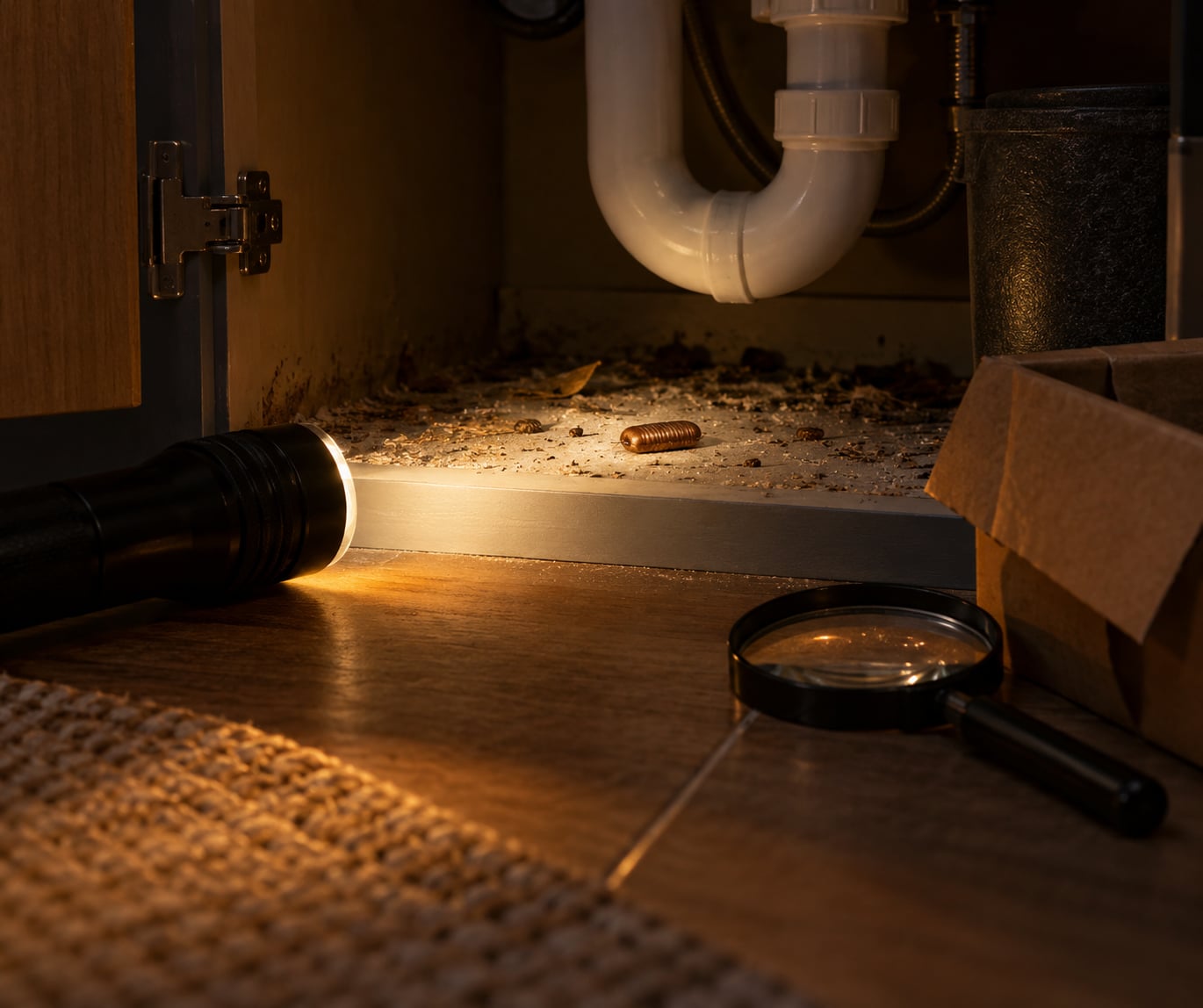
Droppings look like small black specks, pepper-like, scattered along edges of shelves, under the sink, inside cabinet corners and behind appliances. Heavy deposits usually trace a route between a food source and water.
Egg cases are small brown, purse-shaped capsules, roughly the size of a grain of rice. Finding several means breeding is happening close by.
Shed skins and droppings in the same spot mean a harbourage, not a pass-through. A roach that hides somewhere deposits far more than one that is merely crossing the room.
Musty odour. A persistent musty smell in a cupboard or behind an appliance usually means a populated harbourage nearby.
Night activity. Come home after dark, walk in with a flashlight, and check the kitchen and bathroom before switching on lights. German cockroaches run from light, so this works better than any daytime inspection.
Place sticky traps under the sink, behind the refrigerator, inside a low cabinet, in the bathroom and near the laundry area. Check them in a few days and count what is on them. Traps in rooms with heavy activity tell you where the population is concentrated; empty traps in the room you have been spraying tell you the spray is going into the wrong place.
For the harder pockets, pull the refrigerator and dishwasher out and look at the floor behind them, check the motor housing at the back of the fridge for warmth and droppings, look inside the cabinet under the sink for damp or staining, and inspect the plumbing chase if the bathroom and kitchen share a wall. Inspect wall voids and the backs of electrical outlets as well, since those are places you cannot check with a flashlight alone. Knowing which species you are dealing with decides where to look: German cockroaches cluster in kitchens and bathrooms near water, American and Oriental cockroaches come from drains, sewers and basements, and smokybrown cockroaches live outdoors in mulch and tree canopy and follow moisture indoors.
How to Stop Roaches from Coming Back
Once you know where they live, work outward from the harborage rather than around the visible roaches. Pick the two rooms with the heaviest activity and finish them completely before starting another.
1. Cut off food and water first
Remove every exposed food source for two weeks. Pet bowls go up after the evening meal. Food goes into sealed containers, not cardboard. Take out the trash on a schedule, use a bin with a tight lid, and run the dishwasher on its heated cycle rather than rinsing and leaving dishes overnight. Fix any drip, wipe the sink and sink underside dry at night, and keep the bathroom floor and the area behind the washer dry. This is the step that decides whether the rest works, because a dry, food-free space will not hold a recovering population.
2. Clean the harborage areas properly
Pull appliances out and clean behind and beneath them, degrease the underside of cabinets and the countertop lip where crumbs lodge, scrub inside cabinet corners and around hinges, and remove any egg cases you find. Vacuum droppings and shed skins with a hose attachment and seal the bag before it goes out of the room.
3. Place monitoring traps before you treat
Put traps in the confirmed harbouring spots and note the counts. Those counts are the only honest measure of whether the next step worked, and they keep you from reacting to a bad evening.
4. Use bait correctly, and do not spray over it
Gel bait works by being attractive rather than repellent, so roaches carry it back to the harborage, which is exactly where you cannot reach with a spray. That transfer effect is why bait works on a population you never see. Place small amounts along harbouring edges, behind appliances, under the sink and in cabinet corners, and read the label for placement and reapplication. Never spray residual insecticide over a bait placement. A repellent barrier around bait keeps roaches away from the food source and the treatment stops working; this is one of the most common self-inflicted failures on the forums, and people describe it as spraying again a few days after the technician left.
Adding an insect growth regulator such as pyriproxyfen to the programme is what finishes the job. An IGR does not kill adult roaches; it prevents eggs and nymphs from developing into adults, so the population that the bait cannot reach never recruits a new generation. Apply it as its own label directs, and keep it out of reach of children and pets.
5. Seal every gap you can reach
Caulk around pipe penetrations, baseboards and where counters meet the wall. Fit door sweep, seal the gap under the exterior door, and screen or seal vents and foundation vents. Any opening wider than about a quarter inch needs mesh, not sealant alone.
6. Replace or discard infested material
Cardboard boxes, paper grocery bags and moving boxes stored inside are harbourage and transport at the same time. If roaches are living in them, they need to go out with the trash rather than back onto a shelf. Second-hand appliances and furniture bought in infested buildings are a well-documented way to move an infestation into a clean home.
7. Check the result against your trap counts
Recheck the traps after one to two weeks and again after four. Counts dropping is the signal that the programme is working, even if you still see the occasional roach.
Why Roaches Keep Coming Back After Spraying: What to Do
Use this as a decision path in the days after a treatment, whether it was your own or a technician’s.
Are sightings going up rather than down by day three to seven? A short increase in visible activity is normal after a repellent aerosol because roaches are flushed from harborage. It is also what baiting looks like while the population concentrates around the placements. It becomes a problem only if the numbers are still climbing at two weeks.
Are the roaches you find lying on their backs, twitching or moving slowly? That is neurological knockdown from a pyrethroid. Users on r/pestcontrol and r/cockroaches report finding roaches on their backs regularly after spraying, and it is a sign the product is reaching them, not a sign that it failed.
Are you seeing small pale nymphs? Those are hatchlings from surviving oothecae, which means eggs were never affected. Skip the next aerosol and go to bait plus an IGR, plus the cleanup steps above.
Are they showing up in a room you never treated? The population is elsewhere. Put traps there before spraying anything.
Did you spray after bait was placed? Remove the repellent barrier, replace the bait per its label and let baiting work uninterrupted.
On cleaning: the carcasses and droppings of roaches killed by bait are part of how bait works, because other roaches in the harbourage eat the contaminated remains and die in turn. Remove droppings and dead roaches as you see them, but do not clean bait placements and do not scrub treated surfaces down immediately, or you remove the product that is still working. Follow the label for re-entry and cleanup timing, and follow current EPA label directions rather than any timing you find in a forum thread.
How to Prevent a Repeat Infestation
Prevention is less interesting than the treatment and far more effective. It is also the part most landlords skip between visits.
Storage. Sealed containers for flour, rice, pet food and anything open on a shelf. Dry goods in cans or rigid bins, not a bag folded over with a clip. Keep the pantry shelves themselves clean, since spilled sugar and flour are the best food a cockroach can find.
Garbage. A bin with a working lid, taken out often enough that it never sits overnight with the lid propped open. Rinse containers before recycling them. Cardboard is a roach food source and a harbourage, so recycle or flatten it rather than storing it.
Water. Wipe the sink and the counter at night, keep the dish drain filled or covered, fix dripping taps, check under the sink for leaks, run the washer and dryer fully dry after a load, and refresh standing water in vases, humidifiers and pet bowls. Fixing one slow drip under a kitchen sink does more to end a repeat infestation than any extra can of spray.
Sealing maintenance. Do a walkthrough twice a year for new gaps around plumbing, thresholds, vents and where siding meets the foundation. Caulk and sealant shrink and crack, and a roach problem often starts in the gap that opened two winters ago.
Routine monitoring. Keep sticky traps out in the kitchen, bathroom and laundry area and check them monthly. A single trapped roach caught early is a two-hour problem instead of a two-month one.
Multi-unit buildings. Cockroaches do not respect unit boundaries. Ask management whether adjacent units and the shared plumbing or garbage areas are on the same treatment schedule, and ask for the treatment in writing with the date and the licence number of the applicator. If only your apartment is being treated while the unit next door stays infested, you are buying a repeated treatment every month rather than a fix. Keep dated photos and a log of every sighting and every visit as part of that record.
On health: the CDC and EPA both note that cockroach droppings, shed skins and other debris can trigger asthma and allergic reactions, and that roaches can carry pathogens on their bodies. Children and people with asthma are the reason cleanup matters even after the last roach is gone. Nobody needs a doctor for a cockroach sighting, but anyone with worsening respiratory symptoms should talk to a clinician.
Common Mistakes
Almost every repeated-treatment story on the forums comes down to one of these, and each has a simple fix.
Spraying the roaches you can see. The ones you see are a fraction of the population, and they are usually the ones least sheltered. Fix: treat the harborage with bait, not the living room floor with an aerosol.
Overusing aerosol spray. Repeated pyrethroid use drives avoidance and selects for resistant individuals, so later treatments perform worse. Fix: switch to a different mode of action, such as baits with an IGR, and stop re-spraying on a schedule.
Spraying over bait. A repellent barrier around bait stops roaches reaching the food source. Fix: keep bait placements untouched and follow the label on reapplication.
Leaving food and cardboard exposed. Abundant food means the population recovers as fast as the treatment knocks it down. Fix: sealed storage, pets fed and bowls up, cardboard out of the unit.
Ignoring egg cases. Oothecae are why the nymphs show up weeks later. Fix: find and remove them during cleanup and plan for the hatch window before you assume the treatment failed.
Sealing only the big gaps. A caulk bead across the baseboard is pointless when a supply line gap in the next cabinet is open. Fix: work the whole room, pipe by pipe, with mesh on anything wider than a quarter inch.
Treating one room of an infested unit. The population simply redistributes. Fix: finish the kitchen, bathroom and laundry area in the same visit, then recheck trap counts.
Using foggers. A fogger coats open horizontal surfaces and reaches nothing inside voids, cabinetry or appliance housings, and its propellant is an ignition risk. Fix: take it off the plan entirely and use bait instead.
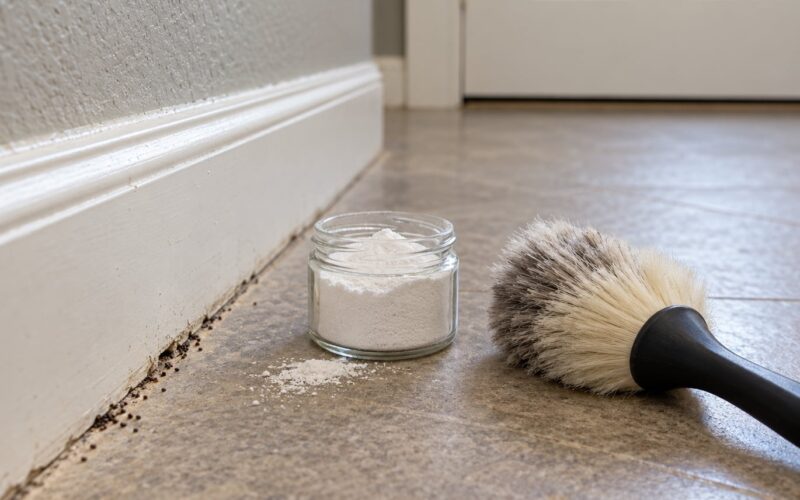
Trusting camphor, mothballs or boric acid powder alone. These show up constantly in DIY discussions. Camphor and mothballs are repellent at best and are registered for other pests entirely, and loose borate powder only works where roaches walk through it, which is nowhere in a wall void. Fix: use them as nothing more than a supplement to sanitation, sealing and bait.
Assuming one dead roach means the job is done. Fix: check the traps and look for nymphs for six to eight weeks before you call it finished.
When to Call a Pest Professional
Book a professional when any of these apply.
You see roaches during the day in a room you did not treat. Daytime sightings usually mean the population is large enough that overcrowding is pushing nymphs out into open spaces.
The activity is still climbing two weeks after baiting began, or roaches are back in the same spots after six weeks. Real programmes take four to eight weeks with two to four visits; nothing should be trending upward that whole time.
The roaches are coming from somewhere you cannot reach. Inside wall voids, above a ceiling, in the plumbing chase, behind a built-in cabinet or inside an appliance housing is technician territory. You cannot seal what you cannot see.
You live in a multi-unit building and neighbours are untreated, or management has scheduled only one unit. Ask for a building-wide schedule in writing before you spend another month paying for the same result.
You have tried the same product twice with no change, which usually means the active ingredient is no longer working on your local population and the next step is a different mode of action rather than a bigger can.
What to ask before booking: the licence number of the applicator, which active ingredients and modes of action will be used and how they will be rotated, whether bait plus an IGR is included rather than spray alone, the number of follow-up visits and their spacing, what the guarantee covers, and whether neighbouring units are included in the schedule. A company that will not give you a follow-up visit count is telling you what you need to know.
Frequently Asked Questions
How long after spraying do roaches go away?
Most DIY aerosol treatments cut visible activity within one to two weeks, and the population is usually gone in four to eight weeks if you also remove food and water and seal entry points. A spike in sightings during the first three to seven days is normal, because repellent sprays flush roaches out of hiding. Seeing more roaches after two weeks, or seeing small pale nymphs, means eggs survived and the treatment missed the harbourage.
Can cockroaches come back after pest control?
Yes. A treatment kills the roaches it reaches, but it does not change the conditions that produced them. If food, water, harbourage and entry points remain, new roaches walk in or hatch from surviving egg cases and the population rebuilds. That is why proper control is a programme of bait and growth regulator with follow-up visits, plus sanitation and sealing, rather than a single spray. Repeat infestations in the same kitchen usually mean an unfixed leak or an untreated neighbouring apartment.
Does spraying kill cockroach eggs?
Rarely. The ootheca is a hardened egg case that contact sprays do not reliably penetrate, and the German cockroach carries hers with her until shortly before hatching, so a well-timed spray misses her entirely. Each surviving case can release around 30 to 40 nymphs two to four weeks after treatment, which is exactly when people see small pale roaches and assume the spray failed. Insect growth regulators and baits address that generation instead of relying on the spray to reach it.
I found one roach in my apartment. Does that mean the whole building has them?
One roach does not confirm a building-wide infestation, but it is worth acting on immediately. Take a photo to identify the species, place sticky traps in the kitchen, bathroom and laundry area, and count what lands on them over the next week. In a multi-unit building, keep a dated log with photos and ask management whether adjacent units and shared plumbing areas are on a treatment schedule. A documented sighting is also your record if the landlord needs to act.
When is DIY treatment enough, and when do I need a professional?
DIY handles a light infestation in one unit if you remove food and water, clean the harborage behind appliances and under sinks, place bait and an insect growth regulator, seal gaps, and check sticky trap counts weekly until they drop. Call a professional when you see roaches in daylight, when activity still climbs after two weeks of baiting, when the harbourage sits inside a wall void or appliance housing you cannot open safely, or when neighbours are untreated. Those cases need equipment and access you do not have.
Conclusion
Roaches come back because spray treats the roaches you can see and leaves the ones you cannot: the eggs, the harbourage, the water source and the neighbour with the same problem. Three actions fix most repeat cases. Inspect the hidden areas behind appliances, under the sink and inside cabinets at night, and remove every egg case and droppings you find. Cut off food and water for good, including pet bowls and that one slow drip. Seal every gap wider than a quarter inch and keep sticky traps out to measure whether the numbers are actually falling.
If sightings are still climbing after two weeks of baiting, or the harbourage sits inside a wall void you cannot open, or neighbours in your building are untreated, stop repeating the spray and get a professional programme with a written follow-up schedule. That is the point where the money spent on another aerosol stops buying anything.