The fastest way to get rid of roaches in a bathroom is to cut off what they need and close what they use: remove moisture, wipe away every crumb and hair, seal the gaps around pipes and baseboards, put gel bait in sheltered spots instead of spraying, and monitor with sticky traps. A serious infestation takes two weeks to a couple of months; a light one can clear in under a month.
Most people start by grabbing a spray and killing the one scuttling across the bathroom floor at 11 p.m. That feels productive, and it changes almost nothing. The roach you see is a scout, not the population.
What follows is a bathroom-specific plan built around that idea. It works for a house or an apartment, with owner-level fixes and renter-level fixes clearly separated.
Table of Contents
- What You Need Before You Start
- Step-by-Step: How to Get Rid of Roaches in a Bathroom
- Common Mistakes That Make It Worse
- Frequently Asked Questions
- How long does it take to get rid of roaches in a bathroom?
- Do roaches in the bathroom mean the whole house has them?
- Does bleach kill roaches that come up the bathroom drain?
- Can I seal gaps and fix plumbing in a rental bathroom?
- When should I call a pest control professional instead of doing it myself?
- Conclusion
What You Need Before You Start
You need five things, and three of them cost almost nothing. The point of gathering them first is that you want to clean, treat, and seal in the right order without stopping halfway through to run to the store.
- Cleaning supplies: a microfiber cloth or sponge, a small stiff brush for the gap behind the toilet and under the sink cabinet, a bucket, and a vacuum you can run along baseboards and the floor-to-wall seam.
- Inspection tools: a flashlight, a small screwdriver or putty knife for the escutcheons and drain grates, and a phone camera to photograph droppings before you clean them away.
- Monitoring: sticky traps or glue traps, and a marker or tape to note the date you set each one.
- Bait: a gel bait or enclosed bait station for inside the room. Boric acid or borax powder is a lower-toxicity option for readers who want to avoid gel, with the safety notes further down.
- Sealing: silicone caulk, a caulk gun, and copper mesh or fine steel wool for the pipe gaps that caulk alone will not hold.
Also worth adding: a drain cover for the bathtub overflow plate and the floor drain, and rubber gloves plus a mask if you plan to work under the sink where the drain trap sits.
Skip the fogger. Total-flood bug bombs in a small enclosed room push roaches out of hiding and into the walls, voids, and neighbouring units, where they breed undisturbed. People on pest forums describe the same result repeatedly: heavy fogging, then a bigger problem two weeks later.
Renters do not need the full kit. You can clean, dry, bait, and trap without permission or a repair. Sealing and plumbing work is different — and it belongs in writing, not a text message. Section three covers what you can and cannot do in a unit you rent.
Step-by-Step: How to Get Rid of Roaches in a Bathroom
Work through the five stages below in order. Each one makes the next one work better, and skipping ahead is why so many people end up cleaning the same bathroom for months with no result.
1. Confirm where the roaches are hiding
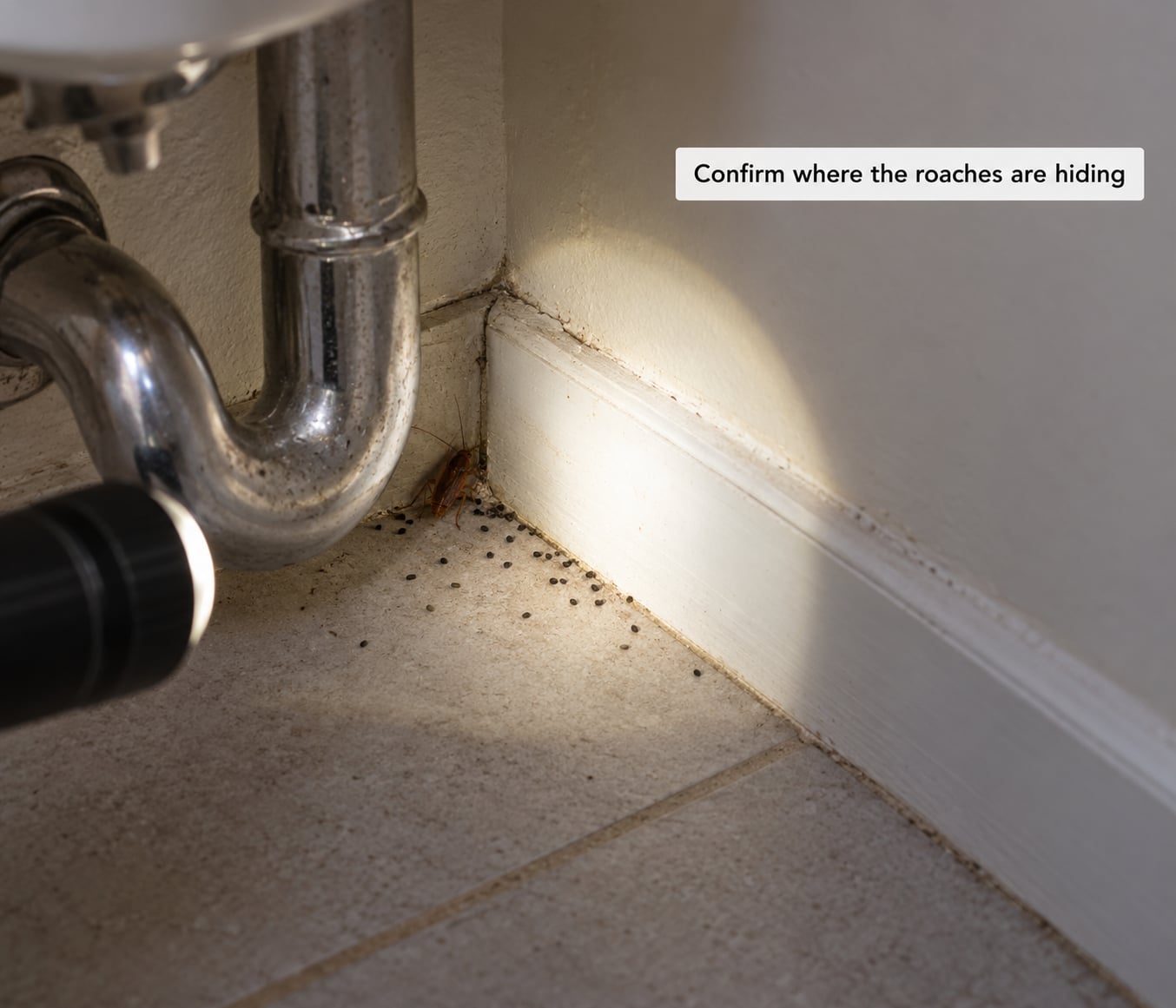
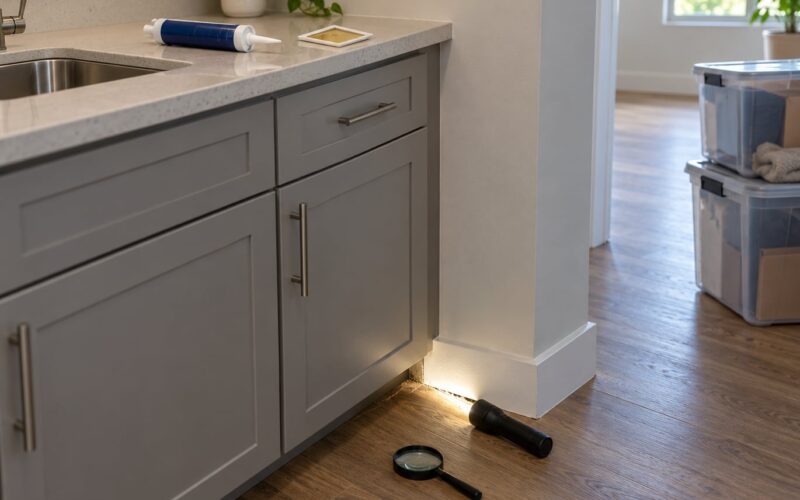
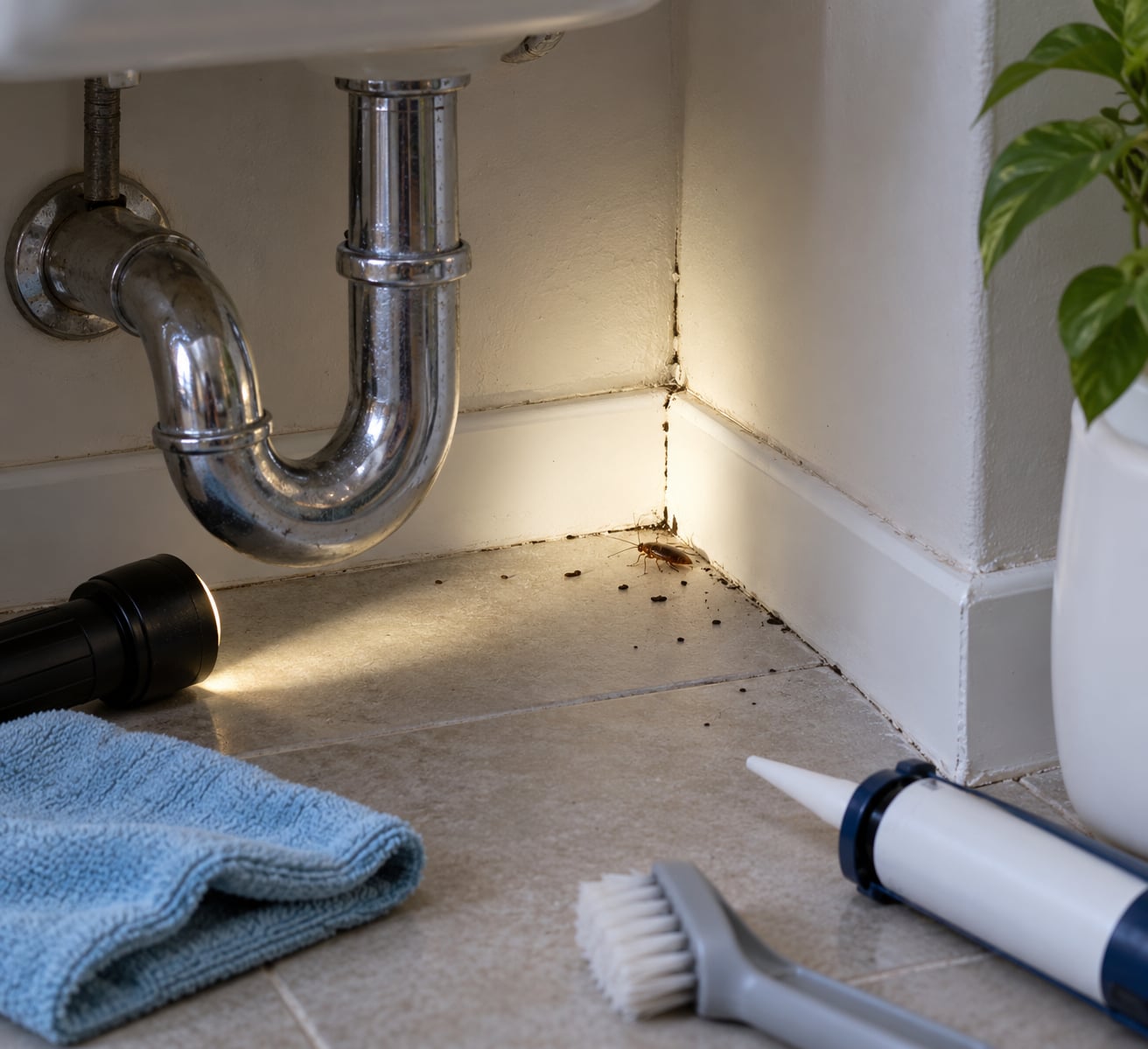
Start in the four places that account for nearly all bathroom sightings: the corner behind the toilet, the cabinet under the sink, the baseboard seam where wall meets floor, and the pipe penetrations where plumbing enters the wall.
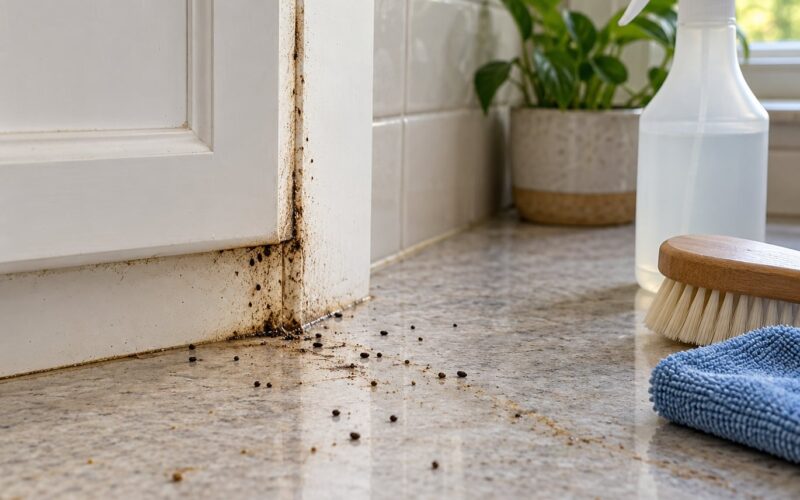
Flash the light along those seams and look for the evidence, not just the roach. Droppings look like coarse ground pepper or black specks, often clustered on horizontal surfaces. An egg case, or ootheca, is a small brown capsule with a ridged edge. Shed exoskeletons show up as translucent, hollow shells left behind after a nymph molts.
Photograph what you find before you wipe it up. If you clean first and cannot tell fresh droppings from old staining, you lose your only honest baseline for whether the treatment worked.
Old evidence is dry, faded and scattered. Active evidence is fresh, glossy, and often means new droppings appeared within the last few days. Live roaches moving in daylight usually means the population is well past the threshold where DIY alone works.
2. Remove food, water, and clutter
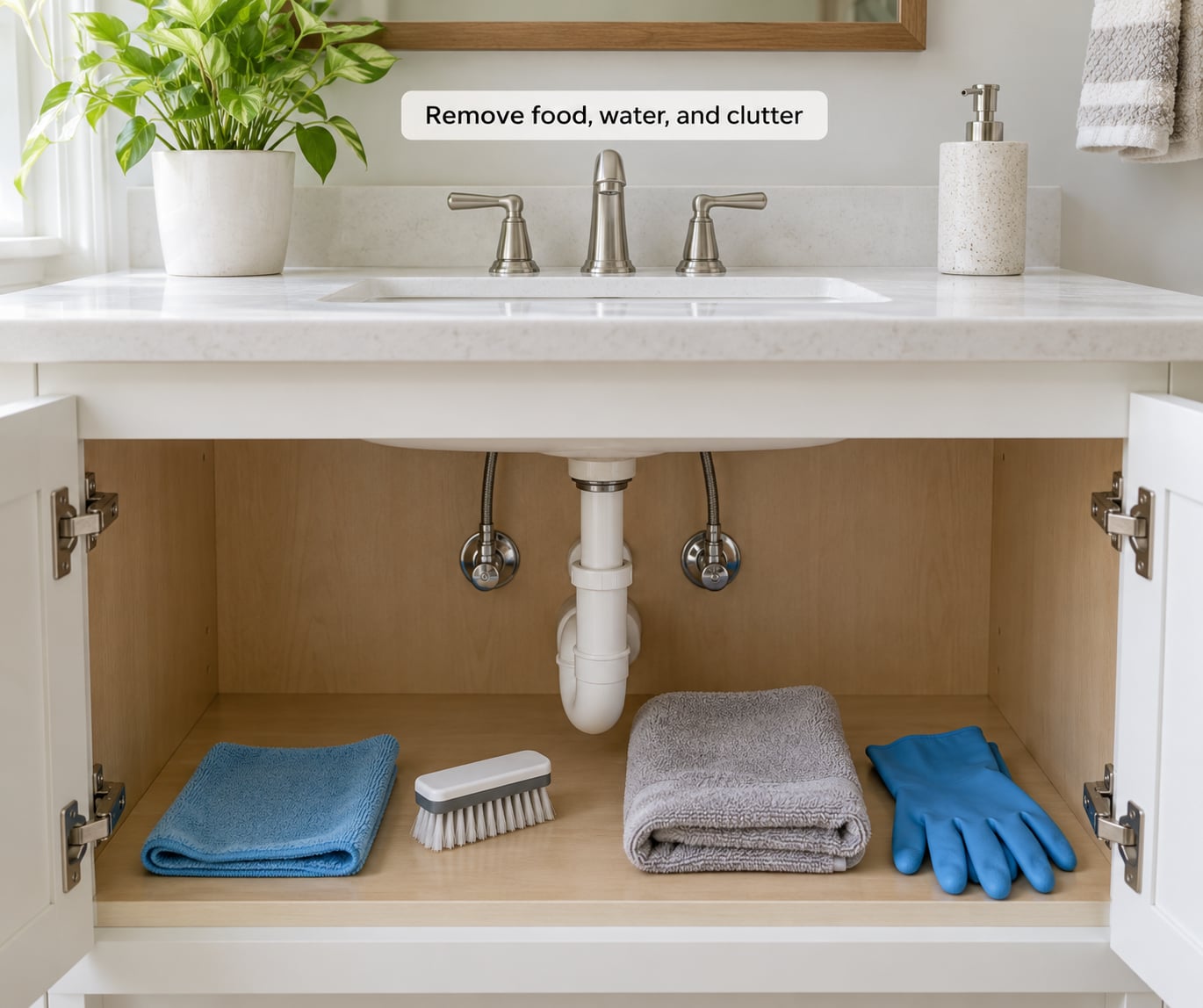
Roaches can live several weeks without food but only about a week with water, which is why the bathroom is so attractive and why drying it out matters more than scrubbing it perfectly.
Empty the bin. Pull everything out from under the sink and wipe the cabinet floor, the back wall and the pipe penetrations with a hot, soapy cloth. Work the brush into the crack between the toilet base and the floor tiles, and behind the toilet where dust bunnies collect.
Fix the moisture sources, which is the real job here. Repair the dripping faucet, dry standing water in the sink and shower, wipe the tub after use, and run the exhaust fan during and for a while after every shower. If the exhaust fan is noisy, clogged, or missing, moisture on the ceiling of the bathroom below you is the likely reason.
Run the hot tap for a minute after cleaning the drains so the P-trap refills and stays full. A P-trap is the U-shaped bend under a sink that holds standing water as a barrier; if a drain rarely gets used, the water evaporates and that barrier disappears.
You will notice conditions have improved when fresh droppings stop appearing and you go a full week without seeing one in daylight or at night. Sighting the roach itself is not the test. Fresh droppings are.
3. Seal gaps and entry points
Cockroaches squeeze through a gap about 1/16 of an inch wide, which is thinner than a dime. Work around the room closing every gap of that size or larger.
- The space where the sink drain pipe and the toilet pipe enter the wall.
- The gap between the baseboard and the floor, especially along exterior walls and the wall shared with a neighbouring unit.
- The edge of the bathtub and shower surround where they meet the wall.
- The gap at the floor-to-wall transition behind the toilet and along the outside of vanity cabinets.
- Penetrations around any electrical outlet or water supply line on a bathroom wall.
For small gaps, silicone caulk alone is enough. For gaps around pipes, or around a toilet base where movement is expected, pack the gap with copper mesh or fine steel wool first, then finish with caulk over the top. Caulk on its own eventually bridges a hole that flexes every time a toilet is flushed.
A few repairs are temporary and worth knowing about. Gel or foam sealant expands to fill a wide cavity but costs more and is harder to trim. A rubber or silicone drain cover over a bathtub overflow plate solves one specific pathway and nothing else. Anything involving the toilet flange, the shutoff valve, or cutting into a wall is not a temporary fix.
For renters, the distinction matters. Rugs, cleaning, baiting and traps are yours. Caulking an opening around a pipe you do not own is usually fine. Any repair to the toilet, the drain line, the subfloor, or the wall cavity needs the landlord or property manager, in writing, with a deadline. Keep photos and dated notes of your traps; a paper trail matters more than being polite about it.
4. Use bait strategically
Place bait where roaches are already walking, not where you can see them. Gel goes in sheltered harborage areas: the back corner of a shelf, under the sink near a pipe, behind the toilet at floor level, along the baseboard seam.
Put small dabs rather than a continuous smear. Too much bait exposed to air dries out and stops working.
Keep the area undisturbed after placing it. No cleaning over the bait, no spray near it, no repellents in the same room. Aerosol sprays and eucalyptus-type repellent sprays push roaches away from the bait, which is exactly the opposite of what you want.
With children or pets in the home, use an enclosed bait station rather than a gel dab, and put it where a pet cannot reach it. Keep the bathroom door closed and the room ventilated while you work. Follow the label on any product you use — the label is the law, and it tells you exactly what is safe to touch, ingest, or place.
You will know the bait is working when it disappears or thins out, when you see dead roaches near the placement rather than live ones, and when fresh droppings stop. Live roaches can take up to several days to die after feeding.
5. Monitor and repeat only what is needed
Put sticky traps under the sink, behind the toilet, near the floor drain and along the baseboards. Check them every two days and count what is on them, rather than guessing from whether you saw a roach.
Read the counts like this. A steady decline across two weeks means the plan is working and you should keep it up. Counts flat or rising after three weeks of bait, cleaning and sealing means something is reaching the bathroom from outside the room — usually a neighbouring unit or a shared plumbing chase in a multi-unit building — and it is time for a professional.
Residual powder such as boric acid or borax along baseboards and inside wall voids is an optional second layer, not a replacement for bait. Both work by drying the insect out after grooming, and neither is fast. Do not apply them in the same spot as gel bait, and do not apply them where a child or pet can reach the powder.
Repeat the bait and the cleaning in two-week cycles until the traps stay empty through a full cycle. Do not scrub the droppings away too early; they are your progress report.
Common Mistakes That Make It Worse
Almost every bathroom that stays infested has one of these seven problems. Each has a straightforward correction.
Spraying over the bait. Aerosol spray kills what is in front of it and repels the rest. The population survives in the walls and returns in a few weeks with numbers you have never seen. Correction: bait only, and keep sprays for a separate, deliberate use if the label allows.
Using a fogger in a bathroom. There is no way to control a bathroom with a fogger. The gas does not stay in the room long enough to reach roaches hiding in a wall void, and the roaches it does flush out move into neighbouring rooms. Correction: remove the foggers, put the effort into bait, sealing and moisture control.
Mixing pesticides. Combining products, or applying a product near another one that is still wet, can create vapour exposure no one intended. Correction: one product at a time, read each label, and never transfer a product from one container to another.
Cleaning away the evidence too early. If you wipe out the droppings in week one, you lose the only honest signal that tells you whether the treatment is working. Correction: photograph each area on day one, leave the physical droppings alone, and judge progress by trap counts.
Ignoring the moisture. You can clean a bathroom perfectly and leave the dripping faucet, the wet shower curtain and the dead exhaust fan in place. Correction: fix the leaks and run the fan, which is the single highest-value change you can make.
Sealing only the cracks you can see. The visible crack is never the only route. Correction: check every pipe penetration, the baseboard seam along shared walls, and the back of the vanity where the wall meets the cabinet.
Applying products without reading the label. Label directions are not fine print; they are the difference between a product used correctly and an exposure. Correction: read the label before opening the container, and again before you apply it.
Noticing the bathroom is not the whole problem. A renter in a multi-unit building often has roaches travelling through shared plumbing chases. Treating your unit alone cannot fix that. Correction: report it in writing, keep documentation, and ask whether neighbouring units are being treated.
Prevention is short once the basics are in place: keep the bathroom dry, keep the sink and tub wiped after use, keep bins empty and lidded, keep the under-sink cabinet clear enough to inspect in ten seconds, and keep those sticky traps out year-round. A trap that reads zero tells you something is wrong before you ever see a roach.
Frequently Asked Questions
How long does it take to get rid of roaches in a bathroom?
A light infestation usually clears in two to four weeks once bait, sealing and moisture control are in place. Expect closer to two months for a heavy one, especially in a multi-unit building where roaches move between units. Judge progress by fresh droppings and trap counts every two days, not by whether you still see one occasionally. If trap counts have not fallen after three weeks, DIY is not fixing the source.
Do roaches in the bathroom mean the whole house has them?
Often, yes, and treating the room alone is why people get stuck. A bathroom is where activity is most visible because of the water and warmth, not necessarily where the population lives. The breeding group is usually hidden in wall voids, under-sink cabinets, plumbing chases and neighbouring rooms. Set traps in the bathroom and along nearby baseboards to find out whether you are dealing with one room or the whole unit.
Does bleach kill roaches that come up the bathroom drain?
Bleach kills on contact, briefly, and it does almost nothing lasting. Roaches that climb up the drain pipe usually do it through the trap or past an imperfect seal, so the pathway stays open and the next one arrives. Boiling water, vinegar and baking soda with vinegar produce similarly short-lived results. The fix that holds is mechanical: a drain cover, a plug in unused drains, and a full P-trap that has not dried out.
Can I seal gaps and fix plumbing in a rental bathroom?
Cleaning, baiting and traps are always yours to do. Caulking a small gap around a pipe is usually fine too. Toilet, drain line, subfloor and wall cavity repairs belong to the landlord, and shared plumbing in a multi-unit building affects everyone. Send the request in writing with photos and dated trap counts, give a deadline, and ask whether neighbouring units are being treated at the same time. Keep a copy of everything you send.
When should I call a pest control professional instead of doing it myself?
Call a professional when roaches are active in daylight, when you see nymphs rather than adults, when bait and sealing have not reduced trap counts after three weeks, or when you live in an apartment where neighbours may be the source. Professionals can reach wall voids and pipe chases and apply an insect growth regulator, which is what actually stops egg production. Any repair involving the toilet or the drain line also needs a plumber, not a spray can.
Conclusion
Do these five things, in this order: inspect behind the toilet, under the sink and along the baseboards before you clean anything, then remove the food, hair and moisture that keep them there. Next, close every gap around pipes and baseboards. Then place gel bait in sheltered spots and leave it alone. Finally, set sticky traps and read them every two days.
Follow the label on any product you use, and if roaches stay active in daylight or the trap counts refuse to drop after three weeks, contact a professional rather than escalating the spraying. In an apartment, send the request in writing with your photos and trap counts attached.