To prevent roaches when moving into a new apartment, you block travel in both directions: inspect the empty unit before a single box comes in, pack so nothing hitchhikes, then seal the gaps, control moisture and food, and set traps to catch early activity. Budget two hours on move-in day and a short weekly routine after that.
Cockroaches reach a new apartment two ways, and the mistake most tenants make is treating only one of them. Some ride in inside boxes, electronics, mattresses and appliances. Others were already in the wall cavity or the unit next door and walk in through pipes, baseboard gaps and utility penetrations. A plan that ignores the second route leaves you sealing the door while the hallway feeds the kitchen.
Timing does most of the work here. Roaches need food and water to breed, and an empty apartment with a wiped-down kitchen and a smear of caulk around the plumbing penetrations is a bad place to live. Give yourself 48 to 72 hours before the truck arrives to handle your own belongings, then spend the first hours in the new unit working from the back of the apartment forward, out toward the door.
Table of Contents
- What You Need
- Step-by-Step: How to Prevent Roaches When Moving Into a New Apartment
- Common Mistakes
- Frequently Asked Questions
- What should I do if the new apartment already has roaches?
- Can moving boxes spread roaches to a new apartment?
- Did I bring the roaches, or were they already in the apartment?
- Should I spray before moving into a new apartment?
- Is it the landlord’s responsibility to get rid of roaches?
- How long should I monitor a new apartment for roaches?
What You Need
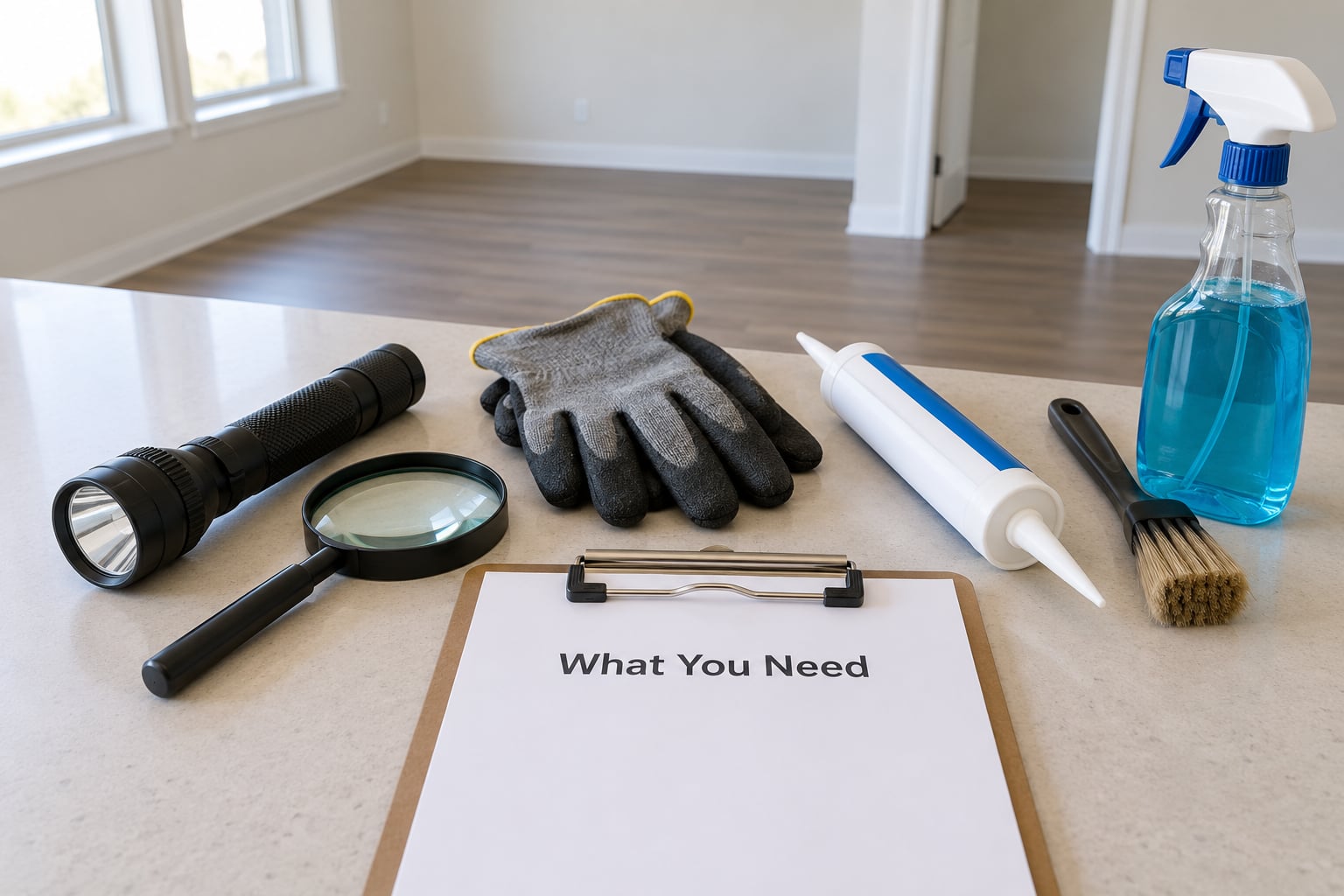
Gather everything before the inspection, because most of it lives in a junk drawer and you do not want to abandon a leaky pipe to go find caulk mid-sweep.
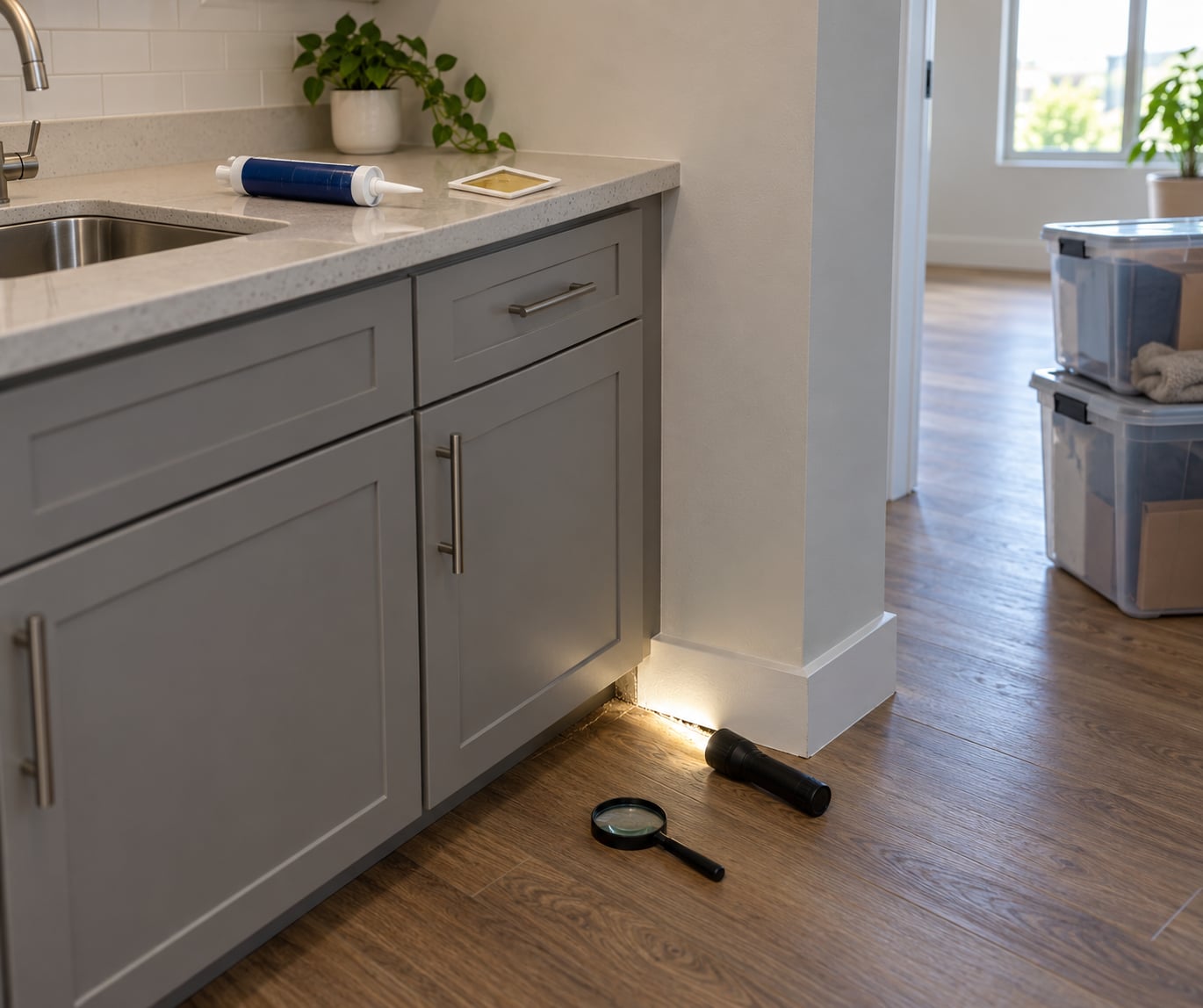
- For inspecting: a bright flashlight, a magnifying glass, work gloves, a small flat-head screwdriver for pulling appliance kick plates, and your phone for photographs.
- For sealing: paintable silicone caulk or acrylic sealant, a utility knife, and a narrow brush if you are applying powder. Caulk labelled kitchen and bath is worth paying a little extra for because it holds up around moisture.
- For containing: airtight plastic bins with tight-fitting lids for anything soft or absorbent, and heavy-duty trash bags you can tie shut.
- For cleaning: degreaser for cabinet interiors and appliance backs, a stiff brush for crevices, a vacuum with a hose attachment, and a dehumidifier if the unit feels damp.
- For monitoring: discreet sticky monitoring traps, plus gel bait or enclosed bait stations if you want to treat while staying tenant-safe.
- For the paper trail: your lease, any pest history the building manager has shared, and the move-in inspection form itself.
The last item is the one people leave behind and regret. Ask management in writing whether the unit has had pest reports in the last year, and whether any adjacent unit is currently under treatment. That single email shapes the rest of your move-in day.
Step-by-Step: How to Prevent Roaches When Moving Into a New Apartment
1. Inspect the Apartment Before Unpacking
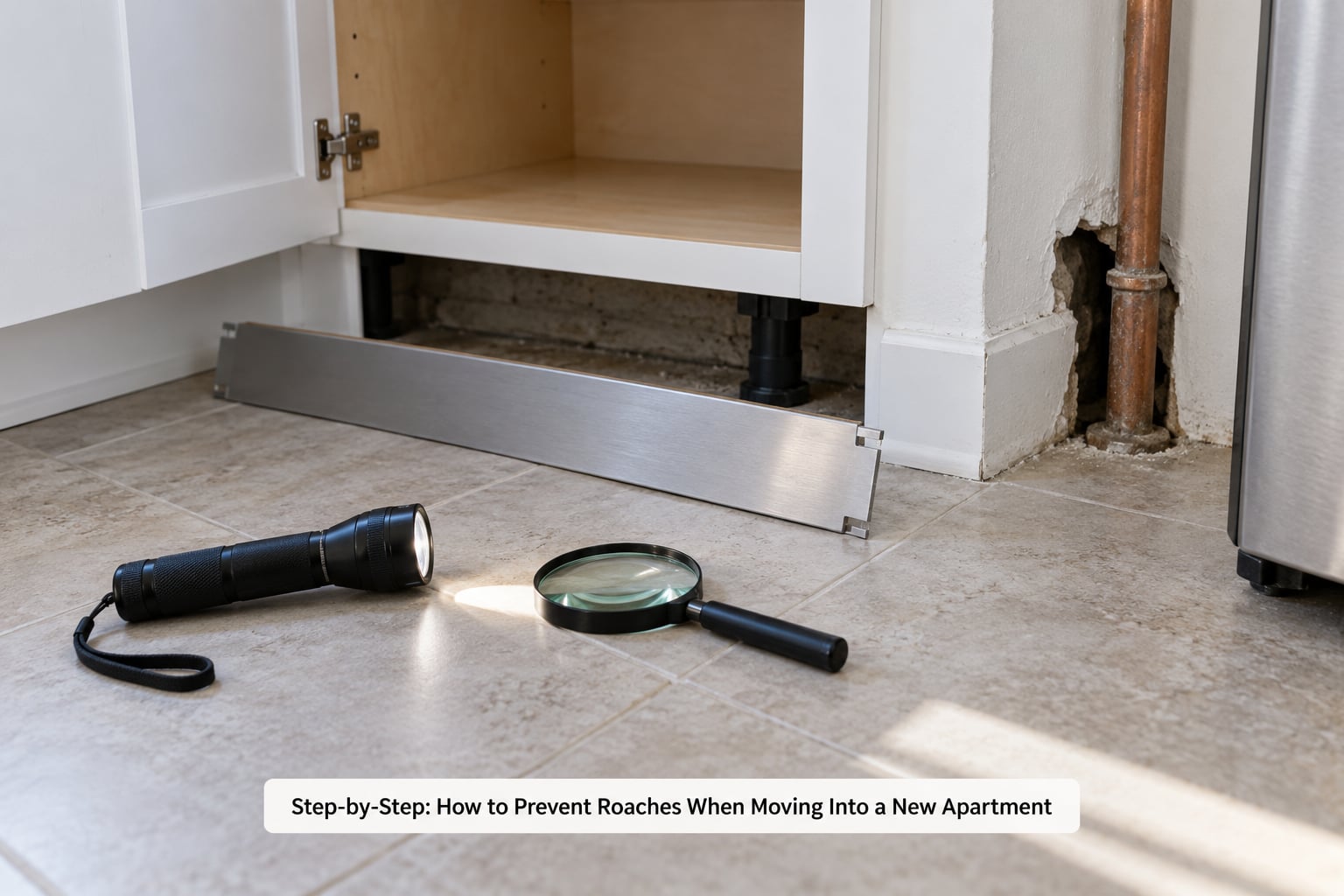
Walk the empty unit with the flashlight before the boxes arrive, starting in the kitchen and bathroom and working outward. You are looking for four things: live roaches, droppings, egg cases and damp or damaged material.
Check the underside of the refrigerator and the kick plates under every appliance, the cabinet interiors including the corners where the shelf meets the wall, the pipes coming through the wall under every sink, the motor compartment at the back of the fridge, and the full length of the baseboards on exterior walls. Roaches follow edges, so the few millimetres between a baseboard and the floor matter more than the middle of the wall.
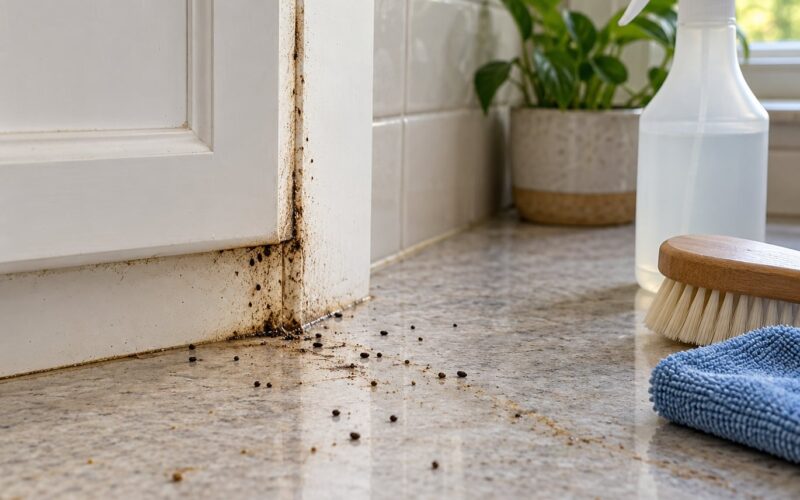
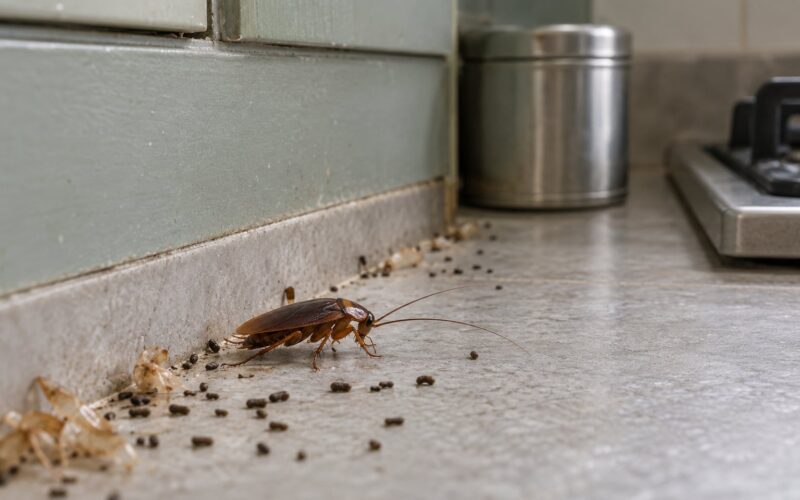
Know your evidence before you decide whose problem it is. Droppings are pepper-sized black specks that smear, shed skins are empty amber-brown shells, and an egg case (ootheca) is a brown capsule about the length of a grain of rice. A cockroach egg case riding in a box will hatch later, which is why you crush or freeze a found case instead of just throwing it away.
| What you find | What it usually means | What to do |
|---|---|---|
| One or two roaches, no droppings yet | Usually a hitchhiker from your boxes | Keep unpacking outdoors, check boxes and furniture before they go in |
| Droppings clustered along a baseboard or under a sink | Activity has been going on for weeks | Photograph it, notify the landlord in writing, treat and monitor |
| Egg case or many shed skins | Breeding is already underway | Skip the DIY stage, request professional treatment |
| Musty, damp smell near a wall or under flooring | Leak plus warmth is an ideal habitat | Report the leak the same day and run a dehumidifier |
Photograph everything before your belongings arrive. Wide shots first, then close-ups with a coin or ruler beside the droppings for scale, then the same wall from a second angle. Timestamped images taken on move-in day are the only clean way to prove an infestation existed before you touched anything.
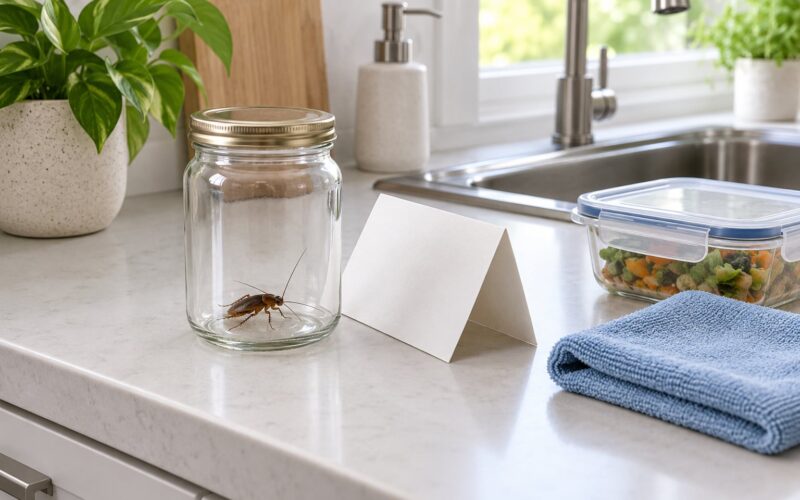
You will also learn which species you are dealing with, and that changes how worried to be. German cockroaches are small, light brown with two dark stripes on the thorax, and breed indoors in warm, humid kitchens. American cockroaches are large, reddish-brown with a pale figure-eight marking behind the head, and usually come in through drains and basements. Oriental cockroaches are glossy black, prefer cool damp areas like basements and utility rooms, and often show up in winter. Smokybrown cockroaches are uniformly mahogany brown with long wings and are almost entirely outdoor insects, so seeing one inside usually means it wandered in through a door or gap.
2. Clean and Dry Every Affected Area
Roaches are not attracted to a clean apartment, but they are immediately attracted to a dirty one. Remove every crumb source you can reach before your food arrives.
Degrease the inside of every cabinet, including the top edges and the corners. Pull out the range and the refrigerator and clean behind and underneath them, where grease films build up unnoticed for years. Vacuum along baseboards and inside wall voids around pipe penetrations, then wipe the surfaces with a degreaser and let them dry fully.
Water is the other half of the equation. Repair any dripping faucet, wipe sinks dry after use, and address damp patches. If the unit is humid, run a dehumidifier in the closed bathroom or bedroom for a few hours a day during the first month. You want the reading on its display to stay below roughly 60 percent if it has a humidistat.
A dehumidifier also serves as an early warning. If the tank fills every day in a unit that should be dry, you have a leak or a building humidity problem worth reporting before it turns into a roach problem.
3. Seal Entry Points and Improve Food Storage
Exclusion is the only step that keeps working after you go to bed. Run a bead of caulk along baseboard gaps, around every pipe and wire where it penetrates a wall, under door thresholds, and along the edge where tile meets wall in the bathroom.
Pay special attention to the laundry closet, the kitchen under the sink, the shared wall between units, and the wall behind the refrigerator where the water line and the power cord pass through. Those penetrations are usually where a service worker cut back into the wall, and nobody sealed it afterward.
Do not forget the outside. Door sweeps and weather stripping on the entry door stop a lot of travel, and a rolled-up strip under the door is cheaper than a sweep.
Food storage matters just as much. Everything dry goes into airtight containers rather than the original bag, which is cardboard and gets gnawed. Trash goes in a bin with a lid, not an open pile, and recyclables go out before they become a food source. Nothing on the counter overnight, no dishes sitting in the sink overnight, and no pet food left out.
If the previous tenant left grease in the upper cabinets, a strong degreaser and a scraper will do more than any pesticide. You cannot bait a roach you have not let come out to feed.
4. Place Monitoring Traps and Check Them
Sticky monitoring traps are the cheapest sensor in the building. Place them where roaches travel, not where you can see them.
Good spots are under the sink, behind the range, next to the fridge motor compartment, inside the lower cabinet near the dishwasher, along the bathroom baseboard, in the laundry closet, and beside the water heater. Keep them away from the middle of open floor, where you would find a roach only by accident. Avoid placing them directly next to gel bait, because you want to count and feed separately.
Check them weekly. An empty trap is genuinely useful information: it means whatever was moving through that area has stopped, usually because you removed the food. A trap with a specimen means you have an active trail worth treating. Several traps catching at once, or a catch that includes nymphs rather than adults, means the population is breeding inside your walls and it is time to escalate.
For treatment, gel bait and enclosed bait stations are the tenant-friendly option. Roaches eat bait while wandering and then carry contaminated droppings and bodies back to the hiding spots, so scattered placements do far more work than one station in a visible corner. Place a small amount in several harborage areas, refresh it as it dries out, and keep the area dry and unscented so it stays attractive. People on r/pestcontrol also refresh boric acid powder along baseboards roughly every three months as a maintenance habit.
Sprays and foggers are a different tool with a different job. An aerosol applied directly into a harborage kills on contact, which is useful, but spraying a whole room drives roaches out of hiding and scatters them deeper into wall voids where you cannot reach them. A fogger reaches almost nothing worth reaching and can make a unit dangerous to be in for days. If a professional residual treatment is part of your move-in plan, coordinate the timing so you do not unpack into a wet unit, and ask what was applied and where.
5. Set Up a Preventative Cleaning Routine
The first month sets the tone. Treat the new apartment the way you would treat a campsite you intend to keep using: wipe counters daily, sweep and vacuum crumbs nightly, take trash out before it accumulates, dry the sink after you use it, and run a load of dishes rather than letting them stack.
Set a weekly rhythm instead of relying on motivation. Vacuum under the appliances and along the baseboards. Wipe cabinet fronts and under the sink. Check every monitoring trap and note what you find. Wipe down door frames and switch plates, which collect grease you would not think to clean.
Then spread the bigger jobs across the first three months.
| When | What to do |
|---|---|
| First week | Deep clean behind and under appliances, set traps, place bait in harborage areas, seal the plumbing penetrations |
| Every 2 to 4 weeks | Reapply bait as it dries out, vacuum baseboards and corners, deep clean behind the fridge as you push it out periodically |
| At 60 days | Re-caulk any new gaps around appliances or plumbing, refresh powder along baseboards, replace used traps |
| At 90 days | Full sweep, reseal, and decide whether the unit is quiet enough to move to maintenance-only monitoring |
Heat and humidity in the unit work for you if you use them. Sunny rooms dry faster after cleaning, and a running dishwasher cycle on the hot setting warms the interior enough to draw out roaches hiding in the drain lines, where a trap or a bait dab will catch them.
6. Know When to Contact the Landlord or Pest Professional
Monitored activity is different from an infestation, and the difference decides who pays. A single roach on a trap, with no droppings and no egg cases, is a monitoring situation you can handle. Droppings along a wall, multiple live sightings during the day, nymphs on traps, or a musty odor that follows the wall cavity all point to an established population.
Notify your landlord in writing and keep the copy. A short dated email with attached photographs describing what you found, where, and what you have done is the difference between a fix and a blame conversation. Reference the pest clause in your lease, which in most standard residential leases places the obligation on the landlord to maintain a habitable unit free of infestation and requires treatment of pre-existing conditions at move-in.
Whether the building is treating the problem is a separate question from whether your unit is treated. In multi-unit buildings roaches travel through shared walls, pipe chases and utility penetrations, so a single unit can be clean while the infestation lives next door and keeps walking in through the kitchen sink penetration. If neighbors report the same thing and your traps keep catching near the shared wall, say so in the email. A unit-specific pest treatment on a building-wide problem produces a result that lasts about three weeks.
Get a professional involved when you see egg cases, when activity is present during daylight hours, when bait stations get emptied and replaced within days without the catch dropping, or when you have small children or someone with asthma in the household. Repeated chemical treatment without food and water removal almost never works on its own, so ask for a plan that includes sealing and sanitation rather than a spray-only appointment.
Common Mistakes
Unpacking first and inspecting later. Once your boxes are open in the living room you have lost the clean read on the empty unit and you cannot prove what was already there. Inspect, photograph, then unpack.
Keeping cardboard boxes. Corrugated cardboard is a harborage. Roaches and their egg cases settle in the dark glued grooves, and a stack of boxes in a closet gives them a home you have paid to build. Flatten and recycle, or reuse them immediately for your own trash.
Soft goods that came from an infested unit. Upholstered furniture is hard to inspect and impossible to treat thoroughly. If your old unit had roaches, the consensus on r/pestcontrol is to ditch the couch and mattresses rather than carry them into the new apartment.
Spraying on move-in day. A preemptive aerosol coat leaves a residue that does little to roaches already living inside the wall and can chase survivors deeper into voids. Empty-unit spraying only makes sense as part of a professional residual treatment with a planned follow-up.
Relying on foggers. Foggers saturate the air and settle on exposed surfaces. Most of a cockroach population lives in protected harborage the mist never reaches, and the vapor can irritate lungs and pets.
Putting out one bait station. One station in a visible corner is easy for roaches to walk around. Bait works because foragers feed and carry it back; scatter small amounts across multiple harborage sites instead.
Assuming no sightings means no pests. Roaches are nocturnal and hide at the first sign of light. A clean-looking kitchen tells you nothing until you check droppings and egg cases behind the appliances.
Leaving paper and documents in transit. People moving out of problem units commonly move paperwork straight into the new place without looking. Unpack in a garage, driveway or laundry room first, check each bin, and only then put things into cabinets.
Frequently Asked Questions
What should I do if the new apartment already has roaches?
Photograph everything before you unpack, then notify your landlord in writing the same day with the photos attached. Ask whether the unit or any adjacent unit has had pest reports or treatment in the last year. Clean and degrease before you move in, seal plumbing penetrations and baseboard gaps, place sticky traps and gel bait in harborage areas, and keep food airtight and trash lidded. If you find egg cases or see roaches in daylight, request professional treatment rather than treating it yourself.
Can moving boxes spread roaches to a new apartment?
Yes, and it is one of the most common ways a clean unit becomes infested. Roaches hide in the dark glued grooves of cardboard and ride inside electronics, appliances and furniture. Pack soft goods and electronics in airtight plastic bins instead, inspect the underside of furniture and inside appliance cabinets before loading, flatten cardboard for recycling rather than storing it, and unpack in a garage or laundry room rather than the kitchen so you can check each bin before it goes anywhere.
Did I bring the roaches, or were they already in the apartment?
Look at where the evidence sits. Droppings clustered along a baseboard, behind the refrigerator, or inside a cabinet mean activity predates the move. One or two roaches with no droppings or egg cases usually means a hitchhiker from a box or piece of furniture. Musty damp odors and moisture damage around a pipe penetration point to a pre-existing problem. Photograph and timestamp whatever you find on move-in day, because that evidence settles the argument later.
Should I spray before moving into a new apartment?
Not as a routine precaution. Spraying an empty unit kills very little because most of the population lives inside wall voids, pipe chases and appliance compartments where the aerosol never lands, and it can drive survivors deeper where you cannot reach them. Work from cleaning, sealing, bait stations and sticky traps instead. A professional residual spray is a different case and can make sense for a unit with known heavy activity, but coordinate it so you do not move your belongings into a wet apartment.
Is it the landlord’s responsibility to get rid of roaches?
In most standard residential leases, yes. Landlords are responsible for maintaining a habitable unit and for treating infestations that existed before you moved in. The key is the paper trail: send a dated email describing what you found, attach timestamped photographs, and ask in writing what treatment will be done and by when. If the lease says otherwise, read it carefully, because the cost of a move-in infestation usually lands on the tenant without written notice.
How long should I monitor a new apartment for roaches?
Keep checking traps and watching for droppings through the first month, since that covers the period when anything you carried would have shown itself. After three months of quiet traps and no sightings, shift to a lighter maintenance routine of monthly trap checks and periodic bait refreshes. If activity recurs after that, the source is almost certainly external, such as a shared wall or utility penetration from a neighboring unit, and it belongs with your landlord.
The shortest way to prevent roaches when moving into a new apartment is to start on move-in day with the flashlight, not the boxes. Inspect the empty kitchen and bathroom, photograph what you find, degrease the cabinets, seal the pipe penetrations, and set traps before a single carton comes through the door. If you are moving out of a unit that had roaches, skip the couch and check each bin in the garage first. Then keep up the weekly clean for a month, and you will not be unpacking into a problem.