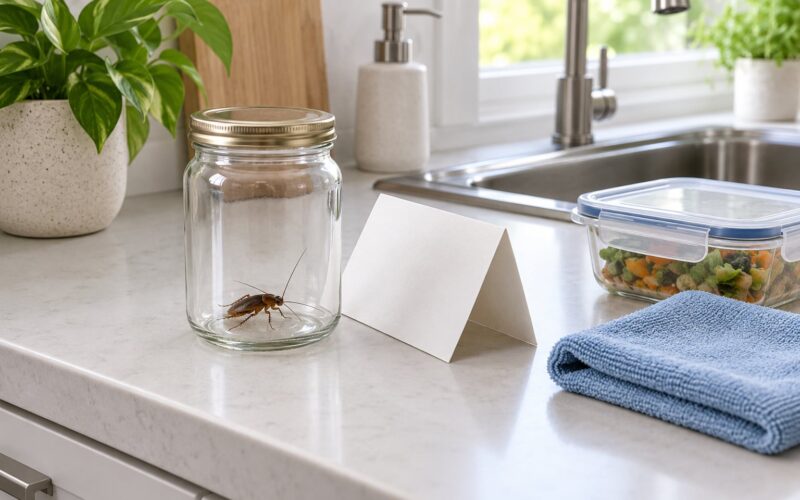
Cockroach pheromone trails are chemical messages cockroaches leave behind as they move, mostly in their droppings and secretions, that point other roaches toward food, water, shelter and each other. Yes, they leave scent trails, and those trails are a physical deposit sitting on your counters, walls and cabinet edges. That is the important part: something sitting on a surface can be washed off.
Most people find this out the hard way. They clean the obvious mess, put down bait, kill a few roaches over the next week, and then wonder why the kitchen is busier than before. The trail they never removed is still there, quietly refreshing itself every night and leading the survivors straight back to the same crack behind the fridge.
This guide covers what the trails are made of, how to tell a real one from ordinary dirt, why cleaning has to come before any kind of treatment, and how to know whether what you did actually worked.
Table of Contents
- Cockroach Pheromone Trails and Why Cleaning Matters
- What do cockroach pheromone trails look like?
- Why cleaning matters for cockroach control
- How to remove cockroach trails safely
- How to tell whether cleaning is working
- Frequently Asked Questions
- Can people smell cockroach pheromone trails?
- Do cleaning products erase cockroach pheromone trails?
- Will cleaning alone get rid of a cockroach infestation?
- Should I use cleaning chemicals and cockroach bait at the same time?
- How long does it take for cockroach activity to decrease after deep cleaning?
- What should renters do when cockroach trails appear in a shared apartment?
- Conclusion
Cockroach Pheromone Trails and Why Cleaning Matters
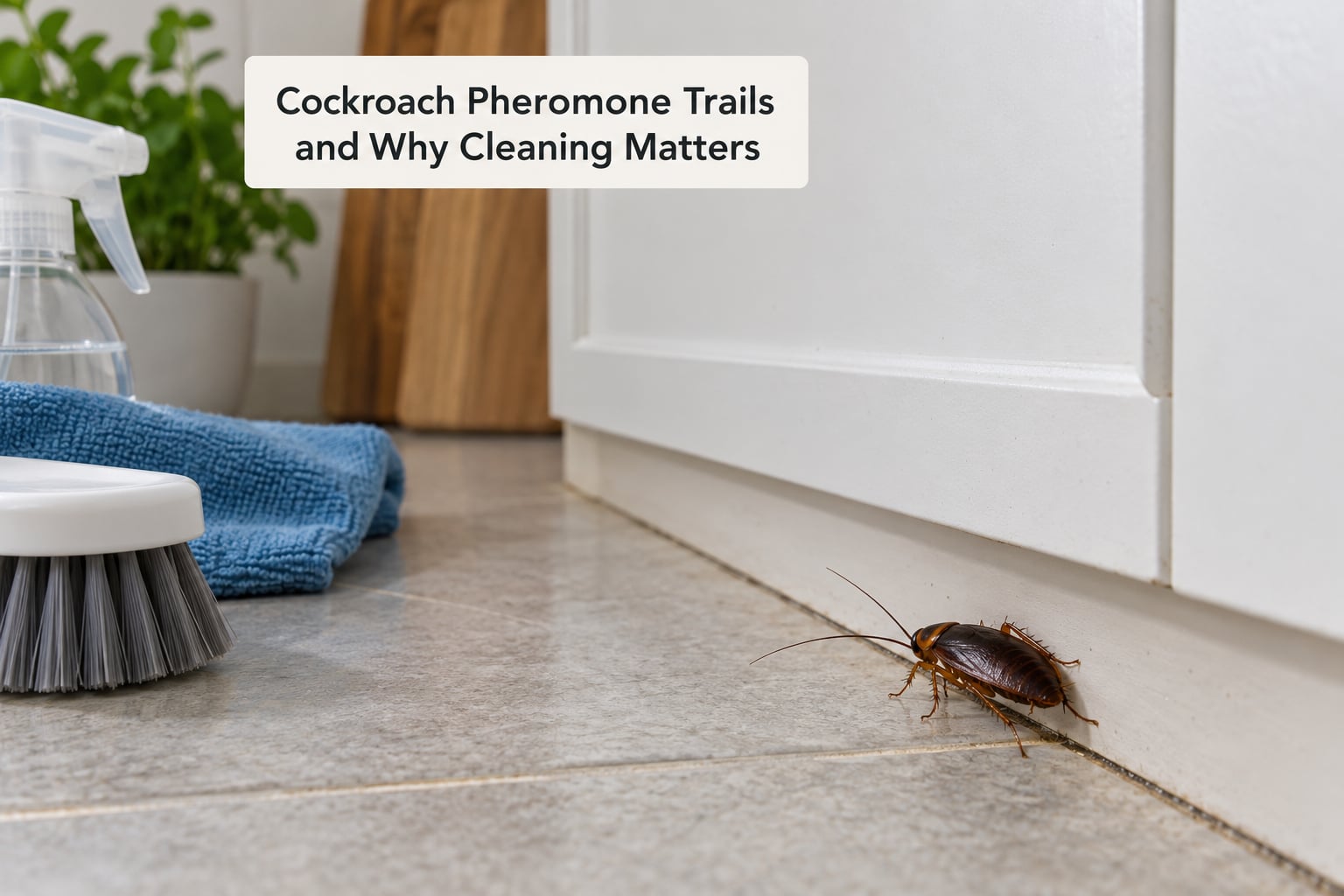
Yes, cockroaches leave scent trails. As a roach walks, it picks up and deposits chemical cues from its body and its faeces, laying a faint line along walls, counters and floor edges. Other roaches detect that line with olfactory receptors in their antennae and follow it toward the resource. Every roach that walks the route strengthens it.
That feedback loop is the whole problem. A lightly used path becomes a busy highway, and a busy highway keeps getting reinforced by the very traffic it attracts. Which means the trail is not a sign of where roaches used to be. It is an active instruction about where to go right now.
Cleaning matters because it is the only step that removes the instruction itself. Sprays and baits deal with roaches. Degreasing and scrubbing deals with the map that keeps producing them.
Why do cockroaches leave pheromone trails?
There is more than one signal in play, and they do different jobs. Most people use the phrase loosely for all of them.
| Signal | What it tells other roaches | Where it is deposited | How to disrupt it |
|---|---|---|---|
| Aggregation | A safe, food-bearing place exists here, come and settle | Faeces, near harbourages and food sources | Degrease surfaces, remove food residue, clean harbourage edges |
| Trail or foraging | This route reaches something worth walking to | Deposited along edges as the roach walks | Wipe and scrub the full edge, not just the visible droppings |
| Sex or mating | A receptive female is close by | Faeces of receptive females, picked up by males | Remove faeces promptly, seal harborage, break up contact with droppings |
| Dispersion | This spot is crowded or unsafe, spread out | Released after a kill, crushing or crowding | Expect scattering, then re-clean and treat the harbourage |
One detail is worth separating out, because it confuses a lot of readers. Male cockroaches are attracted to the sex pheromones contained in the faeces of receptive females. That is a specific chemical relationship, and it is not the same thing as the general scent trail that runs along your wall. The trail is a food-and-shelter road. The faecal pheromone is a mate-finder. Both matter, and both are removed by getting the droppings out of the building and cleaning the surfaces that held them.
The science here is older and better documented than most pest blogs admit. German cockroach aggregation pheromones have been isolated and characterised in the lab, and the dispersion-inducing contact pheromone has been studied in German cockroach saliva, where crushed or killed individuals trigger a dispersal response in the rest of the group. Vision and smell together drive trail-following, which is why a well-lit, freshly scrubbed route gets used less than a dark, greasy one.
What do cockroach pheromone trails look like?
Honestly, rarely anything obvious on its own. A pheromone trail is usually an invisible or near-invisible residue, and what you actually notice is the traffic it produces, the debris that comes with it, and the route it follows.
In practice, look for these:
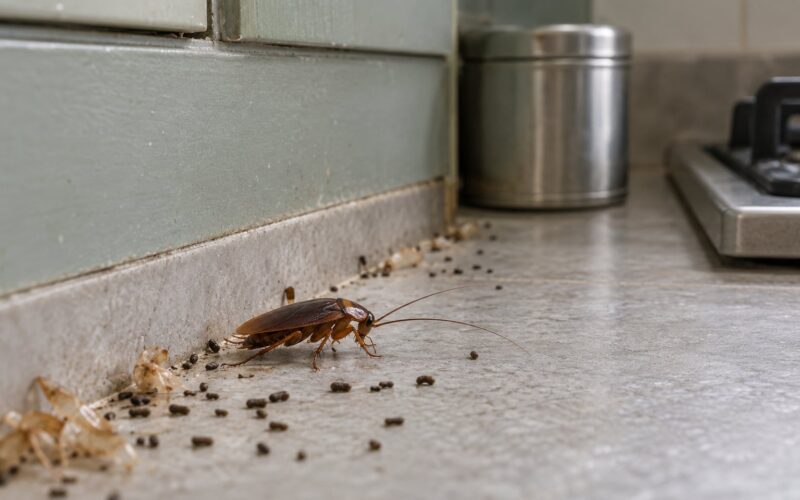
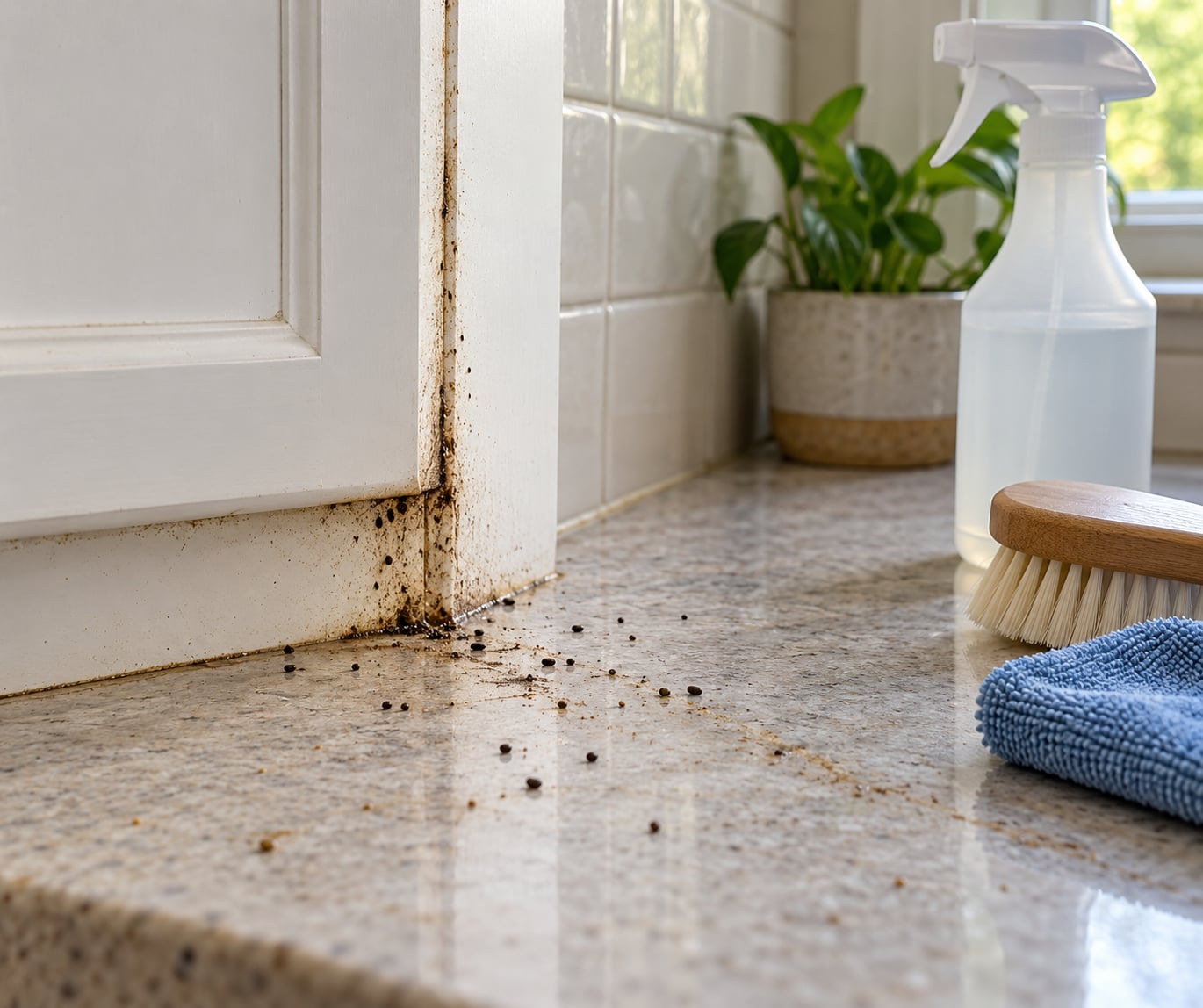
- Smear marks. Dark streaks along a wall, under a shelf, or around a doorway. These are faecal smears, and they sit on the trail route.
- Dark specks that look like ground coffee. Individual droppings, often scattered along an edge rather than in the open. They can be flicked off a surface or stuck to it.
- A route. An irregular line of activity along a wall base, the underside of a shelf, or the gap between a cabinet and the counter. Straight lines are rare. Roaches follow edges.
- Egg cases. Small, brown, capsule-shaped oothecae, often tucked into crevices or stuck to hidden surfaces.
- Shed skins. Nymphs grow by molting, so an active harbourage leaves empty exoskeletons behind.
- A musty, oily smell in a closed space. A heavily infested cupboard or storage bin has a distinct stale, oily odour that gets worse when the door has been shut.
- Daytime sightings. Roaches are nocturnal. Seeing one in daylight usually means a crowded harbourage and a real problem underneath.
The hard part is that plenty of ordinary kitchen grime looks the same. Here is how to sort it out.
| Sign | What it usually is | How to check |
|---|---|---|
| Specks that wipe up in a streak | Fresh droppings, possibly on a pheromone route | Wipe with a damp cloth; a wet smear is more likely faecal, dry grit is likely soil or coffee grounds |
| Evenly scattered fine grit | Coffee grounds, soil, or flour dust | Scattered all over a flat surface rather than concentrated at an edge or corner |
| Streaky film near a stove or hood | Grease film | Wipes off and feels greasy; usually follows the cooking area |
| Dark fuzzy patch on wall or ceiling | Mould growth | Spreads irregularly on damp surfaces, often after a leak or condensation |
| Brown capsule | Egg case (ootheca) | Rounded ends, ridged seam, hollow once hatched |
| Streaks that keep coming back in the same place | Recurring traffic on an intact route | Note the date, clean the surface, and check again a week later |
A trail is not always identifiable by sight, so treat it alongside droppings, egg cases, shed skins and night activity rather than in isolation. One dark mark proves nothing. A repeat offender in the same corner after you cleaned it proves plenty.
One more habit worth knowing: the sighting pattern tells you which species you have. German cockroaches (Blattella germanica) are small, follow edges and clutter closely, and reproduce fast. Brown-banded cockroaches (Supella longipalpa) are small, banded across the wings, and prefer warm dry high areas like upper cabinets and electronics. American cockroaches (Periplaneta americana) are large, often come in from outdoors, and hang around drains, basements and attics. Oriental cockroaches (Blatta orientalis) are large, dark, and favour cool damp ground-level areas. Where the marks sit tells you where to aim the cleaning.
Why cleaning matters for cockroach control
Understanding cockroach pheromone trails and why cleaning matters is where the biology turns into a practical plan. The trail is not an abstract signal. It is a chemical film physically deposited on a surface, held there by grease and dust, and it can be removed with degreasing and scrubbing. Once it is gone, a roach walking into that kitchen has to search again instead of walking straight to the source.
That changes what bait does. Bait is food laced with a slow-acting insecticide. Roaches eat it, carry it back to the harbourage, and pass it around. But bait is competing with every other crumb in your kitchen, and a roach following an intact pheromone trail does not have to find it at all. Clean the trail, remove the competing food, and the bait becomes the most attractive thing available. Bait set down in a dirty kitchen tends to sit untouched, and sticky traps only start catching once the food sources are gone.
Cleaning also does something counterintuitive. Disrupting the routes and the harbourage edges can push roaches out into the open for a while, so you may see more activity for several days right after you start. That is not a sign you made it worse. It is displaced animals in unfamiliar territory, and it is the moment the population is most exposed to bait and traps.
Now the myth. You have probably heard that you should never kill a cockroach, because killing it makes the others multiply. That is half true and half nonsense, and the half that is nonsense keeps people from doing the one thing that actually helps.
What is true: crushing or killing a cockroach can release a dispersion signal, and the sudden loss of a resident in a crowded harbourage pushes the rest to scatter and look for new spots. Some of them end up in the open where you can see them, and the visible count goes up for a while.
What is false: killing a cockroach does not create eggs, does not cause reproduction, and does not double the population. What it does do is convert a sheltered, organised infestation into a scattered, agitated one, and scatter insects are harder to control than settled ones. Spraying a visible roach and letting it die on the counter is worse than doing nothing, because it adds a smear, a carcass and a dispersion signal to the route you were trying to clear.
The same logic kills foggers. Total foggers (bug bombs) fill a sealed room with pesticide mist and settle on surfaces, but cockroaches run away from open light, avoid disturbed air, and spend their lives in cracks and harborage edges where very little reaches. You end up with a heavy residue on the parts you can see and the roaches still living where you cannot. They are not a fix and they carry real handling risk.
What about vinegar, which shows up in a lot of advice? Household white vinegar will cut grease and wipe away a surface film, and on that basis it can help remove part of a deposit. What it does not do is kill cockroaches, and it does not reach into harborage. Treat it as a degreasing tool that happens to be mild, not as a treatment. If you have children or pets, prefer plain detergent and follow every pesticide label exactly; where you are unsure, ask a licensed professional rather than mixing products.
Cleaning has limits, too. If an infestation is established, especially German cockroach in a warm kitchen, cleaning alone is unlikely to finish the job. It is the necessary first half, not the whole answer.
How to remove cockroach trails safely
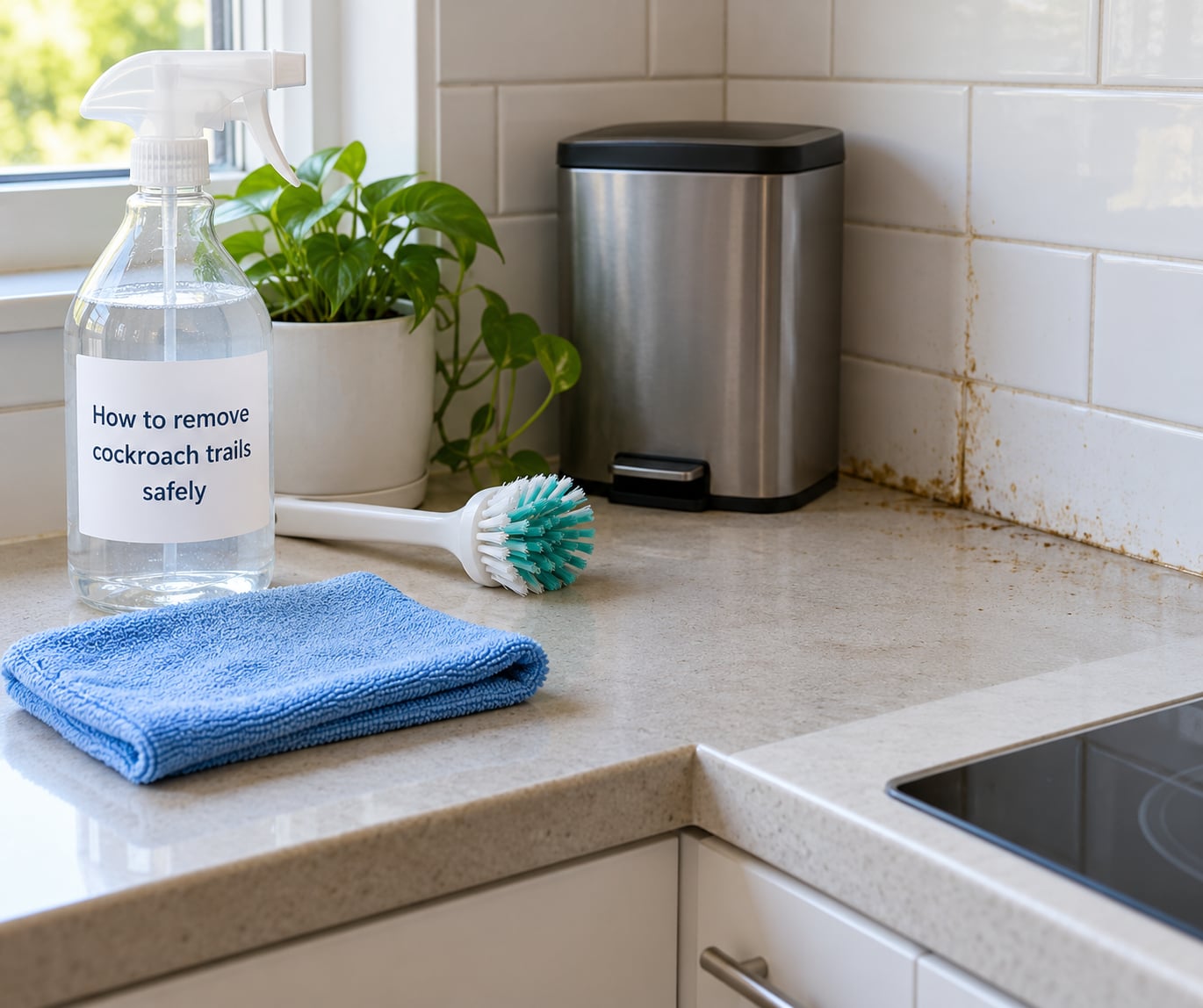
Work in this order. Skipping ahead is the most common mistake, because each step assumes the last one happened.
1. Clear everything out. Empty cupboards, the pantry, under the sink, and any storage bin. Set the contents outside rather than restacking them on the counter while you work. Cardboard boxes are a common hiding place because of the glue and cellulose, so take them out of the kitchen entirely if you can.
2. Sweep and vacuum, then throw it away. Do this first so you are not pushing debris into cracks. Vacuum crevices, edges and the gap behind appliances, and empty the vacuum canister or bag away from the kitchen.
3. Degrease. This is the step that actually removes the film. Hot water with a degreasing dish detergent, or a labelled spray, worked along walls, counter edges, shelf edges, stovetop surrounds and the underside of appliances. Let it sit for a few minutes before you wipe, because contact time is what loosens grease. Take the cloths out of the room afterwards; a greasy cloth keeps spreading what you lifted.
4. Sanitise. Follow the detergent with a sanitiser appropriate to the surface, following its label for dilution and contact time. Do not mix cleaning products. Bleach, ammonia, vinegar and other active ingredients can produce harmful gases, and nobody needs a second problem.
5. Dry everything. Open cabinet doors and leave surfaces dry. Moisture is a resource in its own right, and standing water in a sink or a damp cloth under a fridge is an invitation, not a detail.
6. Seal. Caulk gaps around pipes, wall-to-counter junctions, and under appliances. Fit drain covers. Close the bin and take rubbish out. This is where most of the entry routes get shut down.
7. Then treat. Only now place bait stations and monitoring traps along the cleaned routes and near harbourages, away from where children or pets can reach them. Label them if your household needs the reminder.
Room by room, the priority order is roughly this:
- Kitchen sink and the cabinet under it. Water, drain residue and a warm damp harborage. Scrub the drain, wipe the pipe penetrations and dry the base of the cabinet.
- Under and behind the fridge and stove. Pull them out if you safely can, vacuum the floor beneath, clean the back panels and coil area, and check the water line and drain hose for drips.
- Food storage and pantry. Decant open dry goods into hard, sealed containers. A single infested bag of flour can sustain an infestation on its own, and one source like that explains a surprising number of cases.
- Trash area. A bin that is full or has residue on the lid works as a permanent food source.
- Bathroom. Sinks, tubs and drains, plus towels and cardboard stored in the room.
- Laundry and utility areas. Warm, dark, cluttered. Clean lint traps and any floor drain.
- Bedroom. Usually a spillover space, not the source. Clean under furniture and along baseboards, but spend your effort in the kitchen and bathroom.
How to tell whether cleaning is working
You need a before and after, because cockroach activity is patchy and a single evening tells you nothing.
Start by marking what you found. Note the cabinet or gap where you saw droppings, take a photo, and write the date on the back with a phone or a masking tape note. Then clean. Come back in seven days with a flashlight and check the same spot before you turn lights on.
Put out monitoring devices where activity is suspected rather than spraying. Sticky monitoring traps go down under the sink, behind the stove, along the bathroom base and in the spot you marked. They are not there to catch the infestation, they are there to tell you whether roaches are still travelling that route. People often complain that traps caught nothing despite obvious signs, and the usual reason is placement next to a food source the roaches already prefer. Put them on the trail, not next to the crumbs.
Set realistic expectations. After a real clean and the removal of food and water, you should expect fewer visible roaches within roughly a week or two and a shrinking trail footprint. New droppings appearing on a surface you cleaned on day one means the source is still there, not that the cleaning failed. Ongoing daytime sightings or heavy egg case production means you need more than cleaning.
A few honest caveats worth planning around. If you live in an apartment or a multi-unit building, the source may be a neighbouring unit travelling through wall voids, shared chases, or the drain system. In that case cleaning your unit changes your situation but not the building’s, and you need your landlord or property manager involved. If the infestation is heavy, or you cannot find and seal entry points, or roaches are appearing during the day in multiple rooms, call a licensed pest professional. Heat treatments are often the practical answer for an established German cockroach infestation where the harbourages are unknown.
Two more things people ask about. Boric acid and similar slow-acting materials are not instant, and nothing kills a roach on contact in a way that fixes the population; the point is slow transfer through the colony, which is also why cleanup matters first. As for timing through the year, indoor conditions matter far more than the calendar: warmth, humidity and available food drive the population, which is why heated buildings can hold a steady population through winter.
Frequently Asked Questions
Can people smell cockroach pheromone trails?
No. The pheromone itself is not something a human can detect. What you may smell is the accumulated result: a stale, oily, musty odour in a closed cupboard or storage bin, caused by droppings and shed skins in a damp, dark harbourage. If you can smell it, you are looking at an established population in a sheltered space rather than a faint trail.
Do cleaning products erase cockroach pheromone trails?
They do, and that is the useful part. The trail is a chemical film deposited on surfaces and held there by grease and dust, so hot water with degreasing detergent, followed by a labelled sanitiser, removes it. Wipe the full route including wall bases and shelf edges, not just the visible droppings, and let surfaces dry.
Will cleaning alone get rid of a cockroach infestation?
Rarely on its own, but it is the step everything else depends on. Cleaning removes the trail, cuts off the food and water supply and exposes the harbourages where roaches hide. You then usually need bait stations placed along the cleaned routes and monitoring traps to confirm activity has stopped. For a heavy or long-established infestation, professional treatment including heat is faster.
Should I use cleaning chemicals and cockroach bait at the same time?
Yes, but sequence them. Clean and degrease first, then place the bait. A roach following an intact trail does not need to find your bait, and any crumb in the kitchen competes with it. Keep bait stations away from children and pets, never mix cleaning products, and follow each product label exactly.
How long does it take for cockroach activity to decrease after deep cleaning?
Expect fewer visible roaches within roughly one to two weeks once food and water sources are genuinely removed. Droppings reappearing on a surface you cleaned means the source is still active, usually a neighbouring unit, a pipe chase or an unsealed gap. Activity may spike briefly right after you start, because displaced roaches scatter into the open.
What should renters do when cockroach trails appear in a shared apartment?
Clean and seal your own unit, use monitoring traps under your sink and behind your appliances, and keep written records with dates and photos. Then put the shared problem in writing to your landlord or property manager, asking for building-wide inspection and treatment. In multi-unit buildings the source is frequently a neighbouring apartment, so cleaning alone will not resolve it.
Conclusion
Start by removing the food and moisture, then scrub the trail routes and harbourage edges properly rather than wiping the obvious droppings and calling it done. Seal the entry points, put bait on the cleaned routes, and then monitor with traps instead of guessing. Roaches that are still visible are usually the ones you have not reached yet, and the trail you removed is the reason the next treatment has a chance to work.