Here is how mosquito life cycle works from egg to adult: the insect moves through four stages, and in warm summer weather a female can lay eggs that reach flying adults in roughly 7 to 14 days. Three of those four stages live entirely in water, which is why what happens in your gutters and birdbaths decides how many mosquitoes show up in your yard.
I spend a lot of time looking at wet containers around homes, and the same pattern keeps repeating. Someone empties the obvious bucket, feels satisfied, and gets bitten again a week later. The eggs were still there, sitting on the damp wall above the waterline, waiting for water to come back.
Here is the whole process in order:
- Egg — laid on or just above the water surface, or on damp surfaces beside water
- Larva — the wiggler, feeding and growing in water through four instars
- Pupa — a comma-shaped, non-feeding stage that lives in water
- Adult — the only flying stage, and the only one that bites
How Mosquito Life Cycle Works from Egg to Adult
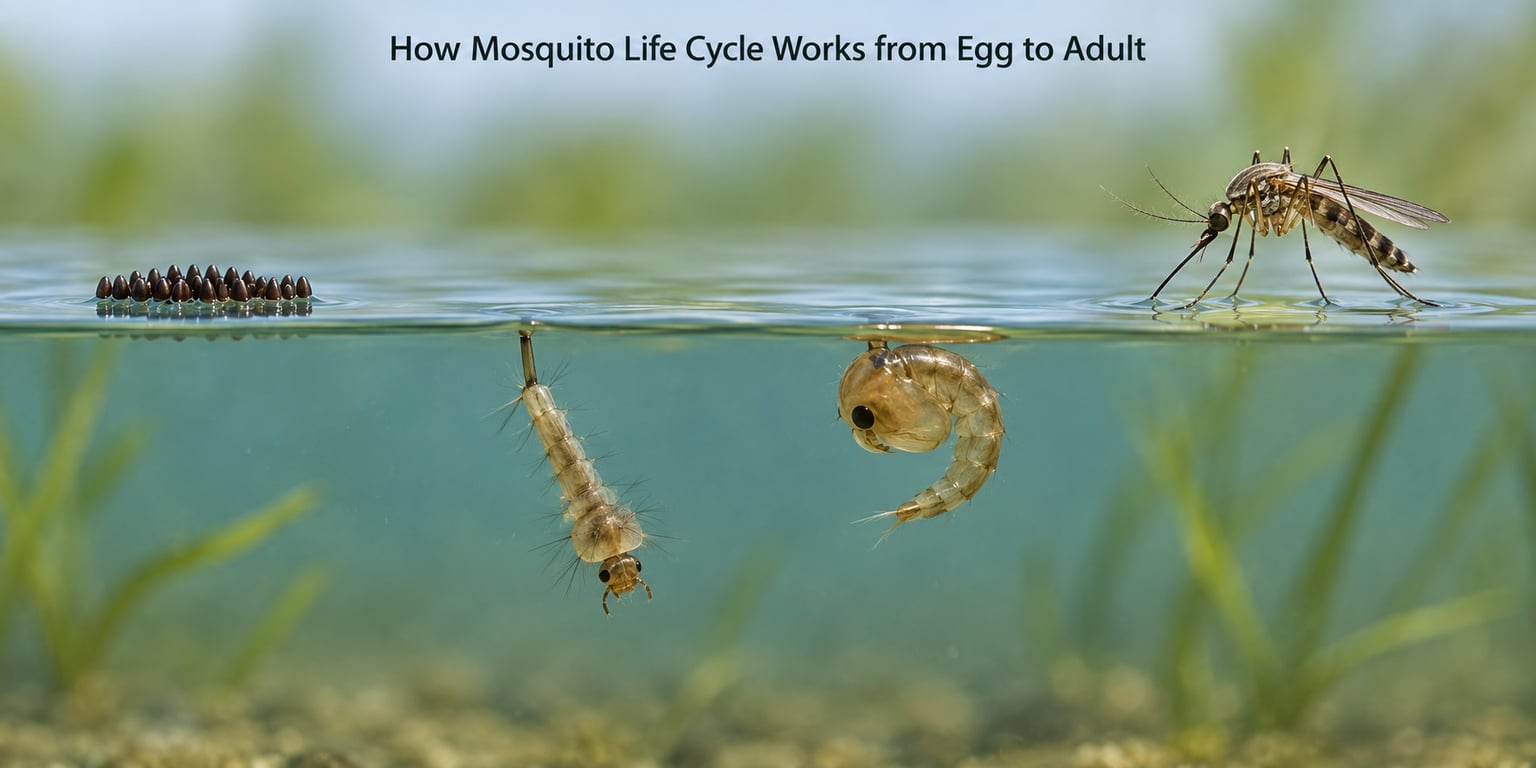
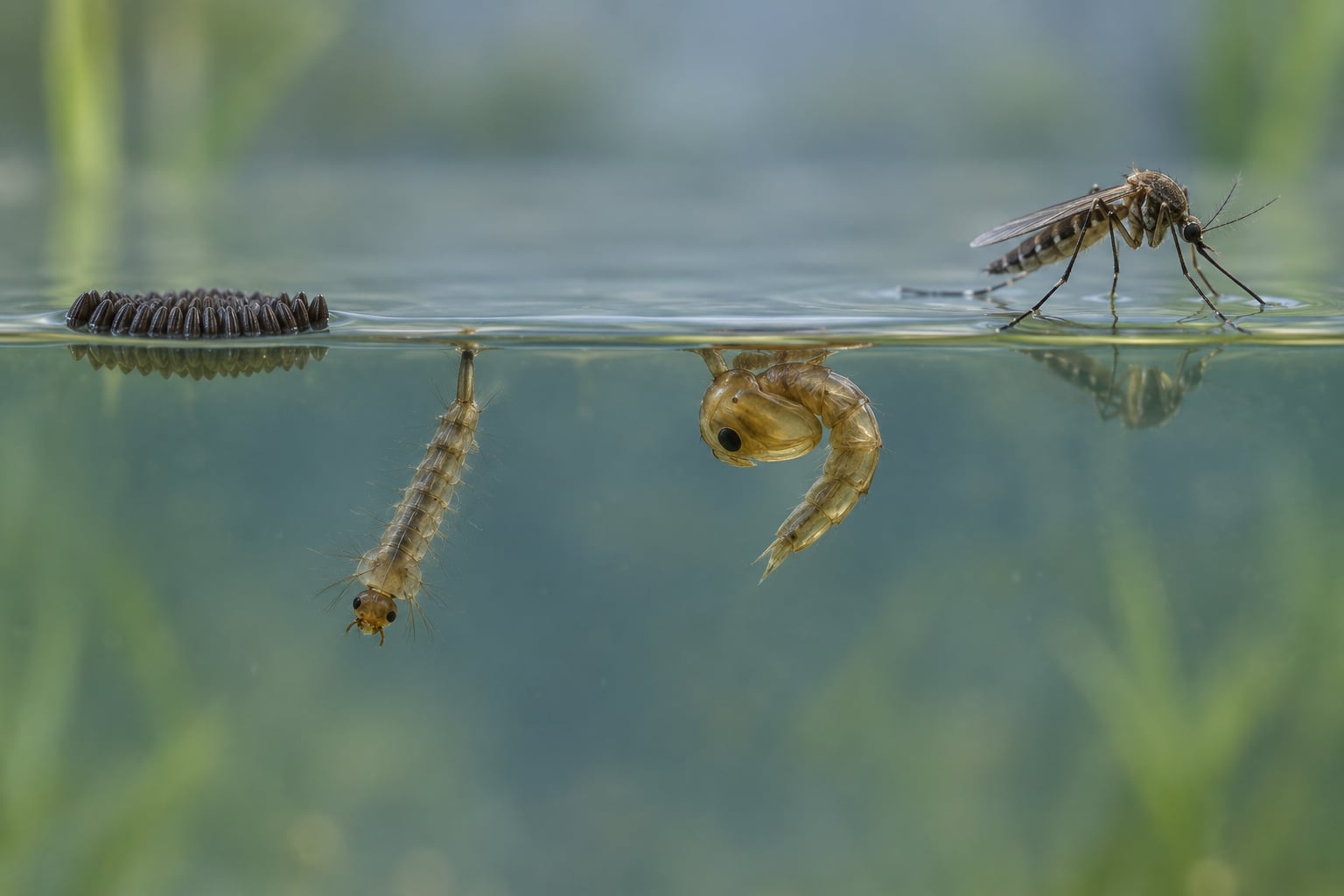
Mosquitoes go through complete metamorphosis, the same process butterflies use, except three of the four stages happen underwater. The larva and pupa cannot survive out of water, and the adult cannot live in it. That single dependency is the whole reason mosquito control works best at the container level.
The cycle restarts constantly. Females mate soon after emerging, seek a blood meal to get the protein needed to develop eggs, and then look for a place to lay. In peak season a single female may lay several batches in a lifetime, so a yard is not dealing with one generation but a rolling series of them.
Timing is not fixed. Water temperature, species, food availability, and rainfall all move the schedule. Warm, clean, food-rich water speeds things up dramatically. Cold or dirty water stretches the larval stage out, sometimes long enough that larvae die before reaching the pupa. As of 2026, most US yards see the first persistent adult activity once nights stay warm, with the heaviest pressure following the wettest part of spring.
The Four Stages of a Mosquito’s Life Cycle
This table is the version worth printing. Every later section expands on one row.
| Stage | What it looks like | Where it is | Main job | What kills it |
|---|---|---|---|---|
| Egg | Tiny dark grains, single or in a floating raft | On or just above the water surface, or damp soil beside a container | Survive drying and wait for the right moment | Draining and drying the container, scrubbing the walls |
| Larva | Worm-like wiggler, comma-shaped when disturbed | Water only | Feed and grow through four instars | Larvicide such as BTI, draining, predation by fish and dragonfly nymphs |
| Pupa | Rounded comma shape, two breathing trumpets on top | Water only | Non-feeding transformation into a winged adult | Very little, since it does not breathe through a gut; draining before emergence |
| Adult | Slender winged insect with long legs and a proboscis | Above ground, flying and resting | Mating, blood meal for egg production, dispersal | Repellents on skin, screens, adulticides, predators like bats and birds |
Stage 1: How Mosquitoes Lay Eggs
Females lay eggs in or very near water, and different groups of mosquitoes use very different methods. That difference matters, because it decides where on your property you should be looking.
- Culex mosquitoes float an egg raft on the surface. The eggs are stuck together in a floating mat that looks a bit like a piece of packing foam.
- Anopheles mosquitoes lay single eggs that float separately on the surface, often with a visible float around them.
- Aedes mosquitoes, including the yellow fever mosquito and the Asian tiger mosquito, lay single eggs on damp surfaces just above the waterline. Aedes aegypti and Aedes albopictus are container breeders, and they are the reason an emptied bucket is not yet a safe bucket.
A female typically lays somewhere between 100 and 300 eggs in a batch, and she often splits that into several smaller deposits rather than one neat clump.
That Aedes egg on the damp container wall is the detail that catches people out. It survives drying out in a dormant state called quiescence, and it can stay viable for months. Refill the container and it hatches. That is why the mosquitoes come back days after you drained everything, and why a scrub of the inside walls matters as much as the emptying.
Stage 2: What Mosquito Larvae Do
Larvae are the stage you are most likely to actually see, because they are active and visible while eggs and pupae are not. Mosquito larvae pass through four growth stages called instars, molting their exoskeleton between each one and growing larger every time.
They feed on bacteria, algae, and organic particles in the water, and they use a siphon tube on the abdomen to breathe at the surface. That is why you see a cluster of them hanging from the waterline. When you disturb the water, they drop down and wriggle, which is where the nickname wiggler comes from.
They can survive in stagnant water, though clean stagnant water is exactly what they want. Rich, still water lets them skip meals they would otherwise have to chase, and a larva that skips a molt can be pushed past the point where it can survive.
Finding larvae means you have a breeding site. Scrubbing away the eggs is necessary but not sufficient, because the water itself is the resource. Removing it entirely, or treating the water with a larvicide that kills larvae as they breathe at the surface, is what actually stops the next generation.
Stage 3: The Mosquito Pupa Stage
The pupa looks like a swollen comma with two breathing trumpets poking out of the top. It is active but it does not feed, so it lives off reserves built up during the larval stage.
This is the shortest stage of the aquatic cycle, often only two or three days. When it is ready, the pupa works its way to the surface, splits along the back, and pushes the adult out. The new mosquito hangs on the pupal shell while it dries, and its wings expand and harden. If you disturb water at exactly that moment, the fragile new adult is easily damaged before it ever gets a first flight.
Pupae get overlooked constantly. People are told to check for wiggling larvae, find none in a container, and assume it is safe. Water that holds no larvae can still be holding pupae, and pupae do not respond to soap or dish detergent the way larvae do.
Stage 4: The Adult Mosquito Stage
The freshly emerged adult is pale and soft, and its body darkens and hardens within a few hours. Males generally live around a week or two as adults. Females live considerably longer, often several weeks, because they are the ones still producing eggs.
Only females bite. Males feed on plant nectar and never take blood. A female needs a blood meal for the protein required to develop eggs, which is the biological reason a female mosquito is the one you notice biting. She can take several blood meals across her life, and she does not bite immediately after emerging. Mating comes first, then a meal, then the search for a laying site.
Do not treat every flying mosquito as a biter, though. Not all species bite people, and not all bite aggressively. Some feed on birds, some on reptiles, and some mostly stick to nectar. In containers, an ornamental pond, or a koi pond, you may have plenty of mosquitoes without a single bite.
How Long Does the Mosquito Life Cycle Last?
Under warm, favourable conditions, expect roughly 7 to 14 days from egg to flying adult. Slow it down with cold nights, dirty water, or scarce food and the same cycle can stretch to several weeks or longer, with a much lower survival rate at the end.
| Stage | Fast development, warm conditions | Slower development, cool or poor conditions |
|---|---|---|
| Egg to hatching | About 1 to 2 days | Several days, or held dormant for months |
| Larval stage | About 5 to 7 days across four instars | 10 days to several weeks, or die before pupating |
| Pupal stage | About 2 to 3 days | Up to a week or more in cool water |
| Full cycle, egg to adult | Roughly 7 to 14 days | Several weeks, with heavy losses |
| Adult lifespan | Males roughly 7 to 10 days; females several weeks | Females can survive well over a month in cool, humid conditions |
Those fast larval and pupal numbers follow the CDC’s Aedes lifecycle figures, where larvae reach the pupal stage in as few as five days and pupae reach the adult stage in two to three days. The egg stage is the wildcard, because quiescence can suspend it indefinitely.
Long evenings, warm rain, and a week of humid weather can compress several generations into a month. Alternating hot days and cool nights slow the whole thing down, which is why mosquito pressure often eases in late summer even though adult mosquitoes are still around.
Where Do Mosquitoes Live During Each Stage?
To follow how mosquito life cycle works from egg to adult in the field, the eggs, larva, and pupa are tied to a specific patch of water, and the adult is the only stage that moves freely. That split is useful, because it separates the problem into two jobs: controlling water and controlling flyers.
In practice, the breeding sites people miss most are small. An uncapped bottle, a child’s sled, a clogged gutter, a birdbath that never gets changed, a wheelbarrow, a blocked roof drain, and an irrigation valve box all hold water long enough to produce a brood. A single capped container can produce several hundred adults.
Adults rarely travel far. Most stay within a few hundred metres of where they hatched, so a steady local population usually means a local breeding site rather than a neighbour’s yard. That also means local fixes work. When mosquitoes seem to come from everywhere, it usually means the yard itself is producing them.
Water level changes are worth watching for. If a container dries out completely, larvae and pupae die, but Aedes eggs on the walls survive and wait. If the container refills, the cycle resumes. If you only top up the water without scrubbing, you are restarting the cycle by hand.
How to Break the Mosquito Life Cycle
Each control method targets one stage, which is why mixing methods works better than any single one. Here is the mapping that makes it usable.
- Target the eggs: scrub and empty weekly. Every week, tip out birdbaths, plant saucers, buckets, tires, toys, and troughs. Wipe the inside walls with a brush or cloth to remove Aedes eggs stuck above the waterline. A container that is emptied but not scrubbed is still a breeding site waiting to be refilled.
- Target the larvae: use a larvicide where you cannot drain. BTI-based pellets or dunks kill larvae as they come to the surface to breathe. Follow the label exactly on dosage, water volume, and re-treatment intervals, and keep the product out of reach of children and pets. Do not use them in water you plan to drink or in a pond stocked with fish you intend to eat.
- Target the adults: screens, repellent, and traps. Repair window screens, use EPA-registered repellents on exposed skin as directed, and run fans outdoors. Traps catch some adults but do nothing about the source.
- Target pupae: act before they emerge. Draining a container between weekly cleanups kills pupae outright, since they cannot survive out of water and are not affected by soap the way larvae are.
- Treat the whole property, not the obvious parts. Walk the yard on a schedule and look at roof gutters, downspout drains, AC condensate pans, water butts, wading pools, and anything holding water under a cover.
Adult fogging is the least useful step on its own. It kills a large number of adults for a short window while doing nothing to the eggs and larvae that immediately replace them. That frustration comes up constantly in local discussions, and it is a fair criticism of treatments aimed only at flying adults.
A small amount of standing water is not a small problem, and neither is a routine you skip for two weeks. If mosquitoes are persistent despite weekly water work, your local health department or county vector control district may run larvicide programs, monitoring, or adult reduction in your area.
Frequently Asked Questions
How long does it take for mosquitoes to go from egg to adult?
In warm summer conditions, a mosquito usually goes from egg to flying adult in about 7 to 14 days. Eggs hatch within roughly 1 to 2 days, larvae grow through four instars in about 5 to 7 days, and pupae take another 2 to 3 days. Cool nights, dirty water, or scarce food slow the whole cycle to several weeks, and Aedes eggs can pause entirely for months in a dormant state.
How do you get rid of mosquito larvae in standing water?
Empty the water if you can, then scrub the inside of the container so Aedes eggs above the waterline come away with it. Where you cannot drain, use a BTI-based larvicide that kills larvae as they breathe at the surface, following the label for dose, water volume, and re-treatment timing. Keep it away from children and pets, and never use it in drinking water.
What kills mosquito eggs naturally?
Drying and physical removal work best. Eggs laid on damp container walls must be scrubbed away, because Aedes eggs tolerate drying and can stay dormant for months. Eggs floating on the surface, as in Culex rafts, die when the water is tipped out and the surface film is broken. Predators such as dragonfly nymphs eat eggs and newly hatched larvae in a permanent pond, but not in a small container.
Can mosquito larvae survive in stagnant water?
Yes, stagnant water is ideal for them. Still water holds bacteria and organic matter they feed on, so they spend less energy hunting and are more likely to finish all four instars and survive to the pupal stage. Cold and dirty water works against them, since they cannot feed efficiently and many die before reaching the fourth instar. Fish, dragonfly nymphs, and tadpoles cut down numbers in a real pond.
What can be mistaken for mosquito larvae?
Water striders skate on the surface and never dip below it. Drain fly or moth fly larvae are translucent with visible dark head capsules, and they often appear in drains and slivers of film in pipes. Fungus gnat larvae are translucent white with small black head capsules and live in moist potting soil, not open water. A mosquito larva tapers at the head, wiggles in jerks, and hangs from the surface by a siphon tube.
How far do mosquitoes travel from where they hatch?
Most adult mosquitoes stay close to their hatching site, commonly within a few hundred metres. Generations accumulate rather than migrating in from a distance, which is why a persistent problem in a specific yard points to breeding sites on that property. Because the larva and pupa cannot travel, anything that dries out or is emptied kills them in place, and only adults move between sites.
Key Takeaways
The mosquito life cycle runs egg, larva, pupa, adult, with the first three stages living only in water and a full cycle finishing in as little as 7 to 14 days in warm weather. Only adult females bite, because a blood meal supplies the protein needed for eggs.
Start with the smallest water on your property. Walk the yard, tip out anything holding water, and scrub the inside walls so dormant Aedes eggs come off with the grime. Then repeat it weekly, because the cycle restarts whenever eggs hatch, water refills, and adults mate. Treat larvae where you cannot drain, and keep your expectations honest about fogging, which shortens the life of adults without touching the source.