Mosquitoes get worse after rain because rain fills containers, puddles and low spots with standing water where females lay eggs, and the humidity that follows keeps adult mosquitoes from drying out so they can fly and hunt for longer. Put simply: rain makes breeding water, and damp air keeps the adults alive and active.
There is a timing wrinkle most pages miss. The bites you notice the evening after a storm come from mosquitoes that were already living on your property. The bigger wave, one to three days later, comes from eggs laid in water the rain left behind.
Getting that distinction right changes what you do this weekend. Adults respond to humidity and resting sites, so mowing back shrubs and using a fan helps. Populations respond to water, so dumping containers matters far more than spraying the air.
Table of Contents
- Why Mosquitoes Are Worse After Rain
- How Rain Creates Mosquito Breeding Sites
- Does Humidity Make Mosquitoes More Active?
- Why You May Notice More Mosquitoes After Heavy Rain
- How to Reduce Mosquitoes After Rain
- When Post-Rain Mosquito Activity May Be a Misidentification
- Frequently Asked Questions
- What to Do First
Why Mosquitoes Are Worse After Rain
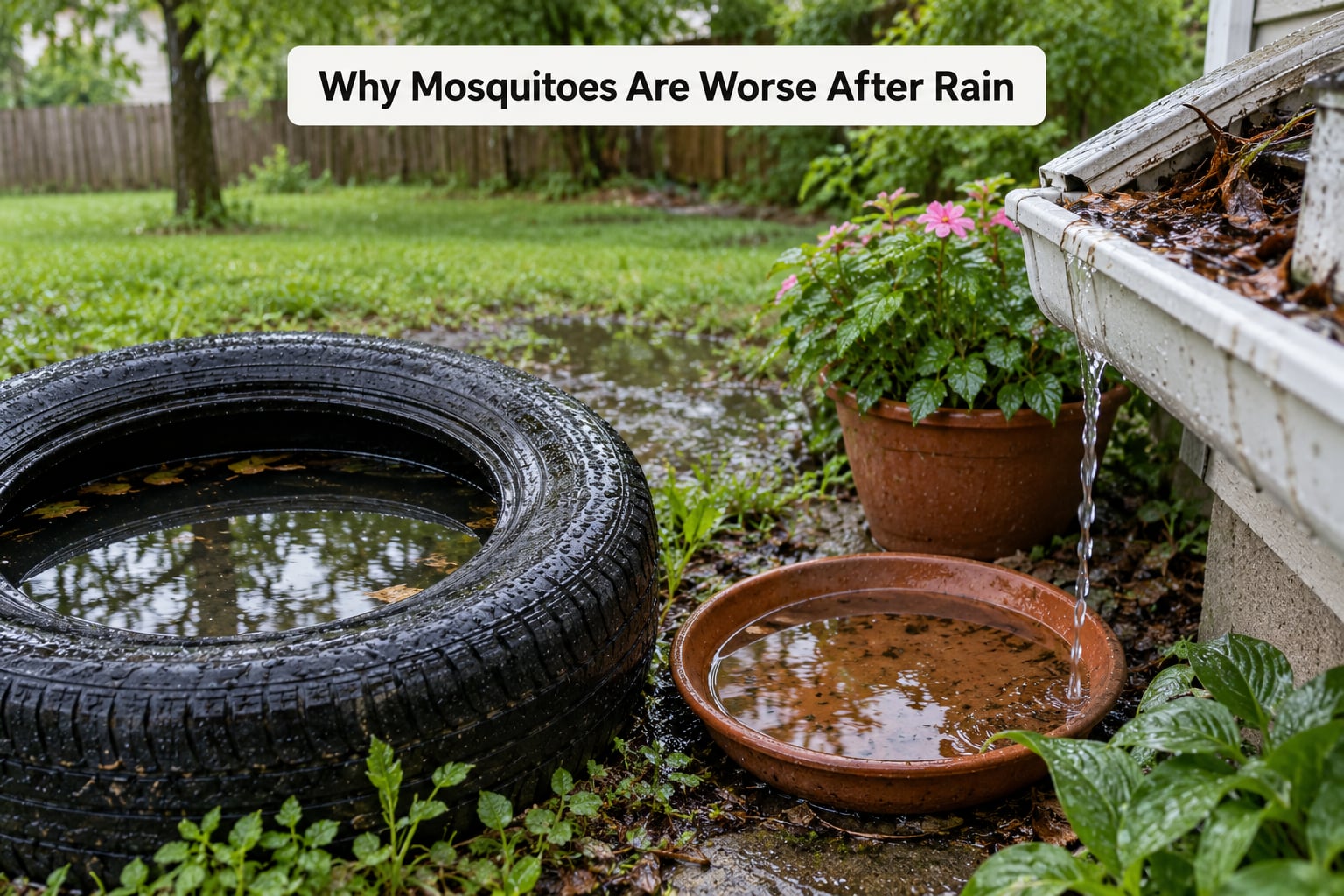
Rain does several separate things to mosquito populations, and the effect you feel is the sum of them.
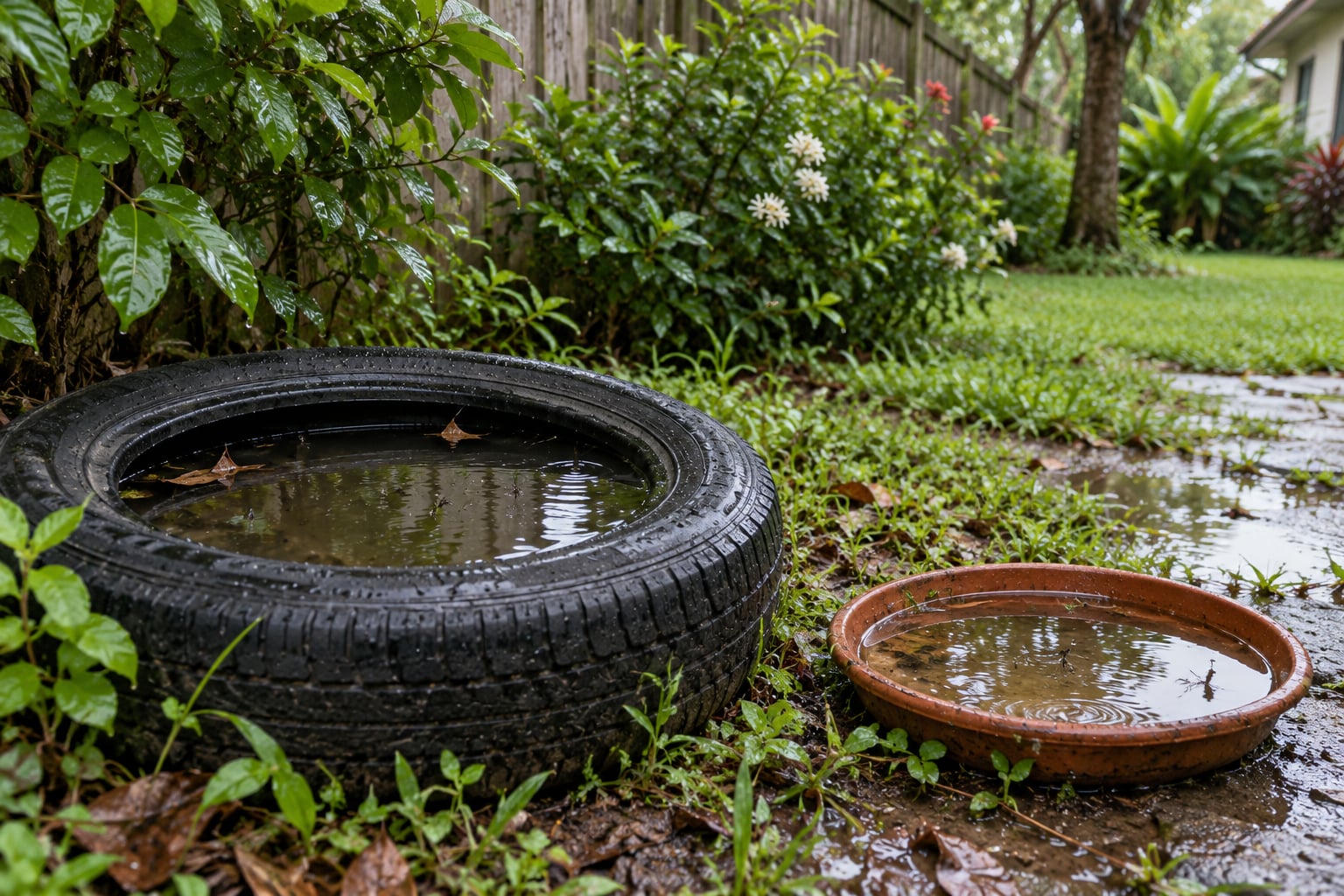
- It creates standing water. Every filled saucer, tire and gutter is an egg-laying site that may have been dry a day earlier.
- It raises humidity. Mosquitoes lose water quickly through their wings, and moist air slows that loss so adults live longer and fly more.
- It dampens surfaces. Wet ground and foliage carry scent and carbon dioxide, which is how female mosquitoes find you in the first place.
- It fills sheltered habitat. Damp mulch, leaf litter and moist soil at the edges of planting beds give eggs and larvae places that containers do not.
- It warms the timeline. Warm post-rain days shorten development, so a week of wet weather can produce adults faster than a week of cool weather.
- It hides mosquitoes in plain sight. During the storm itself, wind and heavy rain ground weak fliers, so the yard feels empty and then feels crowded.
Timing and local species shift what you notice. A yard that stays wet for a week in late summer behaves nothing like one that gets a single afternoon downpour in early spring. The same rainfall produces a nuisance problem in one place and a serious floodwater population in another.
Why Mosquitoes Are Worse After Rain in Your Yard
Most people notice the surge in a specific spot, usually the back patio or the side of the house where shrubs meet the fence. That is not a coincidence. Dense vegetation gives adults a shaded, humid resting site within a few feet of where you sit, and it breaks the wind that would otherwise push them away.
Water is the other half. A puddle that looks trivial to you is not trivial to a mosquito. A discarded tire holds far more water than a flowerpot saucer, but even a bottle cap or a clogged downspout can hold enough for a full generation. Aedes mosquitoes in particular prefer small, artificial containers near where people live, which is exactly what a storm creates on a patio.
So the yard next door feeling worse usually means the water and the shelter are concentrated there, not that your neighbour is doing something to you. More on that below.
How Rain Creates Mosquito Breeding Sites
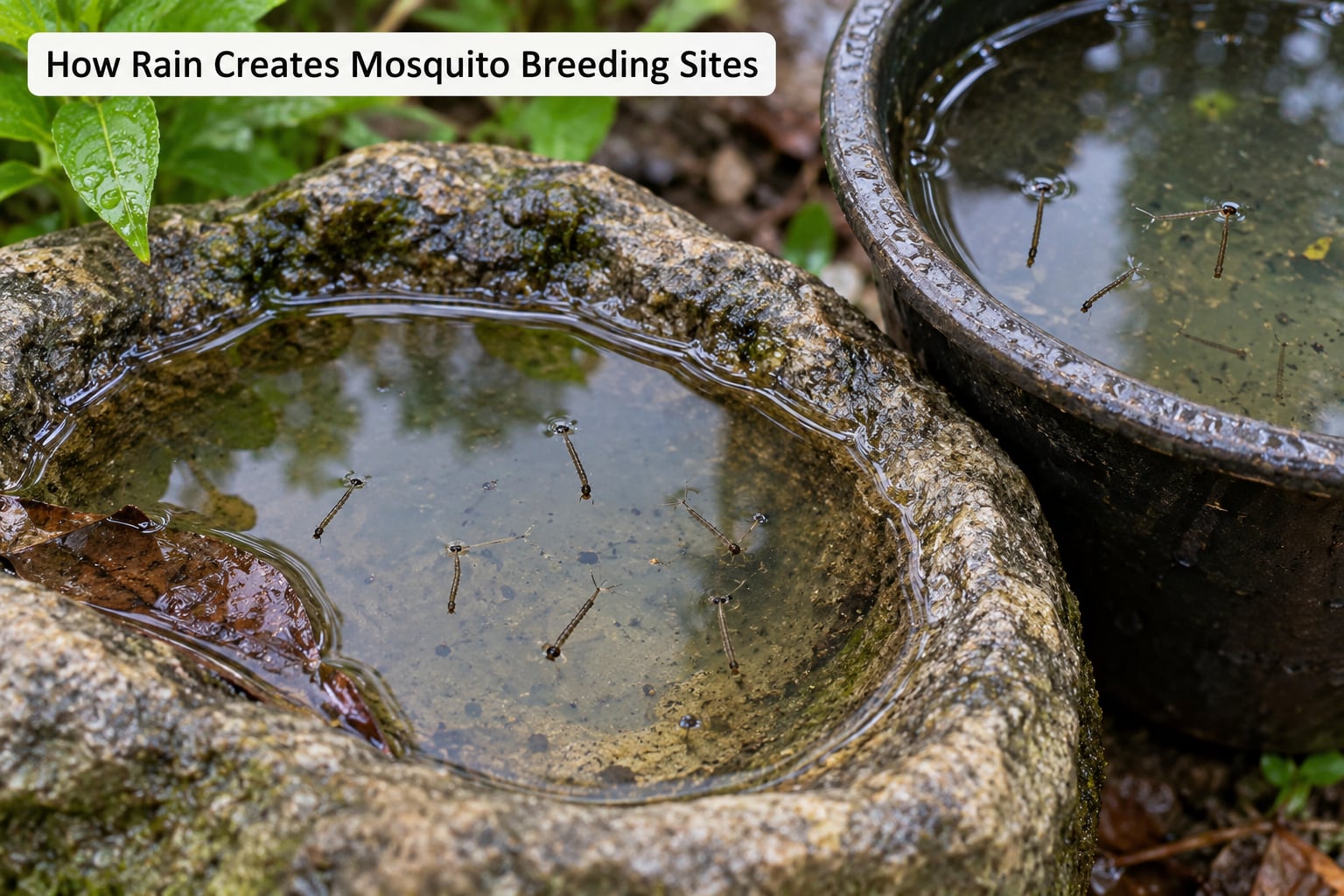
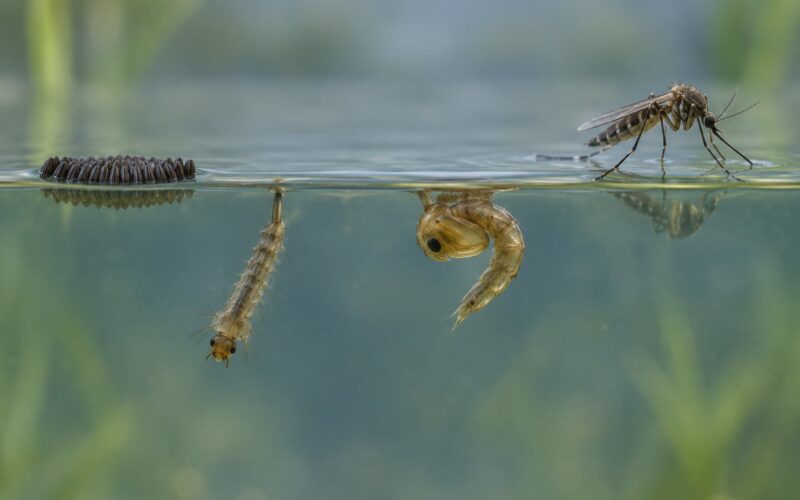
Females do not pick spots at random. They lay eggs on the surface of standing water or on damp surfaces just above the waterline, a behaviour called oviposition. The egg stage often waits for the water to come back, which is why a container that dried out and then refilled after rain can suddenly produce larvae even though it looked harmless all week.
From there the cycle runs through four stages. Development speeds up in warm weather, so a warm spell after rain compresses the whole sequence into roughly a week to ten days.
| Stage | What it looks like | Typical timing in warm weather | What removes it |
|---|---|---|---|
| Egg | Laid on water or damp walls just above the line | Hatches within 24 to 48 hours of water standing | Scrubbing container walls, not just emptying them |
| Larva | Narrow, wriggling shape hanging below the surface | About 5 to 7 days of feeding | Emptying the container, or BTI larvicide |
| Pupa | Rounded, comma-shaped, tumbles to the surface to breathe | About 2 to 3 days | Draining before this stage is reached |
| Adult | Flying, females seek a blood meal | Appears around 7 to 10 days after the water arrives | Repellent, screens, fans, barrier sprays |
That table is also the argument against spraying first. Once adults are flying, a spray kills a slice of the population that will be replaced from somewhere else. Working backwards from the egg stage is what actually lowers the count in your yard.
Moving water is a real factor worth knowing. Mosquitoes do not breed successfully in flowing or churning water, and surface disturbance interferes with larvae breathing at the surface. That is why aerators in ponds and regularly swirled birdbaths behave differently from still, neglected ones.
Does Humidity Make Mosquitoes More Active?
Yes, and the reason is physiological. Mosquitoes have a high surface-area-to-volume ratio, which means they lose water fast through their wings and body. Relative humidity, the amount of water vapour in the air, is what keeps them from drying out.
General guidance puts activity low when relative humidity falls below roughly 40 percent and high once it climbs past 60 to 70 percent. The evening bump matters: as temperatures drop after a storm, relative humidity rises even with no new water, and most species take advantage of it.
Here is the distinction people miss. Humidity raises how many mosquitoes are active and how long they stay out hunting. It does not create more mosquitoes. The count comes from breeding water; the level of activity comes from humidity and temperature. A dry, hot week can produce plenty of mosquitoes and few bites, while a humid evening after rain brings the ones that exist to you.
That also explains why some rainy summers are disappointing. A week of light drizzle on already dry ground may add humidity without adding much standing water. A single heavy storm over saturated soil creates far more of both.
Why You May Notice More Mosquitoes After Heavy Rain
Heavy rain produces a two-phase surge, and confusing the phases leads to the wrong response.
Phase one, the same evening. Mosquitoes already on the property rehydrate, find the humidity comfortable, and start hunting again the moment the wind drops. This feels immediate, but the numbers involved are simply the existing adults, all at once.
Phase two, one to three days later. Water that has now stood for a day or more supports eggs hatching and larvae feeding. Warm post-rain temperatures shorten that schedule, so new adults emerge and the population steps up noticeably. This is the wave people blame on the rain, and they are right to, just with the timing slightly off.
A heavy flood produces something different again. Floodwater species such as Psorophora emerge in large numbers from saturated ground and standing flood water, and they are known for aggressive, painful bites. A lawn sprinkler puddle is a different problem from a flooded basement, even though both follow rain.
Why mosquitoes disappear during a downpour and return right after
Nobody who has sat on a porch in a downpour needs an explanation for this, yet it is the least documented part of the whole question. Mosquitoes are weak fliers. Wind and heavy rain physically knock many of them down, and they spend the storm grounded on low vegetation, under leaves and inside shrubs.
Rain also dilutes the scent plumes mosquitoes use to find hosts, which makes hunting harder while the weather is worst. As soon as the storm passes, those same adults lift off from the shelter that was hiding them and move toward the first warm body and breath they detect. The empty yard followed by the crowded yard is the same insects in both scenes.
This is also why the yard can feel worse than a neighbour’s even when both properties look clean. If your shrubs are thick and theirs are trimmed back, your adults have somewhere to wait out the storm and theirs do not.
How to Reduce Mosquitoes After Rain
Work in this order, and aim to finish within 48 hours of the storm ending. Eggs hatch fast in warm water, so a container left for a week is a lost opportunity.
- Dump anything that holds water. Buckets, plant pots, saucers, tires, toys, dog bowls, wheelbarrows and trash bins. Tip them out rather than setting them beside the house.
- Scrub the insides. Mosquito eggs stick to container walls above the waterline and survive an emptying. A brush and soapy water break that bond.
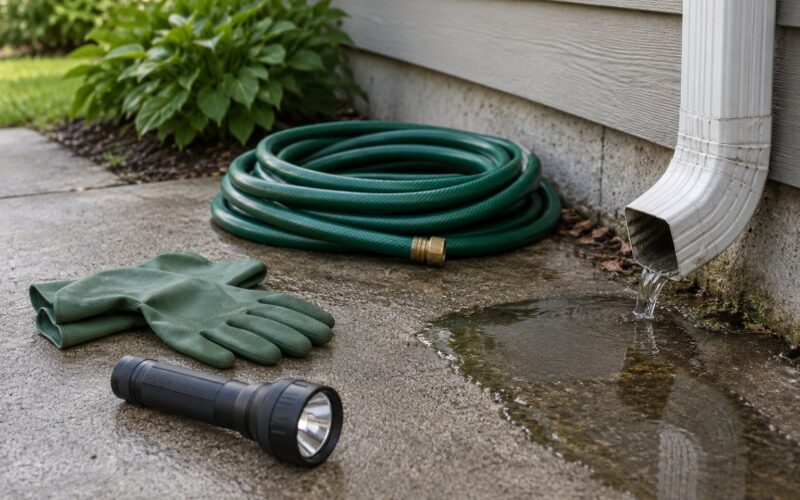
- Clear gutters and drains. Downspouts that drain slowly and low corners that never dry are the two most reliable producers on most properties.
- Refresh birdbaths and fountains. Change birdbath water every two or three days in warm weather. Moving water is not mosquito habitat; still, neglected water is.
- Treat water you cannot drain. BTI larvicide tablets, often sold as dunks, kill larvae before they ever become adults. A thin film of oil over the surface blocks larval breathing. Neither works on adults, and neither is a substitute for draining what you can drain.
- Screen and seal permanent water. Rain barrels and cisterns need tight, intact mesh over the opening. Check the screen after every storm, because a bent hoop turns a safe barrel into a breeding site.
- Trim the shelter. Cut back dense shrubs and tall grass along fences and patios. This reduces the humid resting sites adults use, though it will not change the population on its own.
- Use airflow where you sit. Mosquitoes fly poorly in wind, so a fan on the patio does more than most people expect.
For bites, follow the five D’s promoted by public health agencies: drain standing water, use DEET, picaridin, oil of lemon eucalyptus or IR3535 repellent, dress in long sleeves and light colours, avoid being outside around dusk and dawn, and keep doors and windows screened.
A few honest notes. Showering helps a little, since it removes some of the skin bacteria and odours that make you easy to track, but the effect is short and repellent is the reliable answer. Citronella and similar natural products are useful on a patio as a yard treatment and much weaker as personal protection. And a barrier spray is worth nothing on a windy day, since mosquitoes fly poorly in exactly the conditions that make spraying ineffective for reaching them.
Rain timing matters too. A treatment applied right before a heavy storm is largely wasted, since the product washes off. If you treat, do it after the rain has passed and when winds are light.
When Post-Rain Mosquito Activity May Be a Misidentification
Sometimes the surge is real but the culprit is not a mosquito. Biting midges, gnats, stable flies and small biting flies all increase around wet ground too, and they are treated with different approaches.
There are a few practical ways to tell them apart without handling anything. Mosquitoes usually rest with their bodies held at an angle to the surface rather than flat against it, and they fly in a hopping, wandering pattern rather than the direct darting run of a stable fly. Midge bites tend to arrive in swarms around the lower legs near wet vegetation. Flies land repeatedly and predictably on legs and arms, while mosquitoes usually bite once and move on.
Size and sound help. Mosquitoes are small, produce a high-pitched whine, and are quiet on approach. Flies are often larger, silent or buzzy, and announce themselves.
Some people assume an insect problem when the real problem is a smell source such as a blocked drain, standing garbage or damp organic debris. If you have cleaned the water and the irritation continues, that is worth checking before you treat again.
If bites come with fever, rash or swelling beyond the bite, contact a healthcare professional. For repellent and insecticide choices, follow the label and check the EPA registration number, or ask your state cooperative extension service for current local advice.
Frequently Asked Questions
Why are mosquitoes suddenly worse after rain?
Rain creates two things at once: standing water where females lay eggs, and humid air that lets adult mosquitoes stay hydrated and keep hunting longer. The adults biting the evening of a storm were already on your property. The larger wave, one to three days later, comes from eggs laid in the water the rain left behind.
Are mosquitoes more likely to bite right after it rains?
Yes, but the two causes arrive on different schedules. Within a few hours of the rain stopping, existing adults become active again and begin feeding, which feels like a sudden surge. New adults from rain-filled water take about one to three days to emerge, so the heaviest pressure usually starts a couple of days afterward rather than during the storm.
How long after rain do baby mosquitoes appear?
Eggs on standing water can hatch within 24 to 48 hours, larvae feed for roughly five to seven days, and pupae develop for another two to three days. In warm post-rain weather, biting adults therefore emerge about seven to ten days after the water first collected. Cold weather stretches the schedule considerably, which is why late-season surges tend to be smaller.
Does rain alone attract mosquitoes to my yard?
Rain rarely draws mosquitoes in from a distance. What it does is fill breeding sites and raise humidity on your own property, so the adults already living nearby become far more active and easier to notice. If your yard is dry and clean but bites continue for a week, the source is probably a neighbour’s containers, a shared drainage channel or a nearby low spot you cannot see.
Will rain wash away mosquito control products?
It depends on the product and on how hard it rained. Foggers and barrier sprays applied just before a storm are largely lost, and heavy rain can shorten residual protection on foliage and walls. Timing matters more than most people expect: apply after the rain has passed, when winds are light, and reapply according to the label. Water treatments such as BTI tablets are not washed away at all.
What to Do First
Walk your property within 48 hours of the next storm and find every place holding water. Dump the containers, scrub the walls, clear the gutters and drains, and treat what you cannot drain with BTI or a film of oil. That single hour does more than a season of spraying, because it removes the source instead of the adults coming out of it.
General guidance on mosquito life cycles, breeding sites and personal protection is published by the CDC, the US EPA and state cooperative extension services, and those pages are worth a look if you want the regional detail for your own area.