
Mosquito proof a screened porch by closing every physical entry point first — torn mesh, the gap where the screen meets the siding, the space over the deck boards, and the slop under the door — then adding moving air with a fan. Most bites on a “screened” porch are not a mesh problem. They are a gap problem.
That is the part contractors and forum regulars keep circling: a screen only works if the screen is continuous. The moment there is a half-inch slot at the header, the whole envelope is decorative. Fix the barrier, then worry about repellents.
Here is the honest order of operations. Grab a flashlight and go out at dusk with the porch light on behind you. What you find in twenty minutes usually saves a weekend of buying the wrong thing.
Table of Contents
- What You Need
- Step-by-Step: How to Mosquito Proof a Screened Porch
- Common Mistakes
- Frequently Asked Questions
- What size screen mesh keeps mosquitoes out of a porch?
- Does a fan really help mosquito-proof a screened porch?
- How do I stop mosquitoes coming in under a screened porch door?
- What is the best way to prevent mosquitoes around a screened porch?
- Can I use insect fogger or spray inside a screened porch?
- When should I replace an old or damaged porch screen?
- Final Checklist
What You Need
You can diagnose a screened porch with almost nothing. Repairing it takes a short list, and most items are under ten dollars at a hardware store.
- A flashlight — for the dusk entry-point test. A headlamp is better, since you need both hands.
- Pliers and a flat screwdriver — for pulling old spline and working fasteners loose.
- Replacement screen mesh — fiberglass for standard porch panels, no-see-um mesh if biting midges drive you nuts, polyester if you want tear resistance.
- Spline and a spline roller — the spline is the rubber strip that holds mesh in its channel; the roller is the tool that seats it.
- A screen brush or soft hand brush — cleans debris out of the channel before you set new spline.
- Weatherstripping and a door sweep — for the jamb and the threshold.
- Self-closing hinges — the single best fix for a door that gets propped open.
- Exterior-rated sealant or foam sealant — for utility penetrations and the siding junction.
- A wet-rated ceiling fan — only if the porch is roofed but open on the sides. “Wet-rated” and “damp-rated” are different; wet-rated means it can take direct rain and moisture.
Add a simple caulking gun if you do not own one. Skip foggers and sprays entirely — you will not need them once the steps below are done.
Step-by-Step: How to Mosquito Proof a Screened Porch
1. Inspect the screens, doors, and framing
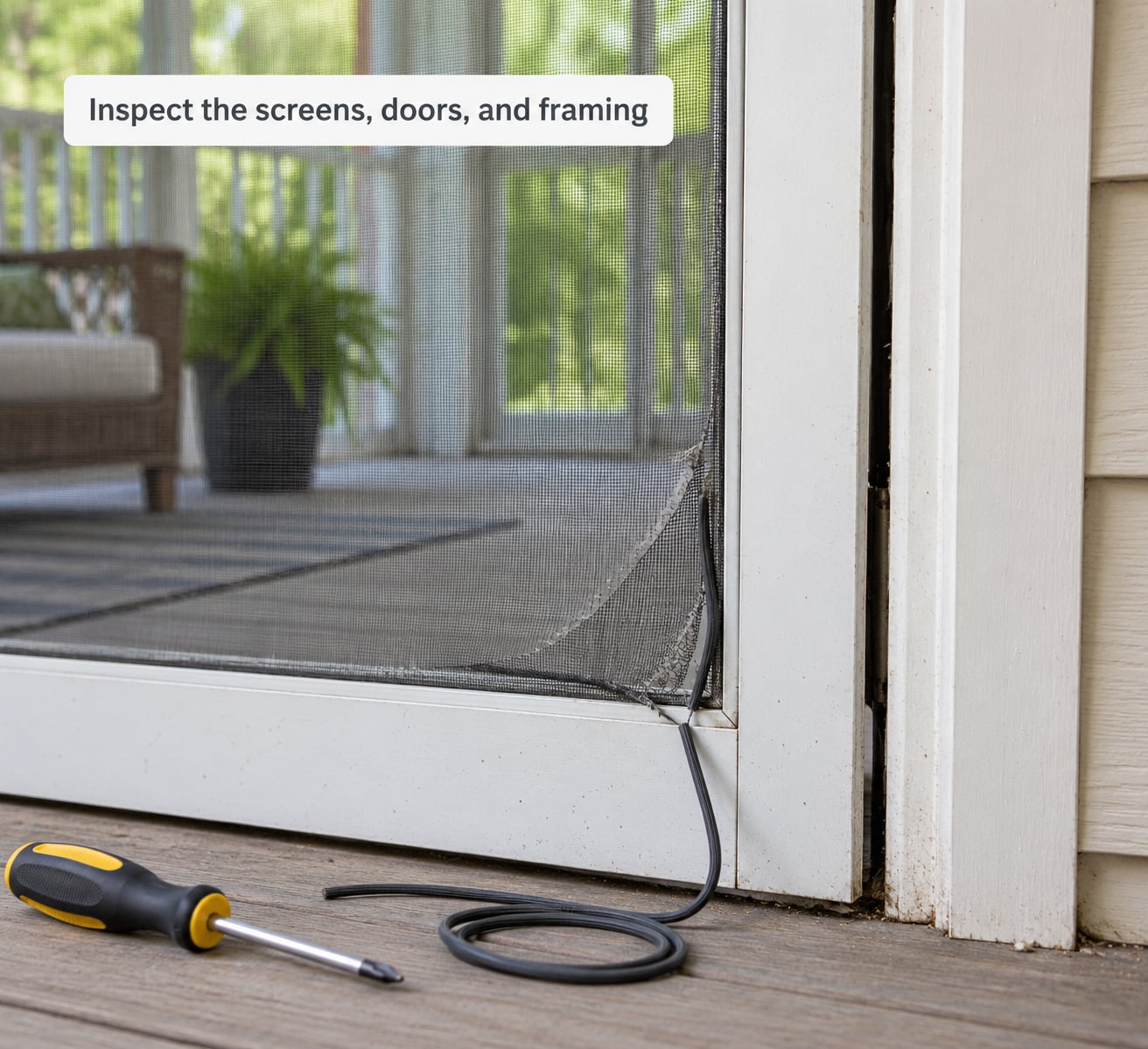
Start with the mesh itself. Look for tears, popped corners, and panels that sag or ripple when you push on them. A sagging panel means the spline has let go at the top or bottom, and the mesh is no longer held under tension.
Then check the four seams where the screen meets structure:
- Top seam. This is the header gap — where the top of the screen stops short of the siding, trim, or roofline. It is the single most common defect in contractor-installed porches, and owners in coastal South Carolina and central Florida describe it as the exact spot where their bites come from.
- Sides. Where screen meets corner post, window trim, or the edge of the house.
- Bottom seam. Where the screen meets the sill or the deck. If the porch floor is open deck boards, that gap can be surprisingly generous.
- Doors. Look at the jamb gap, the top corner, and the gap beneath the door leaf.
Check the utility penetrations too: hose bibs, electrical outlets, cable runs, the dryer or dryer vent, and any hole left behind by a removed fixture or an old antenna mount. Screens get swapped over; holes in the framing do not.
Now the diagnostic. Wait until dusk, switch on the porch light, and stand outside with the flashlight off. Mosquitoes entering from the porch show up as a thin stream of small moving specks backlit against the light. It is a genuinely useful trick, and it tells you which seam to attack rather than which seam you happen to dislike.
2. Repair or replace damaged screen mesh
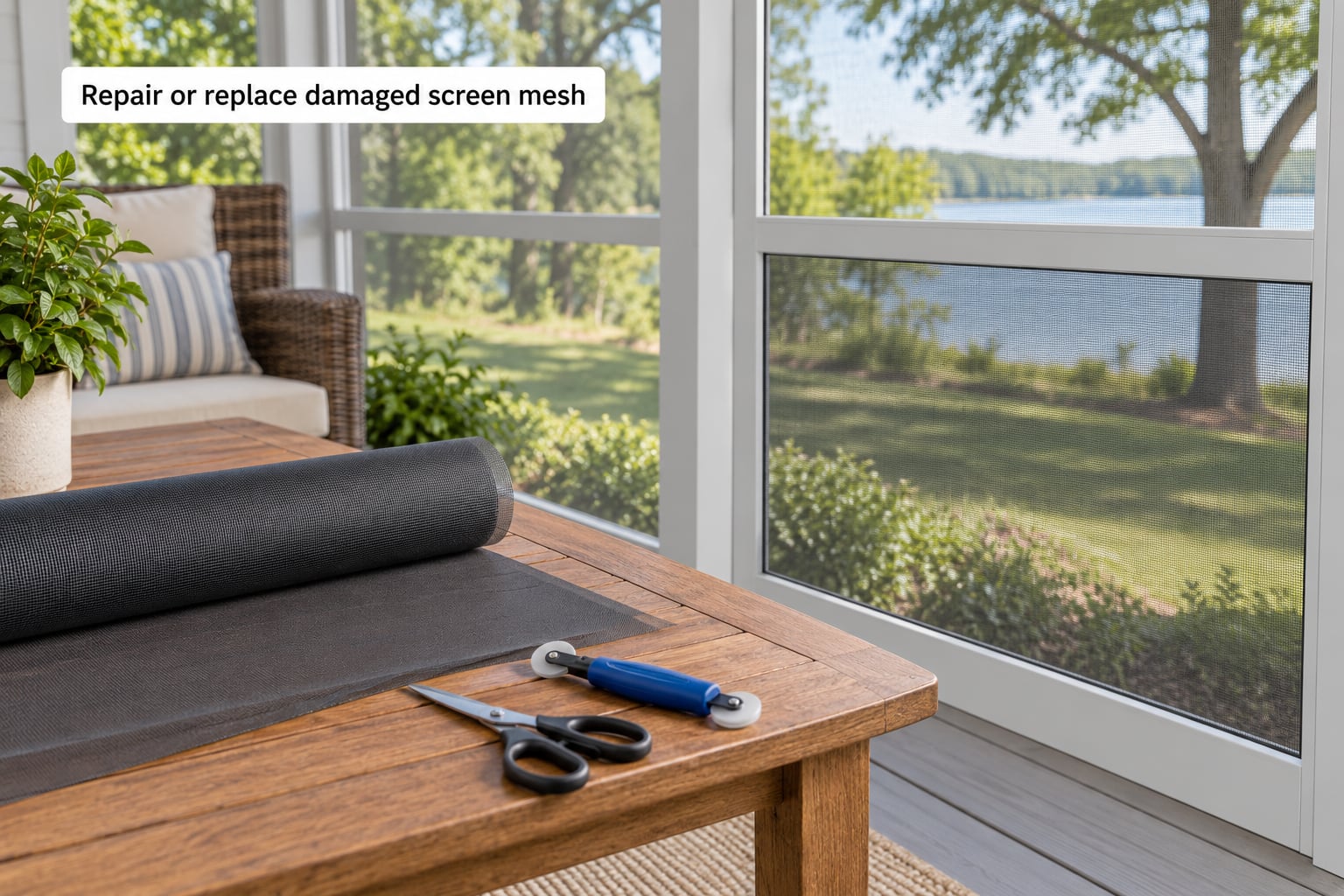
For a hole smaller than a quarter inch, clean the area, cut a square of mesh a couple of inches larger than the tear, and press it on from the inside of the porch so the patch sits against the frame side you view from outside. Patches and screen repair tape work fine on fiberglass.
For anything bigger, replace the panel. This is the fix most people assume they cannot do, and it is honestly a weekend job for a careful beginner.
- Lift one corner of the old spline with a screwdriver or pliers and pull the spline out of the channel. Work around the whole perimeter and remove the old mesh.
- Brush debris out of the channel. Grit left behind will cut new mesh the first time the wind picks up.
- Measure the opening and cut your replacement mesh generously, leaving three or four inches of overlap on every side. Cutting tight is the most common beginner mistake.
- Set the mesh in place and hold one edge with a few temporary screws or tape.
- Roll the new spline into the channel with the grooved side toward the mesh, working in short sections.
- Trim off the excess mesh with a sharp utility knife after the spline is fully seated.
Keep tension steady and even the whole way around. A taut panel sheds water and wind; a loose panel flaps, collects dirt, and eventually rips out again at the same corner.
Worth knowing when you buy mesh: the count tells you the openings per inch in each direction. Standard 18 by 16 fiberglass has fairly wide openings and blocks mosquitoes well. 20 by 20 is tighter. No-see-um mesh is around 20 by 20 but spun from a much finer thread, so its holes are small enough to stop biting midges — the insects behind those painful, invisible bites. No-see-um mesh also cuts airflow and light noticeably, which is a real trade on a porch you sit on every evening.
3. Seal gaps around doors, walls, and openings
Doors defeat more screens than weather does. A propped-open screen door with a dog, a kid, or a box of something the porch is holding makes the entire barrier meaningless.
Three fixes, in order of usefulness:
- Swap in self-closing hinges. These use a spring or a hydraulic arm to pull the door shut from any position. This removes the failure mode entirely, and it is the change homeowners on home-maintenance forums mention most often after doing it.
- Add a door sweep. A vinyl or felt sweep on the bottom edge of the door closes the gap over the threshold. If the door has an uneven bottom, look for an adjustable sweep that seals to a sloped threshold rather than a flat floor.
- Run the jambs. Compressible weatherstripping down the hinge side and the strike side stops the gap that opens as the door warps in summer humidity.
Seal utility penetrations with exterior-grade sealant or a foam sealant rated for the gap. For the header gap where the screen meets the siding, the fix is a strip of extra screening or a rigid trim strip screwed over the seam — the key is closing the space without blocking the porch’s ventilation.
Two cautions. Never seal so thoroughly that the porch becomes a closed box with no cross-ventilation, and stay away from anything that would trap moisture in the framing. If you are unsure about a load-bearing or structural change, this is where you call a licensed contractor instead of picking up a saw.
4. Improve airflow without creating a wind tunnel
Moving air is the second half of a working porch. Mosquitoes are weak fliers with poor hover ability, and they locate people mostly by carbon dioxide, body heat, and skin odors. Constant air movement makes all three harder to track and makes landing difficult. That is the whole reason a box fan works, and it is why people sitting outside at dusk with a fan on report noticeably fewer bites.
Aim the fan at where people sit, not across the empty end of the porch. A 16-inch box fan on a stable stool handles most porches; a 20-inch model is plenty if you have the outlet to run it. For a roofed, side-open porch, a ceiling fan is the tidier answer.
Use a wet-rated or damp-rated ceiling fan. A standard indoor-rated fan in an open-air porch collects moisture in the motor and bearings and eventually fails — people often hold off on fans for that reason, which is a shame, since airflow was the fix.
Size it for the room: roughly a 36-inch fan for a small porch, 42 to 52 inches for a typical one. Never prop a fan directly against a screen panel, where it can blow the mesh and splash rain through a sagging seam.
5. Remove standing water and manage nearby attractants
A sealed porch with mosquitoes breeding two feet away is a sealed porch full of mosquitoes. They find you outside first and walk in through whatever gap remains.
Work outward from the porch:
- Empty anything that holds water within a few days — buckets, planters without drainage, plant saucers, tires, birdbaths, coolers, and the low corner of the deck where water settles.
- Cover water-holding objects you want to keep, with a fitted lid or a tight mesh cover.
- Clear clogged gutters and drain lines, and watch for low spots in the lawn after rain.
- Cut vegetation back so shrubs and grasses are not pressed against the screening. They block airflow and hold humidity against the mesh.
- Clean out leaves and debris between the deck boards, where water sits and mosquitoes breed.
The CDC and the American Mosquito Control Association both point to draining standing water as the single highest-impact step in mosquito control, because a single egg raft becomes hundreds of biting adults within about a week. You are not managing a neighbor’s problem; you are managing the water on your own property.
6. Maintain the finished mosquito barrier
Set a short routine and the repairs hold. Twice a year is enough: once in spring before mosquito activity picks up, and once in late summer after the worst of the season.
Walk the porch with a flashlight and run a hand along each seam, looking for daylight where there should be none. Check that every screen screw is seated, that door sweeps still touch the threshold, and that self-closing hinges have not gone slack. Wipe or brush leaves off the mesh so airflow stays where you set it. If a storm rips a panel, patch it the same week rather than at the end of the season.
If no-see-ums are the problem rather than mosquitoes, a fan alone will not fix it. Those midges pass through 18 by 16 mesh, so the answer is finer mesh, and it has to be a full-panel replacement to do any good.
Common Mistakes
Using the wrong mesh gauge for the insect. Standard 18 by 16 screen stops mosquitoes and houseflies. It will not stop no-see-ums, biting midges, or gnats, and swapping in 20 by 20 no-see-um mesh is the only real fix for those.
Ignoring the header gap. People re-screen every panel in the porch and never close the gap where the screen meets the siding or roofline. Months of work, same bites.
Leaving a gap under the door. A door sweep or a threshold seal costs a few dollars and closes a route that screen mesh can never block.
Letting the door stay propped. A screen door held open with a brick is a screen door doing nothing. Self-closing hinges fix it permanently.
Relying on citronella, coffee grounds, or a bag of water. Coffee grounds repel nothing measurable. The sandwich-bag-of-water trick circulates nothing. Citronella candles work within a foot or two of the flame and lose effect in any breeze, which is most porch evenings. These are fine as a minor addition, never as the main defense.
Blocking ventilation. Sealing a porch into a closed box traps heat and humidity and can promote mold in the framing. If a porch gets uncomfortably hot, the answer is a wet-rated fan, not more sealant.
Skipping upkeep. Screened porches fail slowly, one loose spline at a time, and then all at once in a storm. Fifteen minutes in spring prevents an August re-screen.
One more habit worth building. Learn the difference between mosquitoes, biting midges, and fungus gnats before you spend money, because they arrive through different openings and only one of them cares about your mesh. How mosquitoes find people in the first place is worth understanding too, since it explains why airflow changes your evening so much.
Frequently Asked Questions
What size screen mesh keeps mosquitoes out of a porch?
Standard 18 by 16 fiberglass mesh blocks mosquitoes reliably and is what most porches ship with. If biting midges, also called no-see-ums, are the problem, you need 20 by 20 no-see-um mesh, which has much smaller openings. That tighter mesh also reduces airflow and light, so weigh the trade before replacing every panel.
Does a fan really help mosquito-proof a screened porch?
Yes, and it works for a specific reason. Mosquitoes are weak fliers that find people by carbon dioxide, body heat, and skin odor, and most species struggle to hover or land in moving air. Point a box fan or wet-rated ceiling fan at your seating area and most people notice far fewer bites at dusk. It works best once the gaps are sealed.
How do I stop mosquitoes coming in under a screened porch door?
Fit a door sweep on the bottom edge of the screen door and run the hinge and strike jambs with compressible weatherstripping. If the door is propped open regularly, replace the hinges with self-closing hinges so it shuts from any position. Where the gap follows an uneven threshold, use an adjustable sweep designed to seal against a sloped sill.
What is the best way to prevent mosquitoes around a screened porch?
Fix the barrier before anything else, because repellents cannot compensate for an open door. Then drain standing water on your property within a few days, cover anything you cannot empty, and cut vegetation back from the screening so air still moves. Use an EPA-registered repellent on exposed skin for the trips between the porch and the car.
Can I use insect fogger or spray inside a screened porch?
Use caution here. Foggers and sprays leave a residue on surfaces and in the air that children and pets can contact, and the odor tends to make a porch unusable for the evening anyway. Read the label, apply only where the product is approved, keep food covered, and never spray directly at people or animals. A sealed porch plus a fan is the better path.
When should I replace an old or damaged porch screen?
Replace a panel when tears are larger than a quarter inch, when the mesh sags or ripples under pressure, or when the spline has pulled out along an edge and will not reseat. Replace the whole porch screen when fiberglass has gone brittle and tears at every touch, when daylight shows around the edges despite new spline, or when the mesh is too loose to hold tension.
Final Checklist
Start at dusk with a flashlight and find where the mosquitoes actually enter, rather than guessing. Then work down this list.
- Close the header gap where the screen meets the siding or roofline.
- Close the gap along the deck boards, sill, and window trim.
- Repair torn or sagging mesh, and reseat any spline that has pulled free.
- Fit a door sweep, run the jambs, and swap in self-closing hinges.
- Seal hose bibs, outlets, and cable runs with exterior sealant.
- Point a wet-rated fan at the seats, not across the empty end of the porch.
- Drain standing water nearby and clear vegetation off the screening.
- Book a fifteen-minute screen inspection each spring before the season starts.
If you only do one thing this weekend, close the header and deck-line gaps. On most porches that is where the bugs are coming from, and no amount of citronella compensates for it.