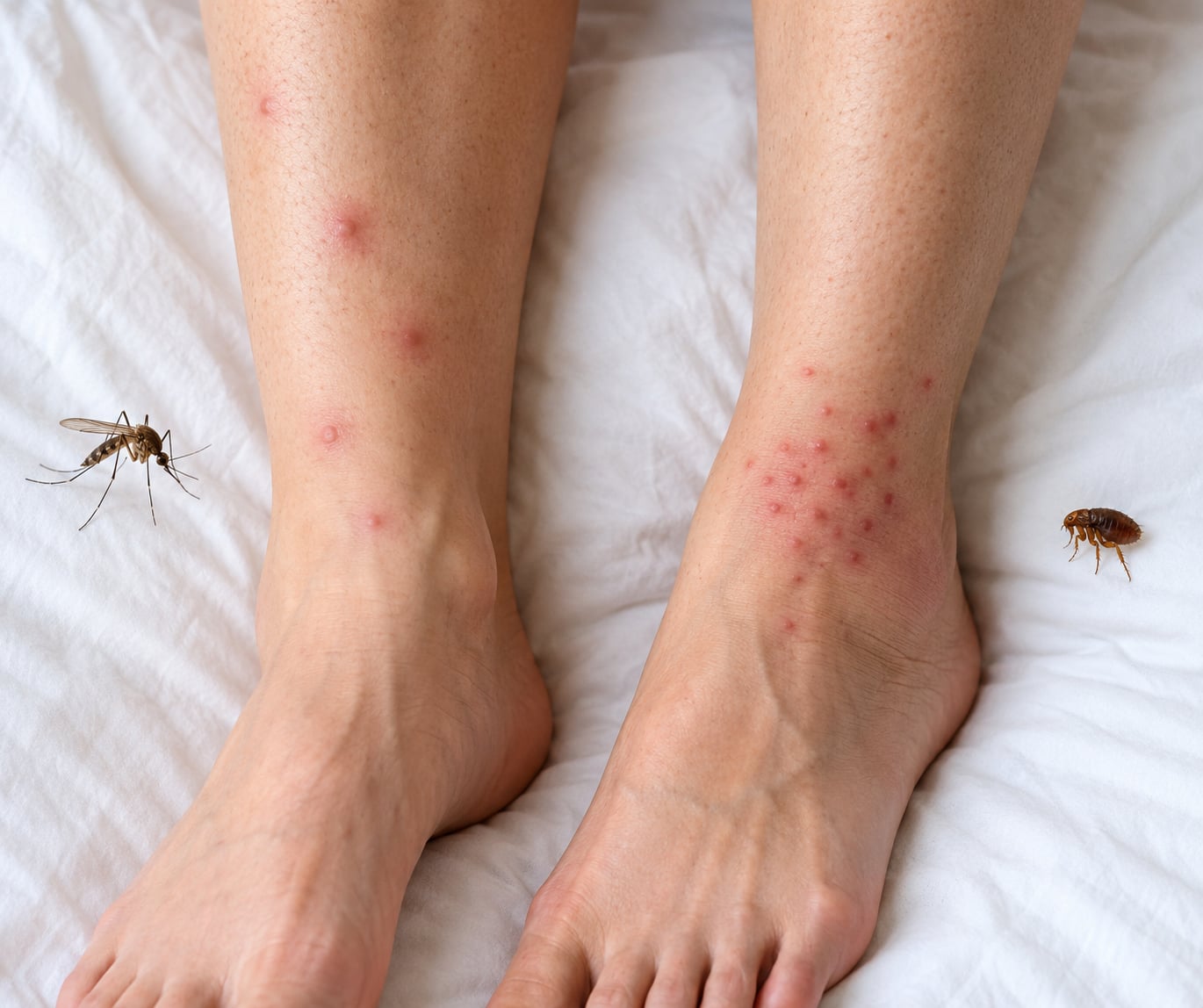
Tell them apart by where they land and how they cluster. Mosquito welts are usually single, puffy bumps on exposed skin, while flea bites are smaller red bumps with a darker center that arrive in tight groups around the ankles, sock line or waistband.
Getting the mosquito bite vs flea bite how to tell the difference question right matters because the fix is completely different. A mosquito bite needs nothing but time and maybe a cold compress, while fleas keep biting until the pet, the carpet and the rest of the home are treated.
This guide walks through eight checks, from appearance to duration to the evidence sitting in your house. Last reviewed for accuracy in 2026. General information only, not a diagnosis — a clinician can confirm anything on your skin that worries you.
Table of Contents
- Mosquito Bite vs Flea Bite How to Tell the Difference at a Glance
- 1. Appearance: Which Bite Looks More Like a Mosquito Bite?
- 2. Location: Where Do Mosquitoes and Fleas Bite?
- 3. Bite Pattern: Scattered or Clustered?
- 4. Itching and Swelling: Which Reaction Is More Intense?
- 5. How Long Does Each Bite Last?
- 6. What Causes Bites: Check the Surrounding Evidence
- 7. Flea Signs and Mosquito Evidence to Look For
- 8. Health and Safety: When Bites Need Attention
- Which Should You Choose?
- Frequently Asked Questions
Mosquito Bite vs Flea Bite How to Tell the Difference at a Glance
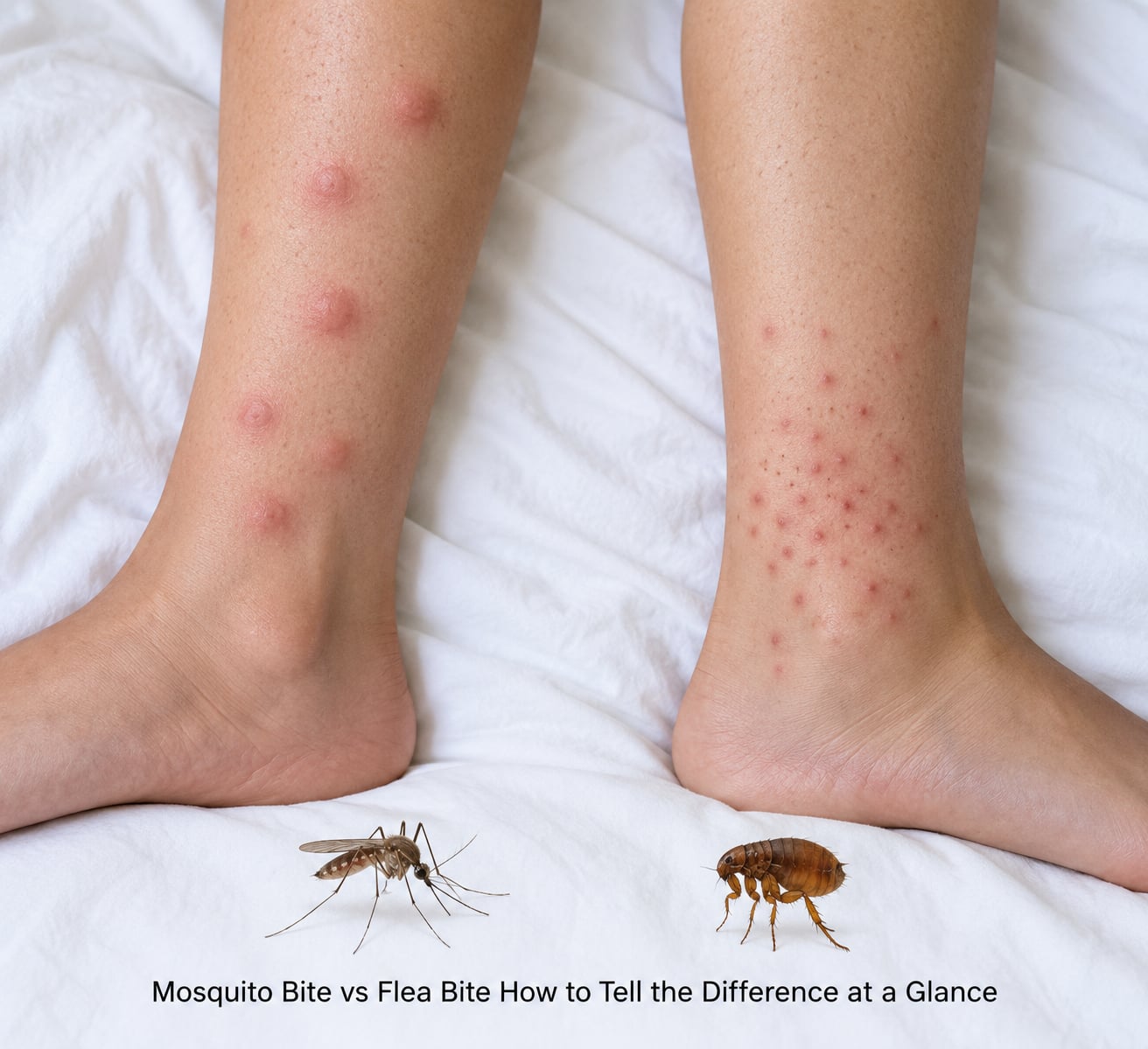
Here is the short version. Mosquitoes fly, land on exposed skin, feed once and leave. Fleas live in carpets, bedding and pet fur, so they jump onto whatever skin sits close to the floor.
| Clue | Mosquito bite | Flea bite |
|---|---|---|
| Appearance | Puffy, raised welt, often a soft bump with a tiny central puncture | Small red papule, frequently with a dark or hemorrhagic center |
| Typical size | About 1/4 to 3/8 inch across | About 2 to 10 mm across |
| Pattern | Scattered, isolated welts, sometimes a few close together | Clusters of two to four, often in a short line or group |
| Location | Exposed skin: legs, hands, arms, face, neck | Ankles, lower legs, feet, sock line, waistband |
| Timing | Mostly at dusk and dawn, or near standing water | Any time indoors, often noticed on waking |
| How long it lasts | The welt fades in a few days, a dark mark can linger weeks | Residual spots fade in roughly a week |
| Nearby evidence | Open windows, water outdoors, a swarm at dusk | Pets scratching, flea dirt on bedding or carpet |
| Underlying concern | West Nile, dengue, Zika transmission | Murine typhus, plague, tapeworm |
Read that table as clues, not proof. Even experienced clinicians can struggle to name the insect behind a skin symptom from the mark alone, because the immune response changes what the same bite looks like from one person to the next. Where the bites sit, and what you were doing the day before, carries far more weight than how red they look.
1. Appearance: Which Bite Looks More Like a Mosquito Bite?
A mosquito welt is bigger and softer than a flea bite. It swells into a rounded bump, sometimes a quarter to three-eighths of an inch, often with a faint pinprick in the middle where the proboscis went in.
Flea bites are smaller — usually 2 to 10 mm — and tighter to the skin. The classic flea papule is red with a darker, sometimes hemorrhagic center, and in people who react strongly it can blister.
Size is the least reliable signal here. Some people produce big welts from bites that would leave no mark on anyone else, and they are the group most likely to worry something more serious is going on. Reaction size tracks your immune response more than the insect.
Color can help in one narrow case: chigger bites often carry a violet or purple hue around the welt, which mosquito and flea bites do not. If you spent an afternoon in tall grass, that tint is worth noting.
2. Location: Where Do Mosquitoes and Fleas Bite?
Mosquitoes pick exposed skin. They go for legs, hands, arms, the back of the neck and the face, because those are the surfaces a mosquito can reach without pushing through fabric. Bites appear after a dusk walk, a morning on the porch, or a morning after you sat outside near standing water.
Fleas go low and they go under clothes. Ankles, lower legs, feet, the sock line and the waistband are the usual list. Fleas jump from the floor upward, so they take the first bare or thin-skinned area they find.
2.1 Where Bites Appear: Mosquito Bite vs Flea Bite Locations
Contrast the scene with your bites. Scattered welts on your forearms and face after an evening outdoors is the mosquito picture. Bites concentrated in a band around the ankle, along the edge of your socks, or ringing your waistline is the flea picture, whether or not you own a pet.
Hikers describe the flea signature neatly: the bites are smaller than mosquito bites, far more numerous, and clustered in twos and threes just below the knee. Location plus cluster size together is the pairing people actually use to make the call.
Location narrows things down. It never finishes the job, since a mosquito will happily settle on an ankle and a flea will jump onto a hand resting on the carpet.
3. Bite Pattern: Scattered or Clustered?
Scattered points to mosquitoes. They work nearby skin in a loop, so you end up with isolated welts spread over whatever was exposed, sometimes with two or three near each other and clear gaps between the groups.
Clustered points to fleas. Fleas probe the same spot repeatedly, which produces the well-known breakfast, lunch and dinner grouping of three or more bites, sometimes in a short row or a loose triangle. Skin showing repeated clusters of three or more is the single strongest visual clue in this whole guide.
Clusters are not exclusive to fleas, though. Bed bugs leave their own signature — usually two or three bites in a straight line. Linear rows point more toward bed bugs, tight groupings of three or more toward fleas, scattered singles toward mosquitoes.
4. Itching and Swelling: Which Reaction Is More Intense?
Neither insect reliably out-itches the other. What differs is how your body responds to the saliva each one injects while feeding, and that varies more between people than between insects.
Most people see mosquito welts swell into larger puffy bumps because the reaction spreads through surrounding tissue. Flea bites tend to stay small and hard, but they itch hard and for a long time, and some people develop prominent inflammation or a blister at the center. The folk rule of thumb — mosquitoes make big bumps, fleas make stubborn itches — is a decent summary of the most common pattern and nothing more.
Some people show almost no reaction to flea bites at all, so a lack of welts proves nothing either way. Others swell dramatically from any bite, which flattens the visual difference completely.
Skip scratching if you can. It breaks the skin, and scratching is the main route to a secondary infection. A cold compress, an over-the-counter anti-itch cream or an oral antihistamine are the standard first-line options; ask a pharmacist or your doctor which suits your situation, and skip heating devices, scraping or anything else that circulates online but is not standard care.
5. How Long Does Each Bite Last?
An individual mosquito welt usually peaks within minutes of the bite and fades over one to three days. The mark can persist for weeks as a small darker or hyperpigmented dot, which is post-inflammatory discoloration rather than an active bite.
Flea bites resolve faster as a rule. The red papule typically fades within about a week, sometimes leaving a small brownish spot for a little longer.
Scratching, sensitive skin, and infection all stretch those timelines. A welt that grows, reddens and hardens over several days, or starts weeping, is not simply healing slowly — that pattern deserves a professional look.
6. What Causes Bites: Check the Surrounding Evidence
Context beats appearance every time. Before you decide which insect it was, ask what happened in the 48 hours before the bites showed up.
- Evening outdoors, dusk to dawn, water nearby, or a swarm in the yard: mosquito.
- Overnight in a room with pets, or a recently occupied room, porch, or rental: flea.
- Rodent or raccoon activity in the ceiling, walls, or yard: fleas carried in by a wandering animal.
- Bites that keep appearing after you stopped going outside: an indoor source, usually fleas or bed bugs.
Finding the insect beats guessing from the skin every time. A single captured specimen or one round of flea dirt on a white sheet settles the question faster than any amount of staring at welts.
7. Flea Signs and Mosquito Evidence to Look For
To check for fleas without pets, place a white paper towel or sheet on the floor where you or the pet sit, then have the animal stand on it. Dark pepper-like specks that smear reddish-brown when damp are flea dirt, and that is the most reliable home test there is.
On a pet, part the fur at the neck, tail base and belly, and look at the skin itself. Fleas move fast. Slow-moving brown specks attached to the coat are more likely flea dirt or ticks, and a fine-toothed comb makes both easier to see. If you see bites on your ankles and your pet is scratching, treat the animal and the environment together — treating one without the other rarely holds.
For mosquitoes, look outward rather than at your skin. Empty standing water in buckets, tires, birdbaths and gutters, plus open windows without screens, tells you where they are coming from. Draining standing water weekly is the single most effective step most people skip.
Stay away from foggers, indoor sprays you have not read the label for, and any pesticide not labeled for the surface. Follow the product label exactly, and keep everything out of reach of children and pets.
8. Health and Safety: When Bites Need Attention
Most mosquito and flea bites are an annoyance, not a danger. Wash the area, keep it cool, and resist scratching.
Contact a healthcare professional if redness spreads, the area swells, warmth or pus develops, pain builds, or you get a fever alongside the bites. Those point to a skin infection that a clinician should assess rather than something to watch for another week.
Seek urgent care for difficulty breathing, swelling of the face, lips or throat, widespread hives, faintness, or symptoms that are spreading fast. Bites can rarely trigger allergic reactions, and a few insects can transmit disease, including West Nile virus and dengue from mosquitoes and murine typhus, plague and tapeworm from fleas. CDC and EPA both publish guidance on reducing those risks; use them as your reference and ask a clinician about anything specific to your health.
Which Should You Choose?
There is no winner here — this is a question about which problem you actually have.
If bites are on exposed skin after outdoor time, focus on mosquitoes: drain standing water weekly, check screens and doorways, and use an EPA-registered repellent containing DEET, picaridin or oil of lemon eucalyptus when you are outdoors, especially from dusk to dawn.
If bites cluster around your ankles, socks or waistband, assume a flea problem until proven otherwise. Treat the pet through your veterinarian, vacuum carpets and furniture thoroughly and often, wash pet bedding in hot water, and seal the pet in a bag or away from the room while you work. Repeat the whole routine, because eggs survive the first pass.
If you have no pets, rodents and raccoons are the usual suspects, along with a stray cat that visited recently. Block entry points and treat the surrounding area rather than only the room.
If the source stays unclear — which happens more often than people expect — get the environment inspected instead of re-examining your skin. An exterminator can tell you what is actually living in the carpet or coming in through the window. If the skin reaction itself is the problem, that is a conversation for a clinician.
Frequently Asked Questions
Can you tell a mosquito bite from a flea bite by how it looks?
Usually not on appearance alone. A mosquito welt is larger and puffier, while a flea bite is a smaller red papule often with a dark center, but reaction size varies so much between people that appearance misleads constantly. Location and pattern are more reliable: exposed skin and scattered welts suggest mosquitoes, clusters of three or more around the ankles, sock line or waistband suggest fleas. Evidence in the room settles it faster than the skin does.
Should I worry about a bite if I cannot find an insect?
Not immediately. Most bites are local irritation that settles within a few days, and not seeing the insect is completely normal — you rarely see a mosquito before it feeds, and fleas feed fast. What matters is the pattern over time. If new bites keep appearing while you stay indoors, or your pet is scratching, that points to a flea problem worth investigating. Seek medical advice if redness spreads, pus appears, or you develop a fever.
How can I tell whether my pet is bringing fleas indoors?
Put a white paper towel on the floor, have your pet stand on it, then dampen any dark specks you find. Flea dirt smears reddish-brown when wet, which distinguishes it from ordinary dust. On the animal, part the fur at the neck, tail base and belly, and check for fast-moving dark insects or slow-moving specks stuck to the coat. A fine-toothed comb over the back makes them easier to see. Your veterinarian can confirm and treat.
Do mosquito bites or flea bites itch more?
It varies by person rather than by insect. Mosquito bites more often swell into large puffy welts, while flea bites more often stay small but itch hard and linger. People who react strongly to any bite will swell from both, and some people show almost no reaction to fleas at all, so itch intensity tells you very little about the source. Keep cool, avoid scratching, and ask a pharmacist or clinician about anti-itch products that suit you.
When should I see a doctor for an insect bite?
See a clinician if the area becomes increasingly red, swollen, warm, or painful, if there is pus or drainage, or if you develop a fever. Those are signs of a skin infection rather than a normal reaction. Seek urgent care for trouble breathing, swelling of the face, lips or throat, widespread hives, or symptoms spreading rapidly. Some bites can transmit disease, so any bite accompanied by fever, headache or body aches deserves a professional assessment.
Start with where the bites sit and whether they come in threes, then check the room for evidence: standing water outside, or flea dirt on the carpet and a scratching pet inside. Whichever clue wins, treat the source rather than the itch, and let a clinician take a look at anything that worsens.