Odorous house ants (Tapinoma sessile) are small, dark brown to black ants that release a foul rotten-coconut or blue-cheese odor when crushed. Identification and control come down to four things: confirm the species with the crush-and-smell test, remove the food and moisture drawing them in, bait the trail instead of spraying it, and seal the entry points. They sting nobody and they do not eat structural wood, but they contaminate food and are genuinely hard to make disappear.
Are they bad? Only in the nuisance sense. Odorous house ants do not bite, sting, or tunnel into framing the way carpenter ants do. What they cost you is food contamination, a smell in the kitchen or bathroom that comes back every year, and the sense that something is living inside the wall.
Table of Contents
- What Do Odorous House Ants Look Like?
- Why Do Odorous House Ants Smell?
- Odorous House Ant Identification: How to Confirm the Species
- Where Do Odorous House Ants Nest?
- How to Find an Odorous House Ant Infestation
- Odorous House Ant Control: A Step-by-Step Plan
- How to Prevent Odorous House Ants From Returning
- When Do You Need a Pest Professional?
- Frequently Asked Questions
- How can I confirm I have odorous house ants?
- Do odorous house ants have a nest inside my house?
- Why do odorous house ants smell so strongly?
- Is it better to use ant bait or spray for odorous house ants?
- How long does it take to get rid of odorous house ants?
- Are odorous house ants dangerous to people, pets, or food?
- Conclusion
What Do Odorous House Ants Look Like?
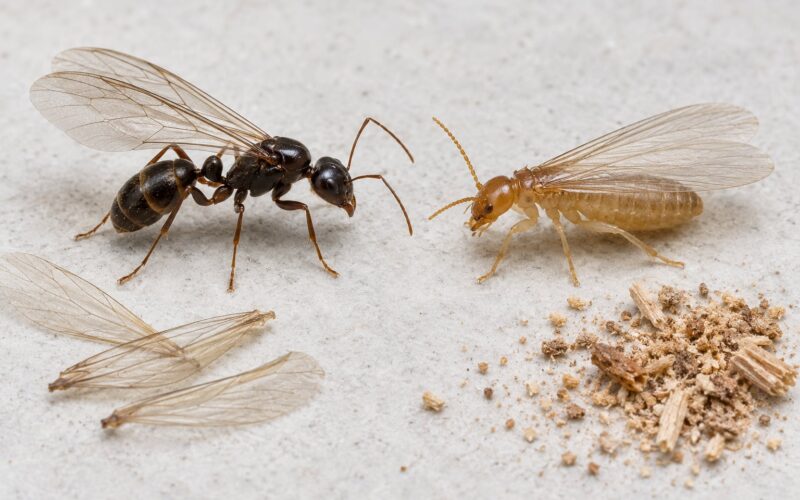
They are tiny, uniformly dark ants with elbowed antennae and a single waist node that the abdomen partly covers. Workers measure roughly 1/16 to 1/8 inch, which puts them in the same visual range as pavement ant workers, so size alone will not settle the question.
Four traits carry most of the weight when you compare a suspect ant to the alternatives:
- Size and color. Workers run about 1/16 to 1/8 inch, dark brown to nearly black. The whole worker caste looks the same size, which entomologists call monomorphic.
- Body shape. One node sits on the petiole, and the first abdominal segment overlaps it enough that the node looks half buried. The gaster often tilts upward as the ant runs.
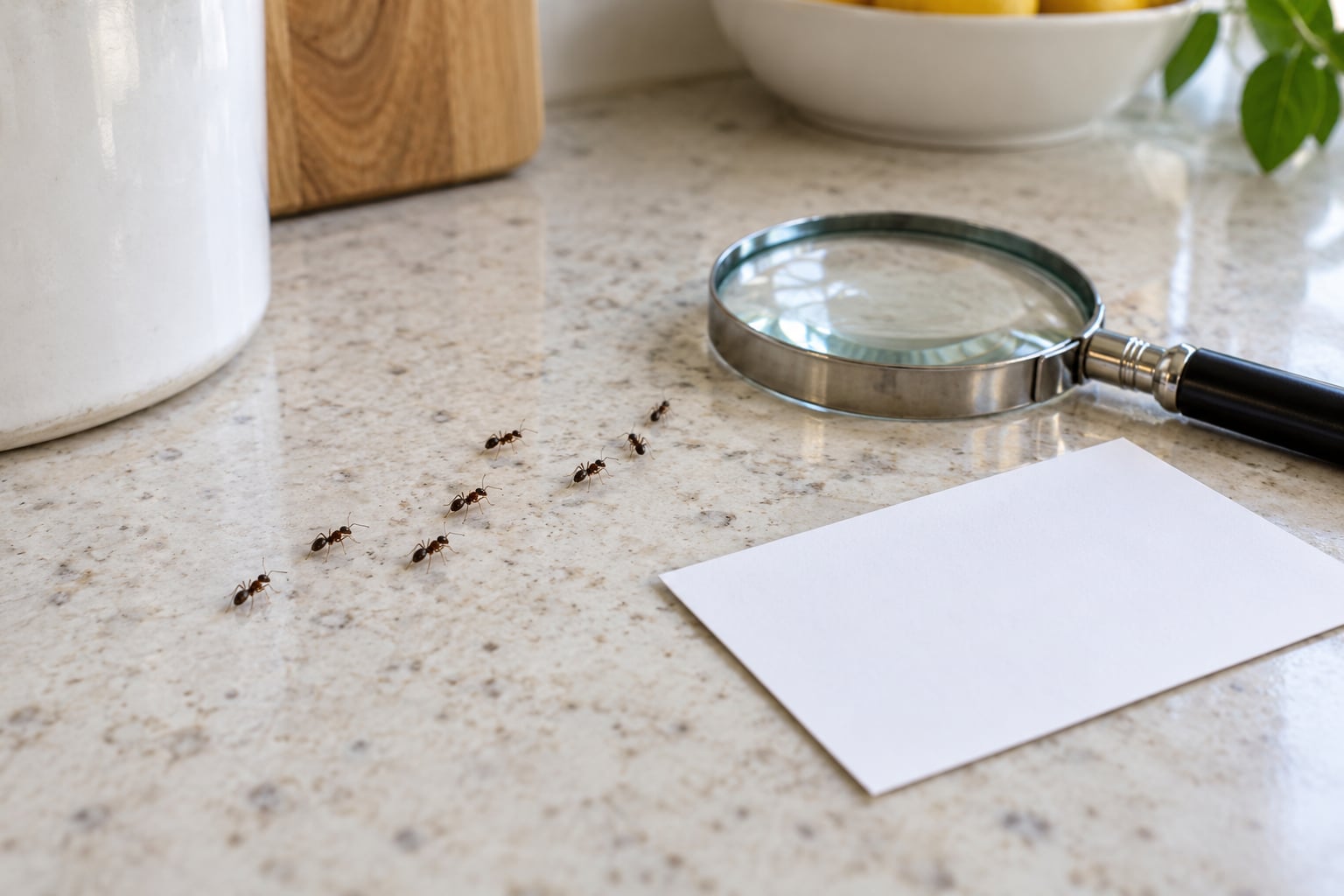
- Movement. They travel erratically with the abdomen held at an angle, in loose scattered lines rather than a tight highway.
- Odor. Crush one and smell it. A sharp rotten-coconut note, often compared to blue cheese, comes out of the body.
What separates them from the ants you will otherwise be comparing:
| Ant | Worker size | Color | Trail behavior | Nesting | Damage risk |
|---|---|---|---|---|---|
| Odorous house ant | 1/16 to 1/8 inch | Dark brown to black | Loose, scattered, erratic | Many nests in soil, mulch, wall voids | None to structure |
| Pavement ant | 1/8 to 3/16 inch | Brown to black, lighter legs | Tight, defined single-file lines | Under pavement, soil, foundation | None to structure |
| Carpenter ant | 1/4 to 1/2 inch | Reddish or black, large | Follows established routes to wood | In damp wood, wall voids | Moist wood, not dry framing eaten for food |
| Pharaoh ant | 1/16 to 1/8 inch | Pale yellow to light brown | Long, orderly trails | Walls, baseboards, warm wet areas | Contamination only, carries pathogens |
| Argentine ant | 1/16 to 1/8 inch | Light to dark brown | Dense, wide-ranging foraging fronts | Under stones, plant debris, soil | Food plant damage, no wood |
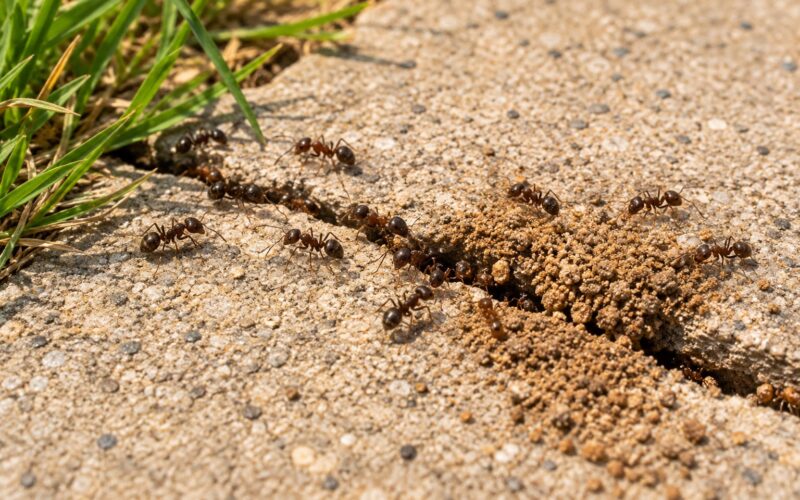
Pavement ants are the most common misidentification, and the trail is the easiest tell. A pavement ant line looks like a marching column with visible spacing between workers. Odorous house ants spread out, cross over each other, and take a wandering route to the same crumb.
Why Do Odorous House Ants Smell?
The smell comes from a defensive chemical these ants release from the body when they are crushed or injured. People describe it as rotten coconut, blue cheese, or a curdled, slightly sulfurous smell, and the odor is stronger in warm weather and in heavy-traffic areas where many workers cross.
What the odor is not is a location clue. A strong smell tells you a lot of ants passed through a spot. It does not tell you where the nest is, and it does not confirm the species on its own, because other ants can carry a similar fermented or musty note. Treat odor as one piece of evidence, not the whole case.
You will notice it indoors in a few predictable places: along a kitchen backsplash, inside a pantry corner, under a pet bowl, or along a bathroom wall where ants travel from a pipe penetration. If you crush one ant on the counter and get nothing, that does not rule the species out either. The scent can fade within minutes, and the sample matters more than the moment.
Odorous House Ant Identification: How to Confirm the Species
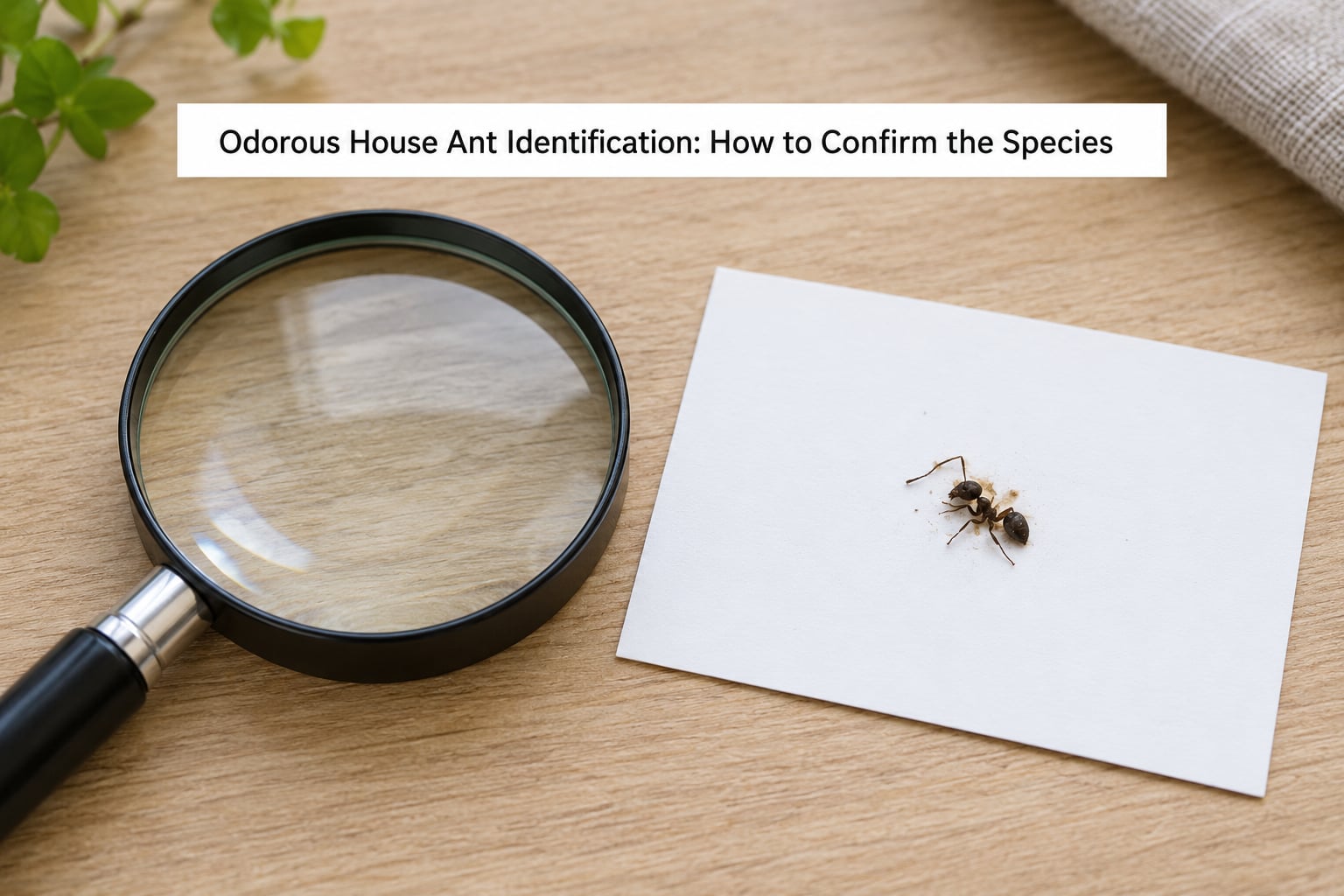
Confirm the species in three passes: collect a specimen, crush it and smell it, then check size and trail behavior against the lookalikes. Photos alone are the weakest evidence, because pavement ant and pharaoh ant photos look nearly identical at the size most people photograph them.
Run the crush-and-smell test correctly
- Collect a live or fresh worker. Use a small vial or a sealed piece of tape folded around the ant. Ants you find dead and dry on a windowsill often have already lost the odor.
- Crush one ant, not three. A single ant is enough and it keeps the smell strong. If you crush several at once, you may smell a stronger version of a different ant.
- Smell it immediately, within about 30 seconds. The volatile compounds dissipate fast, and a delayed check reads as a false negative.
- Then confirm with body traits. Under magnification, look for the single partly-hidden petiole node, the raised gaster, and a worker length in the 1/16 to 1/8 inch range.
Where household identification stops working
If you have no magnifier, if the ants are in the wall and not on a counter, or if the trail is so dense that you cannot trace it to a single entry point, stop guessing. Extension offices at land-grant universities and local pest management technicians can work from a specimen or a photo set, and several universities publish public identification request forms. Getting this right first matters because odorous house ant bait chemistry is not the same choice as carpenter ant or fire ant bait.
Where Do Odorous House Ants Nest?
They nest in more places than any other common indoor ant, and they rarely nest in a single spot. Colonies are polygyne, meaning many queens live and lay in the same colony, and that structure lets a population split into satellite nests rather than expand one central nest.
Outside
- Mulch beds, leaf litter, compost piles and garden soil
- Under flat stones, paving slabs and stacked firewood
- Along foundation walls in soil that stays damp
- Inside rotting logs, stumps and water-damaged wood near the structure
- Within colonies of aphids or scale insects on ornamentals, where honeydew is the food supply
Indoors
- Wall voids around pipe penetrations, especially under sinks and behind bathrooms
- Under subfloor insulation, sometimes above a crawl-space or garage slab
- Beneath appliances, in hollow bases of cabinetry, and inside hollow door frames
- Along baseboards where the interior wall meets the foundation slab
Why nesting location shifts
These ants are nomadic in the practical sense. When a nest gets disturbed, too hot, too wet or simply too crowded, workers and brood relocate. Technicians regularly treat a visible kitchen trail while a second nest sits undisturbed inside a wall, which is why a single treatment spot can look like a complete failure.
Seasonally, pressure builds through spring as soil warms, peaks in the hottest months when honeydew and plant insects are abundant, and declines in the fall. In most regions the species is less active outdoors in the fall but keeps foraging indoors if it has a reliable sugary source. That indoor habit through winter is what turns a spring sighting into a year-round problem in heated homes.
How to Find an Odorous House Ant Infestation
Look for concentration rather than a single ant. One ant near a fruit bowl means nothing. Repeated traffic to the same sink, the same pet bowl, or the same pantry shelf, day after day, means a colony has a route between that food source and a nest.
Trace the trail both directions
Start at the food source and walk the trail backward to whatever gap it disappears into: a baseboard, a pipe collar, a door threshold, a window sill. Follow it forward and you will often find it originates in an exterior mulch bed or a shrub, which tells you where to place outdoor treatment and where to seal.
Check the highest-traffic zones first
- Kitchen sink, dishwasher door seal, and the trash pull-out
- Pet food bowls and water dishes, including a spill you have wiped up but not dried
- Pantry shelves, cereal boxes, and any open bag or jar not sealed
- Bathroom sinks, tubs, and toilet bases, where moisture and pipes attract them
- Near indoor plants that have aphids or scale, since honeydew pulls workers right in
Look at night, which solves the hidden cases
Workers often avoid light. Shine a flashlight along the trail route after dark and you will frequently see a busy line that was invisible during the day. When there is no trail at all, check the exterior first: turn over mulch near the foundation, move flat stones, and look at the foundation line for tiny entry gaps. A wall-only population is rare, so the outdoor habitat usually confirms itself when you go looking.
Inspect for entry points and moisture
Run your finger along the gap where siding meets the foundation, around hose bibs, sill plates, and where plumbing penetrates the slab. Any ants coming from inside rather than outside usually mean a moisture problem nearby: a dripping supply line, a failed washing machine hose, a sweating shower valve, or a poorly sealed crawl-space.
Odorous House Ant Control: A Step-by-Step Plan
Get rid of odorous house ants in this order: confirm the species, remove the food, clean the routes, seal the entries, bait the remaining traffic, then monitor for several weeks. Skipping straight to a spray kills the ants you can see and does almost nothing to the colony, which then sends new foragers.
- Confirm what you are dealing with. Do the crush-and-smell test and the size check before you buy anything. A misidentified species usually means the wrong bait chemistry and a season of no progress.
- Deny the food supply. Store food in sealed containers, not cardboard boxes. Put pet food away after meals, wipe down counters and floors with soapy water, and take out trash on a schedule rather than when it is full. Clean the sink cabinet and under the dishwasher, where crumbs and dried sugar hide.
- Clean the trails. Wash the route with warm soapy water so the pheromone path is gone. Some homeowners mix about 2 ounces of hand soap per quart of water and wipe it along the line. This does not kill the colony, but it resets the ants’ map and makes the new route worth re-establishing.
- Seal the entries. Close the specific gaps you traced in step 1 of the trail search, not every gap in the abstract. Use exterior-grade sealant or copper mesh on foundation cracks and pipe collars, add door sweeps, and repair screens. Anything wider than about a quarter inch needs mesh rather than sealant alone.
- Bait, do not spray. Place slow-acting bait where you see traffic, along the trail, in the cabinet corner nearest the source, and near the entry point you traced. Expect workers to keep showing up for days before the trail thins.
- Recheck for four to eight weeks and treat outside. Bait that works in summer can be ignored for weeks in early spring, when the colony’s diet shifts heavily toward protein. If the indoor trail persists, apply a non-repellent perimeter treatment to the mulch zone and foundation line rather than a spray indoors.
Why sprays and foggers backfire
Contact sprays kill the foragers you can see and leave the colony intact. Worse, a repellent residue can push the colony deeper into the wall or trigger budding, where one colony splits into two or more satellite nests. A fogger seals nothing, gets nowhere near a wall void nest, and adds a pesticide layer that keeps ants from using the bait you placed. Kill the visible ants and the population rebounds; feed the visible ants and take the colony with them.
Choosing between gel bait, granular bait and liquid stations
- Gel bait is the most widely recommended starting point. Advion is the name most often recommended first, with Max Force Fleet used as an alternative. Gel stays where you put it and holds up in warm spots better than granular does.
- Boron-based stations such as Terro bait work as a slow-acting option and are commonly placed near the trail rather than on it. Keep them outside any animal enclosure, and confirm the active ingredient with your veterinarian before use around reptiles.
- Granular bait suits outdoor placements, flower beds and mulch, where it will not dry out quickly.
- Liquid bait stations work in wall voids and under appliances where you cannot reach with a wand, but they are a professional tool more often than a homeowner one.
Keeping bait away from children, pets and reptiles
Any bait you use is a pesticide, so follow the label. Place stations where nobody handles them: behind appliances, under sink cabinets, along the backsplash edge, and inside wall voids rather than on open counter space. Keep pet food in a sealed container and feed animals away from the placement area. In a reptile enclosure, put stations outside the enclosure and choose a product your veterinarian or reptile-care references confirm is appropriate, since many reptile species are sensitive to airborne pesticide residues. Never spray a product in an enclosed animal space.
DIY bait program or a licensed technician?
A homeowner bait program works well when the trail is visible, the food supply is fixable, and one or two entry points can be sealed. A licensed pest management technician is worth it when there is no visible trail, ants are appearing in rooms with no food source, the problem returns after two or three treatment cycles, or you suspect a wall void nest. Ask for a written warranty and for the treatment scope in writing, including whether exterior perimeter treatment is included. Expect any reputable provider to explain what a follow-up visit is for rather than charging for visits without a plan.
How to Prevent Odorous House Ants From Returning
Prevention is sanitation and habitat removal, and it works because it takes away the two things these ants chase: a sugary food supply and damp sheltered ground. Spraying alone does none of that.
Inside
- Move pantry goods into sealed plastic, glass or metal containers, never cardboard.
- Keep pet food in its original bag inside a lidded bin, and clean the bowl and floor after every feeding.
- Take trash out on a fixed schedule and rinse the bin occasionally, since a residue of sugar on the rim is enough to hold a trail.
- Wipe counters weekly with soapy water, and clean under the dishwasher and inside cabinet corners.
- Fix the leaks. Dripping plumbing, a failed washing machine hose or a sweating shower valve can keep a whole wall attractive all year.
Outside
- Pull mulch back so it sits below the threshold of the foundation, ideally under about 2 inches of depth, and leave a bare gap between mulch and siding.
- Trim branches so nothing rests against the siding or roof line and bridges ants from plant to structure.
- Control aphids and scale on ornamentals near the house, because honeydew is the colony’s food supply and an aphid-heavy tree is effectively an ant farm parked next to your wall.
- Keep firewood, stacked lumber and stored cardboard away from the foundation and off bare soil.
- Seal foundation cracks, and check pipe collars and hose bib penetrations once a year in the fall.
Prevention and treatment are different jobs. Once ants are already walking through your kitchen, sealing alone will not chase them out, and a bait program alone will not keep them out next spring. You do both, and you do the second one every year.
When Do You Need a Pest Professional?
Call a licensed technician when the problem stops being a kitchen nuisance and starts being something you cannot see or trace. The clearest signals are ants appearing with no trail, repeated reappearances after several proper bait cycles, activity in the same rooms every spring, or any evidence of wood damage, which points to carpenter ants rather than this species.
A professional can inspect wall voids, attics and subfloor spaces, identify the species from a specimen, treat nests you cannot reach, and apply a non-repellent perimeter treatment calibrated to the outdoor habitat. Ask what is covered by a warranty and how long it lasts, because a species that buds into multiple nests usually needs more than one visit.
Keep structural and electrical work with licensed tradespeople. Cutting into a wall to reach a nest, or applying treatment around an electrical panel or exterior receptacle, is not homeowner work. So is anything involving a crawl-space that involves standing water.
Frequently Asked Questions
How can I confirm I have odorous house ants?
Collect a fresh worker, crush it and smell it within about 30 seconds. A sharp rotten-coconut or blue-cheese note suggests Tapinoma sessile, then confirm workers measure 1/16 to 1/8 inch, carry one partly hidden waist node, and move in loose erratic lines rather than the tight single-file highways pavement ants use. A negative smell result does not rule the species out, because the odor fades fast.
Do odorous house ants have a nest inside my house?
Often, yes. They nest in wall voids around pipe penetrations, beneath appliances, inside hollow cabinetry and under subfloor insulation. Because these colonies are polygyne with many queens, a main nest can bud into several satellite nests in the same structure. Outdoor nests in mulch, soil and under stones are also common, and the ants move between indoor and outdoor sites as weather and food supply shift.
Why do odorous house ants smell so strongly?
When crushed or injured, these ants release a defensive chemical that produces the famous rotten-coconut or blue-cheese odor. The smell marks the spot where an ant was killed and warns others, which is why you notice it along a countertop or backsplash. It does not indicate nest location and it does not confirm the species on its own, since other ants can carry a similar fermented note.
Is it better to use ant bait or spray for odorous house ants?
Bait, without question. Slow-acting gel or granular bait lets workers carry a toxicant back to the colony, where it spreads through food sharing to queens and brood. Contact spray kills the visible foragers, leaves the colony intact, and the repellent residue can push ants deeper into walls or trigger budding into satellite nests. Foggers add residue that keeps ants away from the bait you placed.
How long does it take to get rid of odorous house ants?
Allow one to two weeks for bait to reduce visible traffic, and four to eight weeks for full elimination of a multi-nest infestation. Bait may be ignored for a few weeks when the colony’s diet shifts, which is normal rather than a failed product. If activity is unchanged after two or three treatment cycles, or if there is no visible trail at all, the colony is probably inside a wall.
Are odorous house ants dangerous to people, pets, or food?
No sting, no bite, and no wood damage, so they are a nuisance rather than a health hazard. They will contaminate uncovered food and pet food, which is the real reason to act. Any bait you use is a pesticide, so follow the label, keep stations out of reach of children and animals, place them behind appliances or inside cabinets, and never spray inside a reptile or pet enclosure.
Conclusion
Start with confirmation: crush one ant, check the size and the trail, and if you are still unsure, get a specimen to your extension office. Then cut the food supply, wash the trails with soapy water, seal the entries you traced, and place slow-acting bait along the remaining traffic. Monitor for four to eight weeks rather than a few days, and call a licensed technician if there is no visible trail or the ants keep coming back.