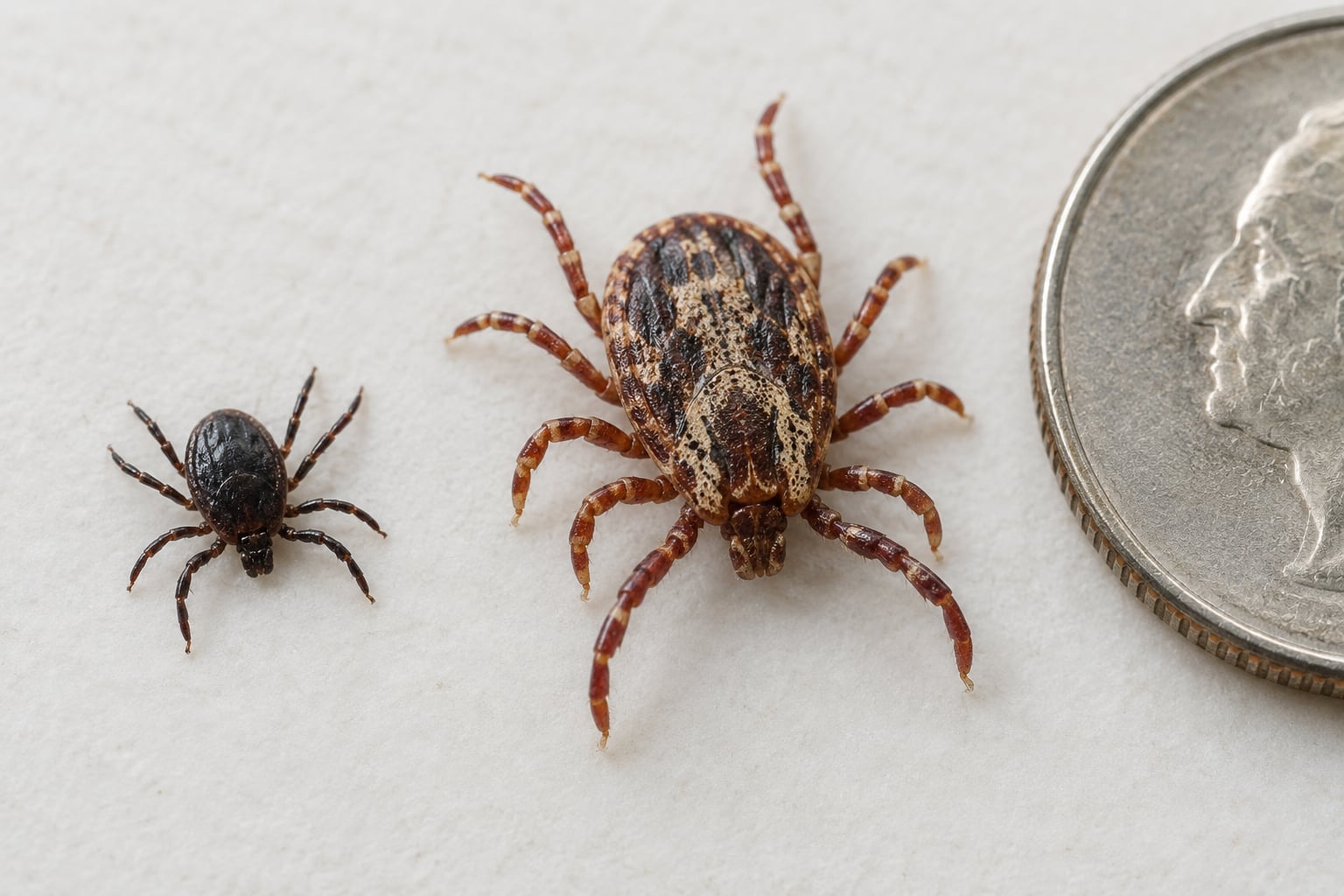
Deer tick vs dog tick identification comes down to three visible traits you can check in a few seconds: the shield behind the head is solid black on a deer tick and mottled white or silver on a dog tick, the legs are black on a deer tick and brown on a dog tick, and an unfed dog tick is roughly twice the size of a deer tick in the same life stage. Get the species right and you know which infections to watch for over the next few weeks, because the two groups carry completely different ones. This guide covers what each species looks like through every life stage, where you are most likely to meet them, and what to do with a tick once it is off your skin or your dog’s.
One caution up front. Field identification is a screening tool, not a diagnosis, and a single feature like size is not proof. If the answer matters, the tick itself can be tested. More on that at the end.
Table of Contents
- Deer Tick vs Dog Tick Identification at a Glance
- What Does a Deer Tick Look Like?
- What Does a Dog Tick Look Like?
- How Can You Tell Deer Ticks and Dog Ticks Apart?
- Where Do Deer Ticks and Dog Ticks Live?
- Are Dog Ticks or Deer Ticks More Likely to Bite?
- Which Tick Is Harder to See?
- What to Do After Finding a Tick
- Deer Tick vs Dog Tick Identification for Common Situations
- Frequently Asked Questions
- What to Do First
Deer Tick vs Dog Tick Identification at a Glance
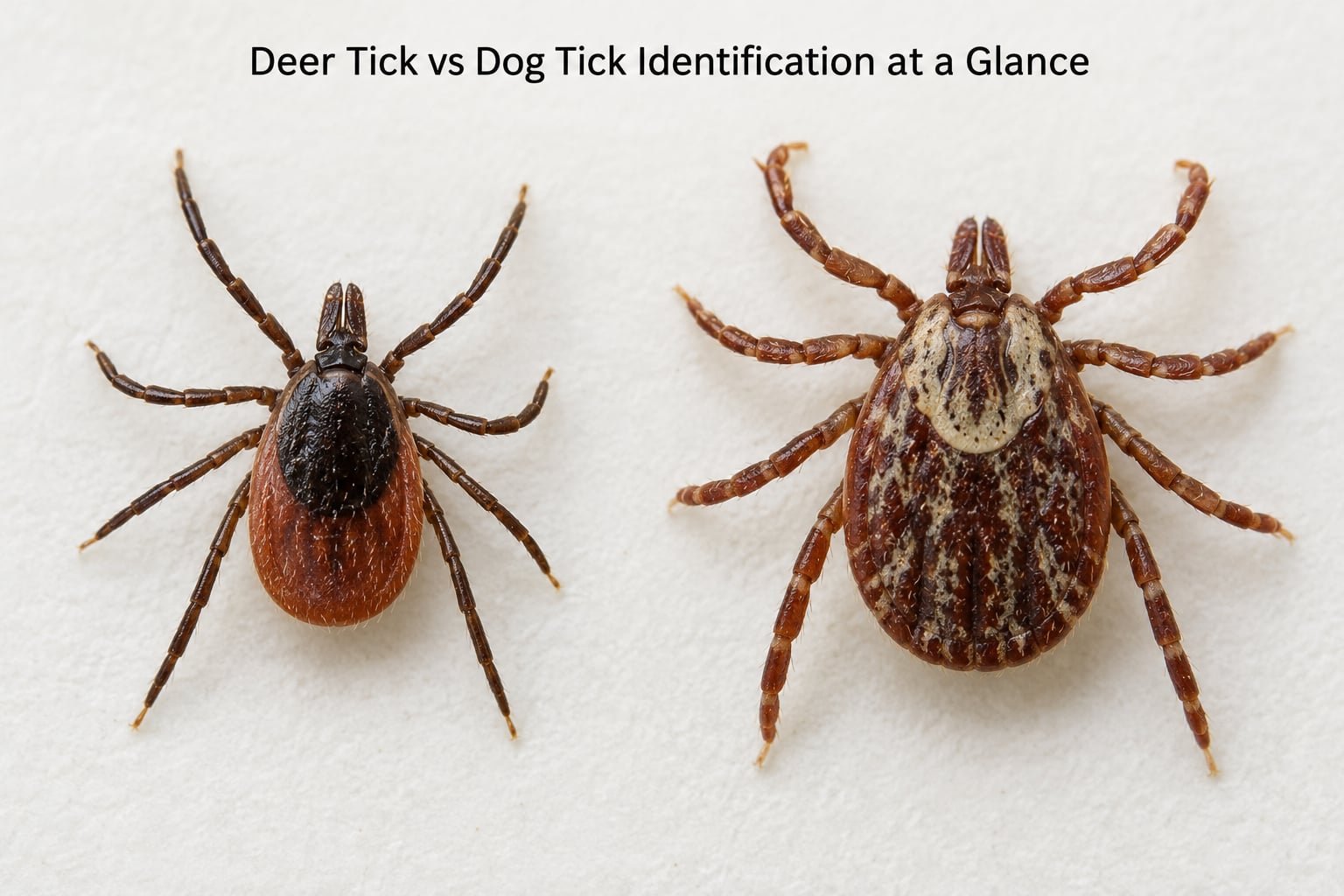
The chart below compares the three North American ticks that account for nearly every tick found on a person or a pet in the United States. Note that “dog tick” covers two different species, and the brown dog tick behaves nothing like the American dog tick outdoors.
| Feature | Deer tick (Ixodes scapularis) | American dog tick (Dermacentor variabilis) | Brown dog tick (Rhipicephalus sanguineus) |
|---|---|---|---|
| Unfed adult body length | About 1/8 inch, sometimes to 1/4 inch in females | About 1/4 inch, females a little larger | About 1/8 inch, similar to a deer tick |
| Scutum (shield behind head) | Solid black, small, plain | Ornate cream, gray or silver mottling, often called racing stripes | Plain brown, no mottling |
| Body color | Reddish-orange to brown in females, dark in males | Mottled gray-brown to reddish-brown | Uniform reddish-brown, no pattern |
| Legs | Black | Brown to blackish-brown | Dark brown to black |
| Body shape | Flatter, teardrop or pear-shaped, hard to spot | Oval and stout, wider at the rear | Rounded oval with short, thick mouthparts |
| Nymph size | Poppy seed, about 1/16 inch, the stage behind most bites | Sesame seed, with a single white dot on the back | Similar to an adult in proportion |
| Engorged adult | Gray-blue, round, typically 1/4 to 3/8 inch | Gray, about the size of a small pea to small grape | Dark gray to black |
| Peak activity | Adults: late fall through early spring; nymphs: spring and summer | Adults: late spring through midsummer | Year-round indoors, in kennels and doghouses |
| Diseases of concern | Lyme disease, anaplasmosis, babesiosis, ehrlichiosis, Powassan virus | Rocky Mountain spotted fever, tularemia, Colorado tick fever, alpha-gal reactions | Babesiosis, Rocky Mountain spotted fever, ehrlichiosis; also causes anemia in dogs |
Two rows in that table are worth reading twice. Dog ticks do not transmit Lyme disease, and the smallest stage of a deer tick is the one most likely to have bitten you.
What Does a Deer Tick Look Like?
A deer tick is the blacklegged tick, Ixodes scapularis, and the western blacklegged tick, Ixodes pacificus, is the same animal in a different part of the country. Both are small, dark and hard to notice, which is exactly why so many bites go unnoticed.
Adult female deer ticks have a solid black scutum, the hard shield just behind the head, with a reddish-orange to brown body behind it. There are no white or silver markings anywhere on an adult blacklegged tick. Males are smaller, almost entirely dark brown to black, and their scutum covers nearly the whole body.
Nymphs are the stage that causes most human bites, because a poppy-seed-sized nymph is roughly the size of a pinhead head and looks like a fleck of dirt. Males attach but do not engorge, so a swollen deer tick is a female.
What Does a Dog Tick Look Like?
The American dog tick, Dermacentor variabilis, is the dog tick most people picture. It is noticeably larger, more oval, and it wears a pattern: a cream, gray or silver mottled scutum, often described as ornate or as racing stripes, sitting on a mottled gray-brown to reddish-brown body. The legs are brown rather than black, which matters less than you would think under a flash.
Female dog ticks grow to about a quarter inch unfed, and the engorged adult is a familiar gray-blue lump roughly the size of a small pea. Dog tick bites are often painful, unlike the painless bite of a deer tick. Nymph dog ticks are about the size of a sesame seed and carry a single bright white dot on the back.
Then there is the brown dog tick, Rhipicephalus sanguineus, which is a different animal wearing the same name. It is a plain reddish-brown with no mottling, has short thick mouthparts, and it is the one that survives indoors, in kennels and doghouses, often all year. If you find a dog-like tick in a house with no recent outdoor exposure, that is the one to suspect.
How Can You Tell Deer Ticks and Dog Ticks Apart?
Size: the fastest clue
Use something familiar as a ruler. A deer tick nymph is about the size of a poppy seed, an adult unfed deer tick runs from a pinhead to a sesame seed, and a dog tick adult is closer to a quarter inch. An engorged adult of either species reaches the size of a small grape. Size narrows the field quickly but never settles it on its own, because an engorged deer tick is as big as an unfed dog tick.
Scutum color and markings: the most reliable clue
A solid black scutum with no decoration is a deer tick. Cream, silver or gray mottling, whether in stripes or an all-over pattern, is a dog tick. This is the single most dependable feature you can check at home, and it is the one that survives a decent photograph better than size does.
Leg color and body shape
Black legs with a reddish-orange body points to a deer tick. Brown legs with a mottled body point to a dog tick. Shape helps too: deer ticks are flatter and more teardrop-shaped, while dog ticks are stouter and more evenly oval from shoulder to rear.
Male versus female and nymph stages
On a male tick, the scutum covers most or all of the back. On a female, or on a nymph, it covers only the front portion. So a patterned shield that runs the whole length of the body is a male dog tick, and a small shield with a bare abdomen behind it is a female. Nymphs of both species have six legs as larvae have, then eight, and neither has a visible scutum worth naming.
A three-step deer tick vs dog tick identification check
Look at the shield first, because markings beat size. Then check the legs, then measure against something in the room. If all three point the same way, you have a confident field ID. If they disagree, treat the specimen as unknown and get it identified properly rather than guessing from one feature.
Where Do Deer Ticks and Dog Ticks Live?
Deer ticks are creatures of the northeastern and upper midwestern forest. Ixodes scapularis ranges across the Northeast, the upper Midwest and into parts of the Southeast and Texas, and Ixodes pacificus fills the Pacific coast and inland West. They sit in leaf litter and low brush on forest edges, along trails, in damp areas and around stone walls.
Dog ticks favor open, sunny, grassy ground. Dermacentor variabilis is the eastern species and Dermacentor andersoni is the Rocky Mountain and Pacific Northwest version, and both do well in tall grass, pasture edges, road margins and yard borders. Ixodes species wait on vegetation with their front legs extended, a behavior called questing, and they grab onto a host passing within a few inches. Dog ticks are more willing to travel on the ground to find a host, which is why they end up on pets and in lawns.
Habitat is a clue, not a verdict. Plenty of yards have both kinds, and a dog tick shows up in leaf litter too. Use where you were as supporting evidence, never as the answer.
Are Dog Ticks or Deer Ticks More Likely to Bite?
Both bite people and both bite pets, and which one gets you depends far more on where you are and what you are wearing than on the species name. Time outdoors, the height of the grass or brush, long sleeves and pants tucked into socks, and an EPA-registered repellent all move the odds more than any label does.
The number that surprises people is the life stage. Deer tick nymphs account for the large majority of reported bites, and dog tick adults account for a good share of what people actually notice, because a big tick on your scalp is impossible to ignore. Neither group is dangerous by default. Most bites transmit nothing, which is worth remembering before you panic over a single find.
Which Tick Is Harder to See?
The deer tick, and it is not close. An unfed adult is flat, dark and easy to dismiss as a speck, and the nymph stage is the size of a poppy seed. The dog tick is the more conspicuous of the two, which is often why identification posts online lean on size.
Size is also where identification gets harder, not easier. Once a deer tick engorges, its original reddish-orange body is largely hidden under a swollen gray-blue abdomen, and the scutum becomes a small dark spot on top of a lump. People in identification forums say the honest truth about these photos: without good lighting, a scale reference and a clear dorsal view, most IDs are guesses. This is the single most common complaint in tick identification threads, and it is a fair one.
If you want a usable photo, use a plain light background, window light or flash, shoot straight down on the back, and put a coin in the frame for scale. Include your state, the date, and whether the tick was on a person or a pet. Geographic context is required for a reliable answer; most identifiers will ask for it if you do not volunteer it.
What to Do After Finding a Tick
Do not pinch a live tick with bare fingers if you can avoid it, and do not squeeze the abdomen. If you touched it, wash your hands and treat the spot as you would any skin exposure. Here is the CDC-aligned sequence.
1. Remove it with fine-tipped tweezers. Grip as close to the skin as you can, at the mouthparts.
2. Pull upward with steady, even pressure. Do not jerk or twist.
3. Clean the area. Wash with soap and water, then apply an antiseptic or an over-the-counter anti-itch product to relieve the itch.
4. Dispose of the specimen. Flush it down the toilet, or seal it in a bag and throw it in the trash.
5. Save it if you can. A specimen in a sealed zip bag or a clean vial, with the date and your location written on it, can still be identified or tested later. Do not burn it, smother it with petroleum jelly, drown it in alcohol, smear it with nail polish, or crush it. Those methods do nothing reliable and they destroy the very evidence you would want tested.
6. Note the date of removal and watch how you feel. Most people who are infected develop symptoms in the days to weeks that follow, which is why the date is worth remembering. Contact a clinician promptly if you develop fever, chills, headache, fatigue, muscle aches, a rash, or neck stiffness. Ask about a single-dose preventive antibiotic if the tick was attached long enough to plausibly transmit anything.
What you put on the bite after removal is basic wound care: soap and water, then an antiseptic, and an over-the-counter anti-itch cream or hydrocortisone if the spot itches. Hydrogen peroxide is not recommended, because it damages tissue and does not improve healing. For pets, use a veterinarian and never a human medication.
One question comes up constantly, so it gets a direct answer. There is no household product that kills a tick instantly and safely, and the folk methods people repeat online make things worse rather than better. Petroleum jelly, oil, butter and lighter flames either fail or force the tick to regurgitate into the bite. Tweezers and patience are the method.
Deer Tick vs Dog Tick Identification for Common Situations
A tick found indoors
Indoor finds point toward the brown dog tick, Rhipicephalus sanguineus, which completes its life cycle inside homes and kennels. A single spec-shaped, plain reddish-brown, eight-legged arthropod on a wall or windowsill is very likely a brown dog tick or a recently dropped nymph, not a deer tick. Check whether a dog or cat came in from outside recently, and look along baseboards and window sills where engorged females drop to lay eggs.
A tick found on a dog or cat
Pets pick up dog ticks more often than deer ticks because dog ticks quest from the ground, which is where animals spend their time. Judge by the same marks, not by the coat. Check the ears, neck, between the toes, the groin, and the base of the tail, and remember that a fully engorged female is a gray lump a pet can feel but owners rarely see. If a brown dog tick is involved, anemia in dogs is a real concern worth raising with your veterinarian.
After hiking, yard work or a hunting trip
Shower soon after you get in, then do a deliberate tick check with a mirror, paying attention to the scalp, hairline, waistband, groin, behind the knees and under the arms. Deer ticks are found low at first and migrate upward over the next hours, which is why the hairline and waist are the usual spots. A tick found in January is not strange in Wisconsin, Michigan, Maine or upstate New York; adult deer ticks are active from late fall through early spring precisely because that is when hosts are available.
Ticks found in different U.S. regions
Region narrows the field faster than anything else. The Northeast, upper Midwest and coastal West are deer tick country, with the Pacific coast running mostly Ixodes pacificus and the eastern forest Ixodes scapularis. The Great Plains, the Southeast and the lower Mississippi Valley lean American dog tick, and the interior West leans Dermacentor andersoni. Both groups overlap across the middle of the country, which is where home identification gets shakiest.
Two lookalikes and three myths worth retiring
Not everything with eight legs is a tick. Carpet beetles and spider beetles are small, rounded and often found indoors, and seed bugs look similar in a photo but have a long snout. Bed bugs are flat, reddish-brown and have six legs, so a hand lens settles that one quickly.
Three beliefs cause real harm. Deer ticks do not only live on deer; they feed on dozens of hosts including mice, which is how Lyme spreads. A bullseye rash is not required and is not even present in most cases, so no rash does not mean you are fine. And the big engorged tick is not the most dangerous one; the unnoticed nymph is the real problem.
How to get a definitive answer
Photographs help, but a physical specimen gets a definitive answer. Seal the tick in a clean zip bag or a small vial, write the date, your state or county and where on the body it was found, and submit it to your state health department, many of which run free tick identification and testing programs. The University of Maine Cooperative Extension TickLab accepts mailed submissions, and the Texas A&M Tick App accepts photo submissions with location data. Expect a turnaround measured in days or weeks, so if symptoms are developing, do not wait on the mail to decide whether to see a clinician.
Frequently Asked Questions
Are dog ticks bigger than deer ticks?
Yes, an unfed American dog tick is roughly twice the length of an unfed adult deer tick, usually around a quarter inch compared with an eighth inch. That comparison only holds between ticks in the same life stage and the same condition. A fully engorged deer tick reaches the size of a small grape, which is larger than an unfed dog tick, so size alone can mislead you.
Does a dog tick carry Lyme disease?
No. American dog ticks are not considered vectors for Lyme disease; the blacklegged ticks Ixodes scapularis and Ixodes pacificus are the ones that transmit it. Saying dog ticks carry no disease at all is also wrong. Dog ticks transmit Rocky Mountain spotted fever, tularemia, Colorado tick fever and can trigger alpha-gal reactions, and they cause anemia in dogs.
What do deer ticks have that dog ticks do not?
Look at the shield behind the head. A deer tick has a small, solid black scutum with a reddish-orange to brown body behind it and uniformly black legs. A dog tick has ornate cream, gray or silver mottling on a larger scutum, a patterned body, and brown legs. Adult deer ticks also have no white or silver markings anywhere on the body.
What time of year are dog ticks most active?
American dog tick adults are most active from late spring through midsummer, roughly April into July depending on how far north and south you live. Deer ticks split the year instead: adults are active from late fall through early spring, and nymphs dominate from spring through summer. That is why finding a deer tick in the middle of winter in the Northeast is normal rather than alarming.
Can you identify a tick from a photo?
Sometimes, and more often than not for a clearly patterned adult dog tick. Nymphs, damaged specimens and engorged deer ticks often cannot be resolved from a photo, which is the most common complaint in tick identification forums. You improve your odds with a plain light background, straight-down view of the back, flash or window light, a coin for scale, and your state and date in the caption.
What to Do First
If a tick is on you right now, remove it with fine-tipped tweezers and note the date. Then look at the shield: solid black and black legs means deer tick, mottled cream or silver and brown legs means dog tick. If the specimen is small, damaged or engorged, seal it in a bag and send it to your state health department rather than settling for a guess from one feature. If symptoms develop, contact a clinician instead of waiting on an ID result.
Last reviewed in 2026. This article is general information about tick identification, not medical or veterinary advice. Guidance follows CDC and public health department recommendations, and individual concerns belong with a doctor or a veterinarian.