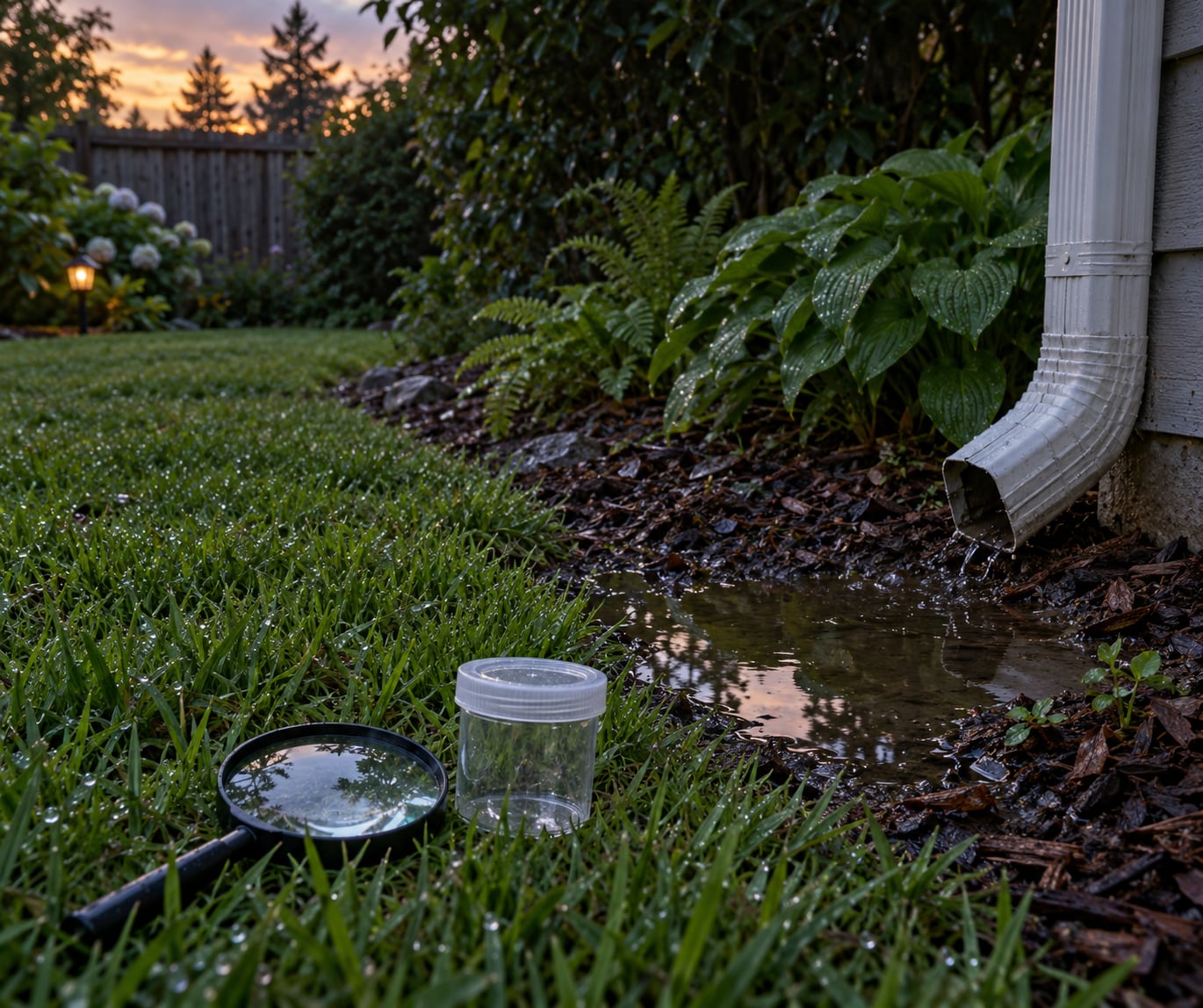
To identify a biting midge problem in a yard, watch when and where the bites land, then go out at dawn and dusk with a flashlight and a clear container to look for adults hovering over damp ground. If you also find wet organic matter, mulch or standing water with tiny pale larvae wiggling in it, you have your answer: midges breed in moisture, not in open puddles like mosquitoes. The whole check takes an evening and a slow walk around the property, and it costs nothing but time.
The reason this matters: a midge problem gets misdiagnosed almost every time. Most homeowners treat the yard for mosquitoes, watch the mosquitoes thin out, and assume the problem is solved. The welts come back the next evening, because mosquitoes breed in open water and midges breed in damp soil, leaf litter and wet mulch.
Before you spend money or spray anything, run through this short checklist. If most of these match, keep reading and confirm with the walkthrough below.
- Bites show up in clusters of three to twenty, often on the legs, ankles, arms or neck.
- You can barely see what is biting you. The insect is smaller than a mosquito.
- The itching outlasts a mosquito bite, sometimes lasting a week or more.
- The trouble is worst at dawn, dusk, or in the hour after sunset, and eases in the middle of a bright, breezy day.
- Worst spots are near damp mulch, a low wet corner, a downspout, a pond edge or dense shade.
- Standard window screens do not stop them. They pass through ordinary mesh.
- You see a loose grey cloud of dust-sized flies hovering over damp soil, mulch, or a hedge.
What You Need
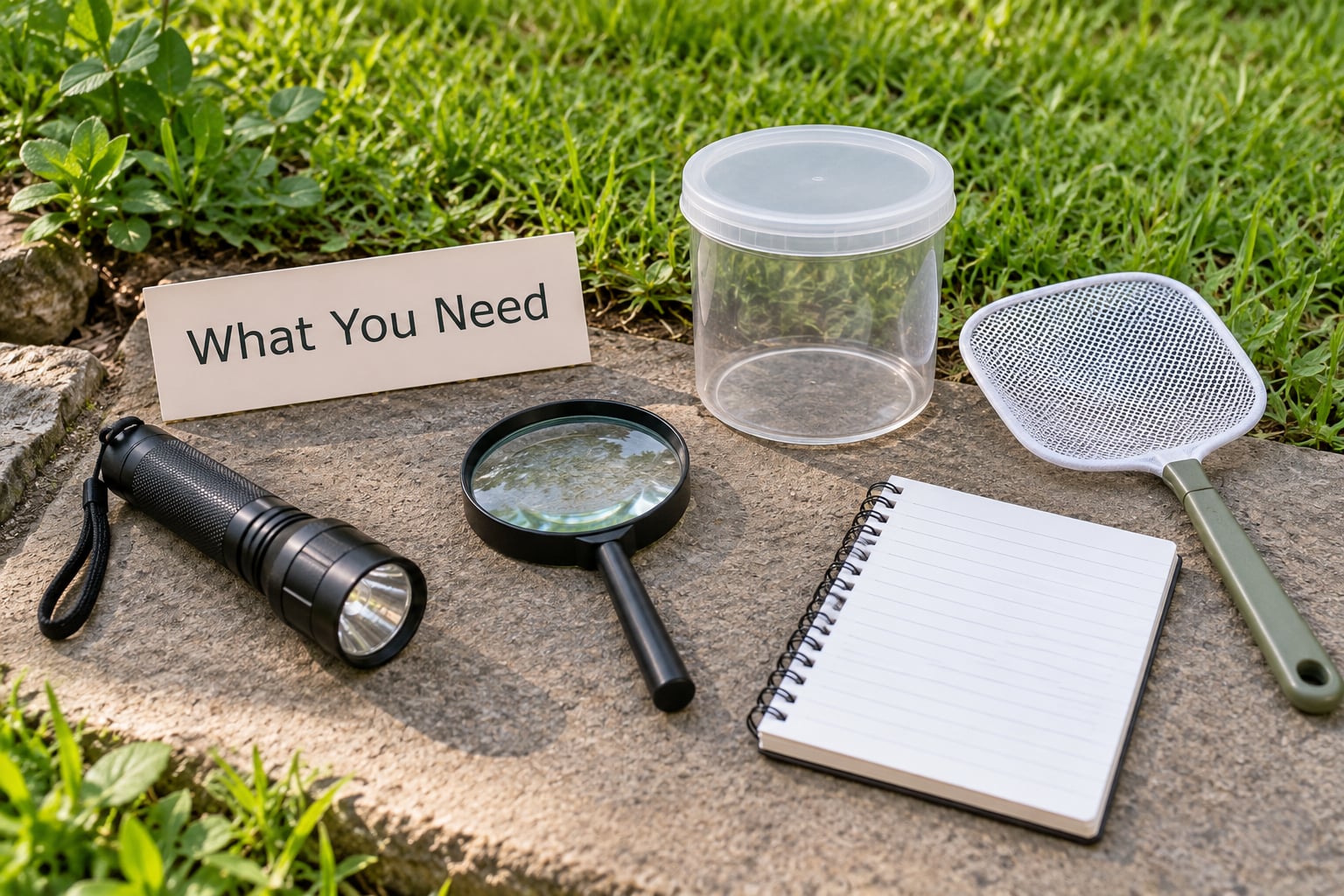
None of this is expensive and none of it requires pesticide. A clear cup or straight-sided container with a lid is the single most useful item, because a midge is 1 to 3 mm long and impossible to identify in flight.
- A clear cup or container with a lid to catch adults for close inspection.
- A magnifying glass or 10x hand lens to read body shape and wing pattern.
- An insect-safe net or swatter so you can capture without smearing the specimen.
- A flashlight or headlamp for dawn, dusk and shaded inspections.
- Gloves for digging in mulch, leaf litter and wet soil.
- An EPA-registered repellent containing DEET or picaridin for your own protection while you work outside.
- A notebook to log time, location, weather and bite counts.
- Optional: a local insect identification guide, plus white sticky traps or a small fan for the confirmation step.
The repellent matters more than people expect. Homeowners report that standard sprays lessen midge activity without clearing it, so treating yourself before an inspection is worth the few minutes it takes.
Step-by-Step: How to Identify a Biting Midge Problem in a Yard
1. Determine When and Where the Biting Happens
Start with the pattern, not the insect. Note the time of day, the spot on your body, the part of the yard and the weather. Then compare that record across several days.
Biting midges are most active in low light and in still air. Homeowners usually report a peak in the early morning and again in the late afternoon into dusk, and a real lull on bright, windy days. Weak fliers means moving air knocks them down, which is one reason a breezy patio often stays bearable while a still, shaded corner becomes unbearable.
Body location matters too. Mosquitoes hunt for exposed skin and settle on ankles, wrists and the back of the neck. Midge bites show up wherever clothing presses against skin or where damp vegetation brushes a person: ankles inside socks, arms under a shirt sleeve, the waist, the back of the neck, and even beneath clothing in some reports.
What supports a midge diagnosis: clusters rather than single isolated welts, an itch that runs for days, and pressure that spikes at dusk in one damp corner of the property. What weakens it: bites that appear at midday with no location pattern, or a rash that appears without any outdoor exposure.
2. Look for Adult Midge Activity
Go out at dawn, at dusk, and again in shaded areas during the day. Biting midges, or no-see-ums, belong to the family Ceratopogonidae, and the genus Culicoides causes most of the bites people notice in yards.
At under 3 mm, they read as dust in the air. What gives them away is the way they move: a loose cluster hovering in one spot, darting in short fast bursts, then dropping back into the cloud. Mosquitoes fly a steadier patrol and dip toward you; midges hover in a swarm and come to you.
Sweep the net over a hover cloud, then tip the catch into the container and hold it against a light source. Under a lens you should see a small fly with a fuzzy body, long slender legs held out from the sides, and narrow wings held out at an angle over the back, giving it a hunched, triangular profile. That silhouette is genuinely useful, because it is how you rule out fungus gnats and non-biting midges, which have longer, more delicate legs and a looser, more erratic flight.
Other signs worth logging: a cloud that forms over damp mulch the moment you disturb it, insects diving toward outdoor lights at night, and a biting sensation sharper than a mosquito bite with nothing clinging to the skin afterwards. That last detail matters, since fleas stay on you and bed bugs bite in lines on exposed skin while you sleep.
A single captured adult is suggestive. A repeat catch in two or three places over several evenings, in the same damp spots, is convincing.
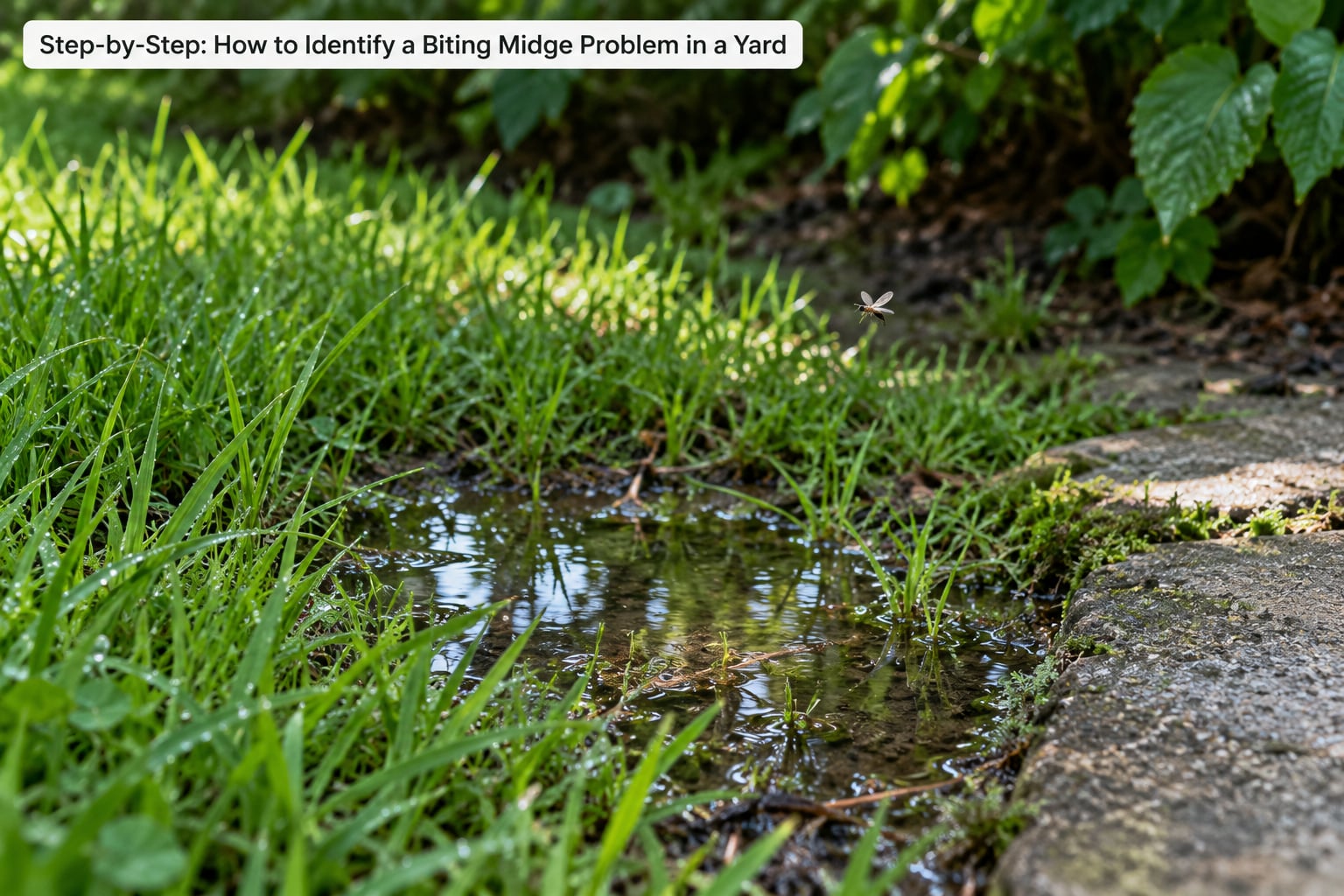
3. Check Likely Breeding Areas
Here is where most identification attempts go wrong. People walk to the puddles, because puddles are where mosquitoes breed. Midge larvae live in moisture, but usually thin moisture rather than deep open water.
Work through this list with gloves on:
- Low spots and drainage channels where rainwater sits after a storm.
- Damp mulch and wet organic matter, especially new landscaping mulch and leaf litter piled against a fence.
- Gutters, downspout splash zones and AC condensate drip lines, which keep a narrow strip of soil wet all season.
- Pond, ditch, stream and marsh margins, including muddy shorelines.
- Containers and vessels holding water: buckets, plant saucers, clogged drains, birdbaths, tires.
- Raised beds and irrigated zones that stay saturated from frequent watering.
- Disturbed ground from new construction, which homeowners repeatedly single out as the trigger for a sudden midge problem.
Scoop a little of the wet material into your container, add a finger’s depth of water, and let it sit for ten minutes. Small pale or whitish larvae wriggling in the silt, often in groups, are strong evidence. Finding larvae tells you breeding is happening on your property, which no flying adult can confirm on its own. Finding them at several points in the wet areas turns suspicion into a diagnosis.
Habitat does vary by region and species, so do not treat one empty scoop as proof of anything. Coastal and marsh-adjacent properties, humid inland yards and shaded lots are all typical, and the pattern of wet, organic, sheltered ground is what to look for.
4. Compare Midge Bites with Other Yard Bites
Do not diagnose the insect from the reaction alone. People react differently to the same bite, and a scratch or an insect bite can look like either. Use the insect, the timing and the location together, and treat the skin symptom as supporting evidence at best.
- Biting midges: small red pinpoints that turn into itchy raised welts, frequently clustered, worst at dawn and dusk, often near damp ground, and itchy well past what a mosquito bite usually causes.
- Mosquitoes: fewer, more isolated welts, mostly on exposed skin, concentrated around dusk and near standing water.
- Black flies: a more painful bite that leaves a dark scab or a mark in the bite line, and are often found near fast-moving streams and wooded riverside areas.
- Fleas: bites on the lower legs, often in small groups of three, with insects that jump and stay on clothing; usually tied to pets or an entry point indoors.
- Bed bugs: a line or grid of bites on skin exposed while sleeping, appearing overnight and indoors rather than after time in the yard.
- Chiggers: itchy bumps clustered where clothing meets skin, typically after walking through tall grass, with no adult insect you can see at the site.
If bites appear indoors overnight, or in a fixed pattern on the bed, the yard is not the source and you have a different problem on your hands. Homeowners with indoor bite reports are usually dealing with fleas or bed bugs, which is the confusion most worth resolving early.
5. Confirm the Problem Before Treating the Yard
Before spraying anything, put the evidence in one place: the bite pattern, the adults you caught, the larvae you found, the weather, and whether the pattern repeats. A problem that shows up on three separate evenings in the same damp corner, with larvae from that corner, does not need another guess.
For monitoring, hang white or yellow sticky traps at seated height near the suspect zones, run a fan across the area to create air movement, and count catches before and after any change you make. Light traps and CO2-emitting traps catch plenty of midges, but treat them as population indicators rather than control. Reducing airflow around a seating area tells you how much of the problem was still air, which is useful information before anyone signs a service contract.
For an unusual, severe or persistent problem, send the specimen in your container to a county extension office, a local insect identification service, or a pest professional who will actually look at the insect. Homeowners report that some companies decline midge work as difficult to control, so ask directly whether they treat biting midges before booking.
6. Reduce Biting Activity and Yard Exposure
Once midges are confirmed, work on three fronts at once: source, airflow and personal protection. No single one of them carries the whole load.
- Source: empty standing water weekly, clear leaf litter and wet organic debris, unblock drains, correct a persistently wet patch, and pull mulch back from the foundation where it stays damp.
- Airflow: run a fan on any seating or eating area you use at dusk. Weak fliers lose their advantage in moving air.
- Screening: standard window mesh will not exclude a 1 to 3 mm insect. Replace damaged screens with 16-mesh or finer screening, and check door sweeps and torn corners on screened porches.
- Clothing: long sleeves, long pants and socks at dusk, especially where vegetation brushes against you.
- Repellent: use an EPA-registered product containing DEET, picaridin or oil of lemon eucalyptus, applied exactly as the label directs. Never apply a pesticide to skin unless the label specifically allows that use.
- Targeted treatment: if midges are confirmed and pressure is high, treat the specific breeding and resting zones rather than fogging the whole property, and schedule treatments to match local adult activity rather than a fixed calendar.
Set expectations honestly. The realistic goal is a measurable reduction in bites at the areas people actually use, not a guarantee of a bite-free yard. Aim at the places where you sit at dusk and treat the wet spots you actually confirmed, and you will usually see the difference within a week.
Common Mistakes
Assuming every small biting insect is a mosquito. It is the most common error and the most expensive one, because mosquito treatments target open water. Check for the hover cloud and the clustered welts before you treat.
Treating the bite reaction as the diagnosis. Plenty of people react strongly to midge bites and mildly to mosquito bites. Individual skin response proves nothing on its own, so pair it with an insect observation.
Spraying broad areas before confirming anything. Whole-yard fogging without a confirmed insect wastes money, kills pollinators and beneficial insects, and leaves the actual source untouched.
Looking only at puddles. Puddles are mosquito habitat. Midge larvae sit in damp soil, wet mulch, leaf litter, drainage swales and pond margins, so a puddle-only inspection misses the population.
Ignoring low spots and irrigation edges. Gutters, downspout splash zones, AC condensate lines and over-watered beds create the damp organic ground midges need. These are also the easiest problems to fix.
Using repellent wrong. Applying too little, spraying clothing instead of exposed skin, washing it off too soon, or applying a lawn product to skin. Read the label, follow the directions, and skip repellents on hands and around the eyes of small children.
Disturbing beneficial insects along the way. Broad treatments kill spiders, predatory insects and pollinators. Target the confirmed zones instead and time applications for when adults are active rather than when larvae happen to be in the soil.
A few habits cut down on bites in the meantime. Do yard work earlier in the day when there is breeze and light, wear socks and long pants when digging in wet mulch, set out a fan before you eat outside, and empty wet containers after every rain.
Frequently Asked Questions
How do biting midges differ from mosquitoes?
Biting midges are 1 to 3 mm long, smaller than a mosquito, and they breed in damp soil, wet mulch and leaf litter rather than in open standing water. They swarm in a loose hovering cloud, mostly bite at dawn and dusk, and deliver a sharper sting that leaves clusters of itchy welts lasting days. Mosquitoes are larger, patrol steadily rather than hovering in a cluster, and mostly bite exposed skin around dusk.
Are biting midges and no-see-ums the same thing?
Yes. No-see-um is the common name people use for the biting members of the family Ceratopogonidae, mostly in the genus Culicoides. The name comes from how hard they are to see, not from any difference in the insect. Regional names include sand gnats and, in some coastal areas, sand flies, though true sand flies belong to a different group.
Can no-see-ums get indoors and bite inside the house?
They can get inside, because a 1 to 3 mm insect slips through standard window mesh and past small gaps in door sweeps. But they are yard insects, and indoor bites that appear overnight in a line or grid on exposed skin are far more often fleas or bed bugs. If your bites happen mainly inside at night, check pets and bedding before you spend money on yard treatment.
Where do biting midge larvae live in a yard?
In moist, organic, sheltered ground rather than deep open water. Look at low wet spots and drainage channels, damp mulch and leaf litter, downspout splash zones, AC condensate drip lines, pond and ditch margins, and any container holding water. Scoop wet material into a container, add a finger’s depth of water, and wait: pale larvae wriggling in the silt are the strongest evidence of breeding.
Do vinegar sprays or homemade mixtures work on midges?
Homeowners report short-lived results at best, often two or three days, and nothing reliable on the breeding source. If you want to try a repellent, choose an EPA-registered product containing DEET, picaridin or oil of lemon eucalyptus and follow its label. Never apply lawn pesticides, bleach or household sprays to skin, and never mix products. Source control and airflow give the more durable result.
When is it worth calling a pest professional?
Call one when bites remain heavy after moisture and airflow changes, when you cannot reduce pressure at the seating areas you use, or when you want the breeding zones identified and documented before spending on treatment. Ask whether they treat biting midges specifically, since some companies consider them difficult to control. Send them your specimen from the container so they are working from the real insect.
Conclusion
To identify a biting midge problem in a yard, do three things in order. Log the bite pattern: clusters, exposed or pressed-against skin, worst at dawn and dusk, in one damp corner. Then inspect at those same times with a net and a clear container, and check damp mulch, leaf litter, drainage swales and low wet spots for larvae. Once you have a repeat catch and larvae from the same zone, act on the source, move some air, upgrade screens to 16-mesh or finer, and treat only the zones you confirmed.