Smoky brown cockroach identification and habits come down to a handful of things you can check yourself: a uniform dark mahogany-to-black body with no pale markings, wings that extend past the tip of the abdomen, and an adult length of roughly 1 to 1.25 inches (30 to 38 mm). The species is Periplaneta fuliginosa, and it is peridomestic, meaning it lives mostly outdoors around trees, palms, gutters, and rooflines, then moves into attics, soffits, and upstairs rooms when the weather turns hot and dry.
Here is the part that surprises people. The adult is what most identification charts show, but the adult is rarely what you find. What lands on the bathroom floor or shows up under the kitchen sink is usually a nymph, and a first-instar nymph at about 1/8 inch with bright white tips on the antennae is the single most useful field mark you have.
| Feature | Detail |
|---|---|
| Scientific name | Periplaneta fuliginosa |
| Adult length | 1 to 1.25 inches (30 to 38 mm) |
| Color | Uniform mahogany brown to nearly black, no pale markings |
| Wings | Full wings extending beyond the end of the abdomen |
| Flight | Strong flier, readily attracted to white and UV light at night |
| Category | Peridomestic, lives outside and enters structures |
| Where it lives | Tree holes, palm crowns, gutters, mulch, attics, soffits, eaves |
| Peak activity | Warm, humid months, dusk through dawn |
| Nicknames | Smokybrown cockroach, palmetto bug (Southeast) |
Table of Contents
- What Does a Smoky Brown Cockroach Look Like?
- How Can You Tell a Smoky Brown Cockroach from Other Cockroaches?
- Where Do Smoky Brown Cockroaches Live?
- What Are Smoky Brown Cockroach Habits?
- When Are Smoky Brown Cockroaches Most Active?
- What Do Smoky Brown Cockroaches Eat?
- What Signs Show a Smoky Brown Cockroach Infestation?
- Are Smoky Brown Cockroaches Harmful?
- How Do You Prevent Smoky Brown Cockroaches?
- When Should You Call a Pest Professional?
- Frequently Asked Questions
- Are smoky brown cockroaches the same as Oriental cockroaches?
- How long does it take for a smoky brown cockroach egg case to hatch?
- Do smoky brown cockroaches come indoors from the yard?
- What does a smoky brown cockroach nymph look like?
- Can smoky brown cockroaches fly?
- How many smoky brown cockroaches indicate a serious infestation?
- Conclusion: Start With Identification and Moisture Control
What Does a Smoky Brown Cockroach Look Like?
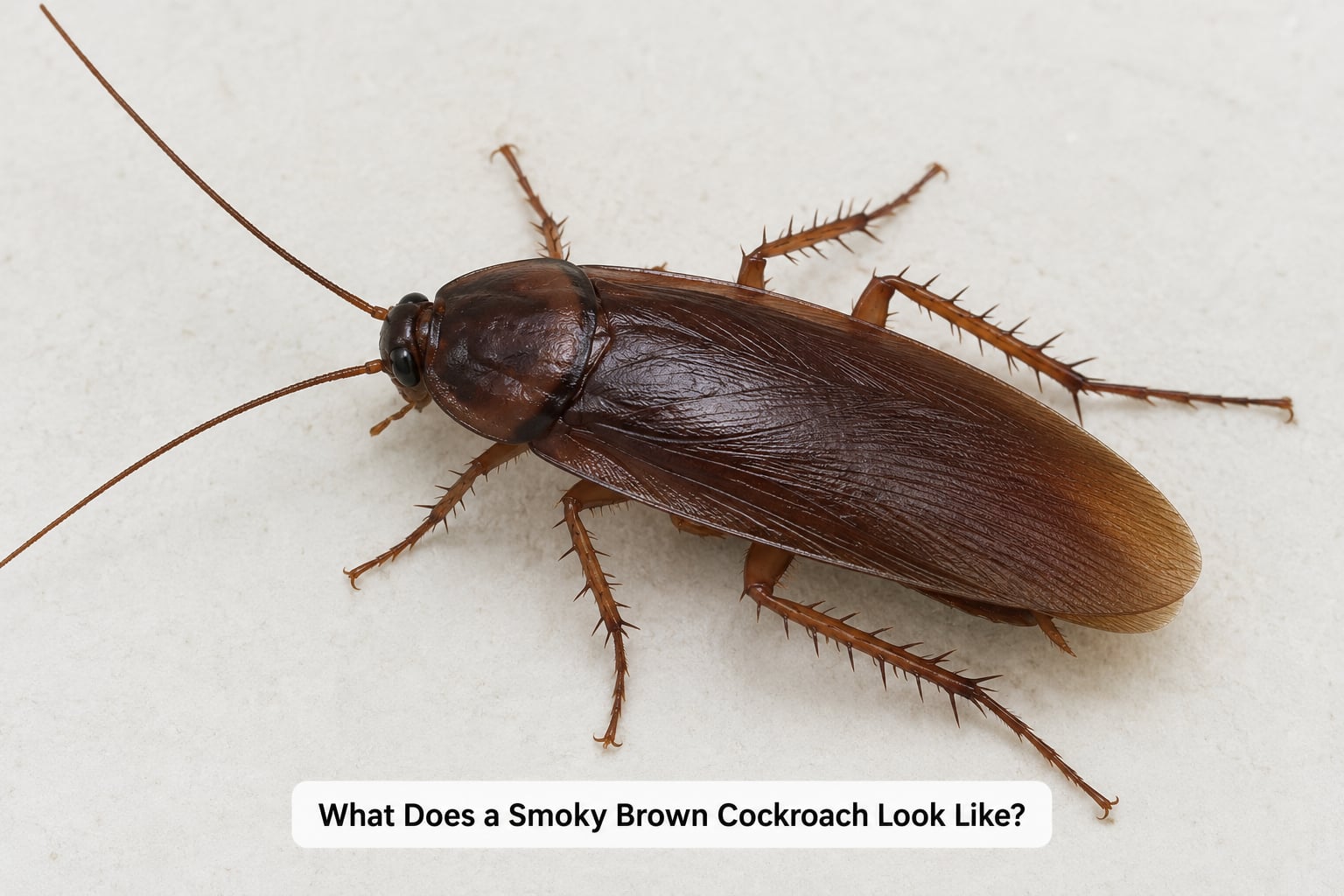
Smoky brown cockroach identification: what adults look like
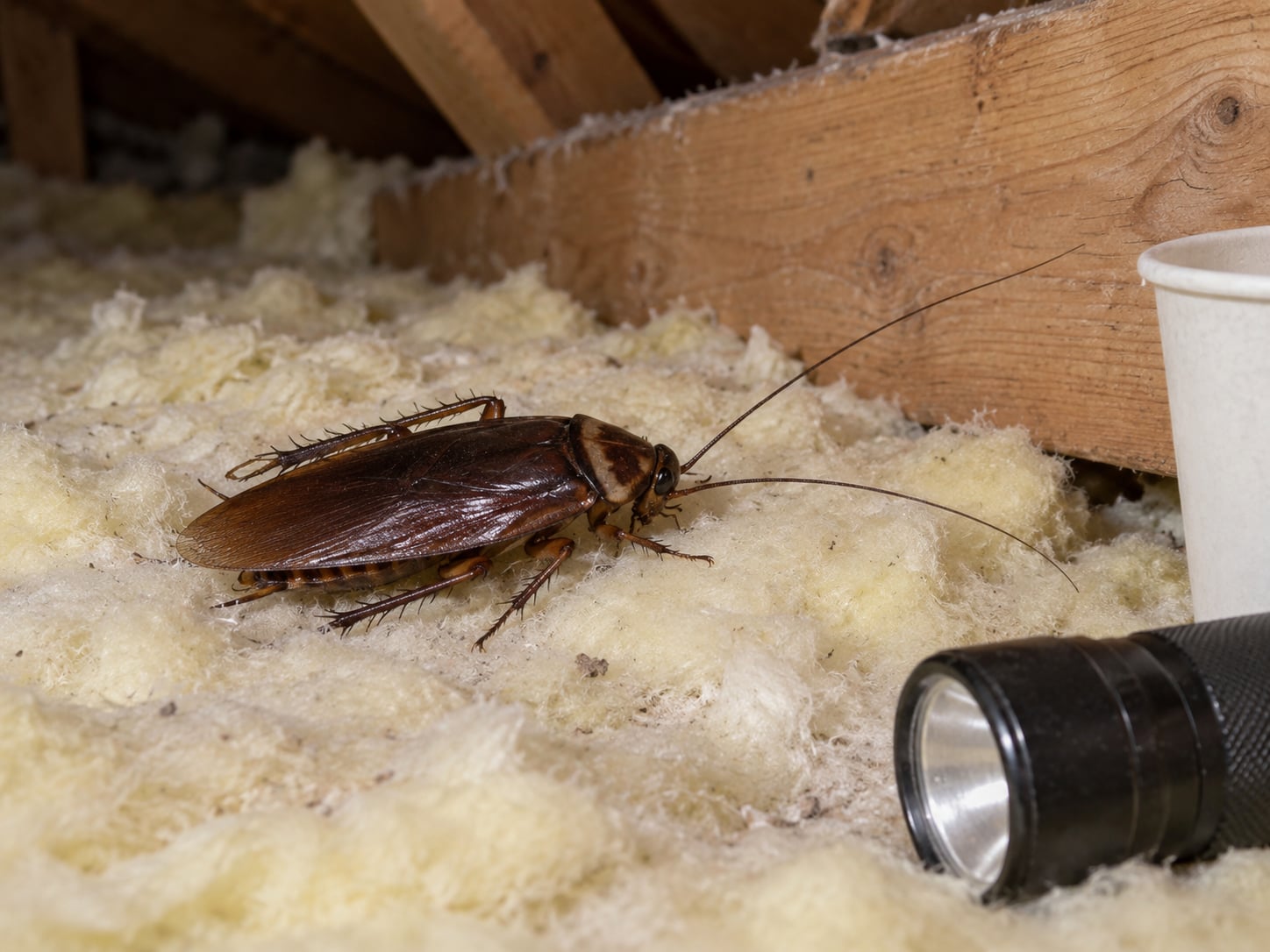
An adult smoky brown cockroach is a big, glossy, evenly colored roach with a flattened oval body and long, sweeping antennae. The color is the giveaway. Where a German cockroach has two dark stripes running down its back and an American cockroach has a pale yellowish figure-eight marking on the shield behind the head, the smoky brown has nothing but solid dark brown.
Wings cover the adult’s back and extend a noticeable distance past the rear of the abdomen, which is one of the easiest ways to separate it from a brown-banded cockroach. Males tend to be narrower and longer, females broader with wings that fall slightly short of the abdomen tip in some individuals.
What smoky brown cockroach nymphs look like
Nymphs are wingless, and they are the stage people actually find indoors. The freshly hatched first instar is roughly 1/8 inch long, dark brown to black, with a pair of distinctive white or pale bands on the antennae near the tips. That white antennal tip fades as the nymph grows through later instars, so early-instar identification is much easier than mid-stage identification.
Later nymphs look like small, wingless adults: the same uniform dark color, the same oval shape, no stripes and no pale markings. Size is the range that trips people up, since a nymph can be anywhere from 1/8 inch to nearly an inch before it reaches maturity.
What a smoky brown cockroach egg case looks like
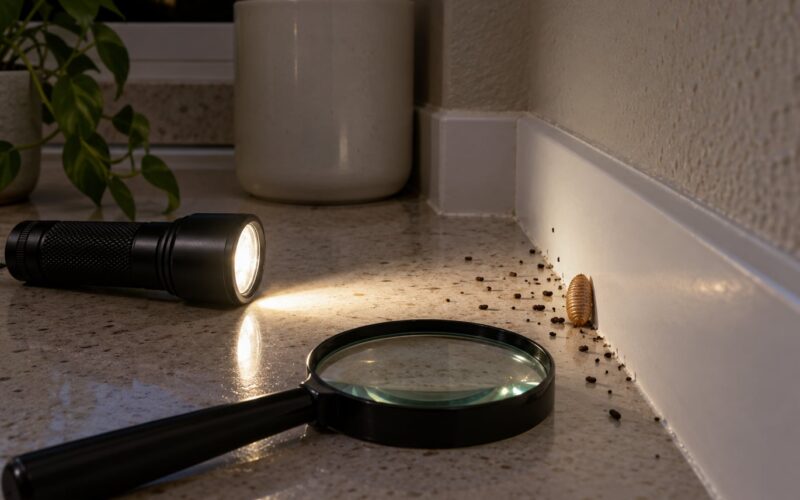
The egg case, or ootheca, is a dark brown, bean-shaped capsule about 3/8 inch long with a faint seam along one edge where it will split. Females glue or tuck it into a protected crevice, and in this species that is often a tree hollow, a gutter joint, a soffit, or a planter box rather than a warm kitchen wall.
Because the case is sealed and hardened, it shrugs off most surface sprays. It also means that seeing one egg case tells you a female deposited it nearby, and that is a stronger signal than a single adult sighting.
How Can You Tell a Smoky Brown Cockroach from Other Cockroaches?
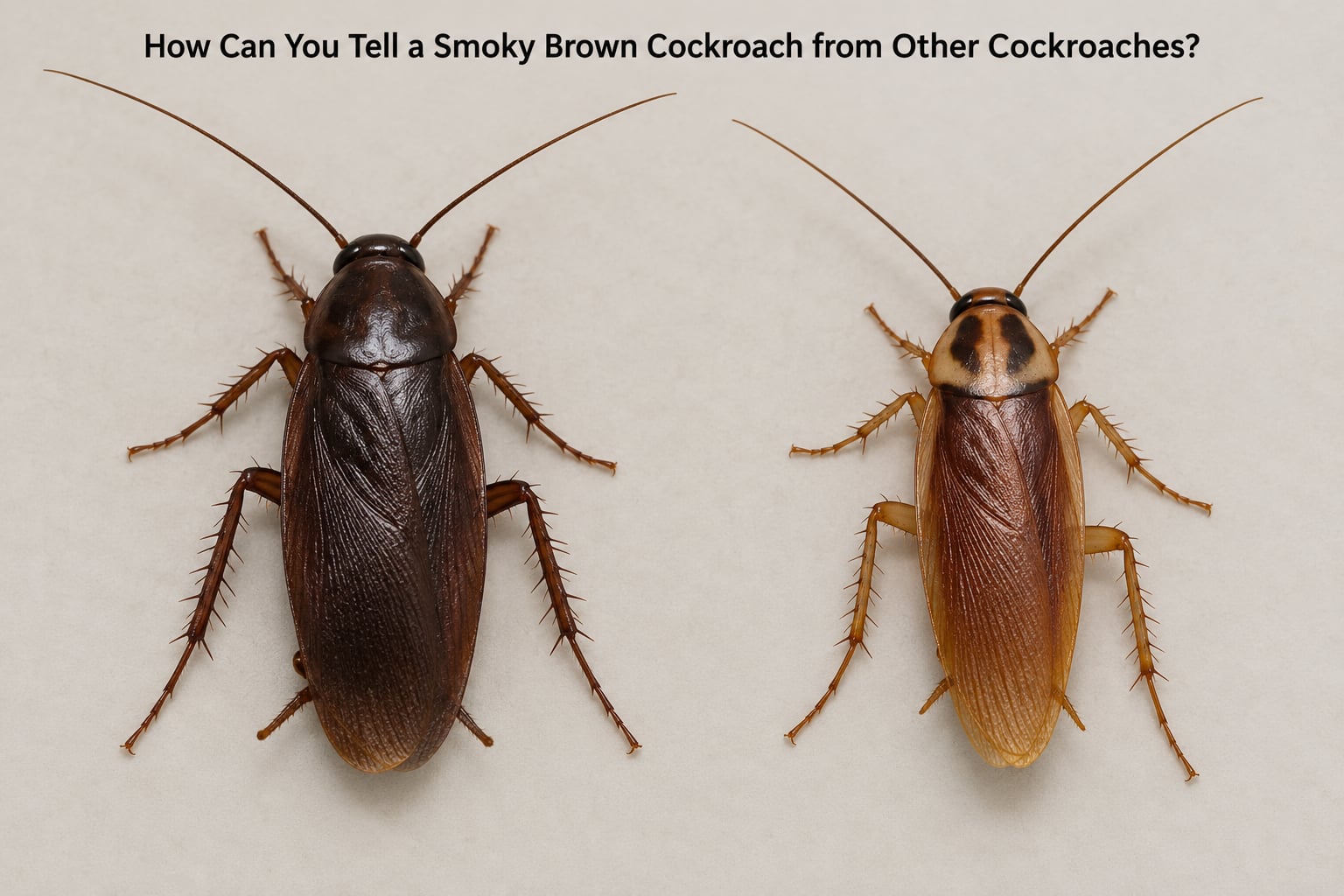
Compare the six species most homeowners are likely to encounter side by side, then use behavior and location as tie-breakers. Two large dark roaches on a kitchen floor look nearly identical, but one carries a pale figure-eight on its pronotum and the other carries nothing at all.
| Species | Adult length | Color and markings | Flight | Typical location |
|---|---|---|---|---|
| Smoky brown | 1 to 1.25 in | Uniform mahogany to black, no markings | Strong flier | Attics, soffits, gutters, palms, tree holes |
| American | 1.5 to 2 in | Reddish brown with pale figure-eight on pronotum | Weak flier, mostly glides | Boilers, utility rooms, crawl spaces, sewers |
| Oriental | About 1 in | Glossy black, very shiny | Does not fly | Cool, damp basements, lower floors |
| German | 0.5 to 0.6 in | Tan with two dark back stripes | Does not fly | Kitchens, bathrooms, warm indoor spaces |
| Brown-banded | 0.5 in | Tan with two light cross-bands | Does not fly | Upper floors, closets, warm indoor rooms |
| Australian | 1.25 to 1.5 in | Dark brown with a pale yellow margin on wings | Runs rapidly, rarely flies | Porticos, porches, drains, indoor utility areas |
Behavior narrows it down further. Finding several large dark roaches on the roofline, in the attic insulation, or flying at an exterior light points to smoky brown. Finding one big roach near a boiler, a floor drain, or a water heater in a crawl space suggests American or Oriental instead.
The nickname that causes the most confusion is palmetto bug. In the Southeast that name is applied loosely to large dark outdoor roaches, and depending on who you ask it may mean a smoky brown or an American cockroach. So treat palmetto bug as a regional description of appearance and location, not as a species name.
Where Do Smoky Brown Cockroaches Live?
Outdoors, this species favors elevated, sheltered, damp harborage. Tree holes and hollowed trunks, the crowns of palm trees, bird nests, mulch beds, leaf litter, and stacked firewood all work, and so do gutters, downspout joints, and planters that hold moisture against the siding.
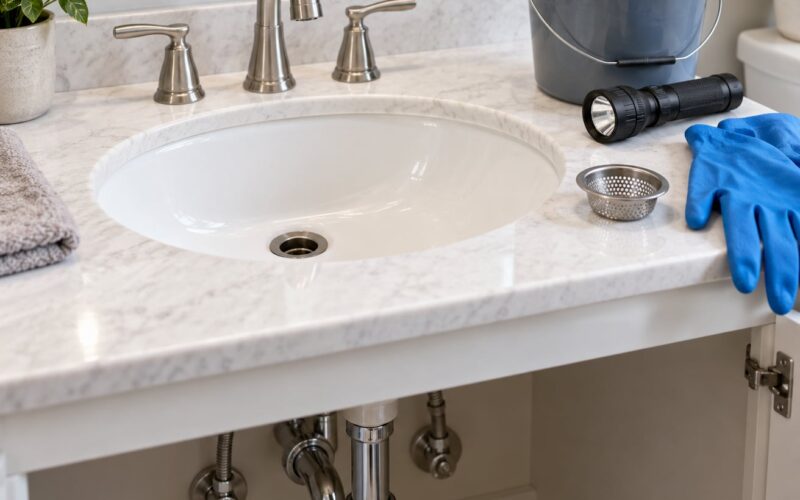
Indoors it gravitates to the upper half of the structure rather than the kitchen. Attics and attic insulation, soffits and eaves, fascia cavities, planter boxes, wall voids behind upper-story drywall, and occasionally a bathroom or sink area where a pipe or drain trap leaks keep them comfortable.
The entry routes match the habitat. Soffit and attic vents without screens, weep holes above windows and doors, gaps where siding meets trim, unsealed plumbing and electrical penetrations, and poorly fitted windows or doors on the upper floors are all openings this roach uses. Screen doors matter less than people think, because this species rarely relies on walking through doorways.
What Are Smoky Brown Cockroach Habits?
Smoky brown cockroach habits revolve around three things: darkness, moisture, and elevated shelter. The species hides during the day and emerges around dusk to forage, staying out until dawn, which lines up with the hours most people are asleep and the lights are on.
It is a strong flier, and adults will travel toward any bright light source, which is why porch lights, entry lights, and bright white bulbs attract them so reliably. It also dehydrates quickly, so it cannot survive for long in dry, air-conditioned indoor air. A leaking pipe or a persistently humid attic does more to explain an indoor sighting than any food source does.
Reproduction follows the standard cockroach pattern. A female produces an ootheca containing roughly 16 to 20 eggs, which she carries briefly before sealing it into a crevice. Nymphs hatch from that case in about 30 to 40 days under warm conditions, then pass through about 10 to 13 instars, molting and growing the whole way, before reaching adult size somewhere around 6 to 12 months depending on temperature and food.
That timeline explains a pattern homeowners report repeatedly. A handful of nymphs appears in late spring, the adults show up at lights through summer, and nothing seems to happen until the following year, when the cycle starts again in a warmer spot.
When Are Smoky Brown Cockroaches Most Active?
You are most likely to see them at night, in the dark, or in a room that suddenly gets a light switched on. Flashlights in an attic, a bathroom light at 2 a.m., or a porch light left on all evening are the situations that produce sightings.
Seasonally, activity rises with heat and humidity through the warm months and drops sharply when nights cool below about 50 degrees F, which is often when people assume the problem is over. It is not. The population moves down into protected harborage and waits.
Hot, dry weather changes the behavior in the opposite direction. When outdoor harborage dries out, the roaches push indoors looking for moisture, which is why mid-summer heat waves often bring a sudden appearance upstairs that has nothing to do with anything you left in a cupboard.
Outdoors, adults are drawn to light and roam along the roofline, in gutters, and around tree trunks at night. Indoors, they are quieter, hide during daylight, and are usually found only by accident or by trap.
What Do Smoky Brown Cockroaches Eat?
They are scavengers with broad tastes. Starchy material comes first: dried pet food, bread crumbs, cereal, flour, rice, and paper products such as cardboard and wallpaper paste. Sugars attract them too, along with fruit residue, decaying plant material, and organic debris in gutters and mulch.
Moisture matters as much as food. Roaches need water far more than they need a meal, and a dripping downspout, a clogged gutter, an over-watered mulch bed, or a sweating pipe can sustain them even when the kitchen is spotless.
This is the most common misconception about the species. Smoky brown cockroaches arriving from the yard and roofline are not evidence of dirty floors or poor housekeeping. Their food supply is usually rainwater, decaying leaves, and pet food outdoors, and a well-kept kitchen will not keep them out.
What Signs Show a Smoky Brown Cockroach Infestation?
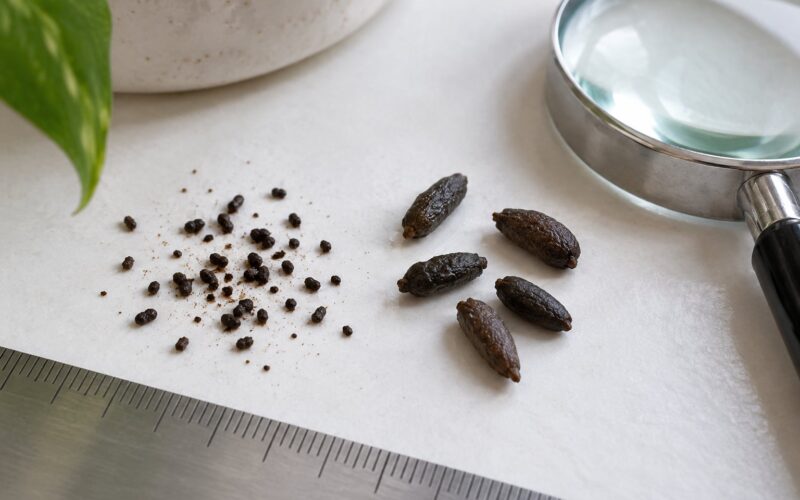
For this species, the useful signs sit above head height. Droppings that look like coarse ground coffee or scattered pepper specks in attic insulation, behind fascia boards, and in soffit cavities are a strong indicator. So are shed skins (exuviae) left behind as nymphs grow, and egg cases tucked into joints near the roofline.
Beyond the physical evidence, look at pattern. One adult found on a porch does not mean much, because they wander in from trees and palms. Repeated sightings inside on the upper floors, in the attic, or around a bathroom sink over several weeks is different. A handful of nymphs once a year, in a coastal or Southeastern home, is usually seasonal drift from outdoors rather than an indoor colony.
This species generally does not establish the large, organized indoor colony that German cockroaches build. What it usually produces is a continuous trickle of individuals entering from above, which is why the count of roaches seen indoors often has very little to do with the number living there.
Are Smoky Brown Cockroaches Harmful?
They are not venomous and they do not bite, so the risk is contamination rather than injury. Like other cockroaches, they pick up bacteria, parasites, and allergens on their bodies and on the food and surfaces they walk across, and they can carry those into a kitchen or pantry.
The allergy angle deserves more attention than most people give it. Shed skins, droppings, and even the body fragments left behind where roaches shelter are known triggers for asthma and allergies, especially in children and in people who already have respiratory conditions. In heavy infestations, cleaning up that material matters as much as eliminating the roaches.
Correct identification changes the response. If you have been treating your kitchen for a German cockroach problem while the real activity is in the attic and soffits, you are spraying the wrong end of the house and the problem will come back.
How Do You Prevent Smoky Brown Cockroaches?
Work from the roofline down, in this order. It matches where the roaches actually live and where they actually enter.
1. Seal the roofline first
Screen or replace attic and soffit vents, seal weep holes above windows and doors, close gaps where siding meets trim or the roofline, and pack plumbing and electrical penetrations with sealant or mesh. Doors and windows on upper floors need weatherstripping. This single step removes more entry points than everything else combined.
2. Control moisture
Clear gutters and downspouts so nothing sits against the fascia, fix dripping outdoor spigots, keep mulch a few inches away from the siding, and repair any pipe that sweats inside a wall. Indoors, a dehumidifier in a persistently humid room and a dry basement help more than spraying a kitchen.
3. Reduce light at the perimeter
Swap white exterior bulbs for yellow or amber LEDs, especially over doors, porches, and gutters. Homeowners on pest forums consistently report a visible drop in night activity at windows and entryways after this one change.
4. Remove outdoor harborage
Cut palm fronds away from the roof, trim vegetation that touches the siding, clear leaf litter and debris from gutters, and move firewood, planters, and stored materials away from the house. Tree holes that hold water are worth filling if a tree cannot be saved.
5. Monitor with traps
Glue traps or duct-tape monitors placed in the attic, near the bathroom, and along an upstairs wall tell you where activity is concentrated and whether your work reduced it. That is a better diagnostic than any ID app, and it is the first thing a technician does.
In the first 24 hours after finding one, take a photo for identification, set out monitors, fix the nearest water source you can find, and swap the exterior bulb by the door. Do not spray along baseboards in the room where you found it. The source is nearly always above you, and a fogger will only chase a few individuals into the walls where they then die and smell worse than the problem.
When Should You Call a Pest Professional?
Call for a professional inspection when activity is indoors on more than one occasion across several weeks, when you are finding adults during daylight hours, when you find egg cases near the roofline, or when you are seeing nymphs in the attic rather than a single stray on a porch.
The rule of thumb most technicians use is location. Sighting one or two large dark roaches outside or on a porch is normal and handled by prevention work. Repeated interior sightings, especially upstairs, in the attic, or around plumbing, point to a harborage and entry problem that needs inspection from the roofline down.
Professional treatment usually combines exclusion work, bait or growth-regulator placements in the harborage, and follow-up monitoring. Ask what the plan covers specifically, how many visits are included, and whether the technician will inspect soffits and the attic rather than only applying spray along baseboards.
If you get two different identifications from two different people, settle it with a clear photo of the adult, a nymph if you have one, and a note on where in the house it appeared. Location is what resolves most conflicts, and it is the detail people forget to share.
Frequently Asked Questions
Are smoky brown cockroaches the same as Oriental cockroaches?
No. Smoky brown cockroaches are Periplaneta fuliginosa, uniformly dark brown with wings that extend past the abdomen and a strong tendency to fly at lights. Oriental cockroaches are glossier, nearly mirror black, about an inch long, and cannot fly at all. Oriental roaches also prefer cool, damp basements and ground floors, while smoky browns stay high in attics, soffits, and rooflines.
How long does it take for a smoky brown cockroach egg case to hatch?
Under warm, humid conditions the nymphs hatch in roughly 30 to 40 days. Each ootheca holds about 16 to 20 eggs, and the female seals it into a sheltered crevice soon after producing it, often in a tree hollow, gutter joint, or soffit. Because the case is hard and sealed, surface sprays rarely kill the eggs inside, which is one reason control has to combine sealing with bait or growth regulators.
Do smoky brown cockroaches come indoors from the yard?
Yes. They are peridomestic, meaning they live outdoors and enter structures rather than living permanently inside. They usually enter through soffit and attic vents, weep holes, siding gaps, and unsealed plumbing or electrical penetrations at the roofline. Moisture is the main draw once inside, so a dripping pipe or humid attic often explains a sudden appearance upstairs more accurately than food left in a cupboard.
What does a smoky brown cockroach nymph look like?
A newly hatched first instar is about 1/8 inch long, dark brown to black, and has distinctive white or pale tips on the antennae. That white marking fades over the following instars, which are wingless and otherwise look like small, uniform dark versions of the adult. The contrast between a very small, very dark, very fast-moving nymph and the striped look of a German cockroach is the practical field test.
Can smoky brown cockroaches fly?
Yes, they are strong fliers, which is unusual among the large cockroaches most people deal with. Adults fly readily toward white, yellow, or UV light sources, and that behavior is the reason they show up at porch lights, entry lights, and lit windows at night. American cockroaches glide rather than truly fly, and German, Oriental, and brown-banded cockroaches do not fly at all, so flight alone identifies the smoky brown.
How many smoky brown cockroaches indicate a serious infestation?
Count matters less than location and pattern. A few large dark roaches outside on a porch is normal seasonal activity in the Southeast, and even a small number of nymphs appearing once a year is usually outdoor drift. Repeated sightings inside, adults active during daylight, or egg cases and droppings in attic insulation point to a genuine indoor source that needs professional inspection and roofline exclusion.
Conclusion: Start With Identification and Moisture Control
Confirm the species before you spend a dollar on anything. A uniformly dark, unmarked roach with wings past the abdomen, or a small dark nymph with white antennal tips, is a smoky brown, and that tells you to look at the attic, soffits, gutters, and roofline rather than the kitchen.
Then work in order: seal the roofline openings, fix dripping water and clogged gutters, swap white exterior bulbs for amber LEDs, clear the harborage that touches the house, and set monitors where the activity shows up. Smoky brown cockroach habits point to one conclusion every time, and that is that this species is a moisture-and-shelter problem above your head, not a cleanliness problem in your kitchen.
If you keep finding them indoors after that work, get the attic and soffits inspected. That is a much better use of your time and money than another round of spray.