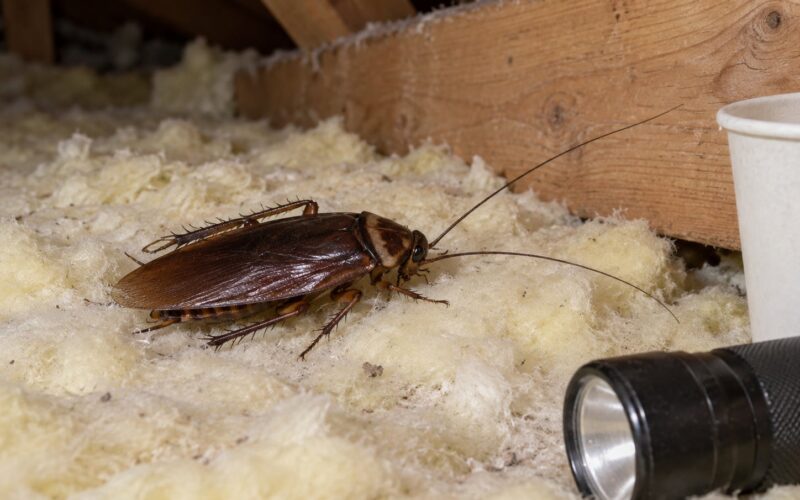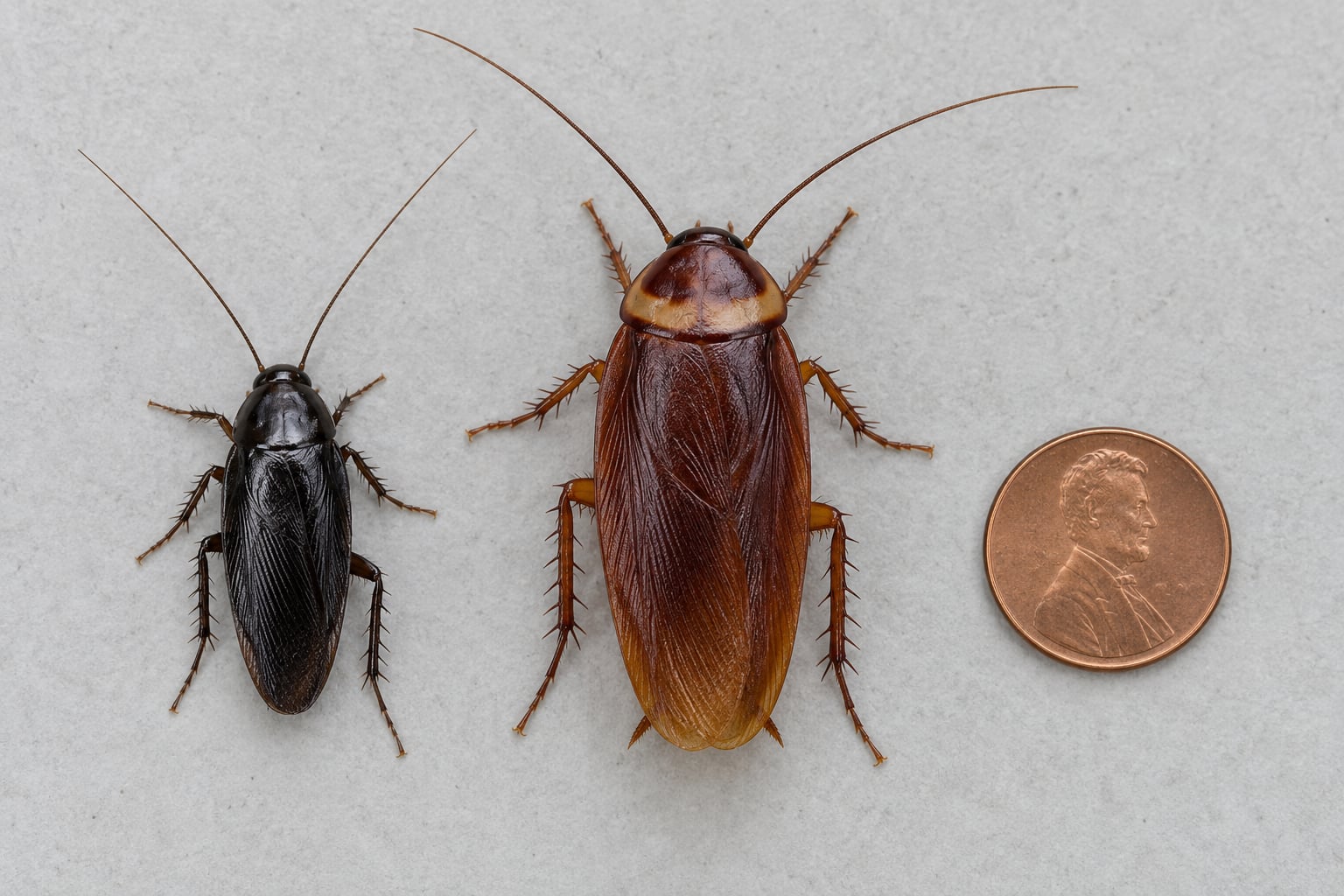
Oriental cockroach vs american cockroach differences come down to three things you can check in about thirty seconds: size, color and where you found it. The Oriental cockroach (Blatta orientalis) is a glossy black, ground-dwelling roach roughly 1 to 1.25 inches long that favors cool, damp basements and crawl spaces. The American cockroach (Periplaneta americana) is a larger reddish-brown roach, usually 1.5 to 2 inches, marked by a pale yellow band behind the head and often found near drains, sewers and mulch.
Getting the ID right changes what you do next. An American cockroach indoors is usually an entry problem — something is getting in from outside. An Oriental cockroach may actually be breeding in the cool damp part of your structure, which is why a first round of spray often doesn’t hold.
Table of Contents
- Oriental Cockroach vs American Cockroach Differences at a Glance
- Appearance: Which Cockroach Is Which?
- Size and Body Shape
- Where Oriental and American Cockroaches Live
- Behavior and Activity Patterns
- Odor and Droppings
- Oriental Cockroach Reproduction and Life Cycle
- American Cockroach Reproduction and Life Cycle
- Which One Causes the More Serious Infestation?
- How to Tell Oriental and American Cockroaches Apart
- Control Differences Based on Identification
- Which Should You Choose?
- Frequently Asked Questions
- The One-Line Rule of Thumb
Oriental Cockroach vs American Cockroach Differences at a Glance
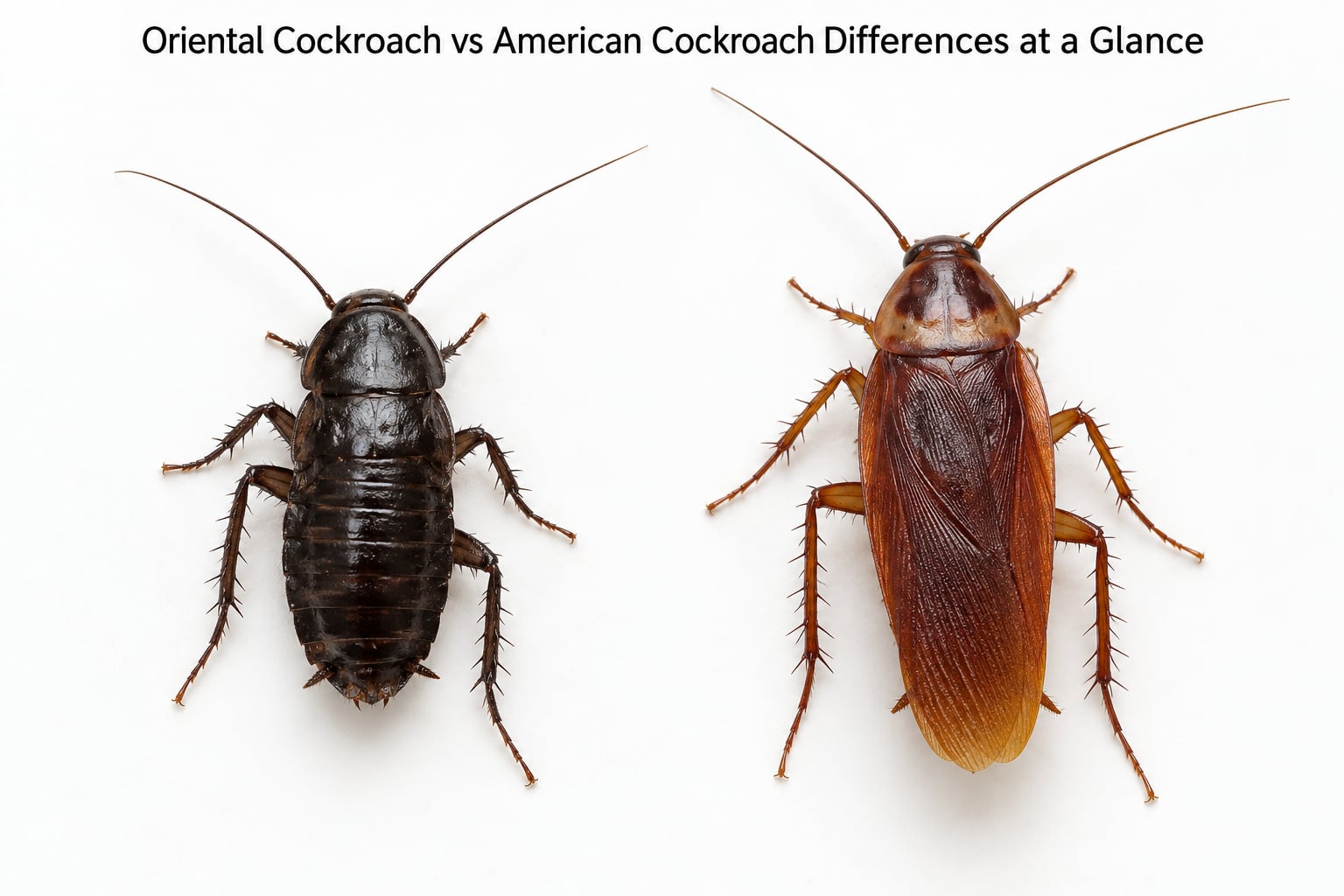
The table below sets oriental cockroach vs american cockroach differences side by side, row by row. Use it as a first pass, then confirm with the clues in the identification section further down.
| Characteristic | Oriental cockroach (Blatta orientalis) | American cockroach (Periplaneta americana) |
|---|---|---|
| Adult length | About 1 to 1.25 inches (roughly 25 to 32 mm) | About 1.5 to 2 inches (roughly 38 to 50 mm), sometimes larger |
| Body color | Uniform glossy dark brown to nearly black | Reddish brown with a glossy sheen |
| Marking behind the head | None; thorax is plain and uniformly colored | Pale yellow or tan band across the front of the pronotum, sometimes described as a figure-eight marking |
| Wings | Adult males have short, reduced wings; females have wing pads only | Adults have well-developed wings that extend past the abdomen |
| Flight | Cannot fly. Glides short distances at most | Good flier; also runs fast and often chooses to sprint |
| Climbing | Weak climber, poor at smooth vertical surfaces | Climbs well and goes up walls, ceilings and pipes |
| Body shape | Flatter and more elongated | Broad, oval and more robust |
| Primary habitat | Cool, dark, damp indoor spaces: basements, crawl spaces, utility rooms, bathrooms, floor drains | Warm, moisture-rich areas: sewers, storm drains, utility rooms, attics, crawl spaces, mulch beds, palm trees |
| Type | Primarily domestic; breeds in and around the structure | Peridomestic; often wanders in from drains, sewers and outdoor harborage |
| Odor | Strong musty odor from secreted pheromones, often noticeable before you see one | Odor present but usually less noticeable in a home |
| Eggs per egg case | About 16 eggs per ootheca | About 14 to 16 eggs per ootheca |
| Nymph development | Slower; roughly a year from egg to adult in cool conditions | Faster; around 6 to 12 months, faster in warm humid conditions |
| Common nicknames | Water bug, black beetle, sewer roach, Oriental cockroach | Palmetto bug, water bug (in the South), Bombay canary, American cockroach |
| Infestation problem | Local breeding problem in cool damp areas, with egg cases hidden in cracks | Entry problem that can escalate into indoor breeding if left alone |
Appearance: Which Cockroach Is Which?
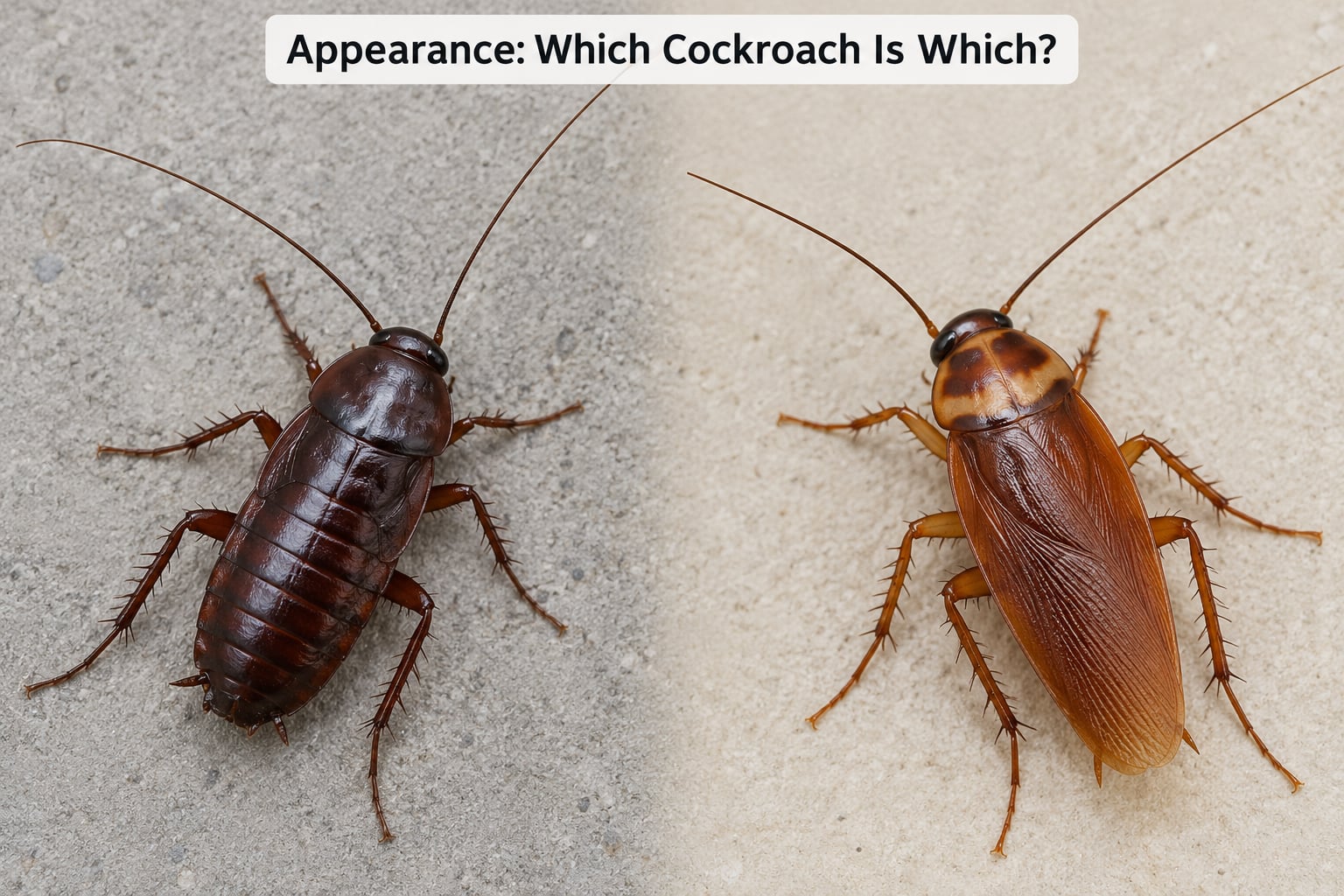
The fastest visual separator is color. An Oriental cockroach is a uniform glossy dark brown to black with no marking behind the head. An American cockroach is a lighter reddish brown and carries a pale yellow or tan band across the front edge of the pronotum, the shield-shaped plate right behind the head.
Wings tell the second story. American cockroach adults have full wings that reach past the tip of the abdomen. Oriental cockroach females have no functional wings at all, just wing pads, and males have short stubs.
One warning before you commit to an ID: nymphs don’t look like adults. Immature roaches of both species are lighter, smaller and lack the adult wing development, so a nymph photo can mislead you. If you find small roaches with two light stripes across the back, that’s a German cockroach nymph, a third species that lives and breeds inside kitchens rather than in damp crawl spaces.
Photo ID without a size reference
Most roach identification questions arrive as a phone photo with no ruler next to the insect, and that is exactly where people go wrong. If you can, drop a US penny beside the roach before you photograph it. A penny is 19.05 mm across, so anything noticeably larger than the coin is out of Oriental range and probably American.
If the roach is already gone, take the measurement indirectly: note which coin fits inside the outline of the body when it was lying flat. When in doubt, capture the location instead of the insect. Where you found it tells you more than what it looks like.
Size and Body Shape
Yes, oriental cockroaches are smaller than American cockroaches. Adult Oriental cockroaches measure about 1 to 1.25 inches (25 to 32 mm) in length, while adult American cockroaches commonly reach 1.5 to 2 inches (38 to 50 mm) and can be larger in warm conditions.
Body shape is the second cue. Oriental cockroaches are noticeably flatter and more elongated, which suits a life spent squeezing under things and in cracks. American cockroaches are broader, rounder and more heavily built, closer to the shape of a large beetle.
Nymphs shrink the usefulness of size on their own. Both species hatch at roughly 3 mm and add about 6 mm with each of ten to thirteen molts. A half-grown American cockroach nymph can easily read as an adult Oriental on length alone, which is why color and location should carry more weight than a tape measure.
Where Oriental and American Cockroaches Live
Oriental cockroaches cluster in cool, dark, damp places; American cockroaches go where warmth and water collect, including places you would rather they didn’t such as sewers and storm drains.
Oriental cockroaches (Blatta orientalis) are found in basements, bathrooms, laundry rooms, boiler rooms and crawl spaces. They also live outdoors in mulch, leaf litter and sewer systems in coastal and northern regions. When late summer turns dry or the first cold snap arrives, outdoor populations push indoors in numbers. People notice them in the fall and assume an indoor problem, but the population may simply be following the weather.
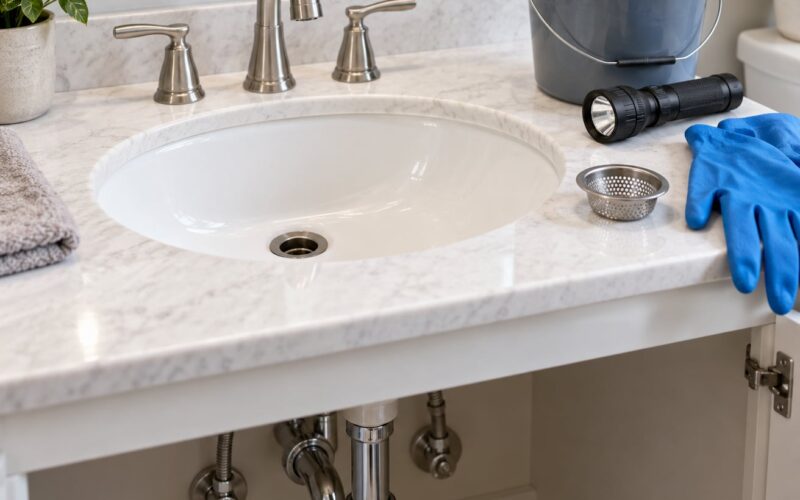
American cockroaches (Periplaneta americana) are described as peridomestic, which means they live around human dwellings rather than strictly inside them. Common entry points include floor drains, sump pump pits, foundation gaps, utility penetrations and doors that don’t seal. Outdoors they live in mulch beds, woodpiles, sewer lines and, in the Southeast, in palm trees, which is where the palmetto bug nickname comes from. They are also strong fliers, and a male can come in through an open window or a gap near the eaves.
Basement sightings after heavy rain are a strong hint toward American cockroach, because saturated ground pushes them out through drains and sewer lines. In northern states, a basement full of dark roaches in late summer points more toward Oriental.
Behavior and Activity Patterns
Both species are nocturnal and both scatter when you turn the light on, but they get there differently. Oriental cockroaches run slowly, glide at most, and are poor climbers on smooth vertical surfaces. American cockroaches move fast, climb well and are more likely to be seen in open areas, on walls, ceilings and in upper rooms rather than pressed into a floor-level crack.
Oriental cockroaches are thigmotactic, which simply means they press against surfaces and hide in tight, dark spaces. That habit is exactly what makes them hard to treat, since a female can carry her egg case deep into a foundation crack where no spray reaches it. This shows up repeatedly in pest control forums as the reason first-round Oriental treatments fail.
Seasonal timing differs too. Oriental activity spikes when outdoor conditions turn dry or cold, usually in late summer through fall. American cockroach numbers climb after heavy rain and during humid stretches, and warm weather plus a steady food source lets them develop much faster.
Odor and Droppings
A strong musty odor in a damp basement is a decent clue for Oriental cockroaches, since they secrete pheromones that produce that smell in heavy populations. Treat odor as a supporting signal rather than proof, because American cockroaches carry an odor too and other problems, like a moldy wall or a wet basement, produce musty smells of their own.
Egg cases, or oothecae, are the stronger physical clue. An Oriental cockroach ootheca is a dark, bean-shaped case about a third of an inch long that the female drops and leaves behind. American cockroach oothecae look similar but are often glued to surfaces in sheltered spots rather than simply abandoned.
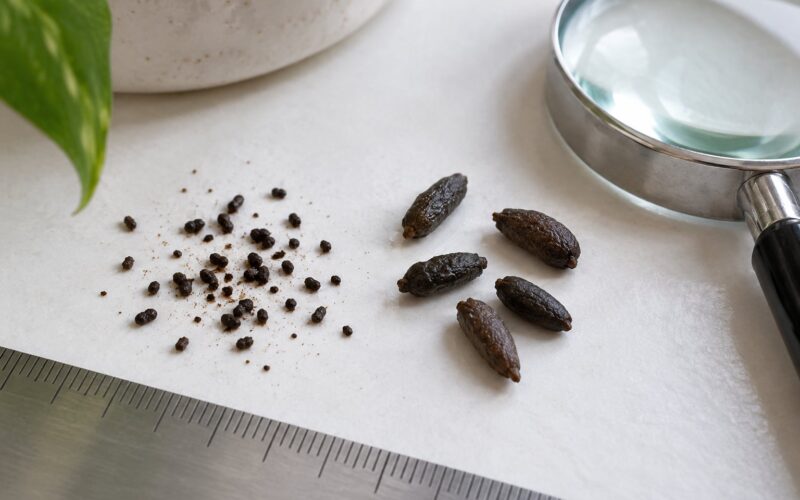
Droppings differ in a way that is useful but rarely decisive. Cockroach droppings look like specks of ground pepper or coffee grounds, and both species leave them. Look at where they land: American droppings and smear marks often show up in kitchens, garages and other food-related areas, while Oriental droppings cluster along basement floors, wall edges and crawl space floors.
Shed skins and dark smear marks along walls near water also point toward American cockroaches, because those marks often sit at eye level on surfaces the roach climbed.
Oriental Cockroach Reproduction and Life Cycle
Oriental cockroach life cycle stages are egg, nymph and adult, with roughly ten to thirteen nymphal instars between the hatch and the final molt. Each female produces about 16 eggs per ootheca, and she drops the case rather than carrying it.
Development is slow compared with the American cockroach. In the cool conditions Oriental cockroaches favor, it commonly takes close to a year from egg to adult. Cool, damp, food-rich conditions speed it up; warm dry conditions stall it.
The practical consequence is that an Oriental population grows steadily and quietly in the part of the house you rarely check, and females tuck egg cases into cracks. That combination of slow growth and hidden egg cases is why Oriental cockroaches often come back after a treatment that seemed to work.
American Cockroach Reproduction and Life Cycle
American cockroach egg cases hold about 14 to 16 eggs, and the female carries the case briefly, sometimes gluing it to a surface in a protected spot before it hatches. Nymphs then develop through about ten to thirteen instars before becoming adults.
Unlike the Oriental, the American cockroach develops fast in heat and humidity, often reaching adulthood in six months under favorable conditions and sooner in a warm boiler room or utility space. That speed is what lets a summer intrusion turn into an established indoor population rather than a series of stray visitors.
The egg case stage is short, roughly six to eight weeks, and nymphs hatch with wing pads that darken with each molt. Adults live for about a year, and females produce multiple egg cases, so an unchecked indoor population compounds quickly.
Which One Causes the More Serious Infestation?
The American cockroach usually causes the larger, faster infestation; the Oriental cockroach causes the harder one to eliminate. They fail in different ways.
An American cockroach problem starts as an entry problem. Something is coming in through a floor drain, a sump pit, a mulch bed against the foundation or a gap in the siding. Fix the entry and you cut off the supply. Ignore it and warm, humid conditions let indoor breeding take over.
An Oriental cockroach problem is a local breeding problem. The population lives inside the structure, in the cool damp zone, and females hide egg cases in cracks where insecticide cannot reach. That is why bait placements help but rarely finish the job on their own.
Health-wise, neither species bites and neither stings. Both mechanically carry bacteria including Salmonella and E. coli picked up from drains and decaying material, and both shed skins and droppings that raise household allergens and can aggravate asthma. The real reason identification matters is practical: knowing which species you have tells you whether to fix a doorway or to fix a basement.
How to Tell Oriental and American Cockroaches Apart
Use at least three clues before you name the species. One clue alone, especially size or color from a phone photo, sends people the wrong way.
- Check the color and the head marking. Glossy uniform black with no marking behind the head points to Oriental. Reddish brown with a pale yellow band on the pronotum points to American.
- Compare size against a coin. Around a penny’s width or less suggests Oriental. Clearly bigger than a penny, closer to a quarter or larger, suggests American.
- Look at the wings. Full wings past the abdomen means American. Short stubs or no wings at all means Oriental.
- Note the exact location. Basement floor, crawl space and floor drain favor Oriental. Upper rooms, garage, kitchen, wall voids and mulch against the siding favor American.
- Check whether you are seeing one or many. A single large roach is often a stray. Repeated sightings, nymphs or droppings in the same area suggest an established population.
Two lookalikes cause most of the confusion. Smoky brown cockroaches are uniformly mahogany brown, glossy and roughly the same size as an Oriental, but they are common in attics, upper floors and gutters rather than damp basements. Wood cockroaches, also called Pennsylvania wood cockroaches, are larger, dark and very long-legged, and they live in decaying wood and firewood piles; multiple sources in entomology and pest forums agree they do not establish indoor populations even when a pair gets inside.
Regional naming adds to the muddle. In the Northeast and Midwest, “water bug” usually means Oriental cockroach. In the South, people often use “water bug” and “palmetto bug” for the American cockroach. Those are nicknames, not identification. When someone tells you a roach was a water bug, ask where it was found and how big it was.
If a treatment decision depends on the species, get a confirmed identification from a licensed pest professional before you spend money on products aimed at the wrong insect.
Control Differences Based on Identification
The species you identified changes the order of operations. Both need water and food removed, but the first priority differs sharply.
If you have Oriental cockroaches
- Dry out the harborage. Fix a dripping condensate line, dehumidify the basement and repair plumbing leaks, because moisture is what keeps the population running.
- Work on the cool, dark rooms first: basement, crawl space, laundry and utility areas.
- Place small bait placements rather than one large blob. Homeowners who compared notes on pest forums repeatedly report better results with many small placements spread along walls and in corners.
- Seal cracks in the foundation and around pipes, since egg cases hidden in those cracks are the main reason treatments stall.
- Clean up leaf litter and mulch stored against the foundation, and move firewood off the ground and away from the wall.
If you have American cockroaches
- Seal the entry first: floor drains with drain plugs, sump pits with covers, gaps around plumbing and siding penetrations, and doors that do not latch.
- Check outdoor harborage near the foundation, including mulch depth and stacked wood or cardboard.
- Address heat and humidity in utility rooms and boiler rooms, which act as indoor nurseries in summer.
- Target wall voids and upper areas with gel bait or dust where you see smear marks, since American cockroaches climb.
- Install screens on windows and seal soffits, because a flying male can get in on its own.
One warning for both: total release foggers rarely solve an infestation of either species. They scatter roaches deeper into wall voids, kill the ones in the open path, and leave the harborage and the food source untouched. Gel bait plus sanitation plus exclusion is the combination that holds.
Which Should You Choose?
Neither species is a choice. The decision is what kind of response your home needs, and it follows from the identification.
- Single stray roach near a floor drain or in the garage? No species decision needed. Seal the drain or gap, set a few sticky monitors under appliances and in the utility room, and watch for two weeks.
- Repeated Oriental sightings in a damp basement? Start with moisture control and crack sealing. This is largely a building problem, and it will return if the damp stays.
- American cockroaches near entry points and in upper rooms? Prioritize exclusion. Until the entry route is closed, treatment is a treadmill.
- Nymphs, egg cases or heavy droppings in several rooms? Multi-unit buildings especially. Oriental cockroaches spread through shared walls, pipe chases and stairwells, so neighbors usually share the problem and coordinated treatment works far better than isolated work in one unit.
- Unsure of the species and about to spend money? Get a licensed pest professional to identify it first. A misidentified infestation is the single most common reason people report paying twice.
Odors and DIY repellents get asked about constantly. No smell reliably repels either species; essential oils, soapy water and homemade mixtures do not hold against an established infestation. Water, food and shelter are what actually drive the population, and those are what you can take away.
Frequently Asked Questions
Are Oriental cockroaches smaller than American cockroaches?
Usually. Adult Oriental cockroaches are generally about 1 to 1.25 inches long, while American cockroaches are commonly 1.5 to 2 inches. Size is a useful clue, but nymphs of both species start tiny and grow through ten to thirteen molts, so a half-grown American nymph can match an adult Oriental. Confirm with color and the pale band behind the American cockroach’s head.
Do Oriental cockroaches live in basements?
Yes. Oriental cockroaches strongly prefer cool, dark, damp spaces such as basements, bathrooms, crawl spaces and utility rooms. They may move indoors when outdoor conditions become hot or dry, so a burst of sightings in late summer or fall can reflect weather rather than an indoor nest. Check for a damp crawl space, a sweating pipe or a failed dehumidifier, since moisture is what sustains them.
Can Oriental cockroaches fly?
No. Adult Oriental cockroaches cannot fly. Females have wing pads only, and males have short, reduced wings, so the most they manage is gliding a short distance across a flat surface. Some pest pages claim Oriental cockroaches are capable of flight, which conflicts with university extension sources. American cockroaches are the flyers in this pair, though they usually sprint for cover rather than take off.
Which cockroach is more dangerous to the home?
Neither bites or stings. Both contaminate food and surfaces, carry bacteria such as Salmonella and E. coli picked up from drains and decaying material, and shed allergen-laden droppings and skins that can aggravate asthma. The American cockroach is bigger and develops faster in warm, humid conditions, so it can build a larger infestation quickly, while the Oriental cockroach is tougher to eliminate because egg cases hide in cracks.
The One-Line Rule of Thumb
Glossy and black, flat, in a damp basement or crawl space, and it cannot fly: Oriental. Reddish brown with a pale yellow band behind the head, larger than a penny, and found near drains, garages or upper rooms: American.
Start tonight with two things. Drop sticky monitors in the basement, utility room and kitchen to find out where the activity actually is, and pull back the bins under your sink and the fridge to look for droppings that tell you which room is feeding them. Then match your species to its weak point: dry out and seal cracks for Oriental, seal drains and entry gaps for American. If you see nymphs or find egg cases in more than one room, call a licensed professional before you buy anything, because the wrong product for the wrong species is the most common reason a first treatment fails.