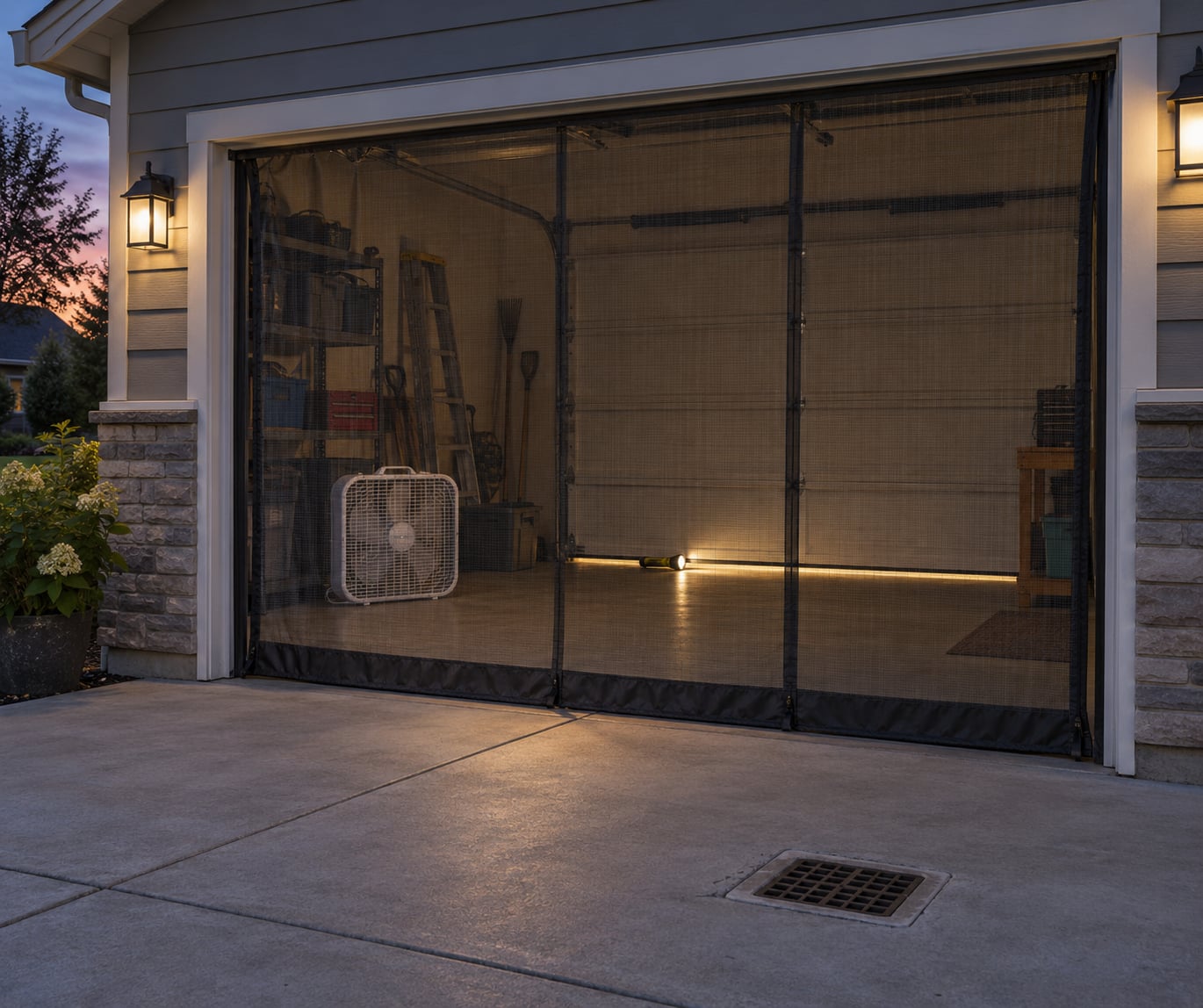
The fastest way to keep mosquitoes out of a garage is to hang a weighted magnetic mesh screen across the open doorway, seal the gap under the overhead door, and drain every bit of standing water inside. Add moving air from a fan and the space becomes genuinely bearable, even with the door up.
The reason the garage deserves its own answer is the working constraint. You are not trying to protect an empty room from an occasional intruder. You are trying to stay comfortable for three hours on a Saturday with the door lifted, a fan running, and your own breath pulling mosquitoes straight in. The person in the garage is the largest, warmest, smelliest target in the neighborhood, which is exactly why screens, fans and drained water do more than any spray you can buy.
Also worth knowing before you start: mosquitoes hunt by carbon dioxide, body heat and the odor of skin, and they are poor fliers. A screen removes the route, water removal removes the nursery, and moving air makes flight hard. That combination solves most garage mosquito problems without a single chemical in the room.
Table of Contents
- What You Need to Keep Mosquitoes Out of a Garage
- Step-by-Step: How to Keep Mosquitoes Out of a Garage
- Common Mistakes
- Frequently Asked Questions
- Do citronella candles keep mosquitoes out of a garage?
- Can a fan alone keep mosquitoes out of a garage?
- Where do mosquitoes hide in a garage during the day?
- How can I keep mosquitoes out of an attached garage?
- What is the best way to treat mosquitoes inside a garage?
- When should I call a pest professional for mosquitoes?
- Conclusion
What You Need to Keep Mosquitoes Out of a Garage
Most of the real work needs a flashlight, some patience and a weekend hour. The rest is optional and should match what your garage is actually built from.
- Flashlight and a hand mirror. A mirror on an extension handle lets you check the top edge of the door track and the underside of the header seal.
- Screwdriver, pliers and a socket set. Needed for roller adjustment, strike plates and hinge hardware.
- Caulk or crack sealant. Use paintable acrylic latex for drywall cracks and gaps around window frames; use polyurethane or hybrid sealant on bare wood, brick and concrete edges.
- Weather stripping for the door bottom and sides. Vinyl or brush seals fit most overhead doors; closed-cell foam weatherstrip works well on the side jambs.
- Screening material for small vents. Aluminum or stainless mesh is durable enough for a garage vent cover; fiberglass screen tears too easily in a dusty space.
- Floor drain cover or mesh plug. The single most overlooked water source in a garage.
- Bucket and old towels. For hauling water from a drain or catching drips while you work.
- A box fan or oscillating fan. The cheapest and most praised method in every garage forum I have read.
- Gloves and a dust mask. Sensible when you are pulling wet debris off a floor or opening a drain.
- Water-based insecticide labeled for the intended site, only if you decide you need one. Check that the label names the location, such as outdoor surfaces or structural joints, before you buy.
If you only want to buy one thing, make it the screen. Fans run close to second and cost almost nothing more than a pizza.
Step-by-Step: How to Keep Mosquitoes Out of a Garage
Work in this order and re-check the garage after the next heavy rain. Physical exclusion plus source reduction does the heavy lifting; treatment products are a finishing touch for what you cannot physically fix.
1. Inspect the garage for entry points
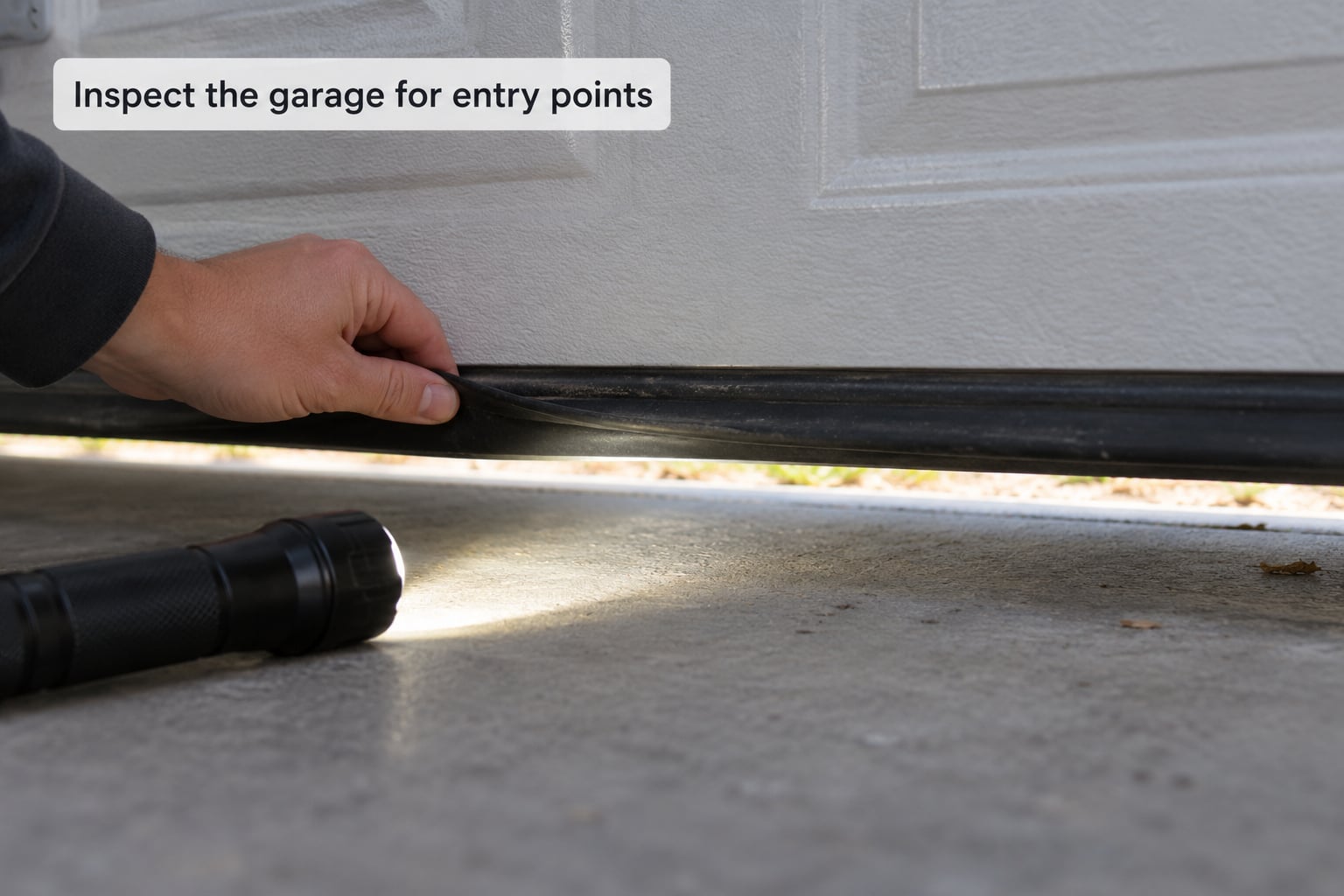
The first thing to do is find out where they are coming in. Do the inspection twice: once in daylight, when you can see daylight lines, and again at dusk, when you can see mosquitoes moving.
Start at the bottom of the overhead door. Close it and look for a band of light along the threshold. Any gap wider than a few millimeters is a highway, because a mosquito is small enough to follow the air through it. Then check the side jambs, where the vertical edges meet the door, and the header gap along the top.
Next look at everything else: the gap under the wall where the house meets the slab, the utility penetrations for the water heater and dryer vent, the pet door, the gaps around the interior door to the house, and the garage service door. Check the ceiling where pipes and wires drop through, and check any window screen that has been pushed back into the frame.
Inside, look for resting spots before you leave. Mosquitoes rest in shade and stillness: along the top of the door track, under shelving, inside cardboard boxes, behind stored plywood, and in the dark corner where the mower sits. Standing water shows up at the same time, and I will cover that next.
2. Repair gaps and seal accessible openings
This is the part that determines whether the rest works. Fit a vinyl or brush seal along the bottom edge of the door so it presses against the slab when the door closes. Cut it to length, nail or screw it at regular intervals, and check that the door still moves freely without binding.
Tighten the horizontal lift cables and adjust the drums so the sections sit evenly. A door that sags leaves a wedge-shaped gap at one side that weatherstripping alone will not close, and a loose section rattles in a way that draws attention to every flaw in the seal.
Run a bead of exterior sealant around the header and side jambs, then fill wall cracks and window frame gaps with paintable acrylic latex. Work in short beads so the caulk can follow movement in the wall instead of tearing later.
Cover small vents and dryer exhaust openings with durable mesh screening, and fit a strip of weatherstripping around the interior door if the garage connects to the house.
The one hard rule: never seal a garage so tight that it traps combustion air. A gas water heater, furnace or any other fuel-burning appliance in the space needs its required combustion and exhaust ventilation. Block a flue or a combustion air inlet and you have created a carbon monoxide problem where there was none. If you are unsure whether a vent serves an appliance, leave it alone and check the appliance manual or ask a qualified technician.
3. Stop mosquitoes from using standing water
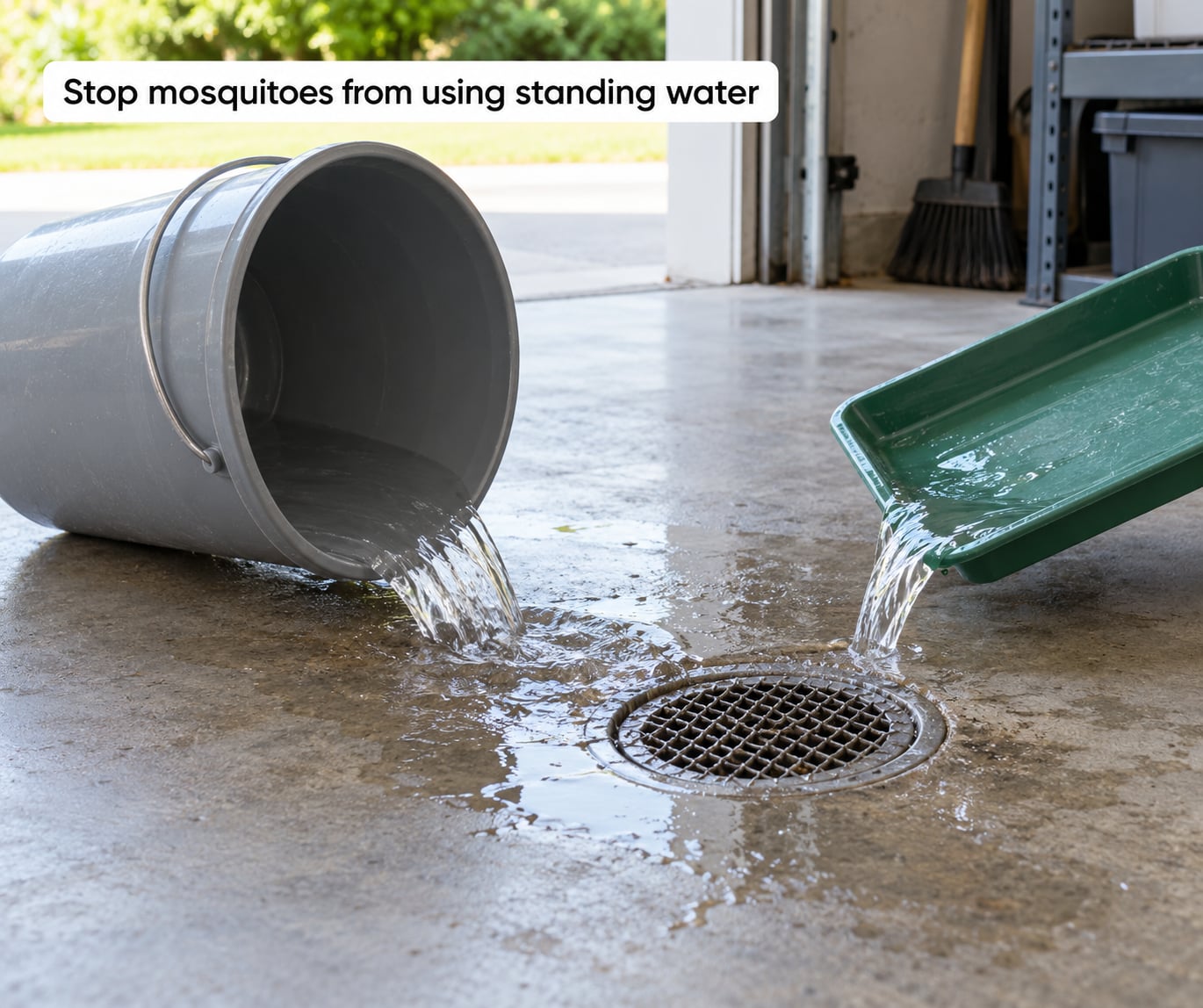
Water is the whole game. Female mosquitoes can lay eggs in a container holding less water than a bottle cap, and those eggs can survive a drying-out period and hatch when water returns. That is why a garage floor drain that holds water for two days after a rainstorm can produce a steady indoor population without any breeding site outside at all.
Run through the garage list once a week and you will usually find several of these:
- The floor drain, especially if it sits in a low spot of the slab. Clear debris, scrub it, and if it holds water after the floor dries, cover it with mesh and add water to the top weekly.
- Mop buckets, mop heads and a wet mop head left on the concrete overnight.
- Paint cans and solvent cans with lids off. Even an inch of solvent-thinned water works as a breeding site.
- Plant saucers, drip trays and pots you brought in for a project.
- A tarp sagging in the middle, where rain collects in a bowl no one notices.
- Piles of damp sawdust and wood chips. Do not leave wet debris on the slab.
- Cardboard and paper, which hold a surprising film of water against the floor.
- Tires, buckets and bins outside the door that fill after a storm.
- Downspouts that dump beside the foundation, and gutters that hold water in a sag.
Empty containers at least once a week. Scrubbing matters too, because eggs stuck to the wall of an otherwise empty bucket survive until you scrub them out.
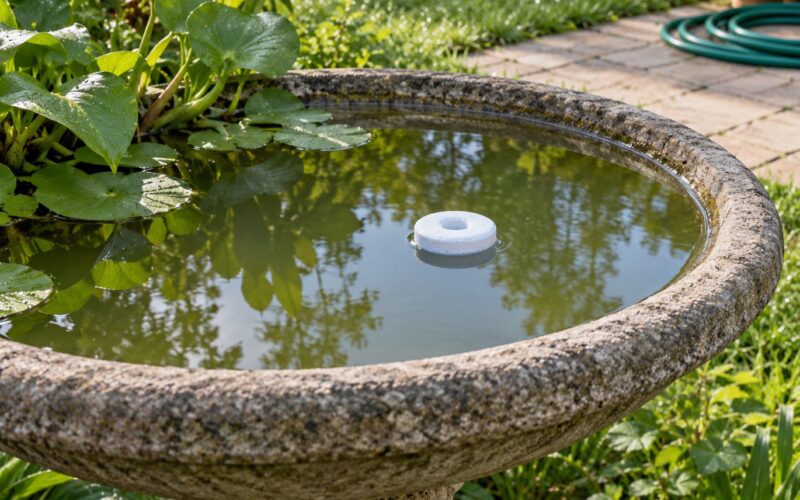
Where water is unavoidable and cannot be drained, talk to your local mosquito control district about Bti (Bacillus thuringiensis israelensis) or methoprene. Bti kills mosquito larvae in the water as they hatch, and methoprene stops them from developing into adults. Neither works on flying adults, both need reapplication as the water dilutes them, and both are best used under a mosquito district’s guidance rather than sprinkled around a workbench.
4. Improve airflow and reduce suitable resting areas
A fan is the highest-value step in this whole guide and it costs almost nothing. Put a box fan or oscillating fan in the door opening, or near a side window, so air moves across the space you are standing in. Mosquitoes are weak fliers with an unstable hover, and a steady breeze makes flight and landing difficult.
Longtime garage users describe it the same way. One wrote on GarageJournal: “Keep the air moving. They do not like a breeze.” Another described a box fan blowing out through the overhead door as the single change that finally made his garage usable in July.
Two caveats. A fan works best as part of a setup, not as a magic switch. If you run a fan to blow air out the open door with no screen in that doorway, you are also giving mosquitoes a wide-open highway. And the fan competes with some repellent devices, which is why the devices people like Thermacell appear to lose effectiveness in a breeze.
Remove the other half of the equation. Mosquitoes rest in still, shaded, cluttered places, so clearing stored cardboard, moving shelving off the wall, keeping objects off the floor and trimming vegetation back from the opening makes the space less attractive to land in.
Lighting deserves a paragraph of its own. Shop lighting is not a control measure, but it changes how much you notice. LED lamps around 5000K are widely reported by woodworkers to reduce the bug load compared with warm incandescent halogen work lamps, and yellow or amber lamps are recommended over white fixtures because white light draws more insects. If you are replacing shop lights anyway, this is a good time to pick a cooler white bulb rather than a warm one.
5. Use labeled mosquito treatments where appropriate
Start with EPA-registered products and read the label before you buy, not after you open it. The label tells you what the product may legally be used on, whether it may be applied indoors or only outside, and what personal protective equipment it calls for. Using it anywhere the label does not permit is a violation, not a shortcut.
What works where, in plain terms:
- Aerosol sprays and any fogger. Knock mosquitoes down quickly and then do nothing at all once the cloud has settled. Never run one in a garage you intend to be in immediately, and never run one in a closed garage at all. The solvent vapour and the fire risk around stored gasoline, fuel and paint thinner are real, and ventilation rarely clears a small space fast enough.
- Water-based insecticide for structural joints and cracks. Useful for resting harborage, applied to surfaces where the label permits, allowed to dry, and kept away from food surfaces, pet bedding and open containers.
- Larvicides. Bti and methoprene in standing water only. They have no effect on adults and no effect on anything you cannot reach.
- Outdoor perimeter treatment. Applied to vegetation and harborage outside the garage where mosquitoes rest before entering, following the label application interval and respecting pollinators. Treat late evening when bees are back in the hive, and never treat where water flows to a drain or pond.
Be honest about devices. Anything that mimics the sound of a female mosquito in flight, which is what ultrasonic plug-ins do, is not supported by reliable evidence. A GarageJournal user put it bluntly: “All ultrasonic pest repellents are a scam. Ask any real exterminator.” Treat that as a reasonable default.
Insect light traps have a real limit too. They kill large numbers of mosquitoes, and the mosquitoes they kill are a fraction of the mosquitoes biting you. Run one inside a closed garage and the ultraviolet and blue light competes with your own body heat and carbon dioxide for the trap’s attention, drawing more mosquitoes toward the working area than away from it. If you own one, put it well outside, roughly 25 feet from the door, and let it draw mosquitoes away from you rather than toward you.
On personal protection: for long sleeves and light colors during garage work, or a product containing DEET, picaridin, IR3535 or oil of lemon eucalyptus, follow the label and keep repellents out of reach of children and pets. The National Pesticide Information Center and the EPA both publish guidance on active ingredients if you want to read past the marketing.
6. Maintain protection and check the result
Set a monthly check during mosquito season and add one after every heavy rain. The check takes ten minutes: run a flashlight line along the bottom of the overhead door, look for daylight at the jambs, empty and scrub the floor drain, check the mop bucket, and confirm any water-based treatment is still inside its labeled interval.
Measure the result honestly. Count bites for twenty minutes of work before you make changes, then repeat the same count a week later. Better: check the floor drain and any water source at the start and end of a week. Fewer bites in the doorway than there were last month, and standing water gone after rain, is the sign that the work held.
If you still get steady daytime bites in the garage after two weeks of sealing, draining and airflow, the entry route is probably not where you looked. Walk the perimeter again at dusk, check the roof edge and any soffit vent, and look for gaps under the door to the house. If you cannot find it, that is the point to call a licensed pest professional and ask them to identify the entry point and the species before anyone quotes you treatment.
Common Mistakes
Nearly every failed garage mosquito attempt I have seen traces back to one of a handful of specific errors.
Common Mistakes and Quick Fixes
Spraying first and sealing never. A knock-down spray reduces the count you can see today and does nothing about the twenty that come in next week. Fix the openings first. Correction: spend the first afternoon on gaps and weatherstripping, then decide whether you still need a product at all.
Leaving water inside the garage. A screen door cannot protect you from mosquitoes born in your own mop bucket. One water source left untouched can out-produce everything you do outside. Correction: empty and scrub every container weekly, and check the floor drain specifically, because most people only think about gutters and tires.
Hanging a bug zapper inside. The light attracts and the mesh kills, which is fine in an unoccupied yard. Inside a working garage you are a better target than the trap. Correction: move the trap well outside and away from the doorway.
Buying ultrasonic plug-ins. There is no good evidence they change mosquito behavior around you. Correction: spend that money on screening or a fan instead.
Blocking ventilation to keep mosquitoes out. Sealing an attached garage airtight can starve a gas water heater or furnace of combustion air. Correction: seal around walls and doors, never around flues or combustion air inlets.
Running a fogger in a closed garage. You are filling an enclosed space full of people, pets, stored fuel and solvent fumes with a pesticide cloud. Correction: keep the door open and leave, or skip the fogger and use a residual product applied to harborage.
Running a propane or CO2 unit inside and expecting it to beat you. These are yard devices. Your own breath and body heat out-compete the lure in an enclosed space, and a running fan disperses it further. Correction: if you use one, place it just outside the doorway in still air, and understand that it is a supplement, not a solution.
Trusting a single measure. A screen with no drainage, or a fan with no screen, or drains with no seal. Each piece helps. Together they work. Correction: treat the garage as three jobs, physical exclusion, water removal and airflow, and finish all three.
Frequently Asked Questions
Do citronella candles keep mosquitoes out of a garage?
They help a little, mostly by masking nearby odors, and one burning in a garage is a poor trade. The smoke is unpleasant in an enclosed space and the candle is a fire risk near sawdust and rags. Some woodworkers place one at the base of a fan blowing toward the open door. Expect a modest effect at best, and never leave one burning while you leave the garage.
Can a fan alone keep mosquitoes out of a garage?
No. Air movement disrupts mosquito flight, and it is the most repeated tip in garage forums, but a fan does not stop them from walking in through a gap under the door or breeding in the floor drain. Pair the fan with a screen in the doorway and a drained floor drain. Alone, it makes conditions harder for them without blocking entry.
Where do mosquitoes hide in a garage during the day?
Look up, not down. They rest in still, shaded spots along the top of the door track, under shelving, behind stored plywood, inside cardboard boxes and in dark corners behind stored equipment. Daytime bites in a garage are often Asian tiger mosquitoes, which bite in daylight and can bite repeatedly before you notice a single bite.
How can I keep mosquitoes out of an attached garage?
Treat it as two jobs. Seal the overhead door, the side jambs and the interior door to the house with weatherstripping and sealant, and screen the open overhead doorway. On the living space side, run screens on windows, keep the interior door closed, and drain any water that collects near the entry. Never seal combustion air inlets for a gas water heater or furnace.
What is the best way to treat mosquitoes inside a garage?
Physical exclusion wins. Screen the doorway, seal the bottom and sides of the overhead door, caulk gaps, drain standing water and run a fan. If adult mosquitoes are still resting inside, use an EPA-registered water-based insecticide applied to harborage surfaces exactly as the label directs. Never fog a garage you plan to re-enter, and never fog a closed space.
When should I call a pest professional for mosquitoes?
Call one if you are finding mosquitoes inside during the day in numbers that sealing and drainage do not reduce within two weeks, if you cannot identify the entry route, or if a neighbor’s property is producing adults that fly into your garage. Ask for an inspection that identifies the species and the entry point first. For a one-car garage, screening and drainage are usually cheaper and simpler than any contract.
Conclusion
Start with three things: find the openings, remove the standing water, and seal or screen what you find. That order matters. Begin at the overhead door, since the gap along the bottom edge and the side jambs is the most common route into a garage, then check the floor drain and any bucket, tarp or paint can holding water.
Add a fan after that, treat anything remaining with a product whose label covers the surface, and re-check after the next rain. Do the doorway and the floor drain in the same afternoon and you will notice the difference the next time you open the door.