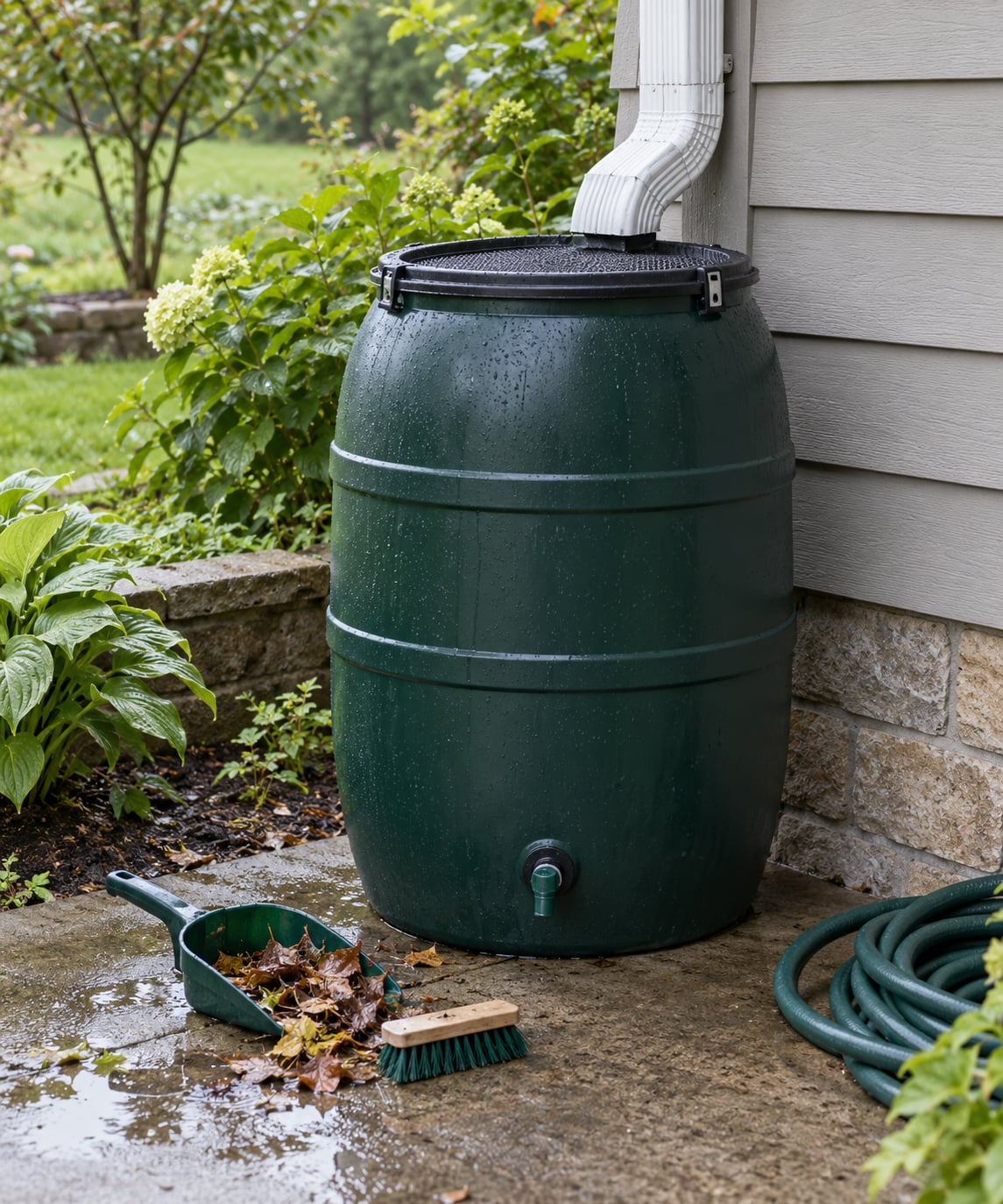
Everything you need for how to stop mosquitoes breeding in a rain barrel comes down to three layers: a tight-fitting lid, a 20-mesh screen over the opening, and a monthly Bti larvicide dunk for anything that slips past. The screen stops adult mosquitoes laying eggs at all, and the dunk kills larvae before they ever become a biting mosquito. Budget about 20 minutes for the first clean-out, then five minutes a week.
A rain barrel is close to a perfect breeding site. It holds a large volume of still water, it sits in shade near the house, and rain keeps refilling it. Female mosquitoes lay eggs on the water surface and on the damp wall just above it, and in warm weather those eggs can hatch and produce adults in roughly seven to ten days.
The good news is that a barrel is one of the easiest places in a yard to fix. You are not chasing swarms or fogging a garden. You are sealing one container and keeping it sealed.
Table of Contents
- What You Need
- How to Stop Mosquito Breeding in a Rain Barrel
- Common Mistakes
- Frequently Asked Questions
- Do I have to empty my rain barrel to stop mosquitoes?
- Is a screen and lid enough on their own?
- How quickly do mosquito larvae grow in a rain barrel?
- Will vinegar or bleach kill mosquito larvae in a rain barrel?
- Are mosquito dunks safe for edible plants, pets and fish?
- Why do I still get mosquitoes even though my barrel has a lid?
- Conclusion
What You Need
Gather these before you start. Most homeowners already own half of them.
- 20-mesh insect screen (1/16-inch openings) in aluminum, stainless steel or heavy-duty plastic mesh. This is the specification that actually blocks mosquitoes. Anything coarser and they walk straight through.
- A lid that fits with no gaps at the rim, plus a clamp, hose clamp or heavy rubber strap to hold the screen and lid down.
- Mosquito dunks or Bti granules, dosed for your barrel volume. These carry the active ingredient Bacillus thuringiensis israelensis.
- A stiff scrub brush and a bucket for draining and cleaning.
- Gloves, especially if you are handling an older barrel with loose sediment at the bottom.
- A flashlight or headlamp for checking gaps and reading the water surface in shade.
- A small aquarium net or dipper for removing larvae and debris without draining the whole barrel.
If your barrel came with a built-in screen, check it before you buy anything. Screens supplied with barrels are often too coarse or sit in a groove that leaves a gap at the edge.
How to Stop Mosquito Breeding in a Rain Barrel
Work through these five steps in order. The first two stop mosquitoes getting in, the last three make sure the barrel stays inhospitable for the rest of the season.
Inspect the rain barrel and its lid before you patch anything
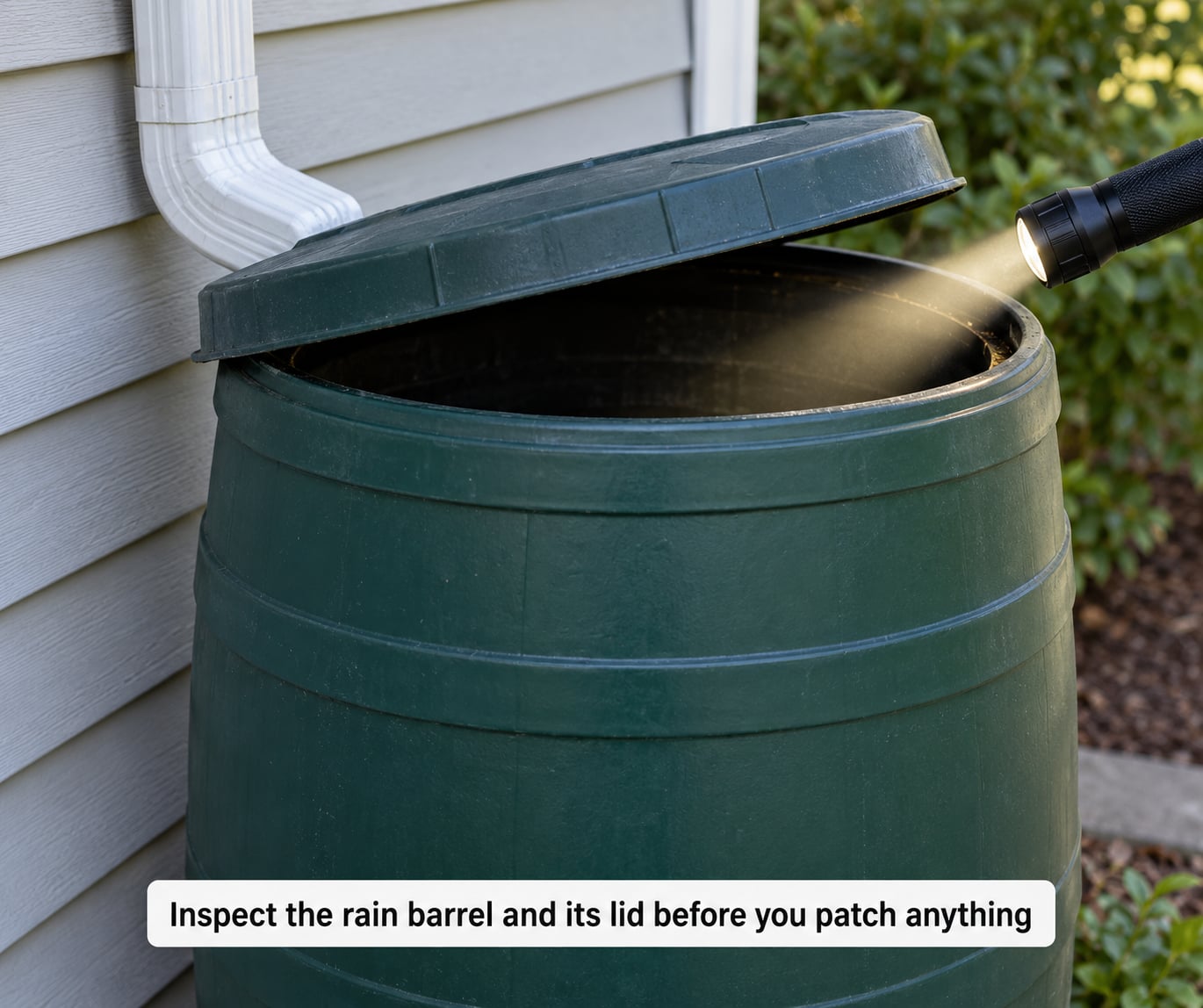
Start with a flashlight and look for every route in. A lifted or propped lid is the obvious one, and it is the most common.
- Run your hand around the rim. Any gap wider than a pencil is a doorway.
- Check the downspout inlet where water enters. Cracked inlets and torn screens around the hole are popular entry points.
- Look at the overflow outlet and the ground around it. Water that pools in a splash block or a corrugated overflow hose is standing water that nobody treats.
- Note any cracks in the body, especially near the base, and any rim damage that stops the lid seating flat.
Shine the light down inside and look at the walls above the waterline. That dark, damp band is exactly where females stick eggs.
Install a tight mosquito-proof screen and lid
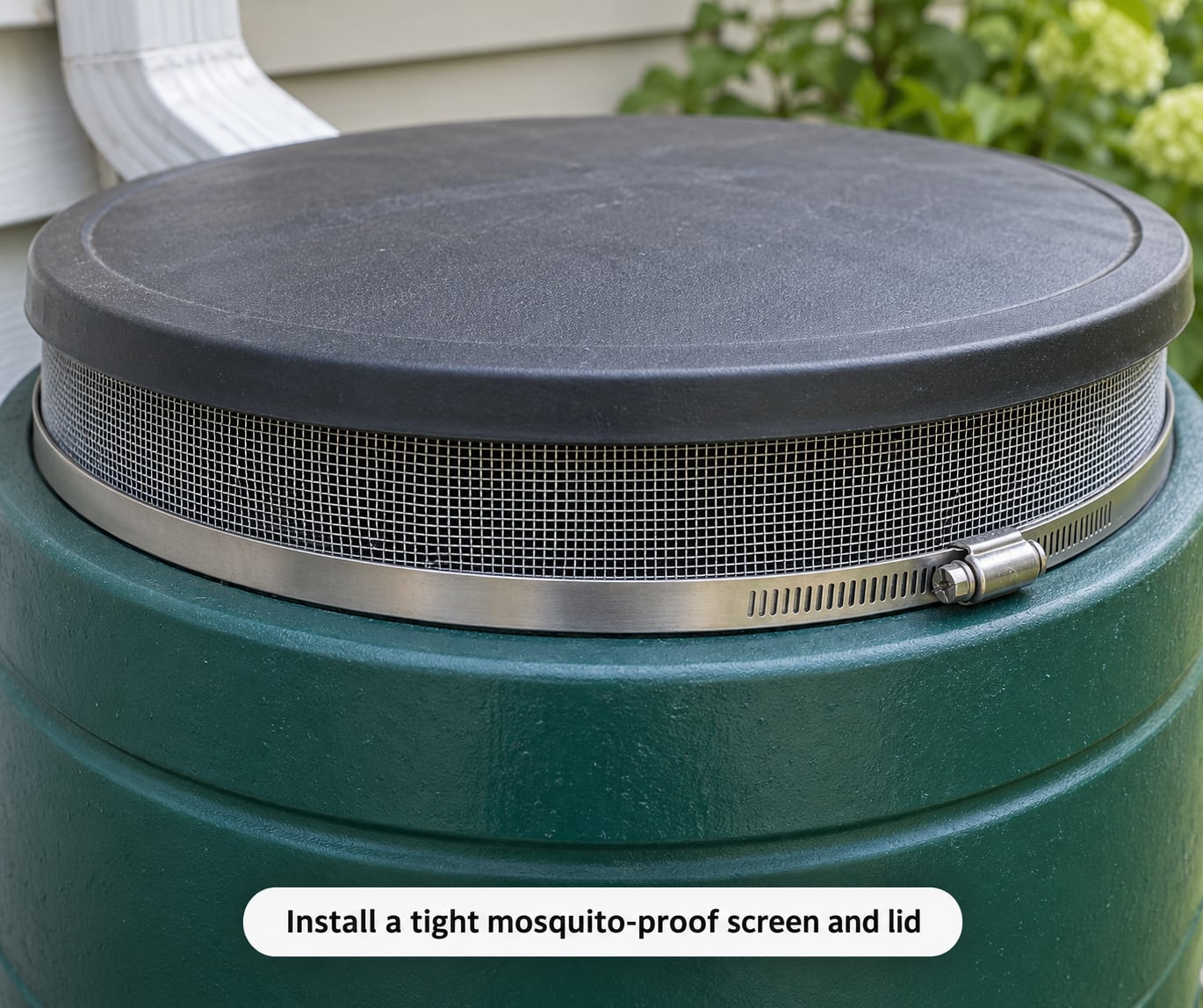
Cut a piece of 20-mesh screen (1/16-inch openings) a few inches larger than the opening. Lay it over the barrel mouth, set the lid on top, and clamp or strap the two together so the screen is trapped between the rim and the lid with no gap.
This sandwich arrangement is the whole trick. Screen resting loosely on top of the barrel gets lifted by wind, leaves an edge mosquitoes can find, and eventually tears at a fixing point.
Check three things before you walk away: that the screen covers the inlet hole as well as the main opening, that the lid still closes fully, and that the overflow and any siphon line still work. A sealed barrel that cannot drain overflows, and overflowed barrels breed mosquitoes too.
Add one Bti dunk per 50 gallons of water, following the label for larger barrels. The bacteria are ingested by feeding larvae and stop them before they reach the pupal stage. Unlike a spray, a dunk stays active in the water for the period stated on its label.
Remove debris and keep the water moving
Once a month, dip out the floating leaves and the settled sludge. Leaves form a mat that holds eggs and larvae against the surface, where they are hard to see and hard to drown.
Scrub the walls inside the barrel too, especially at the waterline. That ring of algae and biofilm is the egg-laying surface you are trying to remove.
Cleaner water with any movement in it is poor habitat. Mosquitoes favor still, sheltered water with a surface film of organic matter. If your barrel has a diverter or a small circulation line, leave it running, or stir the water with a pole during inspection so the surface is never completely static.
Check for larvae and eggs at least weekly
Weekly is enough, and it takes less time than boiling a cup of coffee. Look for movement, not insects. Mosquito larvae, often called wrigglers, hang from the surface film and dart down when you shadow the water with your hand. They are most visible when the barrel is quiet and the sun is low.
You will also see eggs as dark specks stuck to the damp wall just above the waterline, often in a rough cluster.
Here is how the common treatments compare once you have found something.
| Treatment | How it works | Lifespan | Good to know |
|---|---|---|---|
| Mosquito dunk (Bti granule) | Larvae ingest the bacteria as they feed and die before pupating | Up to 30 days per label | Labeled for plants, pets and birds; re-dose monthly or after heavy rain |
| Mosquito bit (Bti water-soluble packet) | Same bacteria, dissolves fully in the water | Up to 30 days per label | Leaves no particles behind; dissolves faster in warm, moving water |
| Vegetable or coconut oil film | Blocks the breathing tube at the surface | Until rain breaks it | Works best in still water; a film can coat leaves and clog the overflow |
| Dish soap film | Breaks surface tension so larvae cannot breathe | Days, until it re-forms | Needs re-dosing after every rain; not reliable against eggs |
If you find larvae, drop in a dunk for the volume, then check again in three or four days. If the barrel is badly infested or you cannot seal it yet, empty it, scrub it, rinse it and refill it before putting the screen back on. Emptying once beats leaving a populated barrel.
Maintain the barrel through rain and seasonal changes
Treat the barrel as a five-minute weekly job and a 20-minute monthly one.
- Monthly: replace the dunk, skim debris, scrub the waterline ring.
- After every storm: check the screen is still seated and clamped, and clear the overflow so water is not pooling behind the barrel.
- In hot weather: the life cycle speeds up and dunks dissolve faster. Top up more often, especially after a large volume of fresh water enters and dilutes the treatment.
- In autumn: leaf fall fills the barrel with the exact organic matter mosquitoes like. Clear it weekly until the trees are bare.
- Before winter: drain and clean the barrel if it is not connected to a downspout, so it does not hold stagnant water all winter.
Label the barrel as non-potable water if anyone but you draws from it. It is good habit and it stops someone treating it as drinking water.
Common Mistakes
Leaving the lid propped open. A lid held back by a rock or a length of hose is the single most common failure. Fix it by fitting a clamp or strap, or swap in a lid with a locking rim.
Using screen with holes that are too big. Window screen and hardware cloth sold as “mesh” are frequently too coarse. If you cannot tell, hold it up to light and check the openings against 1/16 inch. Anything visibly larger lets a mosquito pass.
Ignoring the water around the barrel. A blocked overflow, a splash block that never dries or a corrugated pipe lying in grass can produce more mosquitoes than the barrel itself. Use smooth-sided overflow hose, aim it away from the foundation, and keep the ground around the barrel draining.
Treating with bleach or vinegar on a schedule. Bleach breaks down quickly in sunlight and does not reliably kill eggs stuck to the wall, and repeated dosing makes water unusable on edible crops. Vinegar barely changes the water. Neither replaces a screen. If you want a biological treatment, use Bti, which is labeled for the job.
Relying on smells. Citronella, tea tree, neem and cinnamon oils repel people and, briefly, adult mosquitoes. They do not stop egg-laying in water, and undiluted oils can damage plants and harm aquatic life.
Checking only in July. Mosquitoes are active in spring, not just midsummer, and a barrel left untouched through a warm spell produces a whole generation before you notice.
Fixing the barrel and assuming you are done. If mosquitoes keep appearing after the barrel is sealed and treated, walk the property. Clogged gutter troughs, low spots in drainage swales, tires, folded tarps, blocked drains, bird baths and water held in tree holes are all more productive than one rain barrel.
Frequently Asked Questions
Do I have to empty my rain barrel to stop mosquitoes?
No. Emptying a barrel after every shower is not realistic, and it is not necessary either. A barrel with a snug lid and 20-mesh screen blocks adult mosquitoes completely, which stops egg-laying. Keep one Bti dunk in the water per 50 gallons and replace it about every 30 days, or sooner after a large volume of fresh rain. A weekly glance at the water is still worth keeping.
Is a screen and lid enough on their own?
Yes, if both are genuinely mosquito-proof. A 20-mesh, 1/16-inch screen plus a tight lid stops adults getting in, so no eggs are laid. Screens fail when the mesh is too coarse, when it sits above the rim so mosquitoes slip under the edge, or when a loose lid lifts it. Keep a Bti dunk in the barrel anyway as cover for anything that found a way in before you sealed it.
How quickly do mosquito larvae grow in a rain barrel?
Faster than most people expect. Eggs laid on the surface hatch in 24 to 48 hours in warm water, and larvae reach the pupal stage and emerge as adults in roughly seven to ten days in summer conditions. That is exactly why monthly dosing matters: the treatment window on the label outlasts the life cycle, so no larvae survive long enough to emerge. Cooler weather slows both.
Will vinegar or bleach kill mosquito larvae in a rain barrel?
Neither works as a routine treatment. Household bleach breaks down quickly in sunlight, does not reliably kill eggs stuck to the barrel wall, and repeated dosing leaves water you would not want on edible crops. Vinegar barely changes the water. Both also destroy the harmless insects and bacteria a barrel normally supports. A Bti dunk is designed for this job and labeled for plants, pets and wildlife.
Are mosquito dunks safe for edible plants, pets and fish?
Yes, when you follow the label. Dunks contain Bti, a bacterium that targets mosquito larvae and has no effect on people, pets, birds or plants at label rates. Gardeners routinely use them in barrels they draw from to water vegetables, herbs and houseplants. Follow the dose for your barrel volume rather than adding extra, and keep the barrel labeled non-potable.
Why do I still get mosquitoes even though my barrel has a lid?
Usually the barrel is not the culprit, or the lid is not actually sealing. A propped lid, a gap at the downspout inlet, or an overflow hose pooling behind the barrel all give mosquitoes a way in. If the barrel is sealed and treated, walk the yard instead: clogged gutter troughs, low spots in drainage swales, tires, tarps, blocked drains, bird baths and tree holes are far more common breeding sites.
Conclusion
Three actions cover most of it. Close the barrel properly today, with 20-mesh screen trapped under a clamped lid, and confirm the overflow still drains. Drop in a Bti dunk dosed for the barrel volume. Then take five minutes once a week to skim debris, check for wrigglers and keep the screen seated.
That habit carries you through mosquito season in 2026 and every year after, without emptying the barrel or reaching for anything harsher than it needs.