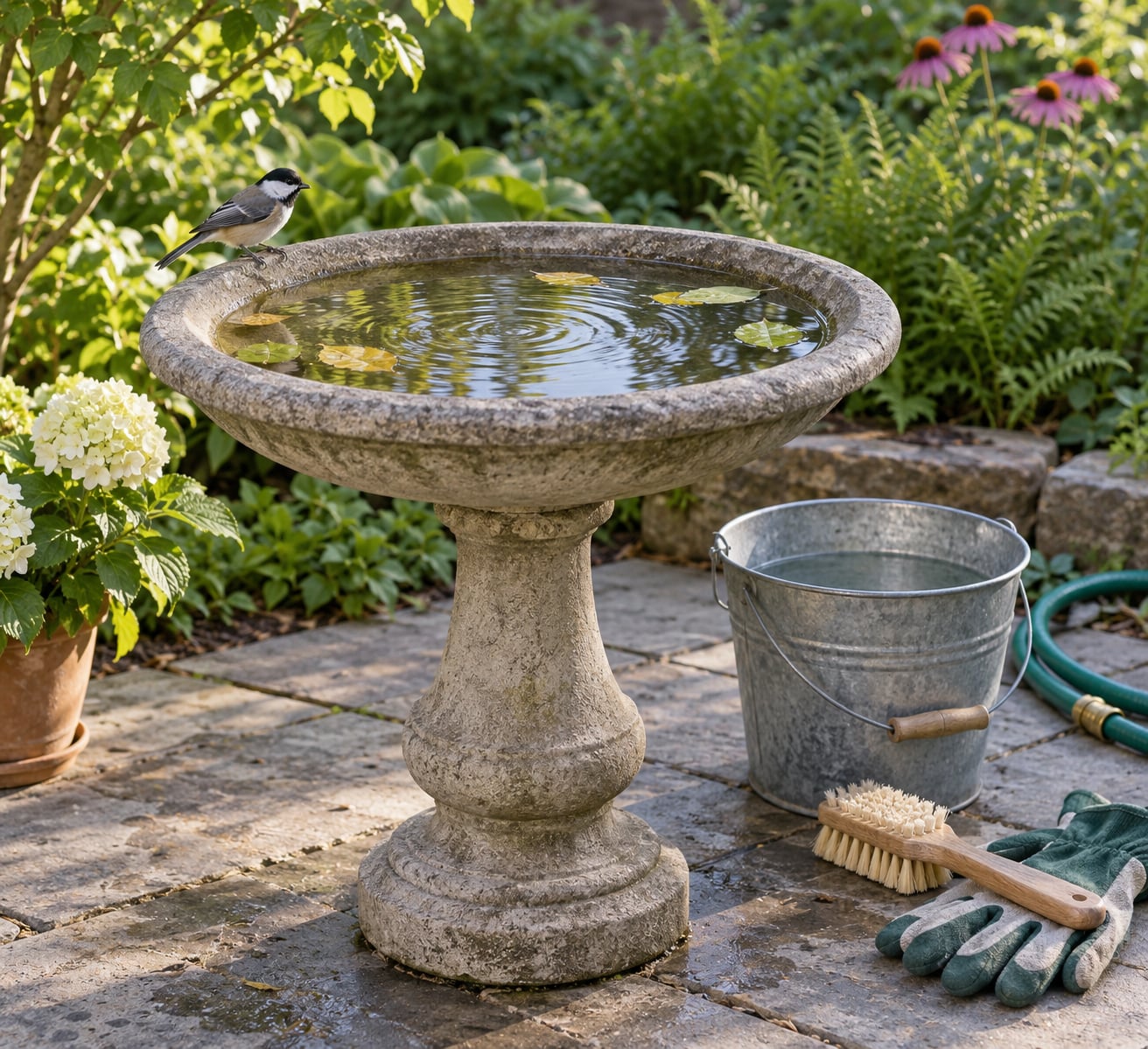
Mosquito larvae in a bird bath are the small dark wrigglers hanging at the surface of still water, and the fix is simple: dump the water, scrub the basin, and refill it every two to three days through mosquito season. If that is too often for you, keep the water moving with a small fountain or add a Bti larvicide that is safe for birds. Ten minutes of work now beats a yard full of biting mosquitoes later.
The reason a bird bath comes up so often is that it does everything a mosquito needs. It holds still water at a comfortable temperature, it has a rim and a bottom for eggs to stick to, and nobody empties it until the water looks bad. A neglected bath can produce a full generation of mosquitoes in about a week.
Table of Contents
- What You Need
- Step-by-Step
- Common Mistakes
- Frequently Asked Questions
- Are mosquito larvae in a bird bath harmful to birds?
- How long does it take for mosquito larvae in a bird bath to become adult mosquitoes?
- Can I use dish soap or insecticide in a bird bath?
- How often should I change bird bath water in hot weather?
- Do mosquito larvae live at the bottom of the bird bath?
- When should I contact a pest professional instead of cleaning the bird bath myself?
- Start by Emptying and Scrubbing the Bird Bath
What You Need
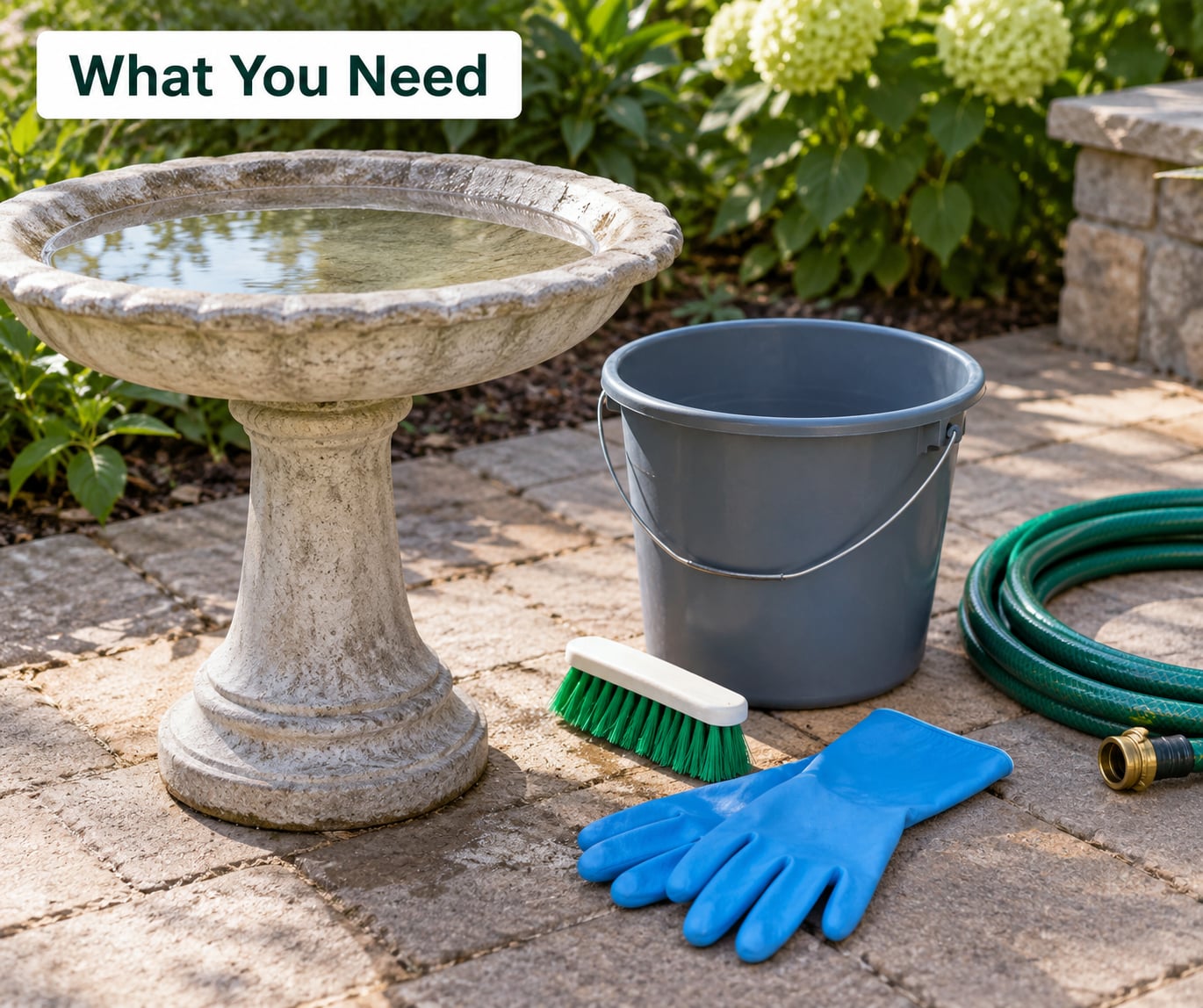
You do not need anything special, and you do not need to buy a treatment to start. Grab what you already own around the house, plus two cheap additions if you want a longer interval between cleanings.
- A bucket or empty lidded bin to carry the water out. A dedicated tub means you are not hauling a full basin across the patio and sloshing larvae back onto the ground.
- Rubber or dish gloves. Bird bath water is rarely clean, and stagnant water can carry bacteria. Gloves also keep you from smearing eggs you missed back onto the rim.
- A stiff brush — an old toothbrush handles the rim groove, a hand scrubber handles the bowl, and a bottle brush gets into the drain hole.
- A garden hose for rinsing and for a quick hose-flush of the basin between full cleanings.
- One part household bleach to nine parts water, or one part white vinegar to nine parts water, for a disinfecting scrub.
- A scrub sponge or non-abrasive pad if the basin is stone, glazed ceramic or copper and you do not want to scratch it.
Those six items handle the whole job. If you plan to clean only once or twice a month, add two more: a solar-powered fountain or a small air-pump agitator to keep the surface moving, and Bti granules, sold as mosquito dunks, which kill larvae as they hatch and hold for about 30 days in the water.
Budget ten minutes for a clean and refill, and put a repeating reminder in your phone for every second or third day. The whole job is not difficult, it is just easy to forget once the summer settles in.
Step-by-Step
Work in this order: confirm what is in the water, empty it completely, scrub the basin, refill, then set up whatever stops it from happening again. Do not skip the scrub. Dumping water without scrubbing leaves eggs stuck to the algae film, and they hatch into the fresh water the next day.
How to Confirm Mosquito Larvae in a Bird Bath
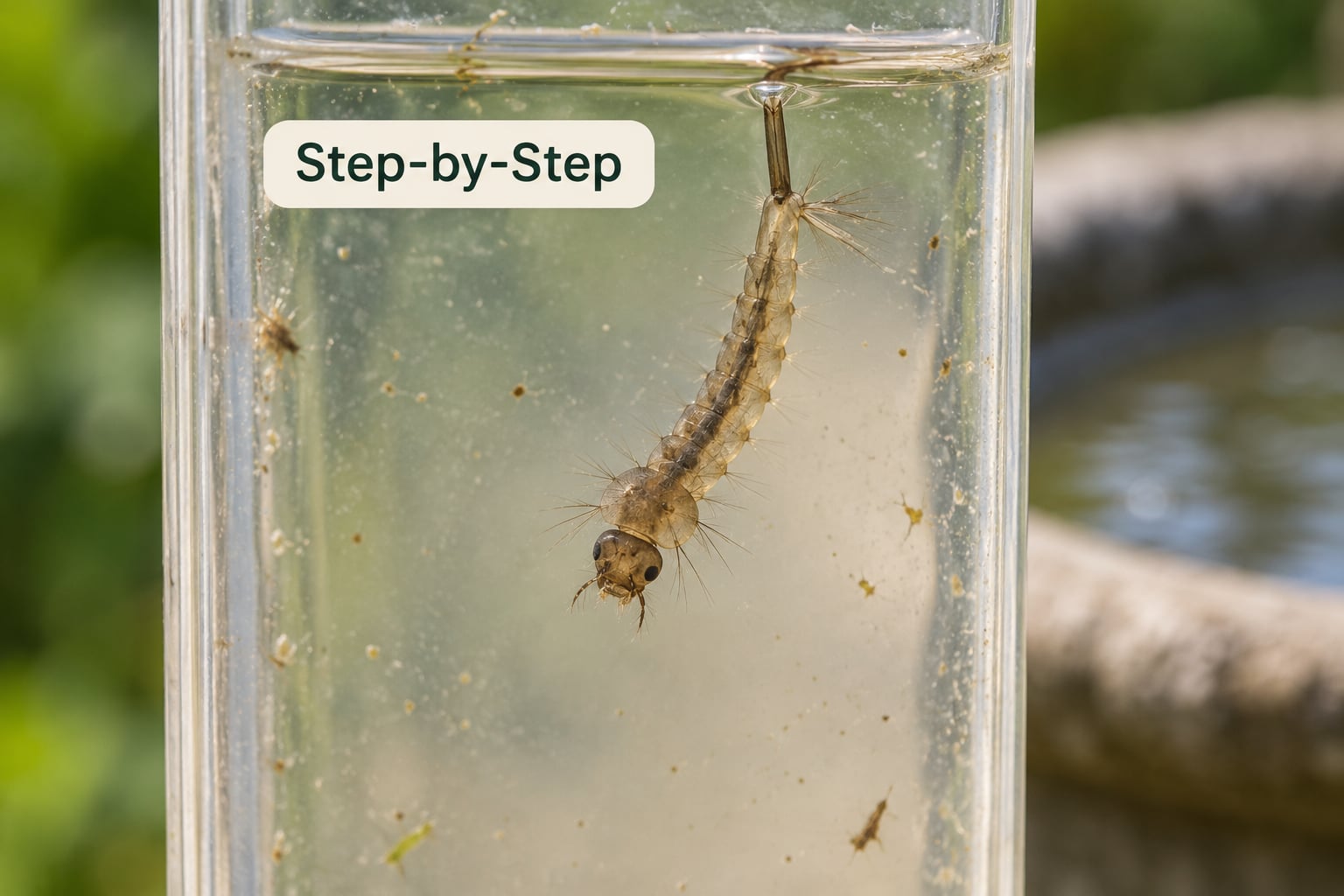
Mosquito larvae are called wrigglers for good reason. They are usually a sixth to a quarter inch long, pale gray, brown or black, and they hang head-down from the surface film with the tail touching the water, breathing through a tiny siphon on the abdomen. Tip a little water into a clear glass and watch: a mosquito larva darts downward, then floats back up to the same spot. Repeat that drop-and-rise loop and you have it.
Everything else in a bird bath either does not do that or is shaped differently. Here is the short version of what you are probably looking at.
| What you see | How it moves | Is it a mosquito larva |
|---|---|---|
| Mosquito larva (wriggler) | Hangs head-down at the surface, drops and rises on a repeat loop | Yes |
| Water strider | Skates on top of the water in long gliding steps, body flat on the film | No, harmless |
| Bloodworm (midge larva) | Long thin red worm, wriggles through the water column | No, harmless midge |
| Fungus gnat larva | Clear legless body with a black head, lives in wet soil and pots | No, harmless |
| Water boatman or backswimmer | Flat oval insect that rows or darts on its back | No, a predator |
If the body has a distinct head, a segmented tail and the drop-and-rise behavior, treat it as a mosquito larva. If it skates, wiggles freely, or looks like a small bug rather than a comma-shaped larva, you have a harmless neighbor and your problem is only the still water.
Empty the Bird Bath Before the Larvae Hatch
Act on a rhythm, not on a sighting. The reason a two-to-three-day schedule works comes down to how fast the life cycle moves in warm water.
| Stage | Typical time in a warm bird bath | What it means for you |
|---|---|---|
| Egg on the water or stuck to the basin | About 24 hours to hatch | Dumping can be enough if the basin is dry right after |
| Larva (wriggler) | 4 to 14 days, often around 7 | Emptying before day 3 stops the whole cycle |
| Pupa (tumbler) | 2 to 3 days | Nearly a full-grown mosquito, hardest to kill |
| Adult | Several more days before biting females are active | This is the stage you are actually preventing |
Larvae breathe at the surface, so they cannot survive a basin that is dumped and left empty or scrubbed and dried. They also die quickly on dry ground rather than drying into a delayed problem. That makes the emptying step genuinely worth doing on schedule even when you cannot see anything.
Empty it properly: scoop out any floating leaf litter and gunk first, tip the basin over the bucket, then wipe the rim and the underside while they are wet. Check the drain hole and any cracks where a larva can hide. When you are done, spread the old water onto dry ground away from any low spot, or pour it into a toilet. Tipping it into a storm drain just moves the problem to the curb.
Scrub the Basin and Refill It Correctly
Six steps, about ten minutes, and the basin is clean enough to refill. The bleach step kills whatever the scrubbing missed; the rinse step protects your birds from residue.
- Scrub the bowl with a stiff brush. Work the algae film and the waterline ring, where eggs hide as a fine speckled coating you can sometimes see in the light.
- Scrub the rim groove and the drain hole. These are the two spots people skip, and both hold water after a dump.
- Wipe with a solution of one part household bleach to nine parts water. Put it in a spray bottle or a cloth and let it sit on the surface for about five minutes. A stiff brush works too. For a metal or natural stone basin, use one part white vinegar to nine parts water instead.
- Rinse thoroughly with the hose. Every bit of bleach that a bird might drink or bathe in is a risk you do not need to take.
- Refill with fresh water. Fill to a depth that gives birds a shallow edge they can stand in, and stay a couple of inches below the overflow hole so rain cannot push water over the rim.
- Add movement if you can. A solar fountain, a bubbler on a small air pump, or even a solar agitator that makes a ripple is enough. Moving water discourages females from laying eggs in the first place.
You can tell it worked when the basin smells neutral, the water line shows no speckled film, and after two or three days you see ripples rather than a mirror-flat surface. If the water goes green with algae within days, the sun is the bigger problem — shade the basin with a piece of corrugated cardboard, refresh more often, and scrub the film off before it hardens.
Keep Mosquitoes From Returning
Pick one long-term method so the two-to-three-day cycle is not the only thing standing between you and mosquitoes. These are the options, honestly compared.
| Method | Effort | How often | How long it lasts | Safe for birds |
|---|---|---|---|---|
| Dump, scrub, refill | Ten minutes | Every 2 to 3 days | Until the next refill | Yes, fully |
| Dish soap drops, then dump | Two minutes | Every 2 to 3 days | Hours, then dump | Only if you rinse before refilling |
| Bti granules (mosquito dunks) | Drop and wait | Monthly, or after heavy rain | Up to 30 days in the water | Yes, labeled for bird baths |
| Solar fountain or agitator | Set up once | Seasonal upkeep | As long as it runs | Yes |
| Cinnamon oil | Sprinkle weekly | Weekly | A few days | Yes, at label rates |
| Fish in the basin | High | Weekly feeding | Indefinite | Not practical in a small basin |
Bti is a bacterium, Bacillus thuringiensis israelensis, and it is the option most extension services point to. It works only against larvae, in the water, not on adult mosquitoes, and it breaks down in sunlight. Products registered for bird baths are considered safe for birds, bees, fish and tadpoles. Re-dose after a heavy rain washes the water out, and keep the container closed until it is back to the label volume, because a floating raft of used dunks is a choking hazard to small birds.
A fountain works because female mosquitoes pick water that is already moving. It is the one set-and-forget option that a lot of people like, and it doubles as the reason birds keep using the bath. What it does not do is kill anything already in the water, so add a scrub or a Bti dunk the first time you switch.
Cinnamon oil is the home remedy that survives contact with reality. A light weekly sprinkle discourages egg laying and does not film on the surface the way cooking oil does. Apple cider vinegar, on the other hand, comes up constantly and does not control mosquito larvae. Nor will a cup of pennies or a copper coin: pennies are mostly zinc, the coins have not been used as a copper source since the 1980s, and any dissolved metal is far below a lethal concentration.
The last piece is everything else on your property holding water, because a cleaned bath next to a tire full of rain just relocates the problem. Walk the yard every week or two and empty or brush out discarded tires, plant pot saucers, clogged gutters and downspout troughs, tarps and canvas covers, bromeliad leaf cups, kids’ toys and wading pools, bird feeder drip pans, wheelbarrows, and rain barrels that have an open or screened lid. Standing water in a bromeliad or a blocked gutter is just as productive as a bird bath, and nobody thinks to scrub those.
Common Mistakes
Dumping water but never scrubbing. Eggs are laid on damp surfaces and stick to the algae film on the basin wall. Dump, let it dry, scrub with the one-to-nine bleach mix, rinse, then refill.
Waiting a week between changes. Weekly is the most common advice on the internet, and it is exactly the interval where eggs hatch, larvae feed for a week and pupae appear. Two to three days interrupts the cycle before any of that happens.
Adding cooking oil or vegetable oil. Oil does not form a continuous film, so it never seals the surface, and any oil that does coat a bird destroys the waterproofing of its feathers. It is folklore that survived because it sounds clever.
Dropping in a penny or copper coin. Copper does kill larvae at laboratory concentrations you will never reach from a coin in a basin. The practice is useless for mosquitoes, and copper can still build up in the water and in soil below the bath.
Leaving soapy water for the birds. Dish soap breaks the surface tension that mosquito larvae, eggs and adult mosquitoes hang on, and that works in seconds. It also fouls drinking water and interferes with a bird bathing, so soap belongs in a basin you are about to empty and rinse, never in water the birds use.
Spraying insecticide around the bath. Aerosol sprays kill adult mosquitoes and they land on bees collecting water at the same time. A larvicide in the water targets the stage you actually have, which is the safer and more effective choice.
Assuming birds handle it. Robins, swallows and ducks eat plenty of larvae, but no bird eats enough to keep a bath mosquito-free, and a bath full of algae and larvae is one birds avoid anyway. Clean-and-change beats relying on predators every time.
Frequently Asked Questions
Are mosquito larvae in a bird bath harmful to birds?
The larvae themselves are not harmful to birds. What matters is the adult stage, because only adult females bite, and birds are not affected by Bti mosquito dunks or Bti granules used at label rates in a bath. That bacterium targets mosquito larvae in the water and does not harm birds, honeybees, fish or tadpoles. The real risk to birds comes from other things people add to the basin: cooking oil mats feathers and ruins waterproofing, and leftover dish soap makes the water undrinkable.
How long does it take for mosquito larvae in a bird bath to become adult mosquitoes?
In warm water, eggs hatch in about 24 hours, larvae feed at the surface for roughly 4 to 14 days, and pupae take another 2 to 3 days before adults emerge. That puts the fastest realistic path at about a week and the slow end closer to three weeks in cooler weather. This is why emptying and scrubbing the bath every two to three days works: you interrupt the cycle while it is still in the larval stage.
Can I use dish soap or insecticide in a bird bath?
A few drops of dish soap do kill mosquito larvae, because they breathe at the surface and lose the surface tension they hang on. But treat soap as a short-term tool: use it in water you are about to empty and rinse, never in water birds drink or bathe in, since it leaves a foul film. For a bath that stays full, use Bti granules instead. Avoid spraying insecticide near the basin, where bees are also collecting water.
How often should I change bird bath water in hot weather?
Every two to three days in hot weather, and every day if the bath sits in full sun, receives rain, or has pets drinking from it. In mild weather every three to four days is usually enough. Scrub the basin with the one-to-nine bleach or vinegar solution once a week even when you are changing the water more often, since the algae film is where eggs are laid. A fountain reduces how often you need to do this.
Do mosquito larvae live at the bottom of the bird bath?
They spend almost all of their time at the surface, hanging head-down from the water film to breathe. They drop to the bottom only when the surface is disturbed or when the water level falls, and they cannot survive a basin that stays dry. This matters because dumping without scrubbing misses the eggs attached to the basin wall, rim groove and drain hole, which hatch into your fresh water the very next day.
When should I contact a pest professional instead of cleaning the bird bath myself?
Call a licensed mosquito control service when you keep finding larvae after a few weeks of weekly cleanings, when bites in your yard continue despite removing water sources, or when the problem sits in something you cannot drain: a pond, a wetland, a fountain with a recirculating pump that keeps drawing water back in, or a neighbor’s lot. Home treatment handles a bird bath. Large or repeated sites need a plan, and unlicensed pesticide spraying is worth avoiding.
Start by Emptying and Scrubbing the Bird Bath
Start today, not this weekend. Take the water out, scrub the bowl and the rim with a stiff brush and one part bleach to nine parts water, rinse it, and refill with fresh water. Then set the phone reminder for every second or third day, and add a solar fountain or a Bti dunk so the routine lasts through the weeks when mosquitoes peak.
If you only do one thing beyond the initial clean, walk the yard and empty every other container holding water. A bird bath you maintain twice a week is not a problem. It becomes a problem the week you go on vacation and forget it is full.