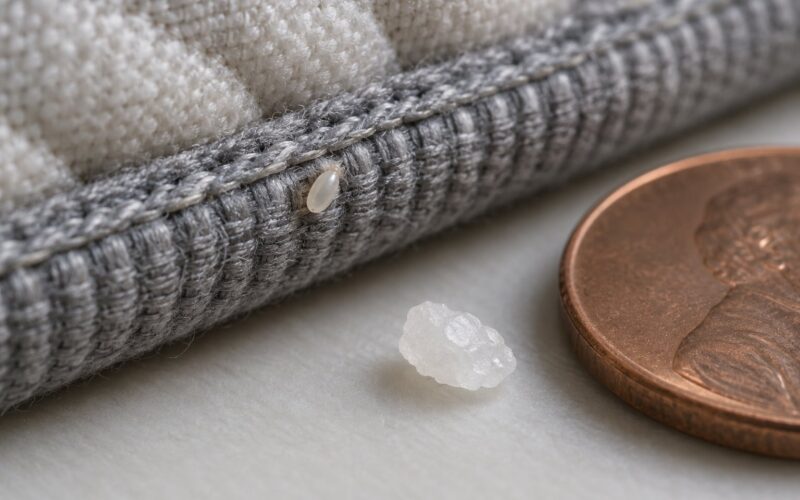
If you have ever caught a musty, sweet scent in a bedroom and wondered whether it means bed bugs, here is the short version: bed bug smell is a persistent musty, slightly sweet odor that people also describe as almond-like, raspberry, or coriander, and it comes from colony pheromones plus the digested blood in their droppings. That scent usually only becomes noticeable once an infestation is well established, so it is a late warning sign rather than an early detection tool. Plenty of other things smell musty, which is why the odor alone confirms nothing.
The confusion is real. On the bed bug forums, people regularly post about a bedroom smell they cannot place, and most of those threads end the same way: someone finds a stain, a shed skin, or a single crushed bug under the mattress seam, and the mystery odor suddenly makes sense. Other threads end differently, with the smell traced to a damp closet wall or a pile of laundry that has been sitting in a closed hamper for a week.
This guide walks through what the odor actually is, how it shifts as an infestation grows, which household smells get mistaken for it, where the scent concentrates, and what a careful inspection looks like. It also covers the part most people skip: what the smell cannot tell you.
Table of Contents
- What the Bed Bug Smell Actually Means
- How the Odor Changes as an Infestation Develops
- Bed Bug Smell vs. Other Musty or Sweet Odors
- Where You May Notice the Smell Most Strongly
- Can You Smell Bed Bugs Without Seeing Other Signs?
- How to Check Likely Bed Bug Hiding Places
- What the Smell Does Not Tell You
- When to Treat the Odor as a Possible Infestation
- Frequently Asked Questions
- What to Do First
What the Bed Bug Smell Actually Means
Bed bugs do not have a single odor chemical. What you smell in an infested room is a mix of several sources that build up together over weeks or months. Understanding the sources explains why the odor is faint at first and sharp later.
Bed Bug Smell: What It Is and When You Notice It
The signature scent is usually described as musty and sweet. People compare it to almonds, raspberries, berries, or cilantro and coriander. Some describe a metallic or rusty edge once the population is large. Very few people describe it as foul, even though the source material is digested blood, because what you smell is the oxidized waste, not fresh blood.
Three things drive it. First, aggregation pheromones, the chemical signals bed bugs release so they find each other and stay grouped in hiding places. Second, alarm pheromones, released when a bed bug is disturbed or crushed, which is why a squashed bug produces a sharp, unforgettable stink-bug-like burst that fades within minutes. Third, fecal matter. A feeding bed bug leaves behind droppings that darken as they oxidize, and that accumulated, aging waste is where the rusty, musty, room-wide smell largely comes from.
Timing is the frustrating part. A handful of bugs in a freshly infested mattress produces essentially nothing you can detect. By the time a scent is obvious, the population has usually been established for a while, which is why most people describe the first real sign as a smell and the second, days or weeks later, as visible evidence.
How the Odor Changes as an Infestation Develops
What changes over time is the intensity and the character of the odor, not the fact of it. The table below shows the general progression people report. Treat it as a rough pattern rather than a diagnostic scale.
| Stage | What the odor is like | How detectable it is | What else you will find |
|---|---|---|---|
| New, low population | Nothing you would name; at most a faint stale note when you press your face to the sheets | Usually not detectable | A single live bug or a couple of fresh bites |
| Early and growing | Faint musty sweetness, easy to blame on damp laundry | Detectable in a still, closed room, mainly at night | Scattered dark spots on sheets and a few shed skins |
| Established | Pronounced sweet mustiness with raspberry or almond character, spread across the room | Noticeable on entering, lingers after the room is aired out | Clusters of bites, rusty staining, live bugs in seams |
| Heavy | Stronger, sometimes metallic or rusty, mixed with plain mustiness | Hard to miss; people smell it in the hallway | Many shed exoskeletons, heavy fecal spotting, multiple hiding sites |
| Disturbed colony | A sudden sharp, chemical, stink-bug-like hit | Instant, local, fades within minutes | You just crushed a bug; the burst marks the spot |
Olfactory sensitivity varies a lot between people, and that is normal. One person in the same room may smell nothing while another is convinced something is off. Forum discussions about bed bugs often turn on exactly this split, with family members disagreeing about whether an odor exists at all. If you cannot smell it but a housemate can, take the physical signs seriously rather than dismissing them.
Bed Bug Smell vs. Other Musty or Sweet Odors
This is where most self-diagnoses go wrong. Damp towels, a musty closet, and mild mold all hit the same part of the nose that a bed bug colony does. The table below lines up the usual suspects with the clues that separate them.
| Odor source | Typical description | Where it comes from | Clue that distinguishes it |
|---|---|---|---|
| Damp laundry or towels | Warm, wet, musty, heavy | Fabrics left damp in a closed hamper or dryer | Washing and fully drying the load removes it within a day |
| Mold or mildew | Damp, earthy, sometimes sharp | Moisture behind walls, under sinks, in window frames, on damp carpet | Visible spotting, peeling paint, or a wall that stays wet; worsens after rain |
| Old fabrics, closets, or storage bins | Flat, dusty mustiness | Cardboard, wool, stored linens | Strongest when you first open the closet, fades once aired |
| Rotting fruit or kitchen odor | Sickly sweet, fermented | Trash, fruit bowl, drain, compost | Traces to the kitchen, not the bed; resolves after cleaning |
| Urine odor | Ammonia, sharp and stale | Pet bedding, an old stain, an unnoticed leak | Worst on soft surfaces that hold moisture |
| Cleaning products | Sharp chemical, bleach, citrus | Recent cleaning or air freshener | Recent use explains it, and it fades within hours |
| Bed bugs | Musty and sweet, almond or berry character, with a rusty or metallic edge at higher levels | Colony pheromones and oxidized fecal matter in hidden areas | It stays even after washing sheets, and physical evidence appears on the bed |
One quick test that helps: wash and fully dry your bedding, air out the room, and come back the next day. Damp-laundry and closet smells disappear. An infestation-driven odor stays, because the source is under the mattress, not on the sheet.
Where You May Notice the Smell Most Strongly
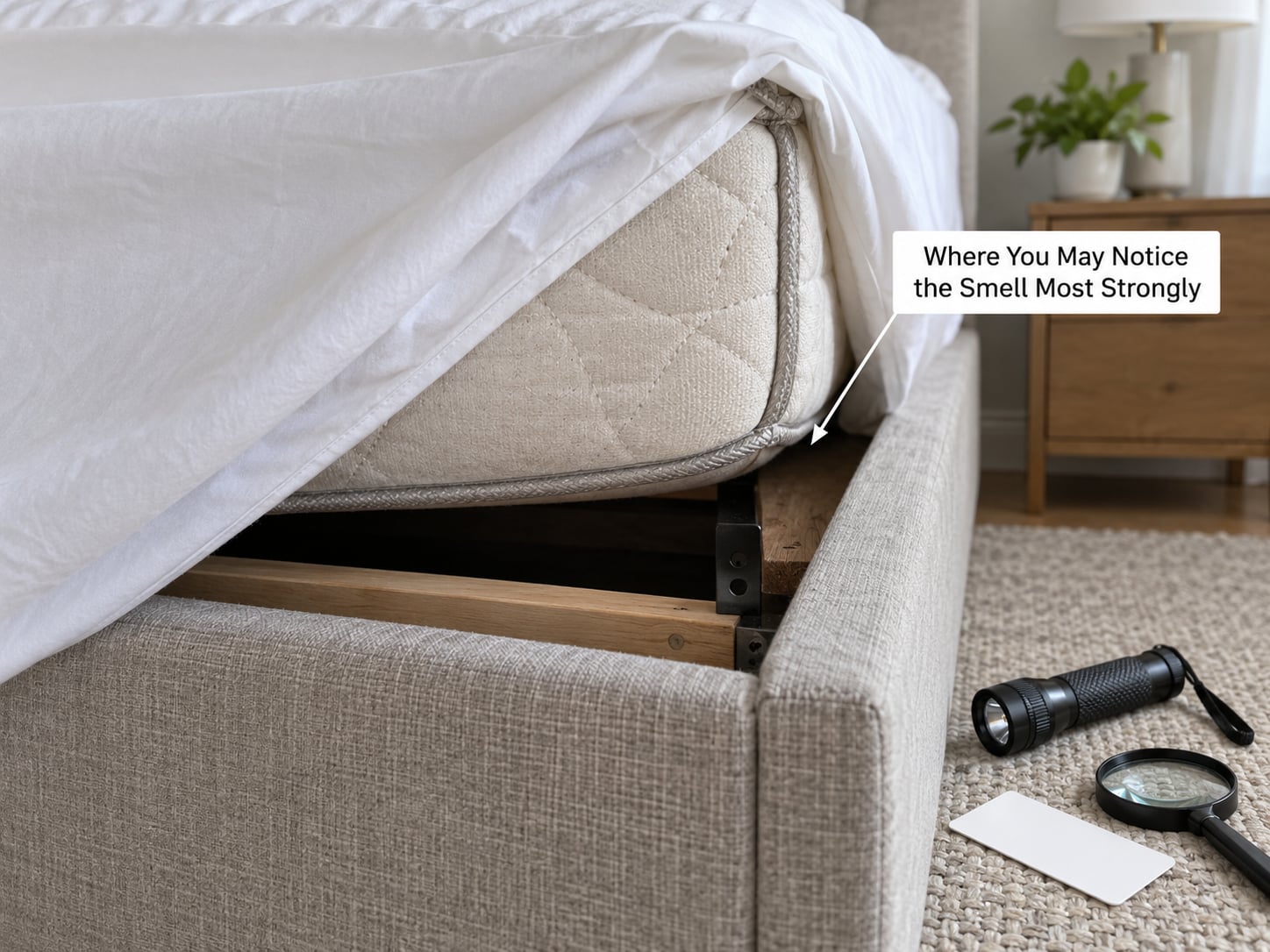
Concentrated evidence sits close to where people sleep and where fabric touches metal or wood. Bed bugs stay close to the host because they feed every few days and move slowly. The odor tends to be strongest at the mattress seam near the head end, in the box spring, and in upholstered furniture that sits close to the bed.
It is also worth checking the headboard, baseboards, and any crack in the wall or floor near the bed frame. Electronics, power outlets, and bedside tables come up often enough that a careful inspection should include them.
Here is the odd part that confuses people: the smell is often stronger on the item than in the room. Lift the mattress corner and the air near the seam can smell distinctly musty while the rest of the bedroom reads as normal. That is why a bedroom can smell fine for months while bed bugs are present, then suddenly smell wrong after someone changes the sheets or re-arranges furniture.
Can You Smell Bed Bugs Without Seeing Other Signs?
Sometimes, yes, and it is worth taking seriously. But smell by itself is not confirmation, because the odor overlaps with damp, mildew, and musty storage. Physical evidence is what turns suspicion into a diagnosis.
Check for these, roughly in order of how much weight they carry:
- Live bugs. Adults are flat, reddish brown, and about the size of an apple seed. Nymphs are smaller and paler. You are most likely to catch one out if you look right after getting out of bed in the dark, when they are still on or near the mattress.
- Fecal spotting. Dark reddish brown to black dots or smears on sheets, mattress ticking, and the box spring fabric. They look like old ink spots and are often concentrated where the mattress seam meets the fabric.
- Blood marks. Small rust-colored streaks or smudges on bedding, sometimes on a pillowcase. A feeding bug that is disturbed mid-meal can leave a spot.
- Shed skins. Translucent, pale brown exoskeletons left behind as bugs grow. These accumulate in hidden seams and are strong evidence of an infestation that has been there for a while.
- Eggs and egg shells. Tiny, pearly white, about the size of a grain of rice, often stuck to surfaces in clusters.
- Bites. Itchy bumps on exposed skin, often in a line or cluster. Bites alone are unreliable proof, since many other insects bite, but a new unexplained pattern plus physical evidence in the bed is meaningful.
How to Check Likely Bed Bug Hiding Places
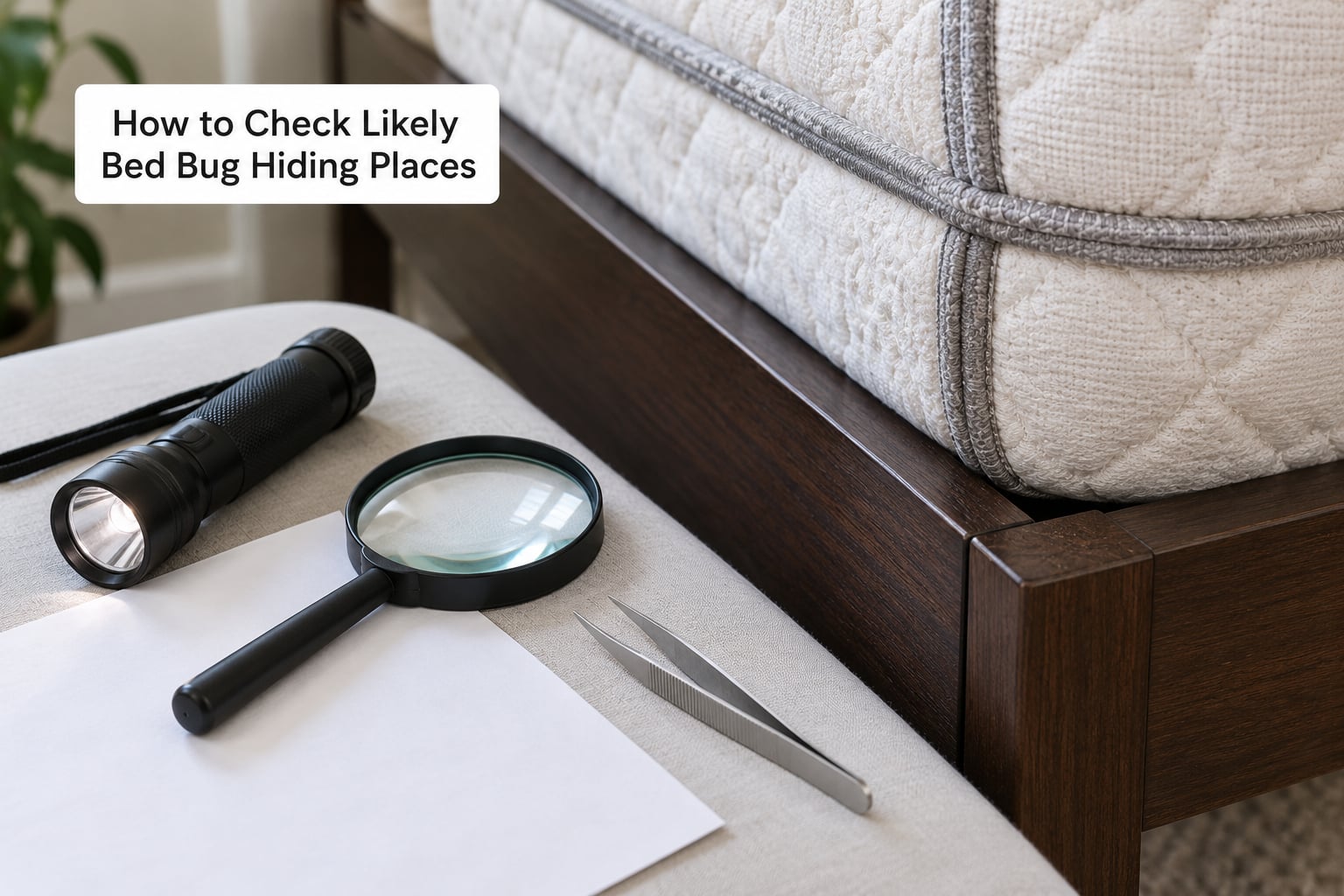
A careful inspection takes twenty minutes with a flashlight and a magnifying glass, and it is worth doing properly before you pay anyone or spray anything. Work top to bottom in a fixed order so you do not skip the same spots.
- Strip the bed. Take off all bedding and wash and dry it on a hot cycle. Do the same with pillows, and check the mattress itself for stains before you look underneath it.
- Check the mattress seams and piping. Run your fingers along every seam, especially the two side seams and the head end. Lift the mattress edge and look at the box spring fabric below. Seam failures and a lifted edge are classic sites.
- Look at the box spring and bed frame. Check joints, screw holes, the underside support slats, and any fabric webbing. Peek inside the headboard if it is attached to the bed.
- Search nearby furniture. Upholstered chairs, a sofa, a bedside table, and any item on the floor within a few feet of the bed. Look along seams, under cushions, and at the bottom edge of fabric skirts.
- Check walls and baseboards near the bed. Peek into cracks, around outlets, and along the baseboard. Bed bugs travel along edges and seams when they move.
- Use magnification for the small stuff. Eggs, nymphs, and fresh spotting are easy to miss by eye. A bright flashlight plus a magnifier catches them quickly.
- Photograph anything you find. Clear photos of spots, skins, or a specimen help an exterminator or a landlord act without a second inspection.
Keep the order fixed and do not move furniture or belongings from one room to another during the process. That is how bed bugs end up in a second bedroom.
What the Smell Does Not Tell You
There is a long list of things people hope the odor will answer. Very few of them it will.
- How big the infestation is. Odor intensity does not map cleanly to population. A well-ventilated room can hide a heavy infestation, and a small one in a sealed space can smell stronger.
- Where the bugs are. The scent drifts and settles, so the strongest smell is often not where the colony is densest.
- Whether it is gone. Residual odor lingers in fabrics, mattresses, and carpets long after the last bug. Persistent smell after treatment is common and is not proof of failure.
- Whether the bites are bed bugs. Insect bites overlap heavily. Smell cannot sort out what bit you.
- Whether you can handle it yourself. Bed bugs spread across rooms through luggage, secondhand furniture, and bedding moved between locations, and the smell tells you nothing about how contained the problem is.
That last point about phantom smell deserves a word of its own. After a successful treatment, many people report still catching something, while family members smell nothing at all. Some of that is real residue in soft furnishings. Some of it is heightened attention to an odor you spent months learning to detect. Getting the confirmation you need means going back to physical evidence, not back to the nose.
When to Treat the Odor as a Possible Infestation
Act when the smell arrives with evidence, or when you have evidence and the smell only strengthens the case. A lone musty note with nothing visible is worth a weekend of laundering, airing out, and a careful inspection. A sweet-musty odor plus spotting on sheets, shed skins in a seam, or an unexplained bite pattern means treat it as a suspected infestation.
What not to do is spray based on smell alone. Foggers and total-release insecticides do not reach bed bugs where they actually live, which is pressed into mattress seams, box spring cavities, and furniture joints. They kill exposed bugs, and the exposed bugs are the small minority. They also push bugs into cracks and can make people think treatment worked when it did not touch the hiding sites.
What helps is targeted and mechanical. Wash bedding at 60 degrees Celsius or above and tumble dry on high for 30 minutes, which kills bed bugs and eggs in the fabric. Vacuum the mattress seams, box spring, bed frame, and surrounding floor, then empty the vacuum outdoors. Encapsulate the mattress and box spring with a zippered cover and leave it sealed for at least a year, since trapped bugs die without feeding and anything that hatches cannot get out. And avoid moving furniture or belongings between rooms until the situation is sorted.
For widespread or uncertain cases, get an identification you can rely on. A licensed pest professional doing a structured inspection, or a scent detection dog through a pest company, gives you an answer based on finding bugs rather than guessing from an odor. In a rental, notify the landlord in writing with photos and a request for inspection, because the responsibility for treatment usually sits with the property owner.
Frequently Asked Questions
How long does it take for bed bugs to develop a noticeable smell?
Usually weeks to months. A handful of new bed bugs in a fresh mattress produces nothing most people can detect. The odor becomes noticeable once a colony has been feeding and accumulating droppings for a while, which is why it functions as a late-stage warning sign. This is also why an early infestation is often found through bites or a single live bug rather than through smell. Treat a new scent with suspicion, but expect the absence of a smell to tell you very little.
Can a musty bedroom smell be bed bugs rather than mildew?
It can, and the two are genuinely hard to separate by nose alone. Mildew usually comes with a damp wall, visible spotting, peeling paint, or carpet that stays wet, and it worsens after rain. A bed bug odor tends to follow the bed rather than the room, stays after you wash and dry all the bedding, and shows up alongside dark spotting, rust-colored marks, or shed skins on the mattress. If the mustiness survives a hot wash and full dry of every sheet, inspect the seams.
Do bed bugs smell stronger in apartments and shared buildings?
In multi-unit buildings, an odor can seem stronger simply because more rooms are involved and air moves between them through hallways, ductwork, and shared walls. That does not change the biology, but it does change how people interpret what they smell. One neighbor treating a unit can briefly raise odor levels in adjacent apartments as bugs are disturbed. The practical implication is that a scent in a unit with no visible evidence may be coming from a neighboring unit, so inspection matters more than odor ever did.
What should a renter do after suspecting a bed bug infestation?
Photograph everything you find, including spots on sheets, seams, and any specimen, and send your landlord or property manager a written request for professional inspection with photos attached. Keep receipts for any cleaning, laundering, or protective covers you buy, since reimbursement terms vary by lease and local law. Do not move furniture or belongings into another room, and do not use foggers on your own. Ask the landlord in writing how treatment will be handled and how follow-up inspection will be scheduled before the problem is considered resolved.
Can bug bombs or foggers remove a bed bug smell?
No. Foggers do not fix odor and they do not fix the infestation. The scent comes from hidden colonies and accumulated droppings inside mattress seams, box spring cavities, and furniture joints, and a fogger cannot reach those spaces. The chemicals kill a small number of exposed bugs and can scatter the rest deeper into cracks. At the same time, residue from a fogger often adds its own sharp chemical smell to the room, which makes the original odor harder for you to identify. Mechanical steps and professional treatment address both the bugs and the smell.
What to Do First
Strip and inspect the bed before you do anything else. Wash every sheet, pillowcase, and cover on a hot cycle and tumble dry high for 30 minutes, then check mattress seams, piping, the box spring fabric, the bed frame joints, and the headboard with a flashlight and a magnifier. Photograph any spotting, shed skins, eggs, or a live bug you find.
Do not spray anything, and do not move furniture or belongings into another room. If you find evidence, or if you find nothing but the odor keeps coming back and neighbors or housemates also smell it, get a professional inspection rather than guessing from the scent. Once you are certain you have bed bugs, encase the mattress and box spring, clean and contain the room, and expect the odor to fade over weeks or months after the bugs are gone.