To identify sugar ants in a kitchen, you are really checking four things on the same worker ant: size (about 2 to 3 mm, roughly 1/16 to 1/8 inch), color (black to dark brown), body structure (one bump on the waist, elbowed antennae), and behavior (a visible line of ants walking between a crack and something sweet). Crush one worker between your fingers and a strong rotten-coconut smell confirms an odorous house ant, the species most people mean. The whole check takes about ten minutes and needs no special equipment.
One thing worth saying up front: “sugar ant” is not a species. It is a nickname people use for any small household ant that shows up where the cookies are, and it usually means the odorous house ant (Tapinoma sessile) or the pavement ant. Getting the name right matters because carpenter ants and pharaoh ants respond to completely different treatment.
Quick ID checklist: five signs your kitchen ants are sugar ants
- They are tiny. Workers fall between 2 and 3 mm, roughly the width of a pencil lead or a grain of uncooked rice.
- They are dark. Black through dark brown, often shiny, and hard to tell apart from a little black ant by color alone.
- They follow a trail. You see a line of workers moving in both directions rather than scattered individuals.
- They go for sugar and moisture. Counter crumbs, a fruit bowl, a pet bowl, or a sink drip draw them in.
- They smell like rotten coconut. Crush one and the odor is unmistakable, a sharp blue-cheese or coconut note.
If the first four fit but the smell does not, keep reading. Size and sweetness-seeking alone rule out carpenter ants and termites but still leave several species that need different handling.
What You Need
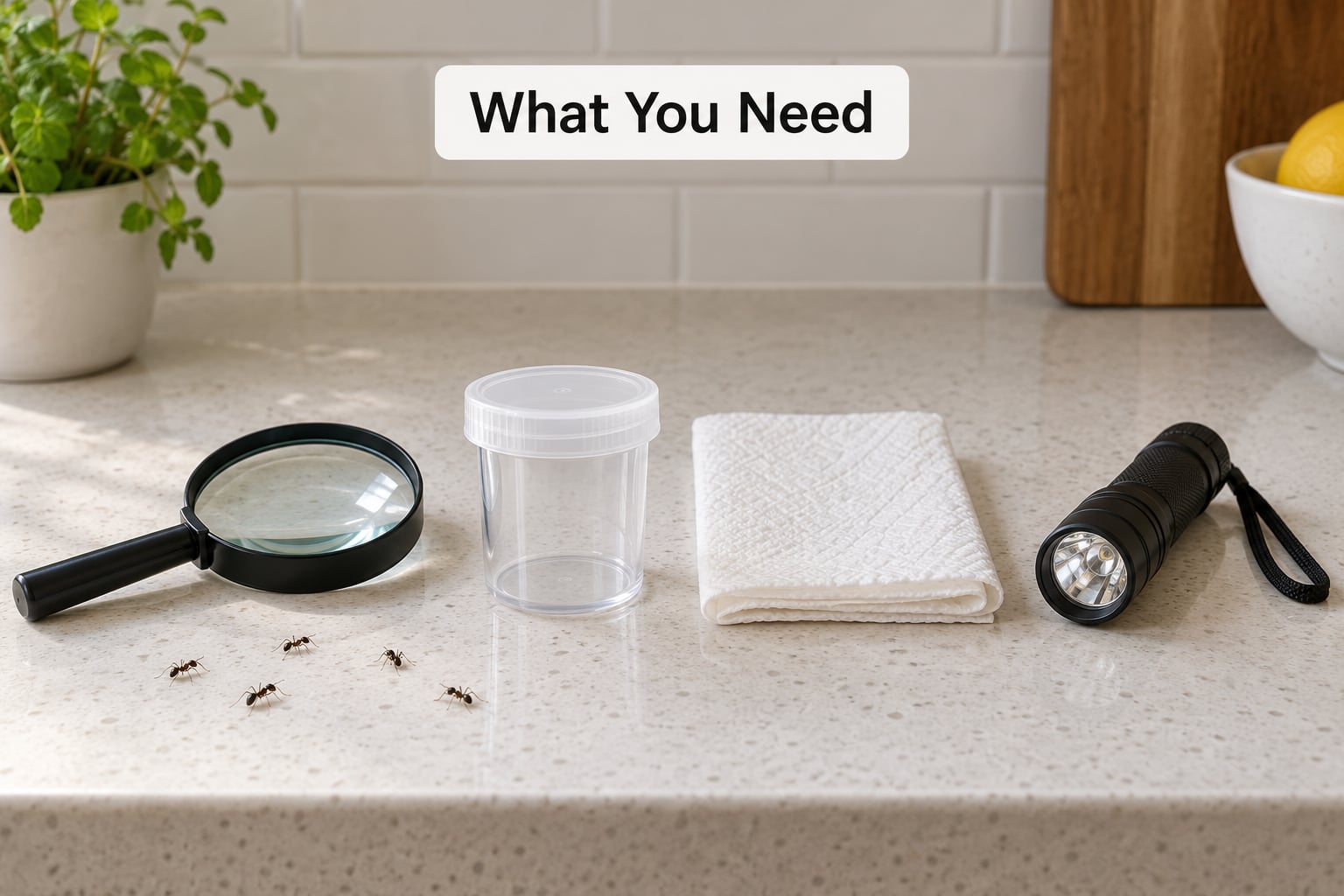
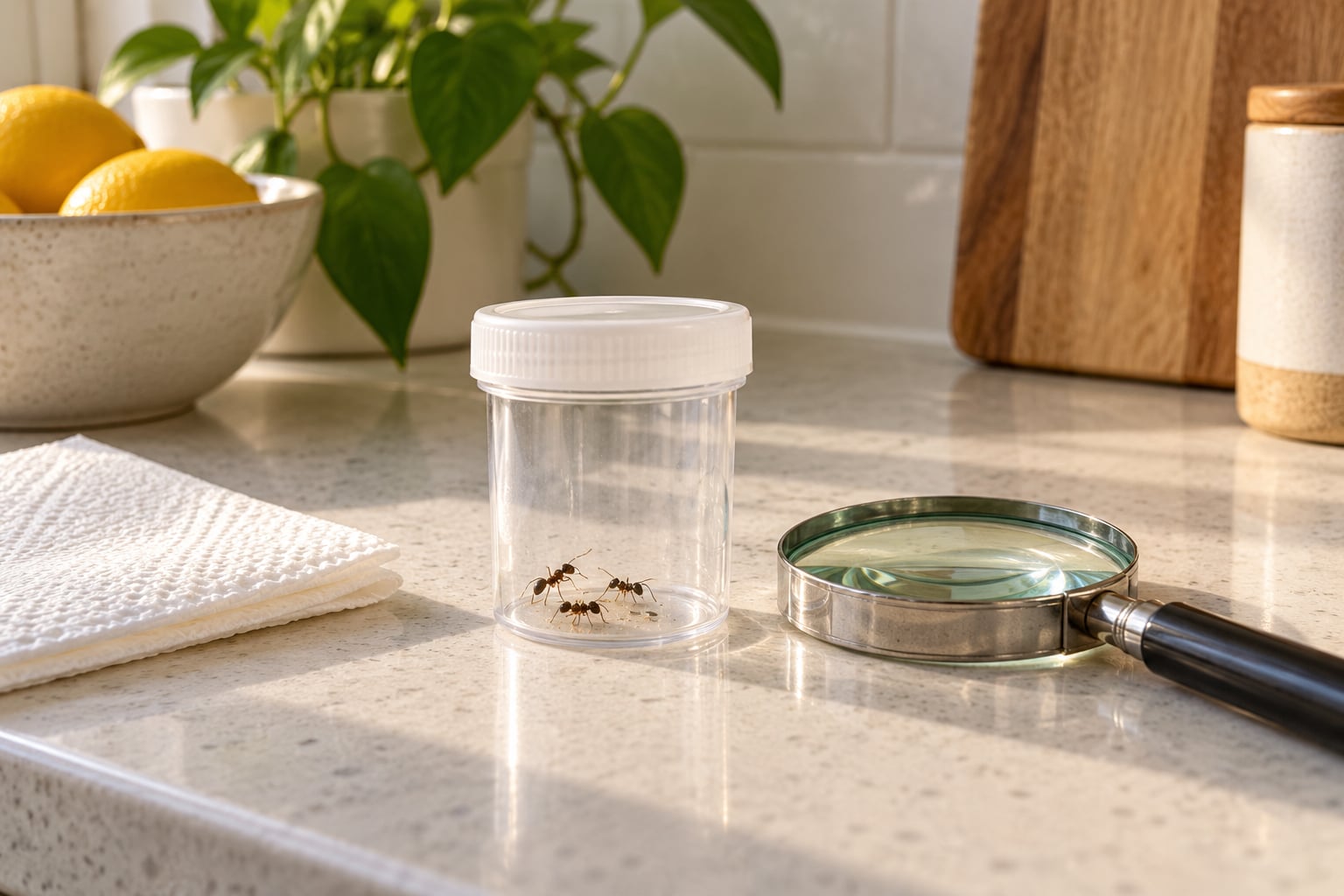
You need almost nothing, and everything is probably already in a drawer. A magnifying glass is genuinely useful for the waist and antennae check, but a phone camera held close with the macro setting gets you close enough. A plain white sheet of paper or a white ceramic plate gives you contrast so a dark ant is not lost against a dark counter.
Grab a flashlight too. Ants hide in the gap between the counter and the backsplash and in the shadow under the sink, and a light angled across a crack makes them move, which tells you more than a photo ever could. Add a small lidded container or a snap-cap vial if you want to bring a sample to a local extension office or an identification forum instead of guessing.
Bring paper towels and your usual kitchen cleaner for the cleanup that comes after. And one instruction worth following carefully: while you are identifying, watch and do not spray. Aerosol spray kills the visible workers and can scatter the rest, and many people wipe out every ant they can see before ever finding out what species they were dealing with. You need live traffic to trace a trail.
Step-by-Step: How to Identify Sugar Ants in a Kitchen
Step 1: Collect a few ants without killing the trail
Watch where the ants are heaviest for a few minutes, then pick three or four workers off the counter with the corner of a folded paper towel. Do not squash them. Drop them onto the white paper, note roughly where they were found, and let them walk. A living ant tumbles right itself with a visible scramble, and it will show you the antennae and waist that a dead one flattens.
Wash your hands afterward. These ants rarely bite, but the same rule applies to any ant you pick up, and you do not want to transfer anything from one part of the kitchen to another. If you would rather not touch them at all, slide a clear container over a few workers on the counter and slide the whole thing onto the paper. That is the same evidence with less contact.
Step 2: Check their size and body shape
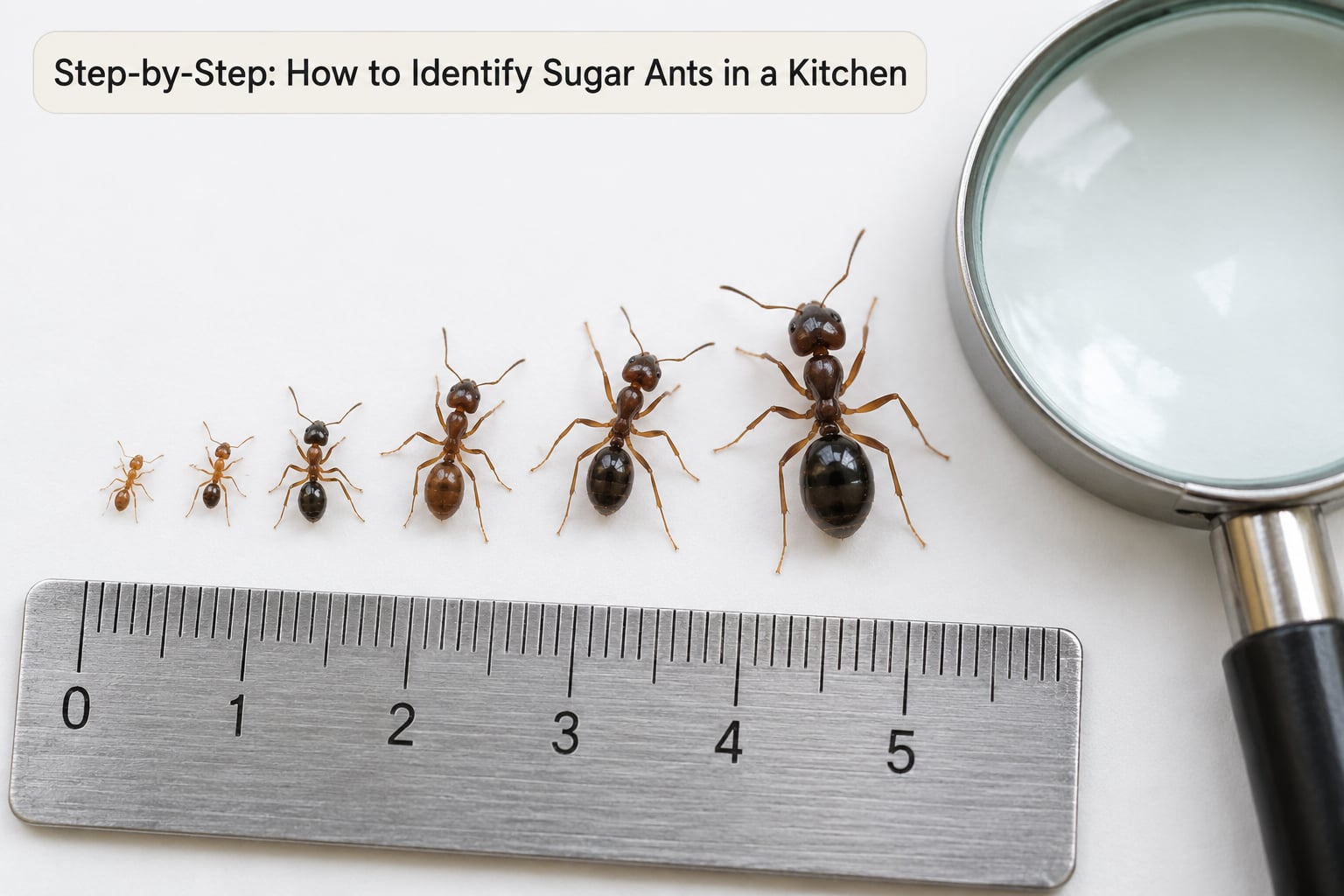
Measure before you judge color. Put the paper over a ruler or hold it next to one, or take a close phone photo with a coin in frame for scale. Sugar ants as people usually mean them run about 2 to 3 mm for a worker, and the workers are fairly uniform in size, so a line of ants that all look the same length points away from a carpenter ant, whose workers range from small to large with big-headed majors mixed in.
Now look at the body. Every ant has an elbowed, segmented antennae and a pinched waist, but count the bumps on the waist. Odorous house ants have a single petiole node, one bump between the thorax and the abdomen. Carpenter ants, pharaoh ants and pavement ants have two. Look for wings on the sample too: a worker you find on the counter never has them, and winged ants indoors mean a different situation entirely, covered later in Step 5.
Step 3: Color and markings: what sugar ants look like
Color narrows things down far less than most guides admit. Odorous house ants run from black to dark brown, and so do little black ants, pharaoh ants and Argentine ants. What separates an odorous house ant from a little black ant is not shade, it is the head: the odorous ant’s head has parallel grooves running lengthwise, and crushed it gives off the rotten-coconut or blue-cheese odor that earned it the name.
Pavement ants are darker brown to black, with a striated head as well but a pair of backward-pointing spines on the thorax. Pharaoh ants are pale yellow-tan to light brown with darker heads and gasters, which is why a colony that outlasts bait aimed at black ants often turns out to be a second species living in the same walls. Argentine ants are uniform medium brown with a faint dark stripe down the middle of the head. Carpenter ants are much larger, roughly 6 to 18 mm, and range from black to reddish brown with large, blocky heads.
| Ant you are seeing | Worker size | Color | Body clue | Odor when crushed | Where it nests in a kitchen |
|---|---|---|---|---|---|
| Odorous house ant | 2 to 3 mm | Black to dark brown | One petiole node, grooved head | Strong rotten coconut or blue cheese | Wall voids, under-sink cabinets, baseboards |
| Pavement ant | 2.5 to 4 mm | Dark brown to black | Two nodes, paired thoracic spines, grooved head | None | Cracks in tile grout, along baseboards, in soil near foundations |
| Little black ant | 2 to 3 mm | Black | Two nodes, smooth head | None | Outdoor mulch, soil, wall voids and under-sink plumbing |
| Pharaoh ant | 1.5 to 2 mm | Pale yellow-tan with darker head and gaster | Two nodes, lighter body with darker markings | None | Deep inside wall voids, behind baseboards, in cabinets |
| Argentine ant | 2 to 3 mm | Uniform medium brown | One node, faint dark head stripe | None | Cracks in concrete, patios, soil, under thresholds |
| Carpenter ant | 6 to 18 mm | Black, reddish brown or banded | Two nodes, large head, uneven worker size | Musty or damp wood, not a food odor | Moist wood in window sills, door frames, roof beams |
The table settles most cases, but the fastest confirmation takes ten seconds: crush one worker between your fingers and smell your fingertips. Odorous house ants give an unmistakable coconut note. If you get nothing, you are looking at something other than an odorous house ant, and the table row that matches your ant tells you what you are up against.
Step 4: Observe what they are doing
Behavior separates sugar ants from other tiny kitchen ants better than color does. Watch a trail for two minutes and count directions. Sugar ants run a defined highway in both directions, workers carrying food back toward the wall or cabinet while outbound scouts come and go, because they follow a scent trail rather than navigating by sight. That trail is a pheromone deposit laid on the surface, which is why wiping a counter with soapy water can slow a trail for a day or two.
Sugar ants also show a clear preference. Put a drop of honey or a sugar cube on the counter, step back, and see how fast it accumulates within about five minutes. That is the five-minute sugar test, and it is the single best confirmation available to a homeowner. Watch near fruit, spilled juice, the dog bowl, the garbage can, or a damp cloth left by the sink, since moisture pulls them in as strongly as sugar does. Along the way, note whether they follow wet areas or dry ones. Ants strongly tied to a leak under the sink are usually odorous house ants, which nest near moisture, while pavement ants turn up along thresholds and outdoor cracks.
One correction to a common assumption: these ants are not sugar-only. They also take protein and fats, which is why peanut butter, cooked meat grease and pet food attract them. Clearing the fruit bowl alone rarely solves anything, while a wiped-down counter with crumbs under the toaster and a rinsed pet bowl taped off for a day usually does more.
Step 5: Trace their route and hiding places
This is the step most guides skip and the one people most often want. Follow the trail backward, away from the food source, and watch where the workers disappear. Trace it with a pencil on the counter so you keep the line, look behind appliances and under the lip of the sink, and check the gap where the countertop meets the backsplash. Ants emerging from a specific crack are telling you their entry point directly.
Then work through the usual kitchen hiding places, top to bottom. Start with upper cabinets, especially around a window sill, and check wall voids behind baseboards for hollow, excavated drywall or a faint path of frass. Look at the under-sink cabinet for damp wood, leaks and pipe joints, then inside the dishwasher and around the sink base, where moisture collects. Check the grout lines in floor tile and the backsplash, the gap behind the refrigerator and stove, the dry pet bowl, and any interior door threshold. People on homeowner forums regularly report ants coming up through tile grout, backsplash cracks, floor tile grates and under-sink cabinet joints, so those are worth checking before anything more hidden.
What you learn from the trace decides your next move. Activity confined to one counter and one crack usually means a nest close by and a sanitation plus bait job you can handle. Ants showing up in three or four rooms with no obvious crack usually means a nest inside a wall void, where bait placed outdoors or in a visible cabinet rarely reaches. A large carpenter ant instead of a sugar ant changes the plan again, since that ant is not eating your food, it is chewing damp wood, and the source is a moisture problem in the structure.
One seasonal note. If the ants you collect have wings, you are looking at swarmers, and a nest under a window sill, in a bathroom or near a woodpile is the likely source. That usually shows up in warm months as a steady column of winged ants near a window or door, and it is a cue to check the structure now rather than in a few weeks.
Common Mistakes
Killing every ant you can see before you identify it. Spraying or wiping out the visible line feels like progress and destroys your evidence. Ants killed mid-trail also release alarm chemicals that can push a colony into a different, harder-to-reach nesting spot. Watch a trail untouched for ten minutes first.
Assuming every small kitchen ant is a sugar ant. This is the most common misidentification in kitchens, and pharaoh ants and little black ants get swept into the sugar-ant bucket constantly. The crushed-ant smell test and the one-node versus two-node waist check take under a minute and prevent weeks of the wrong treatment.
Spraying near food and dishes. Aerosol residue lands on surfaces people eat from, and it kills workers rather than the colony. If you want a fast knockdown, a drop of dish soap and water in contact with a worker breaks the coating that lets it float and drowns it. Clean the surface with the same solution afterward to remove the pheromone, and leave the rest of the kitchen alone.
Cleaning the visible trail only. You wipe the counter and the ants come back the same evening because the nest is untouched and the food is still there. Clean and then bait. Set a small bait station along the trail, away from children and pets, let the workers carry it back to the colony, and expect the visible traffic to get worse for several days before it drops. Killing only what you can see is why so many people conclude nothing works.
Trusting a single ant as your whole sample. One pale ant in a kitchen full of black ants is not a color variant. It is a second colony, very often pharaoh ants, which live deep in wall voids where most surface baits never get carried to. Collect at least three workers from two different rooms before you commit to an identification.
Once the identification is solid, the order matters. Remove the food and water sources first: airtight containers for open packages, a rinsed and wiped counter, a pet bowl that gets washed daily, garbage sealed, and standing water under the sink fixed. Then place slow-acting bait and give it time. Seal entry points with silicone caulk or copper mesh once the traffic has stopped, since sealing too early just locks the colony in with you. And keep watching for three weeks in a row, because ants reappearing weeks later usually means a second queen, and this species colonies carry multiple queens and split to bud new ones when food is short. That behavior is the main reason a single treatment feels like a temporary fix.
Frequently Asked Questions
How small are sugar ants in a kitchen?
Most ants people call sugar ants run 2 to 3 mm long, about 1/16 to 1/8 inch, which is close to the width of a pencil lead. Odorous house ant workers are fairly uniform in size. If you see ants that vary a lot in size, or ones several times that length with large heads, you are probably looking at carpenter ants instead, which need a different approach.
Do sugar ants have wings?
Workers and queens you meet on the counter never have wings. Winged ants appear indoors mostly in warm months, when reproductive swarmers leave an established nest, usually near a window sill or woodpile, and mate. If winged ants show up repeatedly inside, look for a colony in damp wood or a wall void near that window rather than in your food.
How do I figure out where sugar ants are coming from?
Follow a trail backward away from the food source and watch where the workers disappear, marking the line with pencil as you go. Check under-sink plumbing, the dishwasher base, the counter and backsplash gap, baseboards, floor tile grout and behind the refrigerator. If workers appear in several rooms with no visible crack, the nest is probably inside a wall void where only a professional can reach it.
What kills sugar ants in your kitchen?
Clean first, then bait. Remove crumbs, seal open food, wipe down surfaces with soapy water to erase the scent trail, fix leaks and keep garbage sealed. Place a slow-acting bait station along the trail where children and pets cannot reach it and let the workers carry it back to the nest. Expect traffic to increase before it fades, and seal cracks only after the traffic stops.
Do carpenter ants smell?
Carpenter ants do not give off the rotten-coconut or blue-cheese odor of odorous house ants. Crushed, they smell faintly musty, and the bigger clue is the wood: look for excavated, hollow or damp timber, frass, and galleries around window sills and door frames. They are 6 to 18 mm with large heads, and they chew structure rather than food, so a carpenter ant problem is a moisture issue first.
Are sugar ants dangerous to my kids, pets or food?
Odorous house ants rarely bite or sting, and they are not venomous to people or pets. The real risk is contamination, since workers carry bacteria across counters, dishes and pet bowls. Clean up promptly, store food in sealed containers, wash pet bowls daily and keep baits out of reach of children and animals. If you are not certain which species you have, confirm before treating.
Conclusion
Start with the sample, not the spray. Catch three workers without disturbing the trail, measure them, count the bumps on the waist, crush one to check for the rotten-coconut smell, then drop a bit of honey on the counter and see how fast the line builds. Those four checks will tell you whether you are looking at odorous house ants, a second species like pharaoh ants, or a carpenter ant, and that answer decides everything you do next.
From there, keep it simple. Trail confined to one counter plus one crack means cleanup, sealed food and a bait station you can handle yourself. Ants in several rooms with no findable entry point, a colony that keeps coming back after a few weeks of baiting, or carpenter ants and damp wood mean a licensed pest professional, because those cases sit inside the wall or the structure where surface treatments do not reach.