If you have a winged insect on your windowsill and need flying ant vs termite identification, start with three body parts: the waist, the antennae, and the wings. Ants have a pinched waist, sharply bent antennae, and two pairs of wings that are clearly different sizes. Termites have a straight-sided body, fine beaded antennae, and four wings of roughly equal length that reach past the end of the abdomen. Get those three right and you have your answer in about a minute.
It matters because the follow-up work is completely different. Flying ants nest outdoors or in wall voids and are usually an entry problem you can solve yourself, while a termite alate inside can point to an active colony eating the structure. Misidentifying them leads to the wrong treatment, and homeowners who sprayed carpenter ant product on a termite colony have told forum threads exactly how that turned out.
Table of Contents
- Flying Ant vs Termite Identification at a Glance
- 5 Key Differences Between Flying Ants and Termites
- Body Shape and Waist: Which Insect Is Which?
- Wings: How Their Length and Shape Change the ID
- Antennae: Straight and Beaded or Bent and Smooth
- Size, Body Texture, and Eyes
- Flight and Behavior: Swarmers, Workers, and Alarm Trails
- Where You Find Them: Soil, Wood, Windows, and Moist Areas
- Flying Ant vs Termite Identification: A Simple Step-by-Step Check
- What to Do After You Identify the Insect
- Which Should You Choose?
- Frequently Asked Questions
- Final Verdict
Flying Ant vs Termite Identification at a Glance
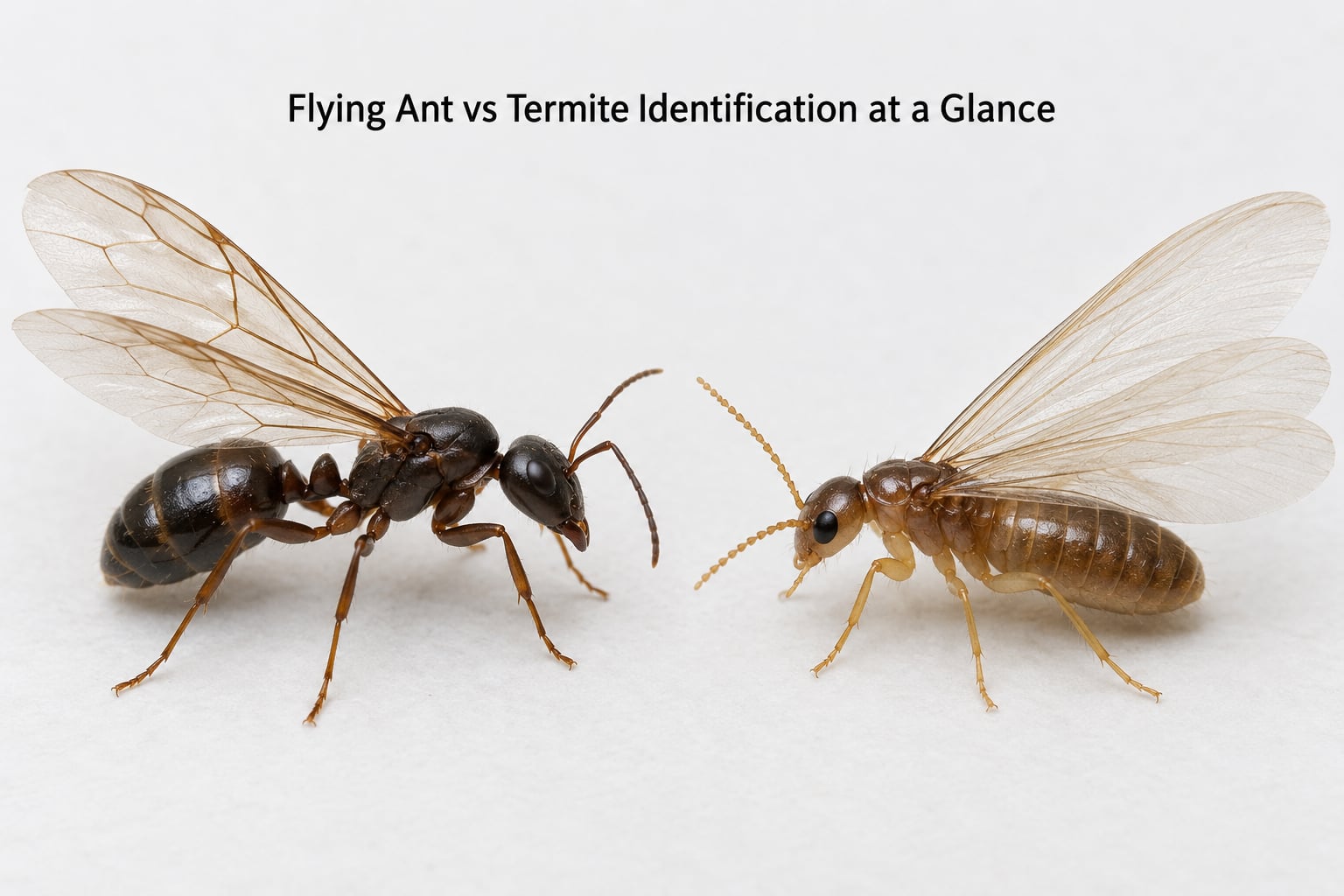
| Feature | Flying Ant | Termite Alate |
|---|---|---|
| Waist | Narrow pinched waist between thorax and abdomen | No waist, body looks like one smooth rectangle |
| Antennae | Bent with a sharp elbow, smooth surface | Straight, lined with tiny bead-like segments |
| Wings | Two pairs, front pair noticeably longer than hind pair | Four wings of nearly equal length, extending past the abdomen |
| Body shape | Clearly segmented, head distinct from thorax | Soft, pale, head barely wider than the body |
| Size | Commonly 1/4 to 3/8 inch for carpenter ant swarmers | Commonly 1/4 to 1/2 inch, pale and delicate |
| Flight | Loose wandering swarm, many direction changes, may enter through a window or door gap | Emerges around a colony, often after rain, sheds wings near moisture on the sill |
| Typical location | Near trees, soil, a nest entrance, or a wall void | Near wood soil contact, a window frame, a crawl space, or a mud tube |
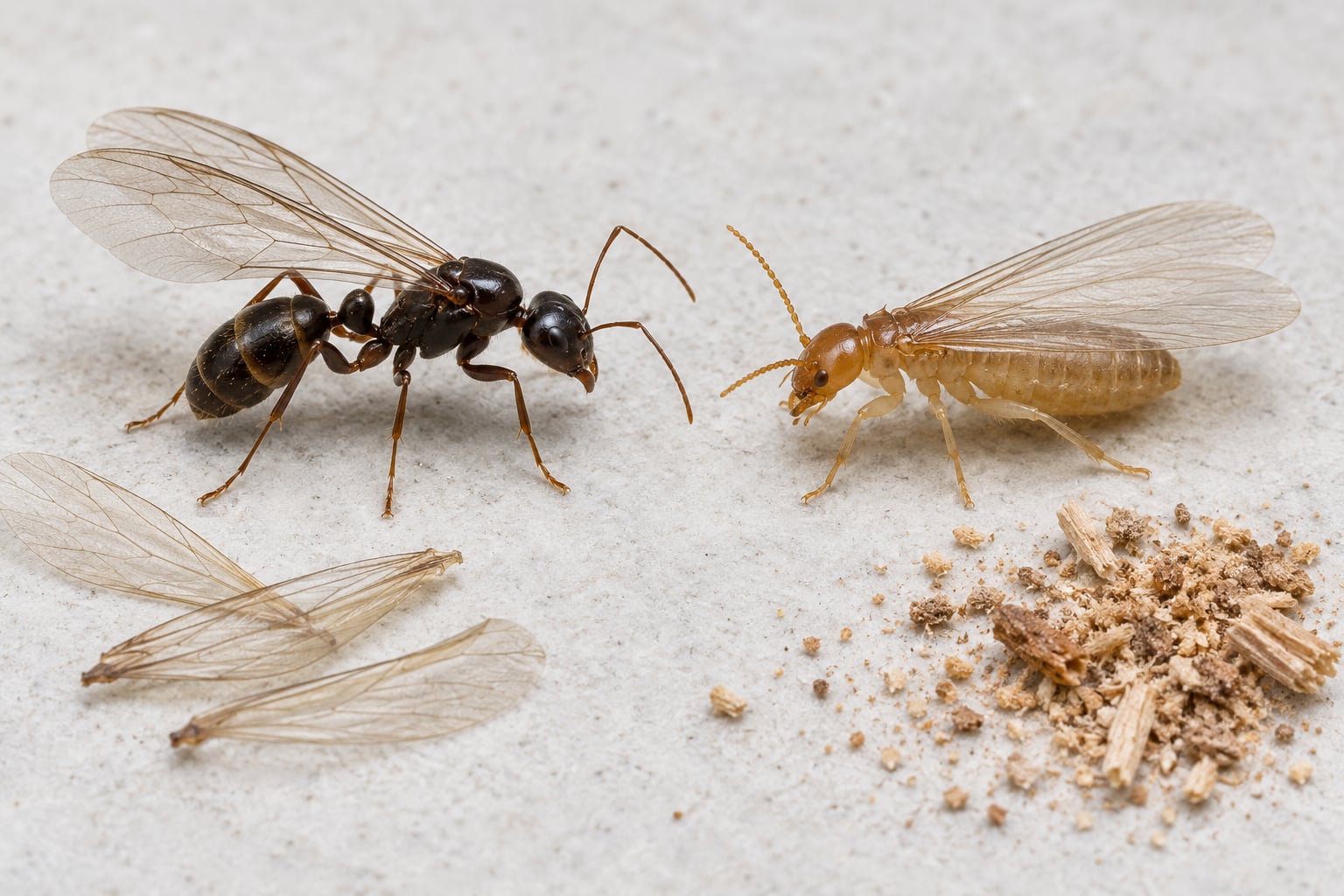
The fastest single test is the waist. If you can see a narrow point where the body pinches in between two wider sections, you are looking at an ant. If the body has parallel sides from head to tip with no narrowing anywhere, you are looking at a termite.
5 Key Differences Between Flying Ants and Termites
Reliable flying ant vs termite identification means checking a combination of features, not one. A single trait can mislead you because some wasps imitate ant antennae and some insects mimic termite body shape. These five clues, read together, settle it.
1. Waist and body shape
Ants have a constricted petiole, the narrow waist between thorax and abdomen, and a distinct head, thorax, and abdomen. Termites have no such narrowing and a uniformly thick, soft-looking body.
2. Antennae
Ant antennae bend sharply at an elbow about halfway out and are smooth. Termite antennae run straight out from the head and look like a string of tiny beads under magnification.
3. Wing length and shape
An ant’s forewings are larger than its hindwings, so at rest the wings stack unevenly. A termite’s four wings are nearly the same size and extend well beyond the rear of the body.
4. Flight and swarm behavior
Flying ants drift and wander in a loose, chaotic cloud that can last days. Termite alates rise from a specific spot near the nest, often right after rain, and tend to be drawn to light once indoors.
5. What the colony leaves behind
Carpenter ants leave coarse sawdust-like frass, often piled outside a nest opening in wood. Termites build mud or shelter tubes along wood-to-soil contact, and their wings are found in neat pairs near moisture.
Read three of these five and you can be reasonably sure. One feature alone is not enough, which is why photo-only identifications so often go back and forth on insect forums.
Body Shape and Waist: Which Insect Is Which?
An ant’s body has three distinct blocks with a narrow neck-like pinch between the chest and the abdomen. That waist is called a petiole, and it is the reason ants carry their abdomen up high when they walk. Termites have a body that stays about the same width from head through the tip, with no constriction at all.
The second difference is texture. A termite alate is soft-bodied and pale, sometimes almost translucent, with a head that is only slightly wider than the thorax. A winged ant is harder and darker, with a head you can pick out instantly even in a poor photo.
This feature is usually the clearest, but not infallible. Wasps and some flies can fake a narrow waist, so if the insect has only one pair of wings it is not an ant. Termites are less often confused with ants on body shape than on wings, which is where most wrong calls come from.
Wings: How Their Length and Shape Change the ID
Look at wing length first. Ants fly with two pairs, and the front pair is noticeably longer and broader than the back pair, so the wings look uneven stacked together along the back. Termites have four wings of similar size, longer and narrower than an ant’s, and they project past the end of the abdomen like a tail.
Veining is the secondary clue. Ant forewings show a clear network of veins, while termite wings are more uniformly translucent and lightly veined. Wing color varies too, so use it last. Some carpenter ant swarmers are black with smoky wings, while drywood termite alates are pale golden-brown.
Shed wings tell their own story. A pair of identical, equal-length wings on a sill usually means a termite landed, mated, and dropped them. Uneven wings with a clearly larger front pair point to an ant. Two of each on the floor after a night of activity is a strong signal even when you never saw the insect itself.
Antennae: Straight and Beaded or Bent and Smooth
Ant antennae attach to the head and angle forward, then kink sharply at an elbow before continuing. Termite antennae come straight out from the front of the head with no bend, and the segments are short and rounded, giving a beaded look. This is the feature insect identifiers check most often because it survives even in a blurry phone photo.
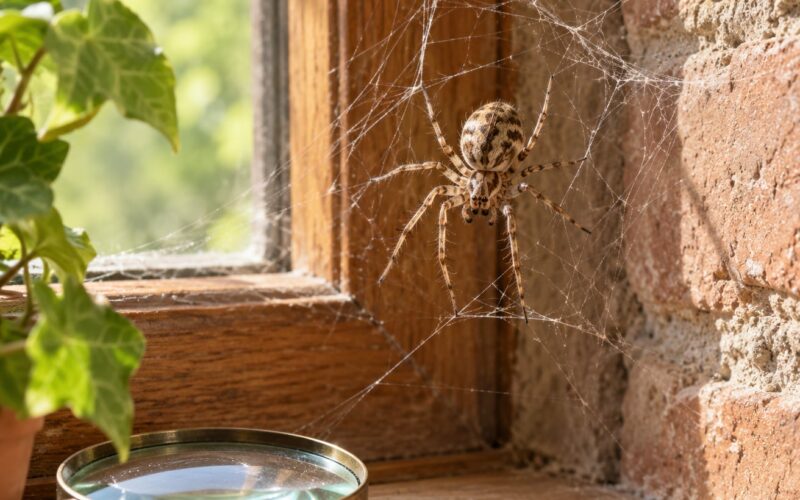
You do not need to crush the specimen. Let it sit on a piece of white paper under a lamp, or place it in a small container and view it through a hand lens. If you must move it, nudge it gently with a paintbrush or a piece of folded paper instead of fingers, because crushed tissue hides the antennae segments completely.
One caution on large carpenter ants: the elbow is obvious. On smaller ants it can be subtle, which is why the waist and wings still matter. Two features agreeing beats one feature being decisive.
Size, Body Texture, and Eyes
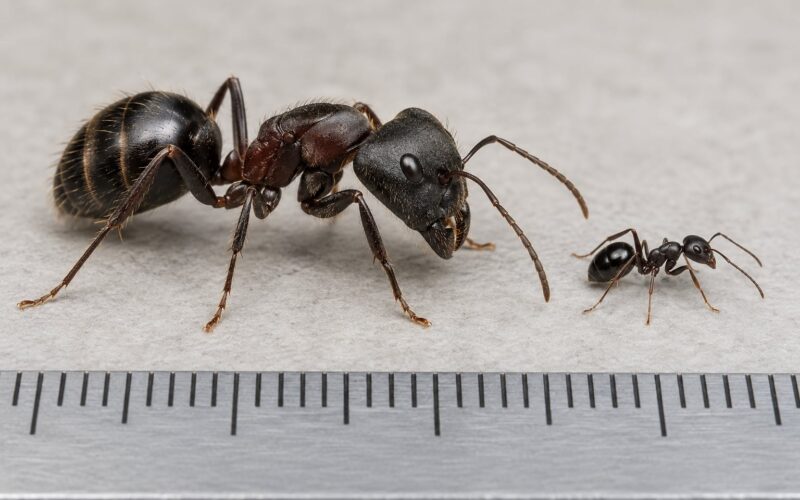
Termite alates are commonly around 1/4 to 1/2 inch long, though drywood species are larger and can reach about 3/4 inch including wings. Carpenter ant swarmers tend to run 1/4 to 3/8 inch, and some species in warmer regions are larger. Size on its own tells you very little, because the ranges overlap.
Color helps more than size. Termite swarmers are pale, cream to light brown, and darken within hours of shedding their wings. Winged ants range from black to reddish brown to yellow, which is a much wider spread and no reliable signal either way.
Eyes are the weakest clue. Termites have small, dark, bead-like eyes that many subterranean swarmers barely show. Ants usually have proportionally larger, more prominent eyes. In a small specimen or a dim hallway, ant eyes are often the first thing you cannot resolve, so set that feature aside until you have the others.
Texture is more dependable than color. Pick up shed wings gently and compare them: termite alate bodies feel soft, ants feel hard and jointed. If you are crushing nothing and still have doubts, move to behavior.
Flight and Behavior: Swarmers, Workers, and Alarm Trails
Flying ants usually emerge from an established nest and fly around it, sometimes for several days in a loose, shifting cloud. The swarm is not organized. Insects wander, cross paths, and land on whatever is around, including your siding and screens. You may see dozens over several days rather than one concentrated burst.
Termite alates behave differently. They leave a colony in a defined area, and the flight often follows warm temperatures and heavy rain because the soil needs to stay wet for the new queen to dig her nuptial chamber. A swarm that arrives on a single warm, damp day near a window frame is classic termite behavior.
Ground traffic is the giveaway. Carpenter ants form well-worn trails from an entry point to a food or moisture source, sometimes with alarm pheromone trails that persist as a visible path on counters and floors. Termite workers follow shelter tubes made of soil and debris, so look for thin mud-colored tubes on foundation walls, piers, or along a sill.
Light attraction works on both but is often stronger for termites. Alates that get inside are drawn to lamps and porch lights, which is why people find them on window screens at night.
Where You Find Them: Soil, Wood, Windows, and Moist Areas
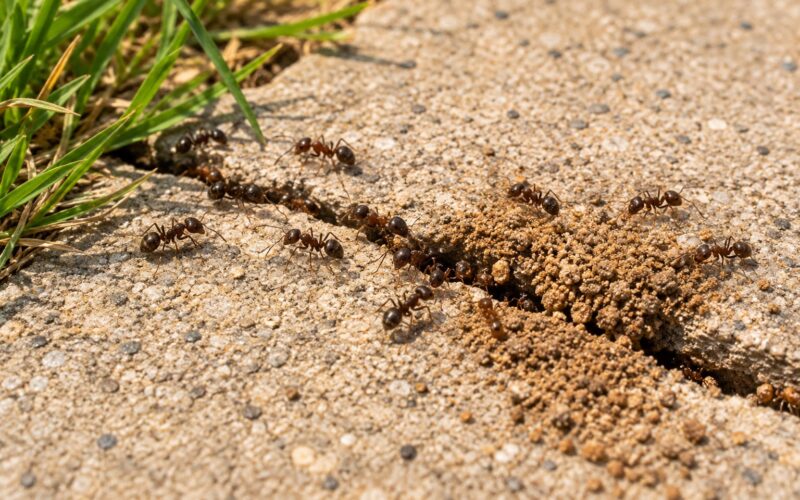
Location narrows things down fast. Flying ants found outside near a tree stump, a rotting log, a cracked patio slab, or a pile of firewood usually point to a nest just outside. Indoors, carpenter ants nest inside the structure, often in a wall void, a damp sill, or a hollow door jamb, and they travel out to forage and back.
Termites need wood-to-soil contact or a reliable moisture source. Subterranean species travel through soil and enter through foundation cracks, around plumbing penetrations, or through mud tubes. Drywood termites live inside the wood itself and are most common in the southern coastal states and parts of California, Hawaii, and Florida.
Moisture draws both, differently. Termites cluster around leaks, poor drainage, and wet wood near the foundation. Carpenter ants are attracted to damp, soft wood already damaged by moisture, which is why fixing a leak is preventive for both.
Species also shift by region. Eastern subterranean termites dominate the eastern and southern US, while Formosan termites are common in the lower Mississippi Valley and parts of the Southeast. In the Pacific Northwest, carpenter ants are a frequent cause of the sawdust pile that homeowners call termite damage. A local pest professional will recognize which species you are dealing with faster than any guide can.
Flying Ant vs Termite Identification: A Simple Step-by-Step Check
Work through this in order on a single specimen, in about five minutes. It takes longer to argue with a swarm than to examine one insect properly.
Step 1: Contain one specimen
Place the insect on white paper, or in a small sealed container. Keep at least one intact for checking both sides, and do not spray it first.
Step 2: Look at the waist
Find the pinch between thorax and abdomen. Present, ant. Absent, with parallel sides, termite. This step decides most cases.
Step 3: Compare the wings
Are the front wings clearly longer than the back pair, or are all four about the same length and extending past the abdomen? Uneven points to an ant, equal points to a termite.
Step 4: Check the antennae and texture
Look for a sharp elbow, or for straight beaded antennae on a soft pale body. Use a hand lens if you have one, and handle the insect with paper or a brush.
Step 5: Photograph and watch
Take a close, well-lit photo before cleaning anything up. Then watch for ten minutes: where does the activity concentrate, and does anything come from a crack, a tube, or a nest opening?
If steps 2 through 5 disagree, treat it as unidentified. That happens, and it is exactly the situation a licensed pest professional is set up to resolve.
What to Do After You Identify the Insect
If it is a flying ant, clean up the swarm, then find the entry. Ants usually enter through a window gap, a torn screen, a door sweep, or a wall void. Seal exterior gaps, replace damaged screens, and repair trim that is touching soil or a tree limb. Carpenter ant colonies in damp wood need the moisture source fixed, otherwise a new colony moves in after treatment.
If it is a termite, stop spraying household aerosol products. Surface sprays kill the alates you can see and do little to the colony behind the wall or below the slab, and repeated spraying can repel alates away from the structure, which delays your chance to catch them. Contain the area, do not disturb wood-to-soil contact while you make arrangements, and get an inspection.
Call a licensed pest professional when you find mud tubes along the foundation, frass inside wall voids or attics, wings in matched pairs inside the house, soft or hollow-sounding wood, or visible distortion in floors and baseboards. Termite damage is often excluded from standard homeowners policies, so early assessment matters more here than for ants.
For a small number of flying ants with no structural sign, sweeping, a vacuum run, and entry sealing is usually enough. If you see the same ants every week, or you see workers carrying food along a trail inside, you have an indoor nest and it needs bait or a targeted treatment.
Which Should You Choose?
Choose your response based on what you found, not on how alarming it looked. Flying ants are usually an entry or nesting problem, and a few of them near a window in spring is common and treatable without professional help. Termites are different in one important respect: the alate you see is evidence of a colony already inside or adjacent to the structure, which means potential ongoing wood damage.
So the order of operations matters. Identify first, then decide. Act on a guess and you will either pay for termite treatment you did not need, or apply ant bait inside a wall while a termite colony keeps eating the sill. When in doubt, spend the small amount of money on an identification visit before committing to any treatment plan.
Frequently Asked Questions
Are flying ants termites?
No. Flying ants are winged ants, usually carpenter ants, and termites are a separate insect order that only looks similar. Ants have a pinched waist, bent antennae, and unequal wings. Termites have no waist, straight beaded antennae, and four wings of equal length. Both fly to mate, so the two look alike in flight and only separate under close inspection.
What do flying ants look like?
A flying ant has a distinct head, thorax, and abdomen separated by a narrow pinched waist, with antennae that bend sharply at an elbow. Its wings come in two pairs with the front pair noticeably longer than the back pair, giving an uneven, stacked look. Colors range from black to reddish brown, and carpenter ant swarmers are usually around a quarter to three-eighths inch long.
Are termites larger than ants?
It depends on the species, which is why size is a poor test. Subterranean termite alates are commonly a quarter to half inch long, while drywood termite alates are larger. Carpenter ant swarmers tend to run a quarter to three-eighths inch, and some species exceed that. Since the ranges overlap, use waist shape, antennae, and wing length instead of overall size to identify an insect.
Do termites have wings?
Yes, but only briefly. Winged reproductive termites called alates leave the colony during a nuptial flight, usually in warm, humid weather after rain. Their four wings are roughly equal in length, narrow, and extend past the tip of the abdomen. After landing and mating, they shed their wings, which is why you often find neat pairs of identical wings on a sill without ever seeing the insect.
How can I tell if a flying insect is an ant or termite?
Check the waist first, since ants are pinched and termites have parallel sides with no narrowing. Then compare the wings: ants have two pairs of different lengths, termites have four of similar length extending past the body. Finally check the antennae, bent and smooth on ants, straight and beaded on termites. Look at all three before deciding, and photograph the specimen if anything is unclear.
What should I do if I see a flying ant or termite?
Catch one specimen on white paper or in a container, take a clear photo, and identify it using the waist, wings, and antennae. For ants, sweep up the swarm and seal window gaps, screens, and entry points. For termites, do not spray, since surface products kill only visible alates and can push the rest away. Contact a licensed pest professional to inspect the structure.
Final Verdict
The fastest way through flying ant vs termite identification is three checks in a fixed order: waist, then wings, then antennae. Pinched waist with elbowed antennae and uneven wings means an ant. Straight-sided body with beaded antennae and four equal wings means a termite.
Keep one specimen intact and photograph it before you clean up. If all three features agree, you have your answer in a minute. If they do not, treat it as an unidentified insect and get a professional opinion, especially if you also find mud tubes, frass inside walls, or shed wings inside the house.