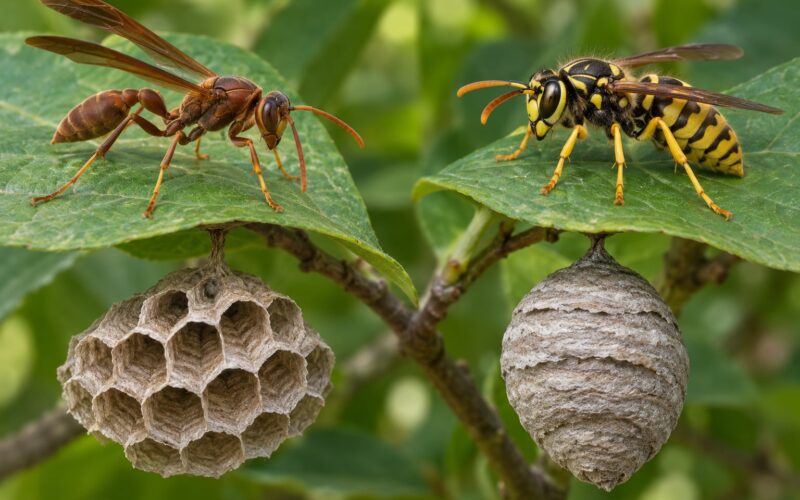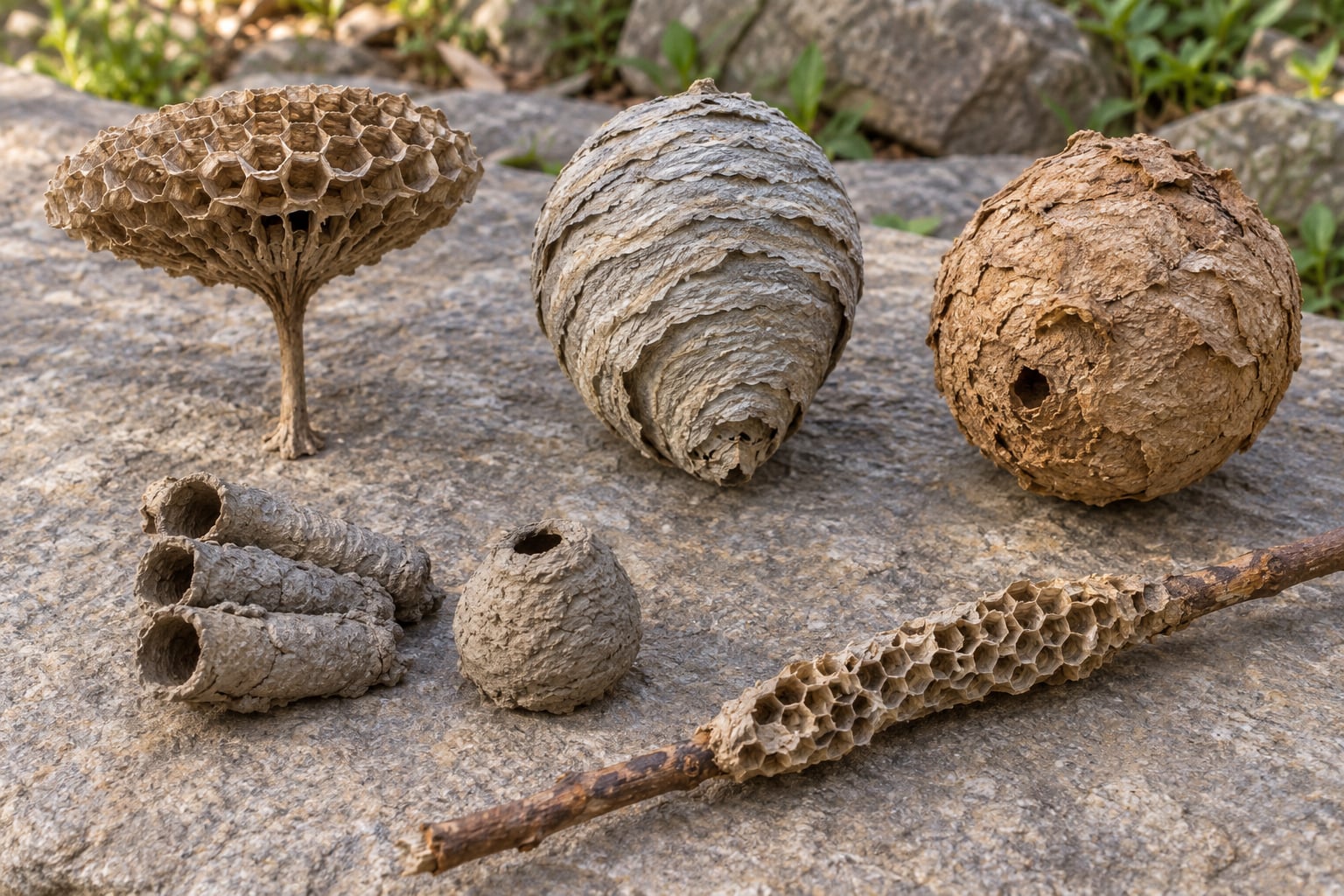
Shape alone gets you most of the way. An open upside-down umbrella of visible hexagonal cells hanging from one stalk is a paper wasp nest. A fully enclosed grey football with a single entrance hole is a bald-faced hornet nest. Mud tubes and clay pots on a wall belong to solitary mud daubers. A nest you cannot see at all is usually a yellowjacket, underground or inside a wall void.
Working out how to identify a wasp nest by its shape takes about five minutes of watching from across the yard, and the whole job should be done from at least 15 feet away. Get it wrong in one direction and you tear out a harmless mud dauber nest for no reason. Get it wrong in the other and you knock down an active yellowjacket nest over a doorway at two in the afternoon.
Below is the order I use every time: location first, because it rules out half the options before you look closely, then silhouette, then surface and color, then the opening pattern, then a comparison against the look-alikes that get mistaken for wasp nests every season.
What You Need
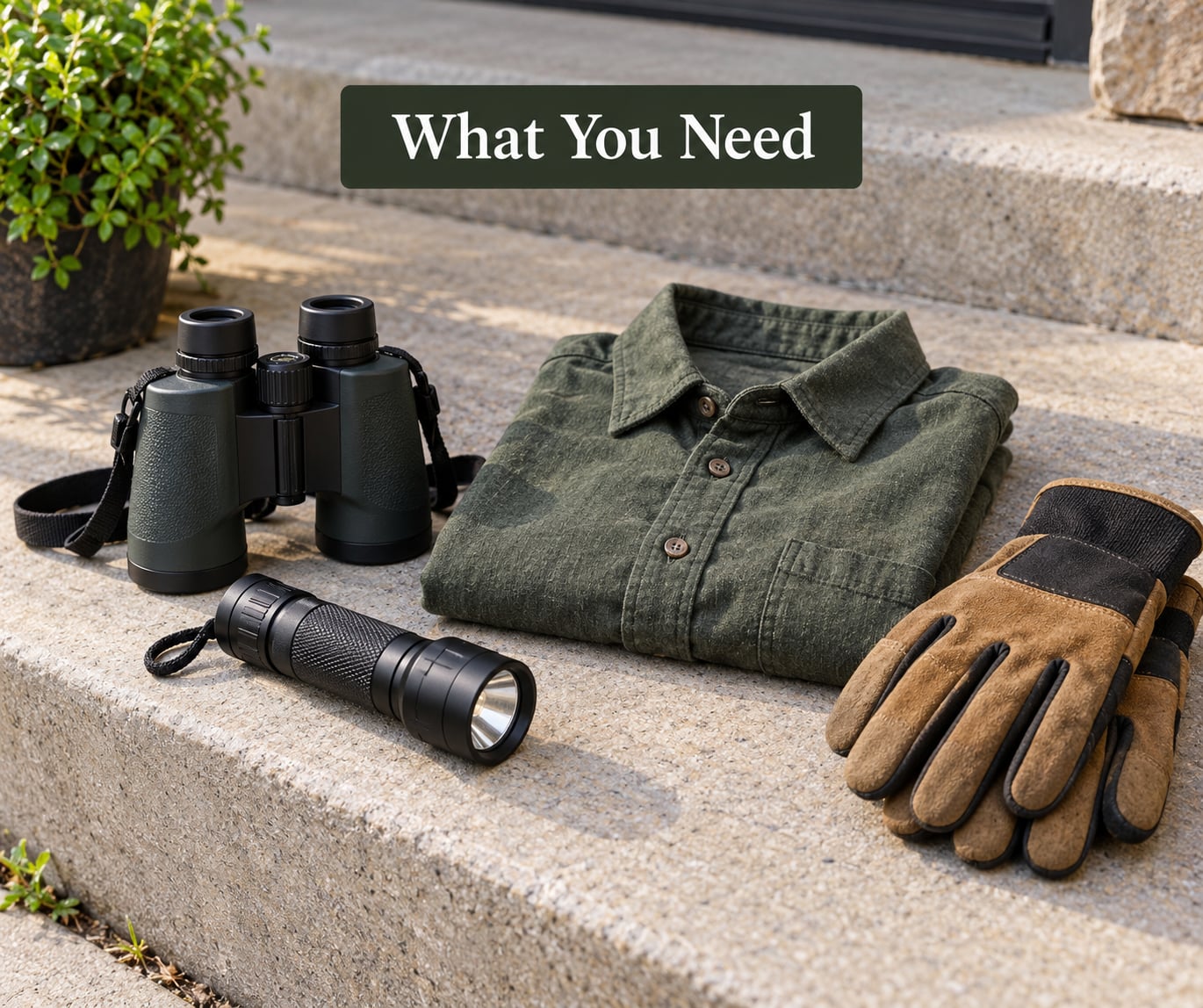
Almost nothing, which is the point. You need to see, not touch.
- Binoculars, or a phone with a zoom lens. Any optical aid past about 15 feet is what makes this safe. Nest identification done at arm’s length is how people get stung.
- A flashlight for soffits, sheds and other dark cavities. A headlamp frees both hands.
- A long-sleeve shirt, closed shoes and gloves if you will end up anywhere near a door, a downspout or an eave where nests are commonly reached.
- A clear escape route. Decide where you are walking to before you start looking. Wasps do not chase far, but they can reach a running person in about 10 feet.
- Time of day and patience. Early morning is best. Wasps are slower and less responsive before they warm up, and traffic at an entrance tells you whether the nest is occupied.
You do not need insecticidal dust, a ladder, or protective gear to identify anything. If you find yourself reaching for those, you have already moved past identification into removal, and that is a different job with different rules.
Step-by-Step: How to Identify a Wasp Nest by Its Shape
1. Check the Nest’s Location
Location narrows the field faster than any other clue, because each species has a short list of places it will build and everything else is already wrong.
Under eaves, soffits, porch ceilings, railings, shed roofs and window frames point to paper wasps or bald-faced hornets. Both hang from an overhead surface, and both build a paper envelope. A bald-faced hornet nest is usually higher up and further out on an overhang, often 10 feet or more above ground; a paper wasp nest is more likely at eye level on something you walk under daily, like a deck beam or a porch light.
Inside an attic, in a wall void, or between the second and third floors points to European hornets or a yellowjacket species that likes cavities. European hornet nests are brown papery envelopes tucked high in a dark corner. Yellowjacket nests in the same wall voids are enclosed paper balls with the usual single bottom entrance.
At ground level, in a lawn, a driveway crack, a paver gap or a rodent hole, you are most likely looking at a yellowjacket. This is the nest that causes the serious multiple-sting injuries, because ground nests sit at the exact height people walk, kneel and mow.
On a vertical surface, a fence post, a brick wall, under a railing or in an old hose reel, mud tubes and clay pots mean a solitary mud dauber or potter wasp. These are not social colonies. One female works alone, and the structure you are looking at is a handful of cells she fills with paralyzed spiders or caterpillars for her own larvae.
In shrubs and trees, a large grey ball hanging in a fork is usually a bald-faced hornet nest. A small flat disc on a branch or a papery cylinder attached lengthwise to a twig is a different kind of wasp, and the shape changes the identification.
Two locations settle it for most people. If the structure is a smooth, earth-colored tube plastered to a flat surface, it is mud, not paper. If it is a soft grey or brown shell that crumbles when you brush it, it is wasp paper made from chewed wood.
2. Observe the Overall Shape: Wasp Nest Identification by Silhouette
There are only four silhouettes that matter on most properties, and one of them is not a wasp nest at all.
The open umbrella. This is the classic paper wasp nest: an inverted umbrella or shallow disc, roughly 3 to 6 inches across, hanging from a single stalk called a pedicel. The hexagonal cells hang downward and are fully visible. You can see straight into them. That visible comb is the whole diagnosis.
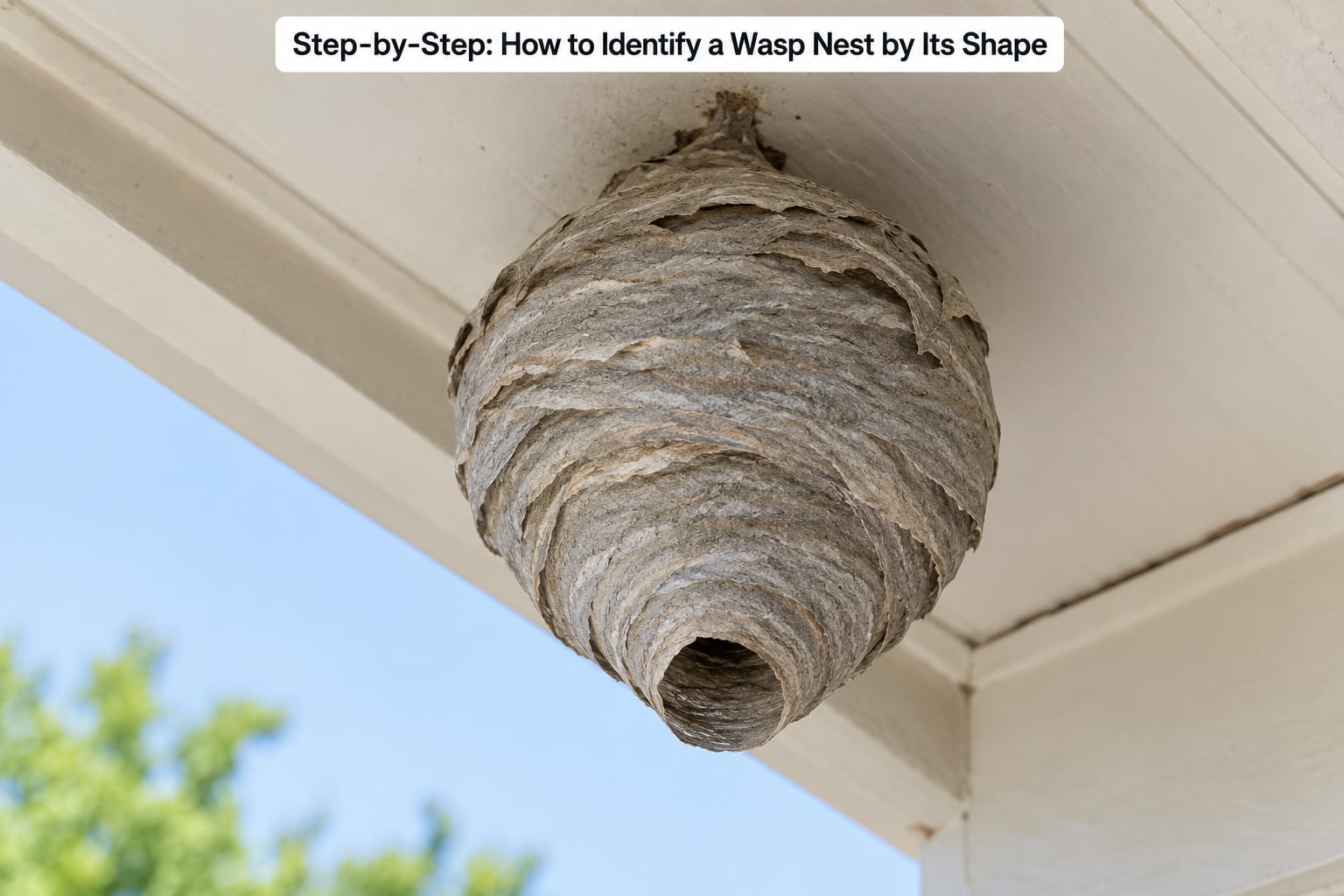
The enclosed grey football. Bald-faced hornet nests start small and open, with cells visible like a paper wasp nest, then close up completely as the colony grows. By late summer the same nest is a smooth grey oval the size of a football or a large grapefruit, with one entrance hole near the bottom. Envelopes are layered paper, striped faintly like plywood edges, and they sound hollow when you tap them from a distance with a stick.
The enclosed ball in a cavity or underground. Yellowjackets enclose their combs, but you usually see nothing at all. You see a hole in the ground, a crack in a patio, an opening under a deck skirt, or wasps entering a gap in siding. The nest itself is a layered paper sphere built around the comb, usually in the dark where you cannot inspect it.
The mud tube or pot. Cylindrical tubes a quarter to half an inch across, sometimes grouped like organ pipes, or rounded pots the size of a thimble with a narrow neck. These are solitary nests, and they are the shape most often mislabeled online. Forum questions about cylindrical pod-like structures turn out to be mud daubers or potter wasps far more often than anything else.
Two more shapes appear outside North America and are worth knowing. Australian and Southeast Asian Ropalidia species build long open combs attached lengthwise to a twig by a short stalk, like a narrow brush rather than a disc. Some tropical paper wasps build a small comb inside a loose woven envelope that looks like a pocket. If you are outside North America and the shape does not match the four above, the covering test and the material check still work; only the species name changes.
Size helps too, but only in combination with the rest. A nest under 4 inches in early summer can reach a foot or more by late August, and a bald-faced hornet nest has been measured at two feet across in good years. Size tells you how strong the colony is. It does not tell you how aggressive it is.
3. Examine the Nest’s Surface and Color
This is where the wasp nest identification gets interesting, because every paper nest answers the same question: what is it made of?
Wasps have no wax glands. Instead, adults chew weathered wood fiber, mix it with saliva, and press it into a thin papery sheet, then layer those sheets over the comb as a weatherproof envelope. That is why a wasp nest looks grey, tan or brown and fibrous rather than waxy, and why old nests fade to a uniform grey with a papery, weathered texture. Bees are the opposite: they build translucent wax comb into hanging sheets with a shine to it.
Color narrows the builder. Bald-faced hornet envelopes are grey with visible layered striping. Paper wasp combs are usually a warmer tan or brownish grey, and the individual cells show more color variation because they are uncovered. European hornet nests are a darker, mottled brown. Yellowjacket envelopes are a dull grey-brown, more brick colored when fresh.
Surface pattern matters more than color in shade. Run your eye along the outside of an enclosed nest and you will see overlapping layers like the edge of a plywood sheet, sometimes six or eight of them, each one a thin weatherproof skin. That layered envelope is the strongest single confirmation that a structure is a paper wasp nest rather than a bee hive, a mud dauber tube, or a termite shelter tube.
Weathering adds one more clue. Nests built early in the season often have a faded, torn, hole-riddled envelope by late summer, and colonies sometimes abandon a nest and build a fresh one nearby. In autumn and winter the whole structure goes papery and brittle and crumbles at a touch, which usually means nobody is home.
4. Look for the Opening and Construction Pattern
Open cells or a closed shell. That is the covering test, and it settles most identifications in a few seconds.
Open cells mean a paper wasp. You can see individual hexagonal cups facing downward and outward, arranged in a single layer, with nothing covering them. There is no outer envelope and there is no single hole. Wasps enter individual cells directly. This is the least defensive of the social wasps, and a nest out of reach of foot traffic can usually be left alone.
A closed shell means a bald-faced hornet, European hornet or yellowjacket. The comb is inside, wrapped in those overlapping paper layers, and there is one entrance hole near the bottom of the ball. Watch the entrance in early morning or evening. A steady stream of traffic in and out means the nest is occupied; an entrance with nothing moving for 20 minutes on a warm day means it is empty, finished or dead.
Mud nests have their own pattern. A mud dauber builds a short tube off a protected surface, fills a cell with several paralyzed insects, lays an egg on top, and seals it with a mud cap. New cells are capped; finished ones are open. Potter wasp pots look like closed clay jars with a narrow neck. Watch the same pot over a day and you may see it open and close as the female provisions it, which is the clearest sign you have a solitary species rather than a colony.
Follow the flight path. If you can see wasps but not the nest, stand still and watch where one individual goes. Wasps travel in a line to and from a single point and repeat that line. Track three or four of them and you will end up at the nest, usually a soffit corner, a wall void, an attic vent, or the base of a shrub. If you cannot find the entrance from the flight path, the nest is probably underground or inside the wall.
5. Compare the Nest with Similar Structures
Some of the structures people photograph are not wasp nests. Here is the comparison that comes up most often.
| What you found | Shape and material | Where it sits | What to do |
|---|---|---|---|
| Paper wasp nest | Open umbrella, 3-6 inches, visible hexagonal cells on a stalk | Eaves, soffits, decks, railings, window frames | Leave it if out of reach; a licensed pro removes it if it overhangs a door or play area |
| Bald-faced hornet nest | Enclosed grey football, layered paper, one bottom hole | High on overhangs, tree forks, attics, sheds | Never knock it down by hand; treat at night or call a pro |
| Yellowjacket nest | Enclosed paper ball around hidden comb | Underground, wall voids, under decks, in roof voids | Treat at dusk or call a pro; the main cause of multiple stings |
| European hornet nest | Brown papery envelope, mottled and darker | Attics, high wall voids, enclosed porch areas | Less defensive, but treat like a hornet and keep clear of the cavity |
| Mud dauber or potter wasp nest | Mud tubes, thimble pots, clay jars | Fences, bricks, posts, under eaves, sheds | Leave it or scrape it off; solitary, not a colony, and not a threat to people |
| Bee hive | Wax comb sheets, pale and shiny, often in a wooden box or wall cavity | Wall voids, attics, hives, tree cavities | Never open or seal it; contact a beekeeper or licensed removal service |
| Termite mud tube or shelter tube | Earth-colored tube along wood, sheeted tube on the ground | Along beams, foundations, pipes, fences | Not a nest to knock down; get a termite inspection |
A few look-alikes deserve their own mention. Carpenter bee holes are bare round holes drilled into wood, with no structure attached and no paper around them. A spider egg sac is a small silken ball in a corner, usually under a porch or in a window, and it has nothing to do with wasps. Cicada and katydid egg cases can look like rows of rice grains glued to a stem. Ant mound tubes are irregular and crumbly, not the neat laminated paper of a wasp envelope.
The material test settles almost everything. Paper crumbles into soft fibrous flecks. Mud is smooth, dense, and holds its shape when you look closely. Wax is translucent and slightly shiny. That single distinction separates nearly every misidentification I see.
If you still cannot tell, this is where most people get a wasp nest identification wrong, and it is the last check in how to identify a wasp nest by its shape: look at the size, the traffic and the location together. A nest the size of a golf ball with heavy traffic in May is a young colony that will be enormous by September. A two-foot grey ball high on an eave with traffic at dusk is a bald-faced hornet nest and a call for a professional. A small mud cluster on a fence with no visible insects is a solitary dauber nest, harmless, and probably full of spiders you would rather not have in the garden.
Common Mistakes
Five identification mistakes that lead to the wrong call
Treating every paper structure as a wasp nest. Mud tubes, wasp paper and bee wax are easy to confuse at a distance. Squeeze a flake of the material between your fingers from a safe distance, or take a photo and compare the texture. Paper is fibrous and crumbly, mud is smooth, wax is shiny.
Ignoring location. A paper nest under a deck beam and a paper nest inside a wall void are different problems with different levels of risk. Ten seconds of looking at where the nest sits prevents most bad calls.
Judging by the wasp’s color instead of the nest. Insect color is unreliable in the field, and several species overlap. The Faunalist and other field guides make the same point: the structure is the faster and safer identifier, because you can read it from 15 feet without getting close to the insect.
Confusing a dormant nest with a new one. Empty nests are common in late fall and winter. No traffic at the entrance on a warm day is a good sign, but check in the morning and again in the evening before you call it dead.
Getting too close to be sure. Identification has a safe distance and it is roughly 15 feet. Everything you need to make the call is visible from there with binoculars.
What not to do to an active nest
Do not knock a nest down in the daytime, block the entrance hole, spray a nest with a hose, or climb a ladder to reach one. Daytime removal puts the whole colony in defensive mode, and wasps that cannot get back inside will attack anything moving nearby. Do not burn a nest or soak it with gasoline or accelerants; the fire risk is real and the wasps scatter. Do not spray WD-40 or any other lubricant on a nest: it does nothing to the colony, it makes the paper greasy and unworkable for returning wasps, and it leaves you with a full-size nest that has to be redone.
There is one more popular idea worth killing off. Fake paper wasp nests sold as decoys, usually bright blue, are based on a misunderstanding: wasps are not strongly territorial about nest sites, so a plastic nest on your eave does not draw them away from yours. It just sits there looking strange.
Season helps with the timing. Colonies grow through summer from a single overwintering queen, so a nest can go from golf ball size in May to a foot or more by late August. After the first hard frost the colony dies and the nest is abandoned. Nests are never reused, so wasps returning to a spot where you removed a nest are scouting for a new site, not moving back in. You may find a new nest within a few yards, and that is expected rather than a sign the treatment failed.
If someone gets stung
Wash the site, apply a cold pack, and take an over-the-counter antihistamine if it suits them. Anyone with a known sting allergy who is showing trouble breathing, swelling of the face or throat, or widespread hives needs emergency help immediately. Multiple stings in quick succession matter too: that usually signals a disturbed colony rather than a bad reaction, and anyone who has been stung many times should be seen by a medical professional. Use an epinephrine auto-injector if one has been prescribed.
Frequently Asked Questions
How can I tell if a nest is a wasp nest or a hornet nest?
Use the covering test. A paper wasp nest has open hexagonal cells you can see straight into, hanging from a single stalk like an upside-down umbrella. A hornet or yellowjacket nest is fully enclosed in layered paper with one entrance hole near the bottom, usually grey and football-shaped for bald-faced hornets and darker brown for European hornets.
Is shape alone enough to identify a wasp nest?
No. Shape narrows it down fast, but location, material and the entrance pattern confirm it. A grey football shape high on an eave is a bald-faced hornet nest; the same shape in a wall void is a yellowjacket or European hornet. Read the three clues together and you will be right almost every time, from a safe distance.
What does a mud dauber nest look like?
Mud dauber nests are narrow tubes, roughly a quarter to half inch across, plastered in rows to a protected surface such as a fence post, brick wall or under an eave. Potter wasps build rounded clay pots with a narrow neck. Both are solitary rather than colony nests, so they hold only a handful of cells and are not a stinging risk to people.
How can I find a wasp nest I cannot see?
Watch the flight path. Stand where the wasps are most active and track individual insects until they repeat a line to a single point. Check in the morning, when traffic is steady but the wasps are slower. Look at soffit corners, attic vents, wall voids, the underside of deck beams, the base of shrubs and cracks in the ground. If wasps vanish into a gap, the nest is inside the wall or underground.
Should you destroy wasp nests?
Only when the nest forces contact with people. A paper wasp nest on a fence corner and a mud dauber nest on a wall can both be left alone, and wasps eat aphids and other insects that damage plants. Remove or treat nests over doorways, above decks where people gather, near play equipment, or anywhere a sting allergy in the household changes the stakes. Use a licensed pest professional for anything high or enclosed.
How can I get rid of an underground wasp nest?
Ground nests are almost always yellowjackets, the most defensive of the common social wasps, and the ones behind most multiple-sting incidents. Do not seal the entrance during the day and do not dig or flood the hole while workers are active. Treat at dusk with a labeled wasp product, or call a licensed pest professional, especially if anyone in the house reacts to stings.
Why do wasp nests look like that?
Wasps cannot produce wax, so they chew weathered wood fiber, mix it with saliva and press it into a thin papery sheet. Those sheets become the comb and then get layered into an outer envelope that keeps rain out. The hexagonal cells and the umbrella or ball shapes follow from that material and from where the colony needs to attach itself.
Conclusion
Identify from a distance, in that order: where it is, what shape it is, what it is made of, and how the opening works. Open cells mean a paper wasp and usually mean leaving it alone. A fully enclosed grey football high on an eave is a bald-faced hornet nest and a call to a licensed pest professional. Mud tubes and pots are solitary and harmless. A nest you cannot see but wasps keep entering is probably a yellowjacket in the ground or a wall, and that is the one worth treating at dusk or not at all without help.