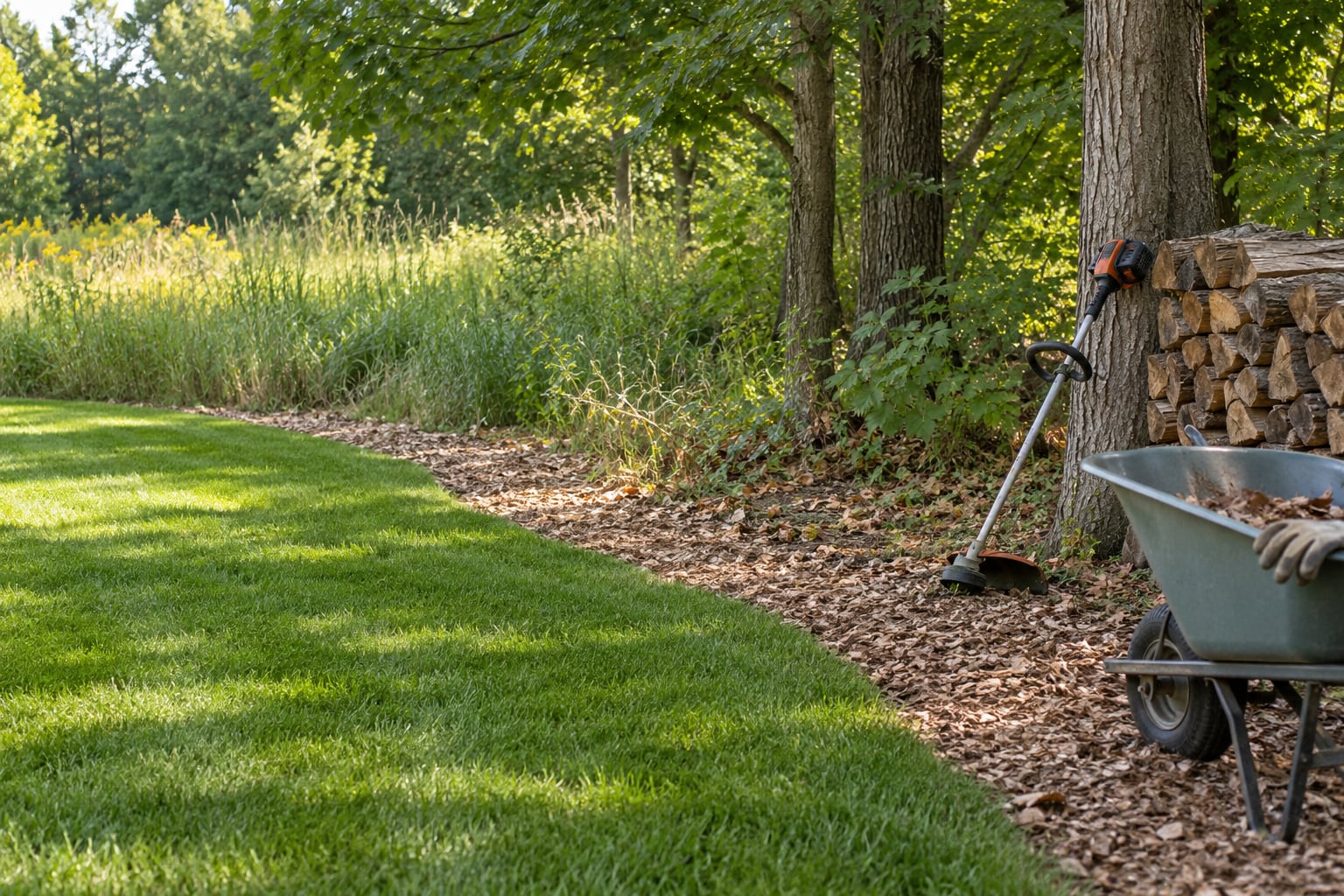
To get rid of ticks in a yard, you cut the grass short, clear leaf litter and brush, put a three-foot barrier between your lawn and the woods, treat the remaining edge habitat with a pesticide labeled for ticks, and cut off access for the mice and other hosts that bring ticks in. Most of that work is free and takes a weekend. Chemicals come last, not first.
Ticks climb to the tips of grass blades and wait there, a behavior called questing, waiting for a warm body to walk past. Deny them the tall blade, the shady leaf litter and the walking route between habitat and your play area, and the yard stops working for them.
Most bites happen at home rather than on a trail, and the CDC lists Lyme disease and Rocky Mountain spotted fever among the infections these yard ticks carry. That is why this is worth doing properly rather than spraying the lawn once and hoping.
What You Need
Most of this job is tools you may already own. Grab a mower or string trimmer, a rake and leaf blower, work gloves, and long clothing you do not mind ruining.
Add a pair of fine-tip tweezers or a tick removal tool for the moment you find one attached, and insect repellent containing DEET or picaridin for your skin. Light-colored long pants, long sleeves and closed shoes matter more than most people expect, because light fabric makes a dark nymph much easier to spot.
If you get to the treatment step, you will need an EPA-registered pesticide whose label specifically lists ticks. Read that label before you buy anything, because it tells you the site restrictions, the water setback distance, and how long pets and children must stay off the treated area. A product labeled for roses is not a yard tick treatment.
One note on when to call someone else. If your property borders woods, untreated neighbor land, or a neighbor who will not treat their side, call a licensed pest professional rather than trying to outrun the problem alone. And if a dog or cat has an attached tick and looks unwell, call your veterinarian before trying to treat it yourself.
Step-by-Step
How to get rid of ticks in a yard: start with the highest-risk areas
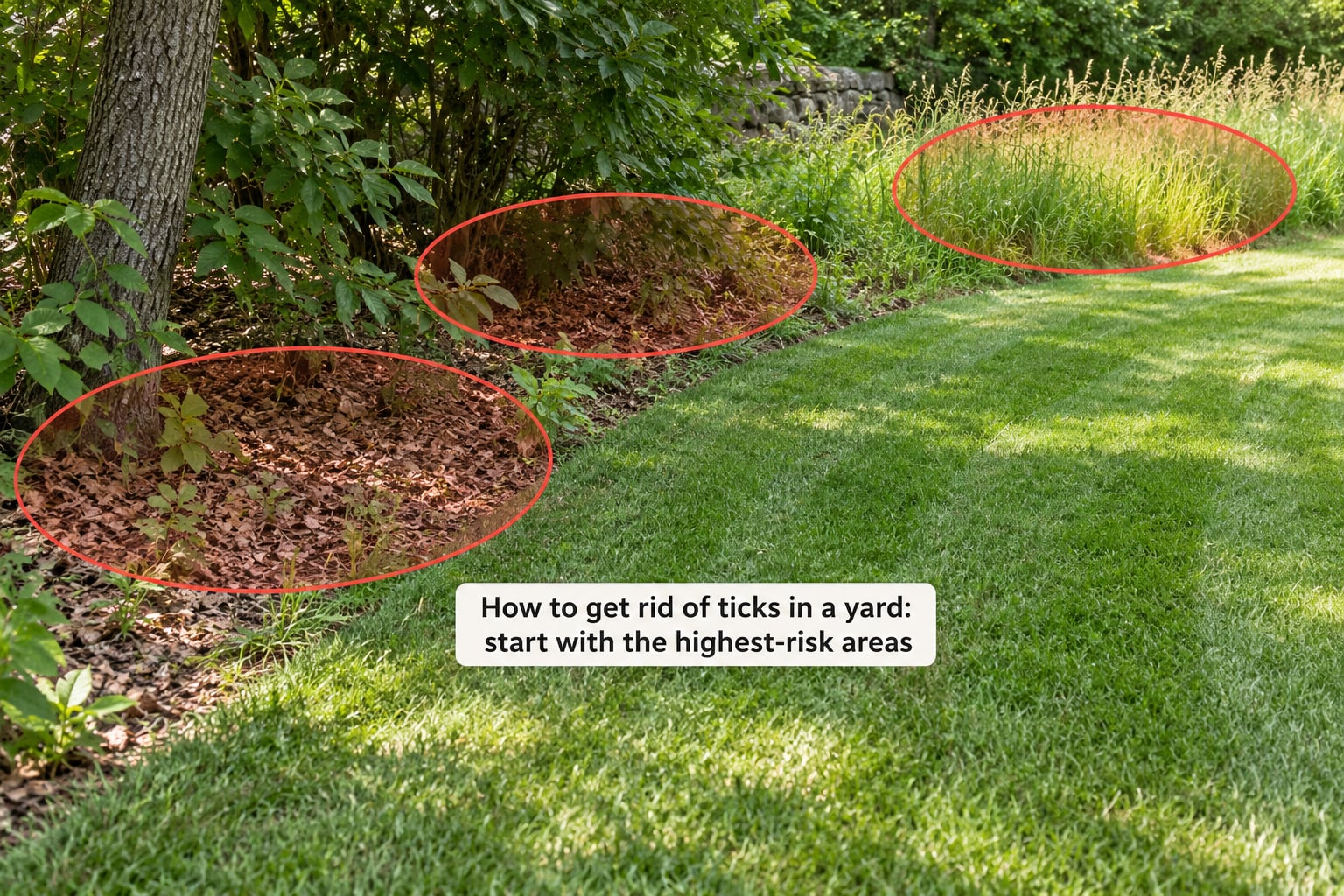
Before you change anything, spend twenty minutes walking the property and marking the spots you would avoid bare-armed on a summer evening. Shaded grass along the tree line, the strip under shrubs, low brush, leaf litter, stone walls, the dog run, and any path where squirrels or raccoons cross all deserve a mark.
You can confirm whether ticks are actually there with a tick drag. Tie a white cloth square, about five inches on a side, to an eighteen-inch pole, drag it slowly over the grass along the woodland edge, then check the cloth for ticks with a magnifying glass. Repeat in several spots. It takes fifteen minutes and it tells you whether treatment is even the right call.
Marking matters because it tells you where to spend the effort. A yard where every tick came in on the dog is a very different problem from a yard with a tick population living along the property line.
Cut grass, brush, and low vegetation
Mow to three to four inches through the season for lawn health, then mow the edges and paths a bit shorter. Never shear down to an inch; scalping the lawn stresses the grass and can make the yard damper, which ticks like just as much.
Bag clippings when you mow the edge rather than letting them sit in a clump, and rake or blow out leaf litter from shaded corners and along fences. Ticks survive winter in leaf litter, so clearing it in fall takes away the overwintering habitat.
Trim brush back from the areas people actually use, and raise stacked firewood off the ground and away from the house. A wood edge kept open lets you see what is moving through it, and a cleared strip around seating areas changes how the yard gets used.
Here is the honest limit: lawn care alone rarely solves a tick problem. If the wooded edge and the wildlife route stay untouched, the ticks keep coming back and you will be mowing forever. That is the single most common reason people think their treatment failed.
Remove yard tick attractants and entry points
White-footed mice carry the blacklegged tick, and mice are the reason tick bites happen in yards that look perfectly tidy. Reduce their access before you spend anything on product.
Seal gaps under decks, around foundation vents and utility penetrations that are wider than a quarter inch with sturdy metal mesh or hardware cloth. Repair damaged siding and trim, and check pet doors for properly fitted screening.
Fallen fruit, spilled birdseed and uncovered garbage are the reason raccoons and opossums settle in. Rake up fruit, use a lidded bin, and store pet food and livestock feed in sealed containers so nothing smells like a cafeteria.
Where fencing is lawful and practical, a run of hardware cloth around a known entry point helps. Keep wildlife control humane and within local rules, and be careful with any trap or handler that puts people and animals into repeated close contact, because that creates fresh bite risk while you work.
Treat hotspots with the right product
If ticks show up in your drag samples and the habitat work is not enough, an acaricide is a legitimate tool. Insecticidal soap and horticultural oil work on ticks that are exposed to them, which in practice means treating vegetation directly rather than the soil beneath it. That is why they fit light infestations and do almost nothing for ticks sheltered under leaf litter.
For heavier pressure, an EPA-registered pesticide labeled for ticks, often with an active ingredient such as permethrin, bifenthrin or carbaryl, applied as a spot treatment along the woodland edge, around shrubs and along fence lines, does the real work. Spraying the entire lawn is wasteful and does not reach the places nymphs hide.
Follow the label exactly. That means spot treatment rather than broadcast unless the label calls for broadcast, a pump sprayer or a lawn spreader, respect for the water setback, no application to edible plants or a vegetable garden, and no spraying where children play or pets sleep. Treat in the evening when pollinators are back in the hive and keep pets off until the label’s dry and re-entry time has passed.
Ask how soon you should expect fewer ticks. Residual pyrethroid products begin working on contact, and many homeowners notice a difference in tick numbers within a week or two, but new nymphs keep hatching from eggs that were never reached. That is why reapplication on the label schedule matters.
Use targeted yard treatments only as directed
Call a licensed pest professional when ticks persist after a full season of habitat work, when your property is mostly woods, or when the treated area is large enough that your own sprayer cannot cover it evenly. The advice from technicians is consistent: target the perimeter and the harborage rather than fogging the whole property, and note that routine lawn care companies often do not offer tick-specific service at all.
When a company knocks on your door, ask exactly six things: which active ingredient and rate they are using, the treated area in square feet, when it is safe for kids and pets to return, what they do about pollinators and nearby water, whether the plan includes reapplication, and how they monitor results afterward. If the pitch is foggers or a blanket spray of the entire lawn, keep looking.
One thing worth repeating: indoor tick problems almost always start with ticks carried in on pets, rodents or birds, not with a tick population living in the house. Once the yard and the pets are handled, that indoor source usually dries up on its own.
Prevent bites while working and reinfestation
Treat yourself as the variable you control. Wear light-colored long pants and long sleeves, tuck pants into socks, and use EPA-registered repellent on exposed skin. Permethrin-treated clothing works well, but the treatment wears off with repeated washing, so re-treat it per the label rather than trusting old gear from a few seasons ago.
Do a full tick check the same day after mowing, trimming or clearing leaves. Ticks attach around the hairline, behind the ears, in the armpits, waistband, groin and behind the knees, and they often wander for hours before settling, so check your clothes and your pet’s collar area too. A shower when you get inside washes off loose unattached ticks.
Then keep the habitat changes on a schedule rather than waiting for next summer. Keeping ticks out of your yard means the same three habits every year: short grass at the edges, no leaf litter against the house, and no open food or entry points for mice.
Common Mistakes
Spraying the whole lawn the first time you find a tick. The ticks are in the shaded edge and under leaf litter, not in the middle of the grass. Spot-treat the harborage instead and put the saved money into mowing the edge more often.
Ignoring the wooded border. A perfect lawn next to untouched woods is an open invitation. Create the three-foot barrier of dry wood chips, gravel or coarse mulch and re-treat that edge band on the label schedule.
Mowing close to the ground on a slope. Mowers and string trimmers tip easily on uneven ground, and a steep bank is where ticks like to sit. Use hand tools on slopes and steep edges, and never mow near a drop-off while wearing a backpack sprayer.
Applying product near a pond, a rain garden or food crops. Runoff carries chemicals to water where they harm aquatic life, and the label’s water setback exists for a reason. Spraying an edible garden with a lawn pesticide can leave residues on food.
Checking only your exposed skin. A full check takes three minutes and covers the places that actually get bitten.
Relying on essential oils and homemade sprays alone. Homemade tick remedies get plenty of trial, and the common thread is that they need constant reapplication and fade after rain. Fine as a supplement, weak as the whole plan.
Assuming diatomaceous earth solves it outdoors. It works by drying out the tick’s exoskeleton, which means it stops working once it is wet, and it kills beneficial insects along the way. Usable in a dry sheltered edge, useless as a whole-yard answer.
How to keep the yard tick-resistant
Set the rhythm to your local tick season rather than the calendar. In the Northeast and Upper Midwest, blacklegged nymphs peak from roughly April through July, which is when most infections are acquired. In the South, lone star ticks are most active from spring into midsummer. Peak activity also depends on the weather, so a warm early spring can shift your whole window forward.
A workable routine: mow weekly during peak season, mow the edges shorter and bag them, rake leaf litter twice a year, inspect the dog run weekly, and re-check your drag spots every few weeks through the season. Treat the edge band again when the label calls for it, usually a couple of times across a season.
Keep every pet on a veterinarian-recommended tick preventive year round, and check them after time in tall grass. Then stop relying on the absence of visible adults as your measure of success. Nymphs are the size of a pinhead and are the stage responsible for the majority of human Lyme infections, so a quiet summer is not the same thing as a tick-free yard.
Frequently Asked Questions
Does vinegar get rid of ticks in a yard?
Vinegar does not clear a yard of ticks. It is acidic and may kill a tick that is soaked directly, but yard ticks hide in leaf litter, low brush and grass tips where a spray never reaches them, and vinegar gives no residual protection afterward. It also kills grass and damages soil biology when used heavily. Fix the habitat instead, then treat hotspots with a product labeled for ticks.
How long does it take to get rid of ticks in a yard?
Habitat work such as mowing, clearing leaf litter and building a barrier changes things within a single season. A pesticide application begins working on ticks it contacts, and many homeowners see fewer ticks within one to two weeks, but eggs and sheltered nymphs survive, so results depend on reapplying on the label schedule. Expect a real drop after a full season of doing all of it consistently.
Do I need professional tick treatment for my yard?
Most homeowners do not need it if they have a small lawn and will do the mowing, edge trimming and barrier work. Hire a licensed pest professional when your property is mostly wooded, borders untreated neighbor land, keeps finding ticks after a full season of your own work, or when the area to treat is larger than your equipment can cover evenly. Ask about active ingredient, treated area, re-entry time and reapplication.
When should I see a doctor or veterinarian after a tick bite?
See a doctor if you develop fever, headache, fatigue, muscle aches or a rash within days to weeks of a bite, and mention the tick bite. Same-day veterinary care is warranted if your dog or cat is lethargic, feverish, has swollen joints or a shifting lameness, or if a tick was on for a long time or you are unsure how long. Do not wait out symptoms, and do not give human medication to a pet.
What is the safest way to remove an attached tick?
Grip the tick with fine-tip tweezers as close to the skin as possible, pull upward with steady even pressure, and do not twist. Do not smother it with petroleum jelly, alcohol, nail polish or a hot match, which can make it regurgitate into the bite. Save the tick in a sealed container or bag in the freezer for testing, clean the area, and note the date.
Conclusion
Start by mapping your yard, not by shopping. Mark the shaded grass, leaf litter and wildlife routes, confirm what you found with a tick drag, then cut the grass, clear the litter and build a three-foot barrier at the wooded edge. That is the part that does most of the work.
After that, treat only the hotspots that remain, follow the label, and keep the habit going through the season. Getting rid of ticks in a yard is mostly a maintenance schedule, not a single application.