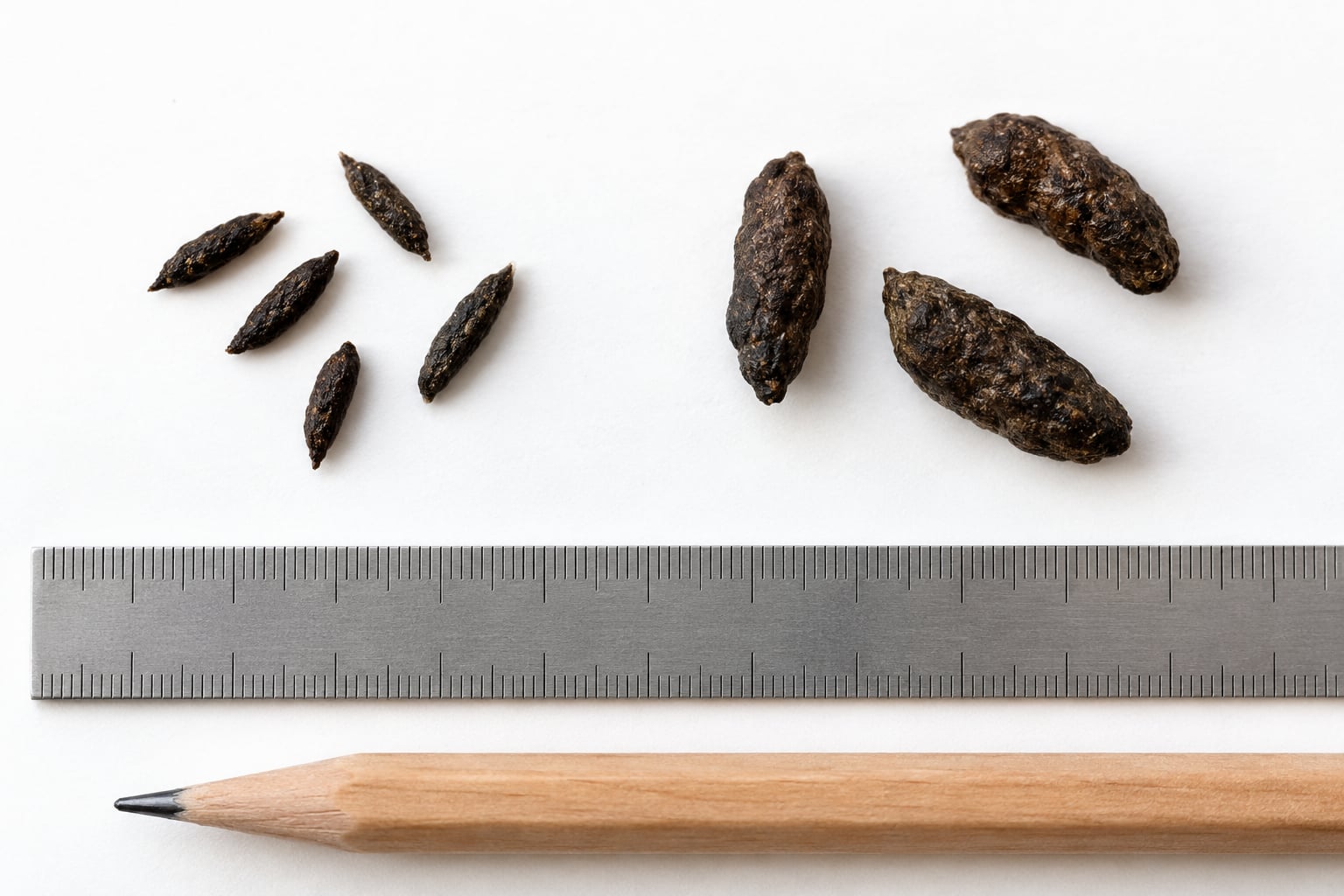
Mouse droppings are small, 3-6 mm long and pointed at both ends, roughly the size of a grain of uncooked rice. Rat droppings run 10-25 mm, are much thicker with blunt ends, and look about the size of a Good-n-Plenty candy. Size gives you the answer fastest, but shape, smell, location and the damage around them are what confirm it.
This guide covers the mouse vs rat droppings and damage differences that actually help you decide what to do next: what each one looks like, what the gnawing looks like, how to clean it up without spreading contamination, and when the evidence points to a job for a licensed professional.
One thing worth saying up front: no single dropping settles the question. A single pellet in an open floor is nearly meaningless. Twelve pellets behind the refrigerator, a grease trail along the skirting board and a chewed cable loom tell a much clearer story.
Table of Contents
- Mouse vs Rat Droppings and Damage Differences at a Glance
- Mouse Droppings: Small, Pointed, and Often Scattered
- Rat Droppings: Larger, Blunter, and Usually Grouped
- Gnawing Marks and Structural Damage
- Nests, Rub Marks, Tracks, and Other Clues
- How to Tell What Dropped the Droppings
- How to Clean Mouse or Rat Droppings Safely
- How to Stop an Infestation
- Which Should You Choose?
- Frequently Asked Questions
- Conclusion
Mouse vs Rat Droppings and Damage Differences at a Glance
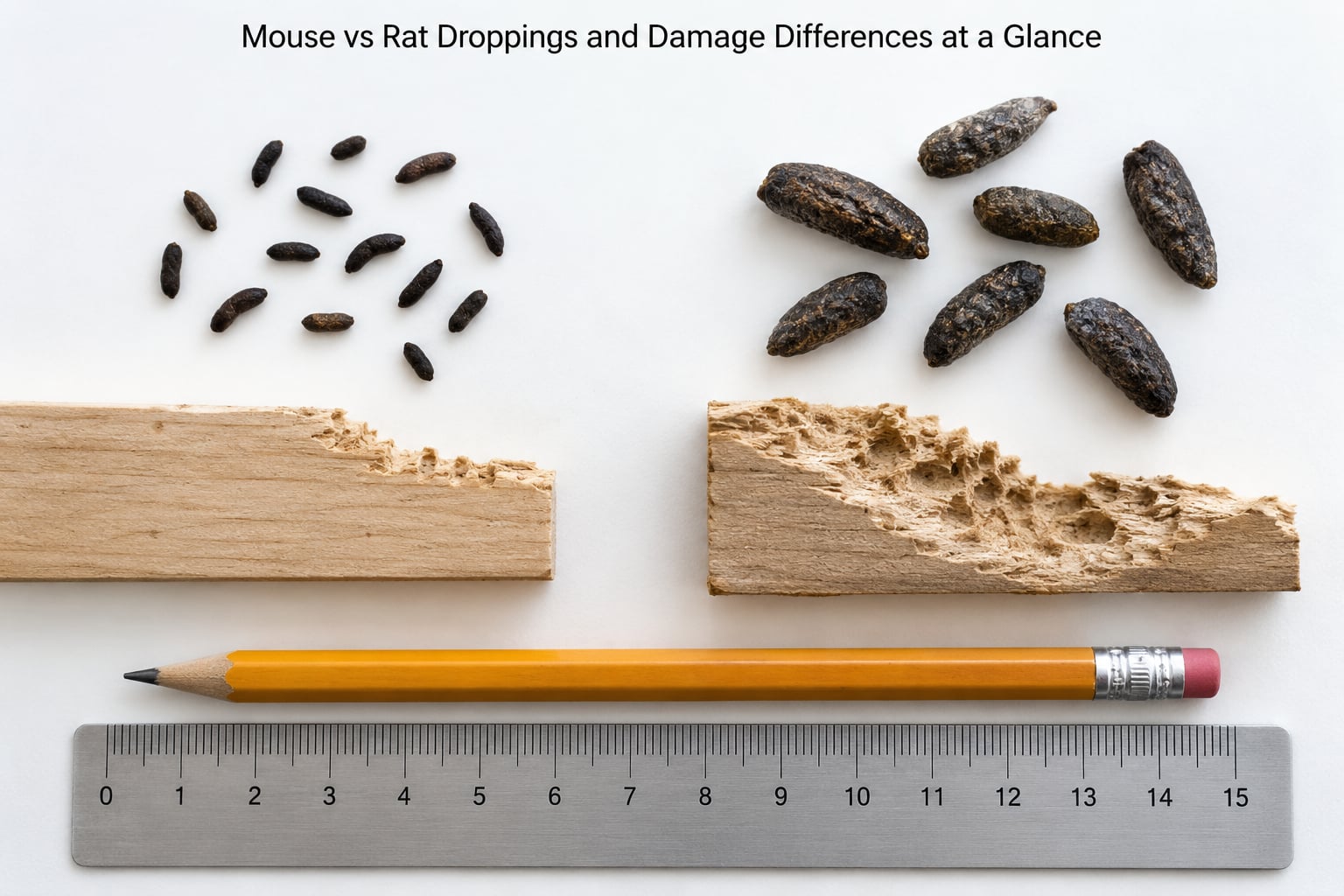
| Sign | Mouse (house mouse) | Rat (Norway and roof rat) |
|---|---|---|
| Droppings length | 3-6 mm (about 1/8 inch) | 10-25 mm (about 3/8 to 1 inch) |
| Size analogy | Grain of uncooked rice | Good-n-Plenty candy |
| Shape | Thin spindle, slightly curved | Thick, straight, sausage-like |
| Ends | Pointed at both ends | Blunt on Norway rat, pointed on roof rat |
| Colour when fresh | Black and glossy, moist | Black to dark brown, glossy, soft |
| Colour when old | Dries out, turns grey or white, crumbles | Dries hard, greyish, crumbles or flakes |
| Quantity per rodent per day | Roughly 70-150 droppings | Far fewer, but each one much larger |
| Where you find them | Scattered in cupboards, behind appliances, along pantry shelves, inside wall voids | Grouped in sheltered spots, along walls and skirting, under stairs, in basements, garages and attics |
| Body length | 7-10 cm including the tail | 20-25 cm or more, including the tail |
| Typical weight | 0.5-1 oz | 5-10 oz |
| Gap needed to get inside | About 6 mm (a pencil width) | About 15 mm (a quarter inch) |
| Scale of damage | Small gnaw marks on packaging, insulation edges and wiring near the nest | Large gouges in timber, stripped insulation, damaged wiring and plumbing |
Two caveats on that table. The roof rat breaks the blunt-ended rule, so a large pointed dropping can still be a rat. And a young rat produces smaller droppings than an adult, so a smaller pellet in the right place is not proof of a mouse.
Mouse Droppings: Small, Pointed, and Often Scattered
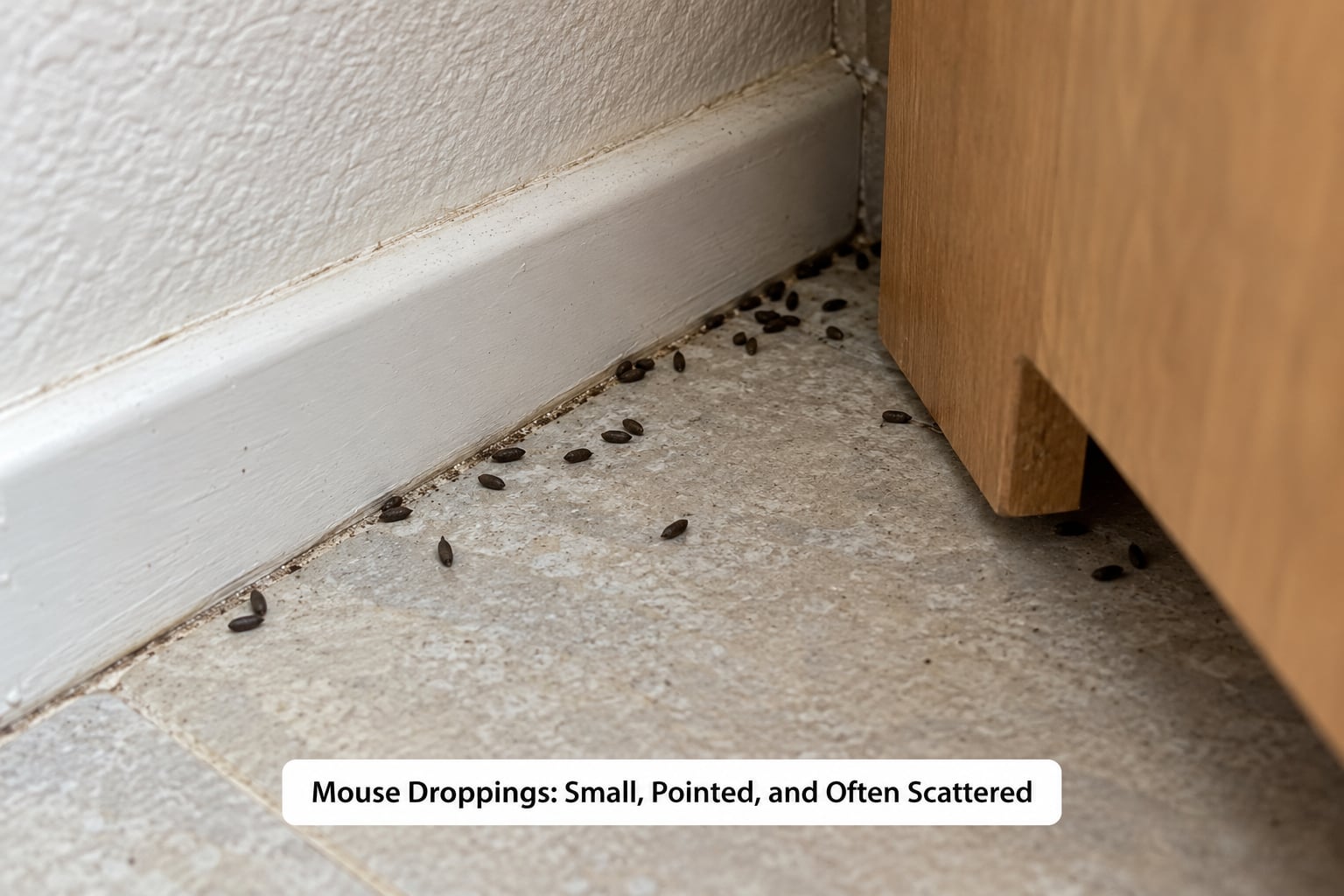
The house mouse, Mus musculus, leaves droppings that are about 3-6 mm long and a couple of millimetres wide. They taper to a point at each end, so they look like tiny grains of rice or slivers of dark grain. A pencil eraser is a decent stand-in for scale if you have nothing coin-sized to lay beside them.
Fresh mouse droppings are black and glossy with a soft, slightly tacky surface. As they dry they turn grey, then chalky, and finally crumble between your fingers. That crumble test is the one people on pest forums use most, and it is genuinely useful: if it crumbles, the dropping is old and tells you about an animal that was here weeks ago.
Quantity is the clue most people miss. A single house mouse can leave roughly 70-150 droppings in a day, so a hidden corner holding a dozen small pellets probably represents more than one animal rather than one very messy one.
Location matters as much as size. Mouse droppings tend to be scattered rather than stacked, and they cluster where food and shelter sit together: inside kitchen cupboards, behind the refrigerator and under the sink, in the pantry, under the back of the stove, and inside wall voids where pipes and cables enter.
They also turn up in places that have nothing to do with the kitchen. People find them inside boots, under a weighted blanket, in a grill cabinet, or in a drawer of clothing. If you find droppings in a bedroom or an upstairs closet, do not assume the source is where you found them. House mice routinely travel about 50 feet from the nest.
Rat Droppings: Larger, Blunter, and Usually Grouped
Rat droppings are the size difference people notice first. A Norway rat, also called the brown rat or Rattus norvegicus, produces droppings 10-25 mm long that are noticeably thicker than a mouse dropping and squared off at both ends. Drop them next to a pencil and they look about the width of a dime.
The roof rat, or black rat (Rattus rattus), is the exception that confuses people. Its droppings are pointed like a mouse dropping, but they are two to three times the length, so an inexperienced eye often files a roof rat dropping in the mouse column. Judge the pointed ones by length, not by shape alone.
Fresh rat droppings are dark, glossy and soft, and they often land as a group because rats deposit along their habitual route rather than wandering randomly. Look for a cluster, a droppings trail hugging a wall or skirting board, or a pile in a sheltered corner. Rats also leave a stronger ammonia smell in enclosed spaces than mice do, and the smell gets noticeably worse when the population is large.
Rats produce far fewer droppings per animal per day than mice, but each one is several times bigger. A small number of large droppings is therefore a worse sign than a large number of small ones. Rats are also harder to live with: a mature Norway rat weighs around 5-10 oz against the mouse’s half ounce to an ounce, and it can chew through materials a mouse leaves alone.
Gnawing Marks and Structural Damage
Droppings tell you which rodent is present. The damage tells you how far it has already gone, and that is the part most identification guides skip. Rodents chew constantly because their incisors grow continuously, so chewing is behaviour, not hunger.
Electrical wiring and electrical boxes
Both species damage wiring, and this is the hazard to take seriously in any home. Rodents are drawn to cables because the outer sheath is rubber or plastic and the core is not food, but gnawing the sheath exposes the conductor. Exposed conductors arc, overheat and start fires, often inside a wall void or behind an appliance where nobody sees the damage until it matters.
Rats cause the larger damage: they strip longer runs of cable, chew junction boxes and work their way into loft and garage wiring. Mice concentrate their gnawing near the nest, so the damage clusters in a small area rather than spreading along a whole run.
Insulation, stored materials and packaging
Mice build nests out of shredded paper, fabric and bits of insulation, so look for a compacted ball of chewed material in a wall void, under an appliance or inside a storage box. They chew through cardboard and plastic packaging to reach food and will take a bite out of insulation to line a nest.
Rats strip far more insulation, sometimes pulling whole batts down in a basement or attic, and they damage stored materials in garages and sheds where food, pet food or bird seed is stored. Chewed cardboard and plastic bags are a good clue to a rat-sized animal rather than a mouse.
Timber, plumbing and structure
Rat incisors leave noticeably larger gouges than mouse marks, and they are strong enough to damage wood in structural elements, plastic pipe and some metal. Norway rats are also burrowers, so filled-in ground outside a foundation wall can be a sign of a rat problem rather than a mouse one.
Unscrew covers on an outlet, lift a kickboard or pull back kitchen plinths and check for gnawed cable. If the insulation behind that panel is chewed through, this is past the point of a trap and a tube of sealant.
Nests, Rub Marks, Tracks, and Other Clues
Droppings are the headline evidence, but the supporting signs often settle it faster. Look for these alongside the droppings rather than instead of them.
- Nesting material: shredded paper, fabric, insulation or dry plant matter compacted into a hidden ball. Rats build bigger, denser nests and often use them as a base from which to scatter droppings.
- Rub or grease marks: dark smears along a wall or skirting board, caused by a rodent’s body oils on fur rubbing the same route repeatedly. Rats travel along edges and leave these more consistently than mice.
- Urine odour: a sharp ammonia smell that gets worse in a closed space. Never smell a dropping directly, since rodents can carry hantavirus and, where it occurs, leptospirosis through their urine.
- Scratching in walls: scratching inside drywall is often a mouse or rat running in a wall void. People regularly mistake this sound for something much larger than it is.
- Tracks and runways: dusty tracks through undisturbed dust, or a cleared runway along a wall with droppings at the edges.
- Feeding damage: gnawed food packaging, bags with small teeth marks, and cereal or pet food scattered in a corner.
None of these signs is decisive alone. Weigh them together with the droppings, because a grease mark means almost nothing without a scale reference and a damaged bag means nothing without knowing what chewed it.
How to Tell What Dropped the Droppings
If you want a repeatable method rather than a guess, work through these five checks in order.
- Measure against something known. Put a coin or a pencil beside the dropping. A house mouse dropping is roughly pencil-width and 3-6 mm long; anything more than 9-10 mm long or clearly thicker than a matchstick is a rat dropping. Forum users regularly settle arguments by holding a screw or bolt next to the pellet.
- Check the ends. Pointed at both ends means a house mouse, or a roof rat if the dropping is much larger than rice-sized. Blunt and thick means a Norway rat.
- Check freshness. Wet glints on the surface and black colour mean active. Dry, grey or white, crumbling material means old and probably abandoned.
- Count and look at the pattern. Scattered small droppings suggest mice. Grouped large droppings, trails and strong odour suggest rats. A dozen small droppings in one sealed space matter far more than a single dropping in an open hallway.
- Look for the matching damage. Small gnaw marks and light insulation nesting point to mice. Larger gouges, stripped insulation, chewed wiring and burrowing point to rats.
How to tell if the droppings are fresh or old
Fresh droppings are black, glossy and soft or tacky. Older droppings dry out, lighten to grey or white, harden, and crumble when squeezed with a gloved hand. That simple test tells you whether you are dealing with an active animal or a problem that was there months ago and has stopped, which changes everything about how you respond.
Once you have removed everything and excluded the entry points, a reliable check is to come back after five to seven days with a bright light. New droppings mean activity continues. No new droppings and no fresh gnaw marks means the source is stopped, and you can move on to sealing and monitoring rather than trapping.
What else gets mistaken for rodent droppings
Several things look alarming and turn out not to be rodents at all.
- Bat guano is crumbly, chalky and often bleached white or tan, and it smells musty rather than ammonia. It tends to appear near an entry point high on a wall or under a roof eave, not along a skirting board.
- Cockroach droppings are much smaller, speck-like, and often carry dark streaks or smearing where the insect has moved across the surface.
- Moth droppings are tiny and sit near the larvae, usually in a closet or storage box with webbing and casings nearby.
- Insect frass from beetles or other larvae looks like coarse sawdust or grainy grit, usually directly under the infestation itself.
Can you have mice and rats at the same time?
Yes, and it is more common than people expect. Rats often drive mice out of a shared space, so a sudden shift from small scattered droppings to large grouped ones, or vice versa, can mean a species change rather than a population boom. If you find both sizes of dropping in the same building, treat it as a mixed infestation: rat-sized traps alone will leave the mice breeding behind you.
How to Clean Mouse or Rat Droppings Safely
Rodent droppings can carry hantavirus, salmonella and other organisms, and the risk comes from inhaling dried particles or contaminated dust rather than from touching the droppings themselves. Cleanup is straightforward if you wet everything first.
- Isolate the area. Close doors to adjacent rooms, move pets and children out, and open windows if you can. Work from the least contaminated area toward the most, and never disturb droppings and then walk the same path with your shoes.
- Put on disposable gloves and a mask. Nitrile or latex gloves, a cloth or paper mask over your nose and mouth, and long sleeves. Wash hands and forearms with soap and water afterwards.
- Do not sweep or vacuum dry droppings. A broom breaks pellets into dust, and a standard shop vacuum or an unfiltered vacuum aerosolises that dust straight into the air and onto the filter. One homeowner who hoovered up droppings with an unfiltered shop vac described it as the one thing they wish they had not done.
- Wet the droppings and wait. Saturate them with a disinfectant or a solution of nine parts household bleach to one part water, leave the surface wet for about 30 minutes, then pick them up with paper towels. Never mix bleach with ammonia-based or acid cleaners.
- Bag and dispose. Seal everything in plastic bags or a lidded bin and take it outside to your local waste or disposal point as your local rules require. Wash any reusable tools and tools in the area with hot soapy water.
- Clean the surfaces around them. Wipe shelves, skirting boards and behind appliances with disinfectant, and clean droppings from hidden voids only when you can do it safely.
If droppings are inside a wall void, under a bath, behind a built-in fridge or in a duct, do not cut into the structure to reach them. That is a good moment to call a licensed pest professional, because exposure during the work is high and the gap will simply reopen.
How to Stop an Infestation
Cleaning droppings without excluding the entry points means you are cleaning, not solving. A workable plan runs in this order.
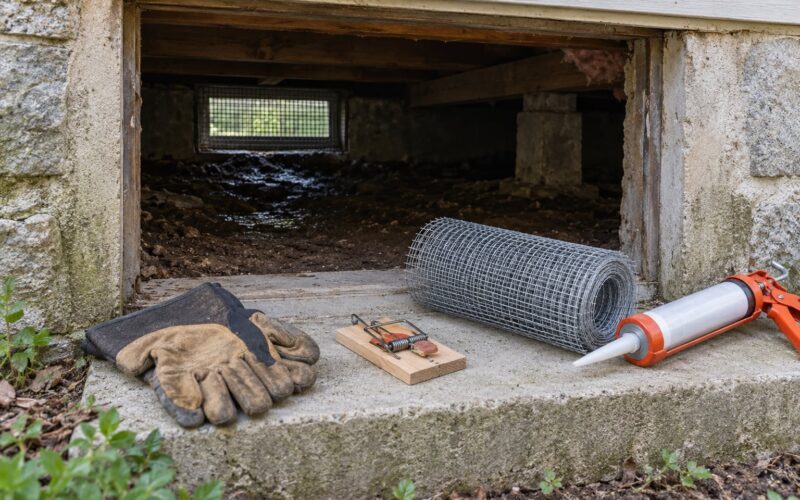
- Seal every gap you can reach. A house mouse needs a gap of about 6 mm, roughly pencil width, so a mouse-sized hole is easy to miss. A rat needs about 15 mm. Fill gaps with steel wool or mesh plus a sealant; foam alone gets chewed out. Pay attention to where pipes and cables enter, the space around the chimney, the attic hatch and the garage-to-house door, and any hole larger than a quarter inch.
- Remove the food supply. Store food in sealed hard containers, keep pet food in a lidded bin rather than an open bowl, take rubbish out regularly, and clean spills immediately. Rats range far enough to find food 300 feet away, so think beyond the kitchen.
- Cut off the water and shelter. Repair dripping taps, clear clutter that gives them cover, and seal gaps around pipes and vents.
- Repair what they chewed. Replace gnawed cable sleeves and insulation, and check wiring inside outlet boxes and behind appliances before closing anything up.
- Use traps sized to the animal. Snap traps built for mice will not kill a rat, and mouse traps are inefficient against rats that are strong, fast and wary. Set traps along walls and edges, not in open floor, and check them often.
- Monitor. Look again after five to seven days for fresh droppings or new gnaw marks.
Call a licensed pest professional when the droppings are grouped and large, the odour is strong, gnawing is extensive, activity is in an attic, basement or wall void you cannot reach, wiring or structural members are damaged, or rodents are active inside the living space during the day. Rats reproduce year-round, so delay in a rat situation compounds quickly.
Which Should You Choose?
If the evidence is small, pointed droppings scattered near food, minor chewing on packaging and a light insulation nest inside a wall void, you are looking at a mouse-level problem. Clear and disinfect the droppings, seal everything at pencil width, remove accessible food, and set mouse traps along the routes. Check again in a week.
If the evidence is droppings 10-25 mm long, grouped or stacked near walls, strong ammonia odour, large gouges in timber, stripped insulation, chewed wiring or a burrow outside the foundation, choose a more urgent response. Rat-level evidence means larger traps, wider exclusion at quarter-inch gaps, a full search of the attic and basement, and quite possibly a licensed professional.
When both sizes of dropping appear, or when you cannot tell what you are looking at, book a proper inspection rather than guessing with the wrong trap. Once you know the species, the control plan writes itself.
Frequently Asked Questions
Can I identify mice or rats from droppings alone?
Not reliably on their own. Size and shape give you a strong first read, but roof rats leave pointed droppings larger than a mouse’s, and juvenile rats produce smaller ones. Confirm with location, quantity, smell, nesting material and the scale of gnaw damage around the site. Several clues pointing the same way are what make an identification trustworthy.
Are larger droppings always from rats?
Usually, but not always. A dropping longer than about 9-10 mm or clearly thicker than a matchstick is almost certainly a rat. The main exception is the house mouse, which produces droppings 3-6 mm long, and young rats, which produce smaller droppings than adults. Roof rat droppings are pointed, so a long pointed dropping still means rat.
How many droppings indicate a serious infestation?
A single house mouse can leave roughly 70-150 droppings in a day, so a dozen small droppings in one sealed cupboard or wall void suggests more than one animal. Rats produce fewer, larger droppings, so the same total number of pellets means a much bigger problem when they are rat-sized. Grouped droppings, strong ammonia smell and fresh gnaw marks point to an active infestation either way.
Can mice chew through electrical wires?
Yes. Mice and rats both gnaw cables, mostly near the nest, and strip the outer sheath to reach the core. Exposed conductors can arc and start fires inside wall voids or behind appliances, which is why gnawed wiring should be replaced rather than wrapped in tape. Rats cause the wider damage, including chewed junction boxes and damaged insulation around cable runs.
Is it safe to vacuum or sweep mouse droppings?
No, not with a standard broom or an unfiltered vacuum. Dry droppings break into dust and spread pathogens into the air and onto surfaces. Wear disposable gloves, wet the droppings with disinfectant or a nine-to-one bleach solution, leave it wet for about 30 minutes, then lift them with paper towels and bag them. Wash hands and surfaces afterwards.
When should I call a pest control professional for rodents?
Call a licensed professional when droppings are large and grouped, the ammonia smell is strong, gnawing has damaged wiring, insulation or structural timber, activity is in an attic, basement or sealed wall void you cannot reach, or rodents are out during the day in living areas. Rats breed year-round and are harder to exclude than mice, so early professional work is usually cheaper than a delayed attempt.
Conclusion
Mouse vs rat droppings and damage differences are easiest to read when you combine them. Size and shape identify the species: small and pointed means a mouse, large and blunt usually means a rat, with the roof rat the pointed exception. Quantity, location, smell, nests, grease marks and gnaw damage tell you how many animals you have and how established they are.
Clean up by wetting the droppings rather than sweeping or vacuuming them dry, seal gaps at pencil width for mice and a quarter inch for rats, then check back in five to seven days for fresh signs. If the evidence is large, grouped and accompanied by serious gnawing, get a licensed professional involved before the wiring and structure take the damage.