Short answer: you should not squash a cockroach because the blow usually does not kill it, and it aerosolizes bacteria, allergens, and gut contents across a surface you may be eating on. Catching and containing one works better than stomping it, and one roach is a clue worth investigating rather than a crisis.
Last reviewed for 2026. I have read enough homeowner accounts of the shoe-and-slipper reflex to know how it goes: you spot movement near the toaster at 11pm, you react before you think, and twenty minutes later you are scrubbing a smear out of your countertop while wondering what you just walked into.
The honest version is less dramatic than most pages on this topic will tell you. Crushing a cockroach does not spray forty live babies across your kitchen, and the idea that killing one summons a crowd is mostly wrong. What crushing actually does is leave you with a fouled food-contact surface, an aerosolized puff of allergens and bacteria, and a decent chance the roach is still alive under your shoe.
Table of Contents
Why You Should Not Squash a Cockroach
Four things go wrong when a roach meets a shoe, and none of them are about eggs exploding. The first is that the kill is unreliable.
- The exoskeleton absorbs the impact. Cockroaches breathe through spiracles along the abdomen and can support roughly 900 times their own body weight. A partial stomp cracks the shell without finishing the job, and an injured roach often goes still rather than dead.
- Crushing aerosolizes body material. Fragments of cuticle, dried feces, and gut bacteria lift into the air. For a household with asthma or cockroach sensitivity, that puff is the part worth avoiding.
- You contaminate a surface you use for food. A crushed roach leaves a greasy smear carrying hemolymph and whatever it was eating. Countertops, stovetops, and sink edges are exactly where we do not want that.
- You get a cleanup task instead of a solution. The roach is gone but the mess is not, and nothing about it makes the next one less likely.
What Happens When You Crush a Cockroach?
Physically, you rupture a rigid chitin shell, and that is where the sharp little pop comes from. It is shell failure, not bursting air. The white liquid that oozes out is hemolymph, the insect equivalent of blood, which looks pale because it carries no hemoglobin.
The smell comes from two places: bacteria coating the body and gut contents, plus whatever the roach was eating. Entomology forum regulars note that American cockroaches genuinely feed on decaying material, so a crushed one can carry a genuinely offensive odor, while a German cockroach in your kitchen usually smells more like grease and old coffee.
Why You Should Not Squash a Cockroach on a Food Surface
A squashed cockroach on a counter where you prepare food is a sanitation problem, not just a disgust problem. The smear holds moisture and organic matter, so you need to disinfect rather than wipe, and you need to do it before anyone touches the area.
If the crush happened on a cutting board, a wooden spoon, or anything that touches food, my advice is to wash and sanitize that item properly, not rinse and return it to the drawer.
Should You Kill a Cockroach You See?
If a roach wanders into an open room and you have pets and small children around, yes, deal with it. The issue is how. A single adult in a hallway is most often a stray from a neighbor’s unit, a recent mover’s box, or something that rode in on groceries.
Identifying what you saw matters more than the killing. The four species you are likely to encounter at home behave differently, and the German cockroach is the one that actually breeds indoors in numbers.
- German cockroach (Blattella germanica): light tan with two dark stripes on the back, about half an inch long, reproduces fastest of all, and carries its egg case internally until it drops it.
- American cockroach (Periplaneta americana): the big reddish-brown one, over an inch long, usually living in drains and sewer lines and wandering in from outside.
- Brown-banded cockroach (Supella longipalpa): smaller, with light and dark bands across the wings, prefers warm dry rooms like bedrooms and upper floors.
- Oriental cockroach (Blatta orientalis): glossy black, strongly damp areas such as basements and utility rooms.
If what you saw was small and striped, assume German and treat it seriously. If it was large, brown, and appeared near a basement or drain, you likely have an outdoor neighbor problem rather than an indoor breeding colony.
What Makes a Cockroach Infestation Worse?
Infestations grow from food, water, warmth, shelter, and entry points, not from dead bodies. Seal those five things and the population stops growing regardless of what you do with individual roaches.
Myth versus reality on crushing a cockroach
Most of what circulates about squashing roaches is half-true, and the reason why you should not squash a cockroach has very little to do with the stories. Here is the split, because knowing which is which saves a lot of unnecessary panic.
| What people say | What is actually true |
|---|---|
| Crushing a female bursts her body and scatters eggs | It does not. If you see an egg case, it is the ootheca she was already carrying. |
| Squashing one calls a crowd of roaches | The alarm pheromone can briefly startle nearby roaches, but it does not attract them. |
| The pop is air escaping | It is the exoskeleton cracking under load. |
| The white stuff is eggs or milk | It is hemolymph, the cockroach equivalent of blood. |
| A crushed roach is definitely dead | Thanatosis, or playing dead, is common. Many revive within an hour. |
| The smell means other roaches are nearby | It means this roach was eating something foul, or it was carrying gut bacteria. |
| They always come back to the same spot | They return to reliable food and water sources, which is a problem you can fix. |
On eggs specifically: a German cockroach female retracts and holds her egg case internally, then drops it once it is sealed, which is why you sometimes see a capsule come out of a crushed female. American and brown-banded cockroaches glue their egg case to a surface in a protected spot before it hatches. You cannot get a spray-burst of live nymphs from a stomp, but you can end up with an egg case on your counter that you then have to find and remove.
One correction worth making, because it changes behavior: a crushed roach does not reproduce. What does happen is that adults you failed to kill stay alive, mate, and produce more, so a bad kill strategy quietly makes your numbers problem worse.
Safer Ways to Catch and Remove a Cockroach
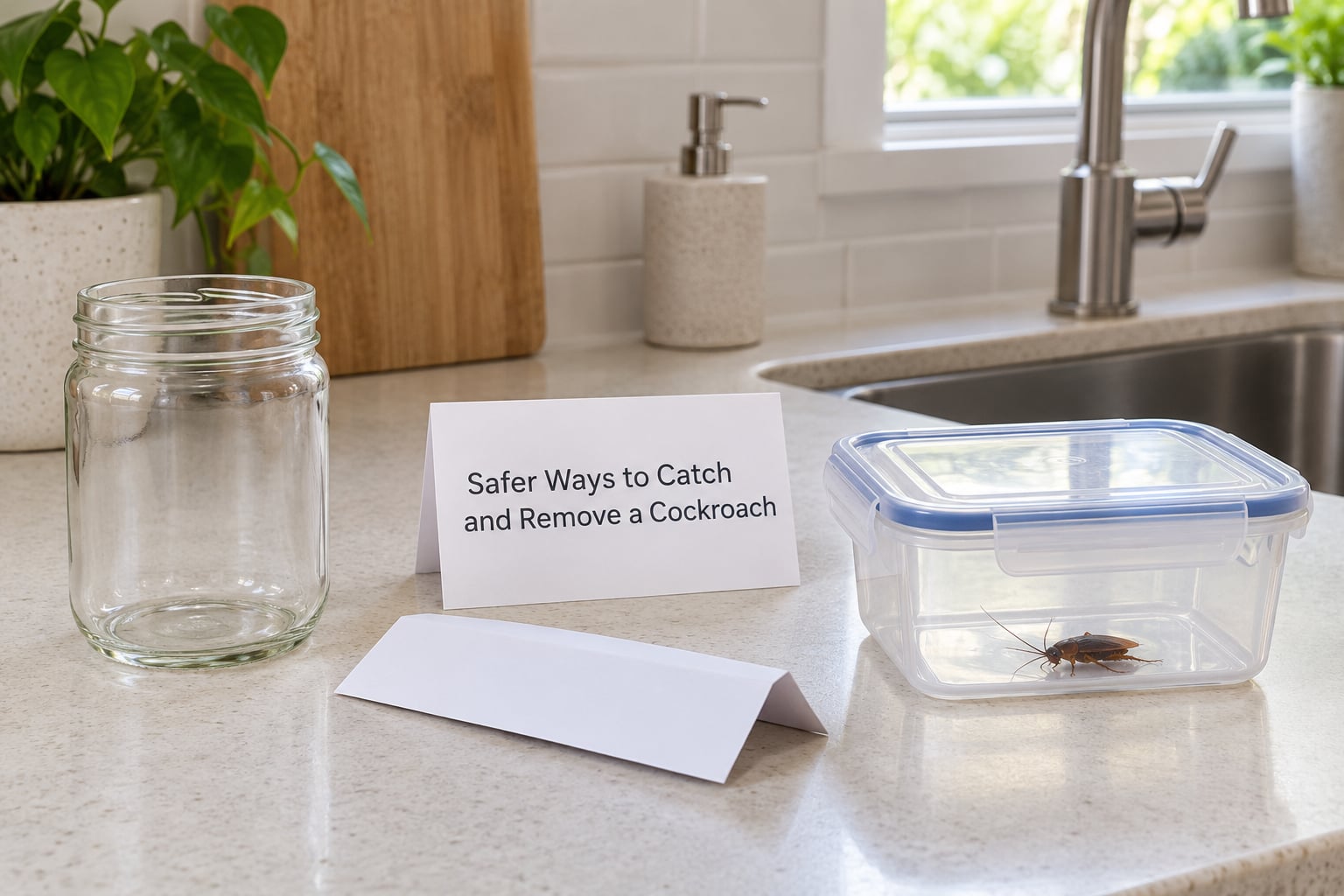
The sequence below takes about five minutes and leaves nothing aerosolized. Work top down, handle food first, and finish with the surfaces.
- Move kids and pets out of the room. It takes ten seconds and removes the main reason to reach for a shoe.
- Cover or move open food. Put lids on anything uncovered and push it back from the wall so you can see the counter surface clearly.
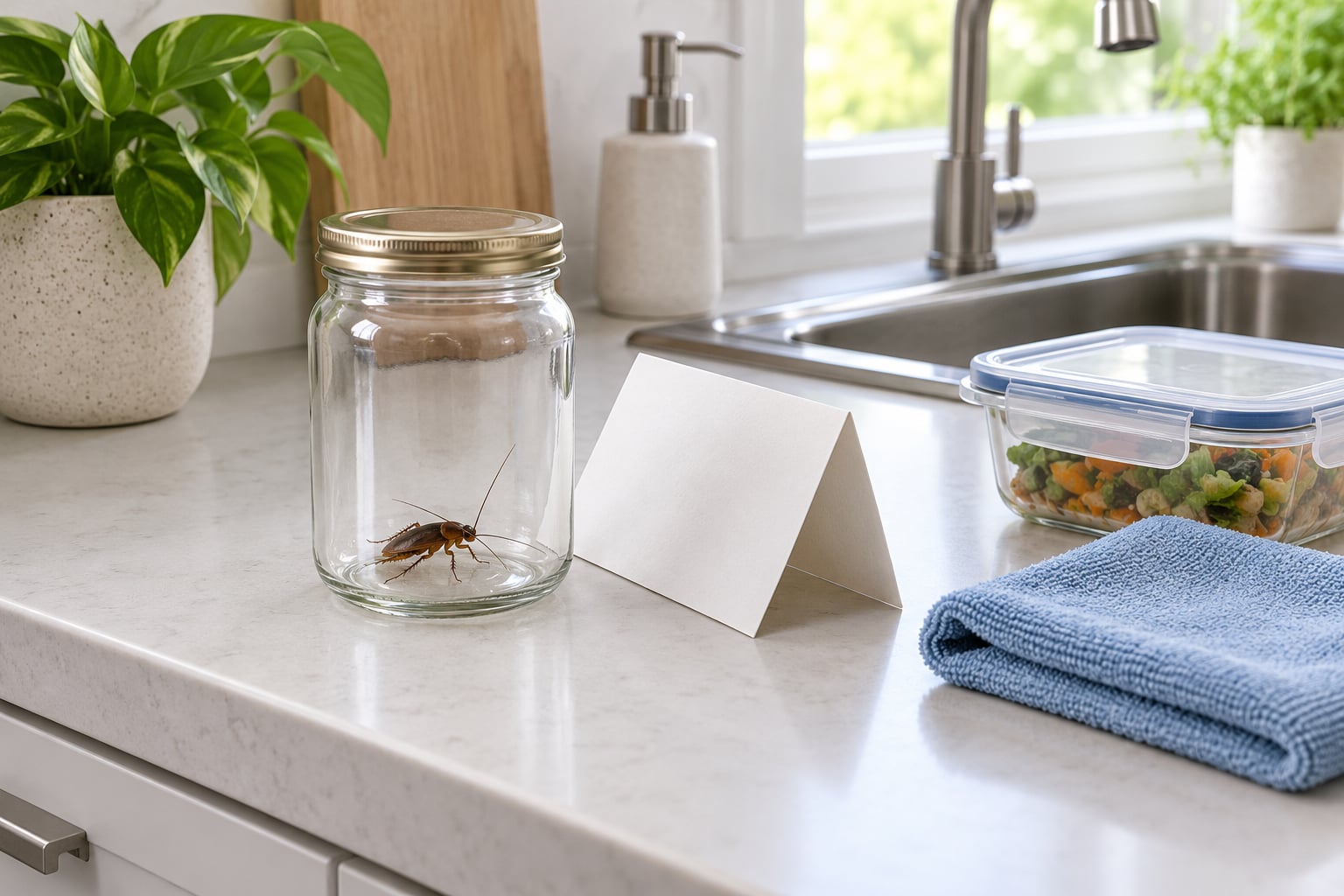
- Flush it down, or jar it. A cup and a quick walk to a drain handles a roach on the counter. For one near a sink or a floor where you cannot safely flush, slide a glass jar over it, slide a folded card underneath, and carry it outside or into the freezer in a sealed bag.
- Wash the surface with soap and water, then disinfect. Clean first, disinfectant second. Skipping the wash leaves the greasy film that disinfectant does not penetrate well.
- Wash your hands and put away anything exposed. Thirty seconds, and it closes the loop.
- Look for where it came from. Under the sink, behind the fridge, along a baseboard gap. That entry point matters more than the dead roach.
Soapy water works on contact because it blocks the spiracles a cockroach breathes through, which is why a spray bottle of dish soap and water is a genuinely useful tool. It is not a long-term strategy, though, and it does nothing about a hiding population.
How to Tell If You Have One Roach or an Infestation
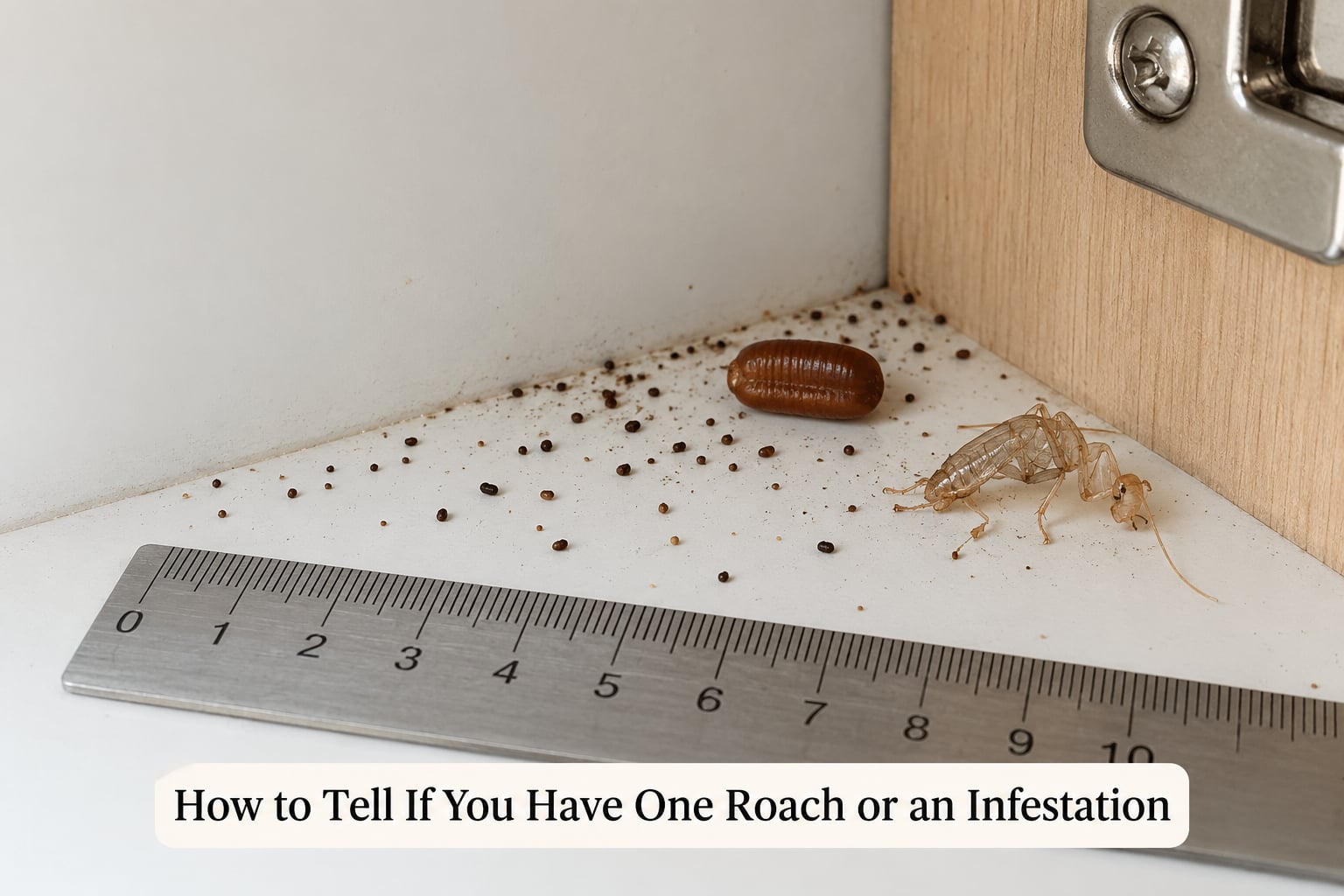
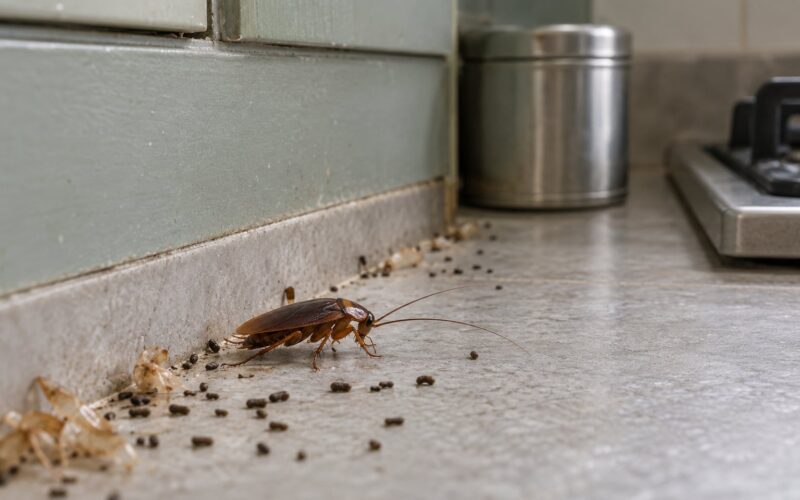
One roach is an event. An infestation is a pattern, and the evidence is almost always droppings rather than sightings. Cockroaches are nocturnal, so seeing one in a lit room usually means the hiding population is already larger than what you have witnessed.
- Droppings. Black specks that look like ground pepper or coarse coffee, often clustered along shelf edges, under the sink, or behind the stove. That pepper look is what makes infestations so easy to miss.
- Egg cases. Brown, bean-shaped capsules about the length of a grain of rice, usually glued to a surface in a protected spot.
- Shed skins. Nymphs grow by molting, so translucent brown shells appear where they hide.
- Musty odor. A damp, musty smell in a closed cabinet or closet that does not go away after cleaning.
- Repeat live sightings. Especially in the same room, in daylight, or more than one room of the house.
- Nymphs. If you are seeing small ones, that is worse news than seeing adults, and it means the population has been reproducing for a while. Adults scatter; nymphs stay close to the breeding site.
If you checked all of that and found nothing beyond one roach, you are probably fine. Clean, seal the obvious gaps, and keep watching for two weeks.
When to Use Cockroach Baits or Call a Professional
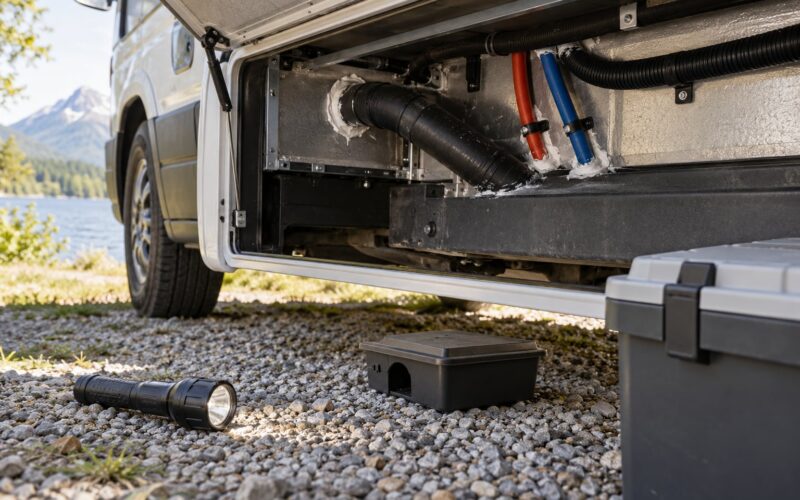
Gel bait and enclosed bait stations are the right first step when you have evidence of more than one roach, because roaches eat them and carry the bait back to the hiding area. Place them along edges, behind appliances, and under the sink rather than in open floor.
One important rule: do not spray repellent insecticide near gel bait, and do not use foggers. Aerosol sprays make roaches flee the treated room and can also kill the bait, which stops the transfer that makes bait work. If you use both, space them out and let the bait do the killing.
Call a professional when any of these apply:
- You are seeing roaches during the day or in more than one room.
- You are finding small nymphs, droppings, or egg cases behind appliances.
- You live in an apartment or multi-unit building, where neighbors feed the same colony.
- The space is hard to treat, such as inside wall voids, a shared boiler room, or a crawlspace.
- Cleaning and baiting have not changed anything in two to three weeks.
Anyone dealing with this in a rental should notify the landlord or property manager first. Sealing your own unit is sensible, but it is not a substitute for treatment of the surrounding units.
Frequently Asked Questions
Does squashing a cockroach make more cockroaches appear?
No. Crushing a cockroach does not create new ones, and the alarm pheromone released when it dies briefly startles nearby roaches rather than attracting them. What does happen is this: the roach may survive a partial crush, and any survivors keep eating, mating, and producing. Sanitation, water, and entry points decide whether your numbers grow.
Is it safe to touch or crush a cockroach?
It is not ideal. Cockroaches carry bacteria on their bodies and in their gut, and crushing one on a countertop spreads a greasy smear plus airborne fragments of body and droppings. People with asthma or cockroach allergies can react to those particles. Wash your hands after any contact, and clean then disinfect the surface rather than wiping it.
How soon should I expect another cockroach after seeing one?
There is no fixed timeline, and that is honest rather than evasive. One roach can be a one-off from a box, a neighbor, or the sewer system, and you may never see another. If roaches are living and breeding inside, expect repeat nighttime activity within days to weeks. Watch for droppings and egg cases, which reveal an established population long before you see another live roach.
Can I use dish soap to kill a cockroach?
Yes, and it is one of the better non-crushing options. Dish soap solution blocks the spiracles a cockroach breathes through along its abdomen, so a spray that coats the insect suffocates it fairly quickly. Spray it directly rather than misting the area, keep children and pets away from the wet residue, and remember it fixes today only. It does not reach roaches hiding in walls or appliances.
Should I spray a cockroach I see in my kitchen?
Spraying one visible roach is usually a mistake. Aerosol sprays drive roaches out of the room and can scatter them deeper into hiding places, and any repellent spray near gel bait cancels out the bait. A single roach can be flushed, jarred, or soaped instead. Save aerosol sprays for nothing at all in food storage areas, and use bait placed along edges where roaches travel.
What to Do First
Contain, clean, and look. Move food and pets out of the way, remove the roach without crushing it, then wash and disinfect the surface and wash your hands.
Next, check for droppings, egg cases, and shed skins in the room and under adjacent appliances. Those tell you whether you had a stray or a population, and the answer decides everything after that. Clean, dry, and seal the gaps you can reach, set bait along edges if you find evidence, and give it two or three weeks.
If activity continues after that, or you live in a building where neighbors share walls, get an inspection rather than escalating your own chemical use. One roach is a question. A pattern is a project, and squashing things never was the answer to either.