To keep spiders out of a garage, you have to make the space stop working as habitat: seal the entry points, remove the sheltered storage they settle into, cut off the insects they feed on, and then deal with whatever is left. Most people do the opposite order. They swipe the webs down, maybe hit the corners with a spray, and wonder why fresh ones appear along the door frame three days later. The web is the symptom. The gap under the door, the wall of cardboard boxes and the bug-repellent bulb over the driveway are the problem.
The whole job takes most of a Saturday, costs very little if you already own a caulk gun and a shop vacuum, and it keeps paying off as long as you touch it up twice a year.
If you only do five things this month, do these:
- Seal the entry points. Weather stripping on the side doors, a door sweep or a new bottom seal on the garage door, silicone caulk on wall cracks, fine mesh or copper mesh over vents and weepholes.
- Replace cardboard with sealed plastic bins. Cardboard is the single most-named harborage in every garage spider thread I have read.
- Open up a gap around the perimeter. Leave six to twelve inches between stored items and the walls so you can see, sweep and reach.
- Change the exterior light. A bright bulb over a garage door pulls in the crickets, moths and flies that spiders are actually waiting for.
- Vacuum with a shop vac, not a broom. A broom smears silk and leaves egg sacs behind. A vacuum hose removes both.
Table of Contents
- What You Need
- How to Keep Spiders Out of a Garage: Step-by-Step
- 1. Inspect the garage for entry points and spider activity
- 2. Seal gaps around doors, walls, and utility lines
- 3. Repair or screen windows, vents, and garage-door gaps
- 4. Remove clutter, webs and sheltered hiding places to keep spiders out of the garage
- 5. Reduce the insects and food sources that attract spiders
- 6. Check and maintain the garage regularly
- Common Mistakes
- Frequently Asked Questions
- Do I need to kill every spider I find in my garage?
- How do I remove a spider egg sac from a garage safely?
- What type of insecticide keeps spiders out of a garage?
- Why do spiders keep coming back after I seal the garage door?
- Are garage spiders dangerous to people and pets?
- When should I call a pest-control professional for garage spiders?
- Start This Weekend: The Order That Works
What You Need
None of this is specialty equipment. Gather it in one place before you start, because the walkthrough is more useful when you can seal a gap the moment you find it rather than two trips later.
- A bright flashlight and a step ladder. A headlamp is better if you have one. You are looking up into ceiling joints and behind shelving, which means you need your hands free.
- Work gloves and a dust mask. You will be pulling decades of dust off a wall. You will also want the gloves when you handle a vacuum bag full of spiders and egg sacs.
- Silicone caulk and a caulk gun. Paintable acrylic latex caulk for drywall and interior joints. Use the paintable kind if the garage is finished, so it blends.
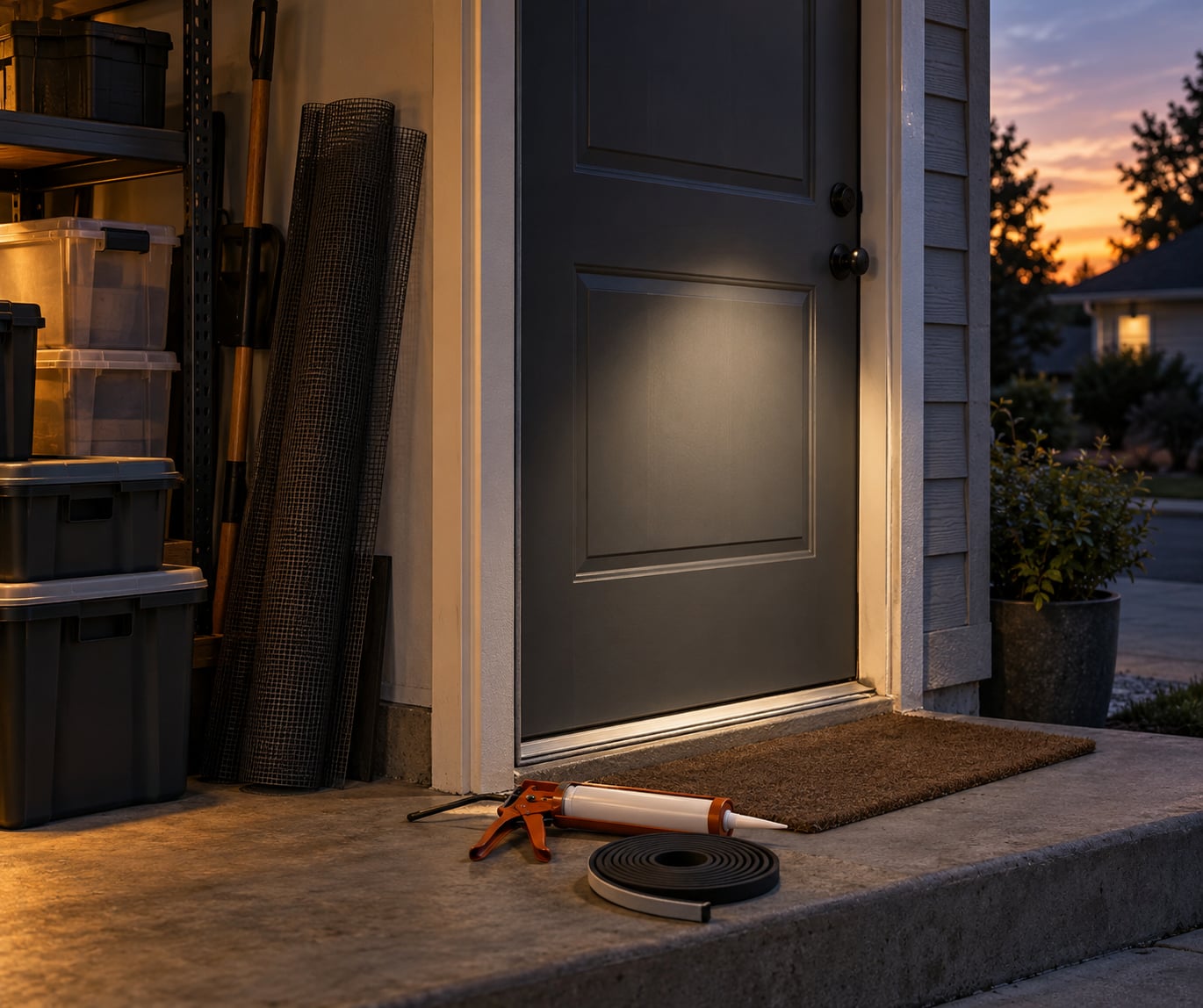
- Weatherstripping, a door sweep and spare bottom seal. Foam or V-strip weather stripping for the pedestrian doors, a sweep for the gap at the floor, and a vinyl or rubber bottom seal to replace a split or flattened garage door seal.
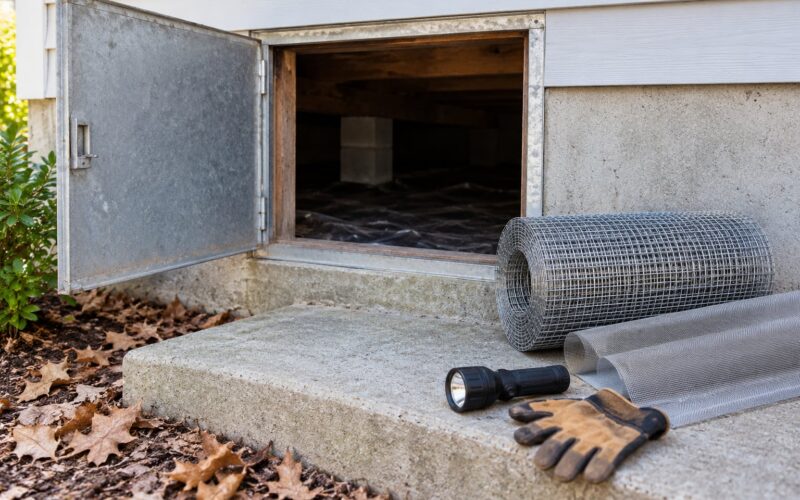
- Fine mesh screen and copper mesh. Stainless steel or fiberglass insect screen for vents. Copper mesh for weepholes, because caulk alone will not hold there.
- Expanding foam or polyurethane sealer. For larger gaps around pipe penetrations where silicone alone will not fill. Use the non-expanding kind near anything you might later need to remove.
- A shop vacuum with a crevice tool. A household vacuum with a hose attachment works in a pinch. A wet/dry shop vac with a beater bar is faster on ceiling corners.
- Sealed plastic storage bins with tight lids. This is the real materials cost of the project. Clear latching totes let you see what is inside, which matters more than you would think.
- Painter’s tape or masking tape. For marking harborage zones while you inspect, so you do not lose track of the corner that was webbed last month.
- Sticky traps. Cheap enough to place along baseboards for a few weeks and read the catches.
- A jar and a stiff card, or a spider grabber. For relocating a common house spider you would rather not kill. See the safety notes below before using it on anything you cannot identify.
How to Keep Spiders Out of a Garage: Step-by-Step
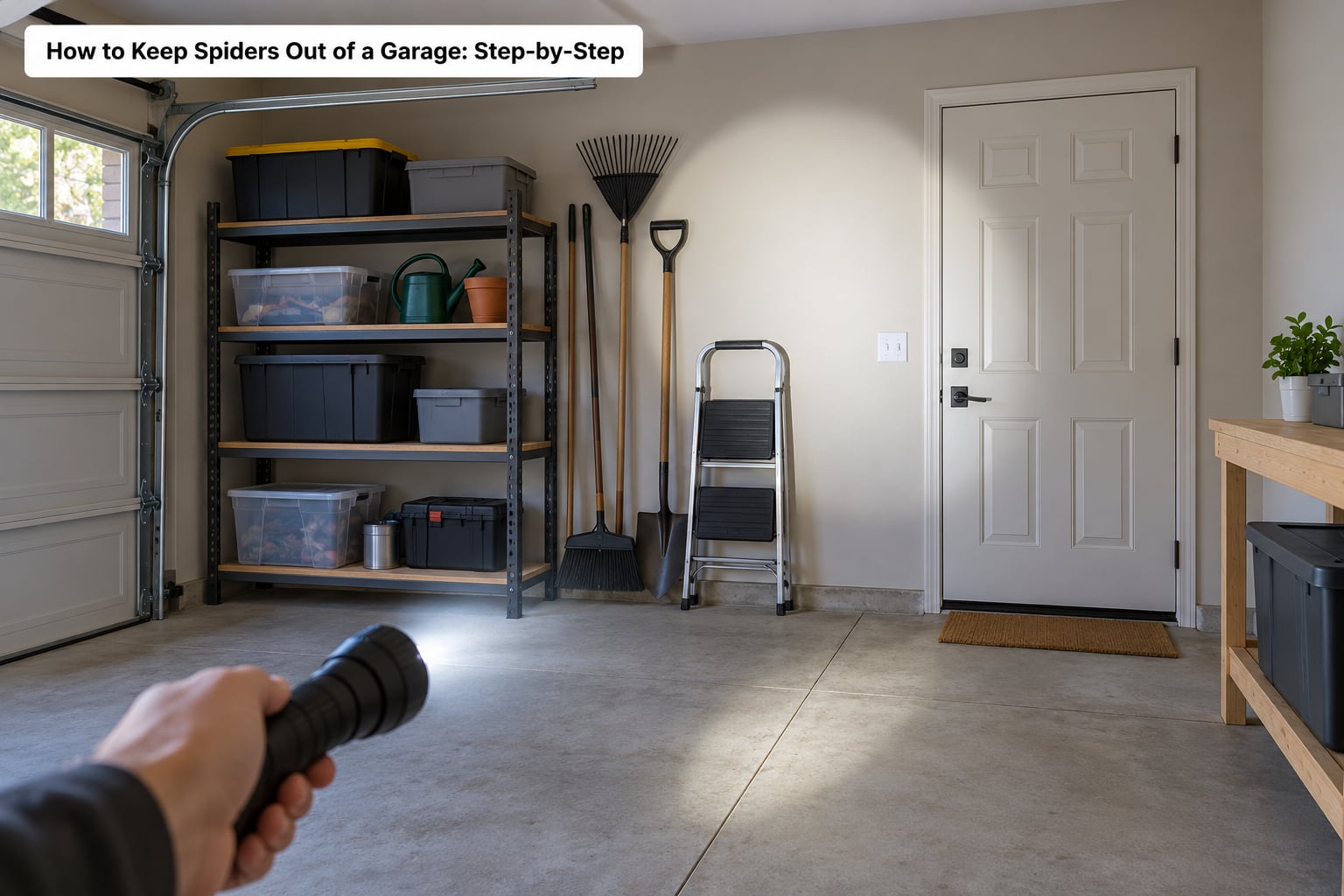
Work in this order. Inspecting first means every seal you apply goes where it actually matters, and clearing shelter before you seal means you are not caulking a gap behind a box you are about to move anyway.
1. Inspect the garage for entry points and spider activity
Spend twenty minutes walking the garage with a flashlight before you touch a single tool. Start at the garage door, because that is where most garages fail first, and work your way around the room in one direction so you cover the full perimeter.
Look at the floor line first. Hold the flashlight flat along the concrete and check the gap under the door, the daylit edges where the wall meets the slab, and the sweep or seal on the side door. Any line of daylight is a highway. Next, look straight up at the ceiling joints, the wall-to-ceiling seam, and the area above the garage door tracks, which is where the heaviest webbing usually lives.
Then work the walls in a band about four feet high. Check the sill plate where the drywall meets the framing, the area around outlets and light fixtures, and any pipe or conduit coming through the wall. A spider does not need a hand-width gap. A gap the width of a pencil is enough, and the same goes for the weephole drains in the foundation, which sit low along the base and must be blocked with mesh rather than caulk.
Mark what you find with tape so you remember it. Patch what is obviously small and note the rest for step 2.
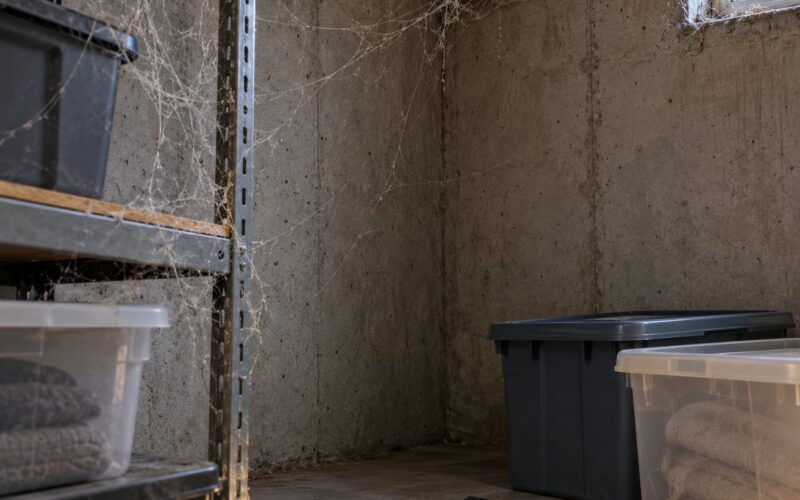
Now look for signs of activity rather than for spiders. Webs concentrated in one corner mean something is living or feeding there. Egg sacs, which look like small silk-wrapped balls roughly the size of a pea, mean a female laid them and the next generation is already committed to your garage. A line of silk running between a storage bin and the wall is a dragline, a spider’s highway between a hiding place and a feeding spot.
One more check that people skip. Spiders ride in on things. Look at the tires of the mower, the frame of a bicycle, the handlebars of a wheelbarrow and any patio gear you brought in from the yard this week. A car parked in the garage for a few minutes in summer can deliver one on the windshield or roof. That is not a failure of your sealing job, it is a separate problem, and it is why the first week of heavy webbing often follows a weekend of moving yard equipment around.
2. Seal gaps around doors, walls, and utility lines
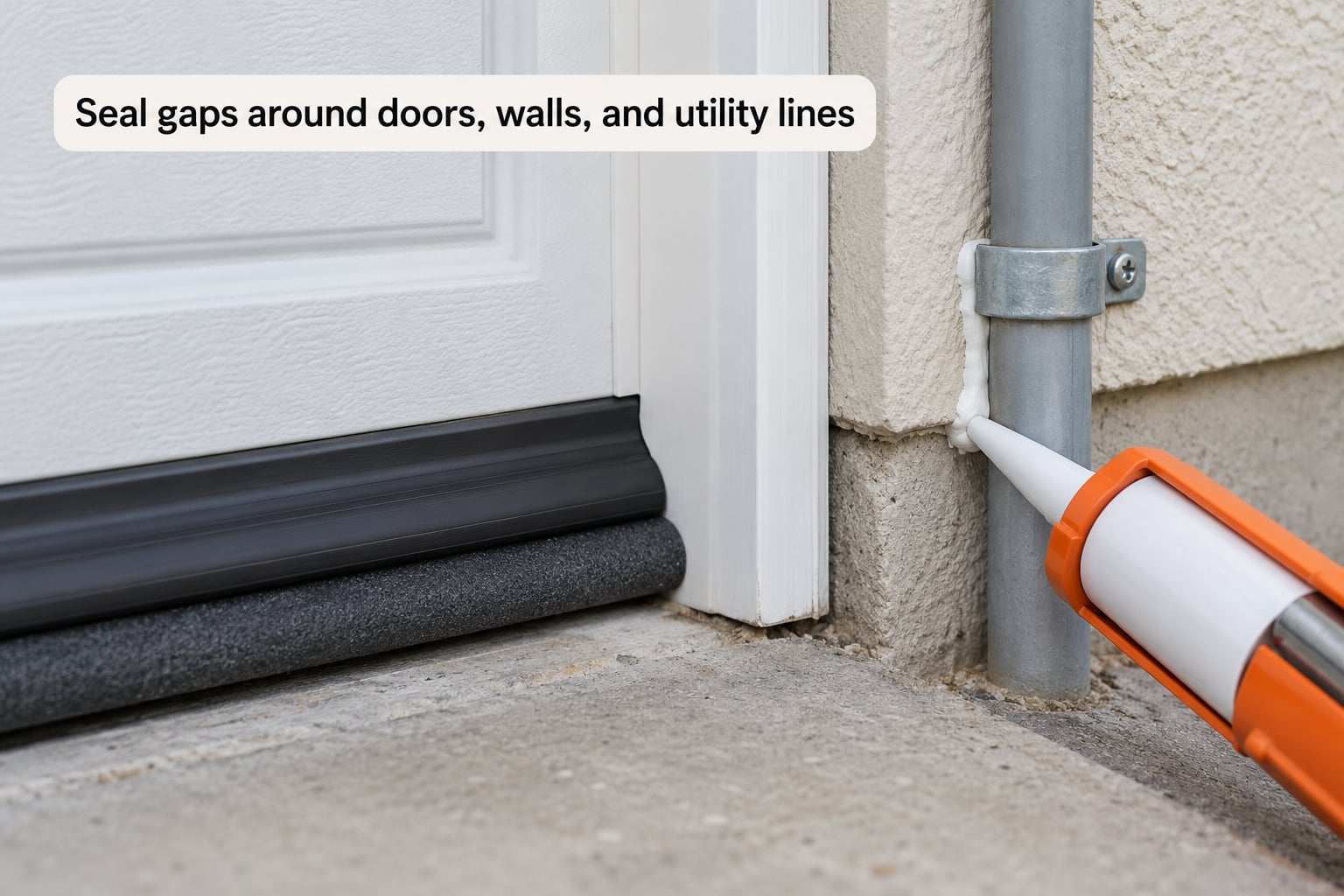
This is the step that decides whether the rest works. Extension guidance on integrated pest management, including from Texas A&M AgriLife Extension and the University of Kentucky, puts exclusion first for a reason: nothing that stays outside never has to be treated.
The doors. On a pedestrian door, run a flashlight at the closed door from inside and look for light lines. Run weather stripping along the top and both sides where the gap is under about a quarter inch. For the gap at the bottom, fit a door sweep that rests on the floor, and check that the door closes fully against it. On an old door, an adjustable sweep mounted on the outside face handles a sagging threshold better than one mounted inside.
On the garage door, look at the bottom seal from inside on a sunny day. Flex it in your hand. A seal that is split, hardened, or flattened to a ribbon lets daylight straight through. Replacement seals are inexpensive and clip or screw into the bottom of the door panel, so this is a half-hour job with no special tools.
Also check the gap on each side of the door track and above the top of the door. A warped or sagging panel leaves a crescent-shaped opening that a door sweep will not fix. Those need panel adjustment or a track alignment, which is a door repair, not a pest job.
The walls and joints. Run a bead of paintable silicone caulk along interior drywall cracks, along the wall-to-ceiling seam, and around the frame of the man door and any window where the trim meets the wall. Fill gaps around pipe and cable penetrations with polyurethane sealer or low-expanding foam, then trim the excess after it cures.
The weepholes. These small openings in the foundation let water drain out of the wall cavity, so do not simply caulk them shut. Push fine copper mesh into the opening, fold it flat against the exterior and hold it in place so it cannot be pushed back out.
The vents. Soffit, gable and louvered vents are often wide open. Cover any that are not already screened with fine insect screen stapled over the opening, and check the existing screen for tears, especially the lower corners where rodents push through.
Some gaps are not yours to fill. Anything near a live electrical panel, wiring junction, a gas line or a combustion appliance belongs to a licensed electrician, plumber or gas fitter. Do not pack insulation or foam around a chimney, a dryer vent or anything that vents combustion gases, and check the label on any can of sealant before it goes near a surface that gets hot.
3. Repair or screen windows, vents, and garage-door gaps
A garage window is often the most obvious hole in the whole structure and the one most owners have never looked at. Close the sash and check for daylight around the frame, then check the screen itself by looking from outside into bright light. A torn or sagging screen is a highway the width of a finger, and replacement screen and spline are cheap.
Test the garage door threshold the same way you tested the pedestrian door. Park in it, look up at the ceiling, and ask whether the webs are clustered directly over the door. If they are, the door is the route in.
Check any pet door, and make sure the flap swings both ways and returns to a closed position. Check overhead door motors for gaps around the chain and header bracket on older openers, which is a low opening a spider can find. Check the crawl-space or foundation vents under the skirt, which usually ship as un-screened plastic louvers.
4. Remove clutter, webs and sheltered hiding places to keep spiders out of the garage
This is the step that decides whether the sealing held. You can close every gap in the building and still have a heavily webbed garage if there is a two-foot-deep space behind the lawn mower where nothing has disturbed the dust in four years.
Start by moving cardboard out. Corrugated cardboard is ideal spider real estate: it is dry, warm in a closed garage, full of air pockets, and full of the silverfish and mites spiders eat. If you cannot part with a sentimental box, put it inside a sealed tote rather than leaving it on the slab.
Then pull everything off the walls. Leave six to twelve inches of clearance behind stored items so you can see the base of the wall, run a vacuum along it, and reach any web that forms there. Storing items wall-to-wall is the most common reason a cleaned garage rewebs within days.
Overhead storage on racks is fine, but leave the ceiling joists visible. Vacuum the ceiling joints, the corners above the door and the underside of shelving from below.
Use a shop vacuum with the crevice tool for webs, spiders and egg sacs, and empty the canister or bag outside immediately. Egg sacs are the reason most people feel like cleanup failed: a vacuum hose removes adults, but a tough silk sac can survive being run over and stays put. When you find one, take the whole thing out. Users on home forums make the same point in different words, wiping at webs does nothing because the spider left the web before you got to it, and the population is still in the room.
Stop and call a professional in two situations. If you cannot identify what is living there and it is staying put, or if you find a black widow or a brown recluse, do not reach into the space and do not shake out stored clothing or bedding in the garage. Leave the area closed and get it identified. For the common species, most people do not need to kill anything at all. A jar and a stiff card works, or a vacuum with the hose held over the spider and the end pinched shut when it goes in.
5. Reduce the insects and food sources that attract spiders
Spiders follow food. A garage that is full of crickets, flies, silverfish and earwigs is a good garage, and no amount of scent spray changes that. One HomeTalk user put it plainly, a garden spider ate the mites off a shrub and disappeared once the mites were gone.
Fix the light. The single most effective change for most people is the exterior fixture above or beside the garage door. A bare bulb is an insect magnet, and the insects it pulls in are the food. Switch to a fixture with a warm color temperature, keep it tightly shaded so it throws light down rather than out at the yard, and aim it at the door and the walk rather than the tree line. Motion-sensor fixtures help because the light is only on when someone is actually there. Keep interior lights off when the garage is empty.
Cut off the water and the trash. Fix the dripping hose bib, the sweating water line and the roof leak that dampens one corner every spring. Damp cardboard in a cool garage is exactly the microclimate spiders want. Keep garbage in sealed containers with lids, and store pet food and bird seed in metal or hard plastic rather than an open bag on the floor.
Pull the vegetation back. Trim branches and shrubs away from the siding and off the roof overhang. Spiders arrive from over the fence, but branches touching the wall give them a continuous route down and a shaded edge to travel along.
Then, and only then, consider scent. Be honest about what these do. Peppermint and spearmint oil in water is the most widely recommended natural remedy, and multiple home forum users independently describe it working when sprayed on ceilings and corners weekly. Nobody has proven a lasting effect, and the honest read is that it works as a short-lived irritant while you fix the shelter and food problems. If you use it, dilute it properly. A few drops of essential oil in a spray bottle of water, never undiluted oil on a wall, and expect to reapply every week and again after rain. Vinegar in water sprayed along a doorframe is a milder version of the same idea with the same reapplication caveat. Citrus peels and conkers get recommended constantly and have no credible evidence behind them. Mint plants around the perimeter are decorative and slightly pleasant, but a potted plant does not seal a gap.
6. Check and maintain the garage regularly
Spend ten minutes a month on a four-part check. Look along the floor line for new light lines or webbing after the first cold morning. Look at the door sweep and bottom seal for wear. Walk the perimeter of the storage to confirm nothing has been pushed back against a wall. Check under the sink and along the slab edge for dampness.
Sticky traps along the baseboards turn this into real monitoring rather than guessing. Set out a few, check them every week or two, and write the date and the catch on the trap with a marker. A trap with one small spider on it is normal background activity for a garage. The same trap with repeated catches over several weeks tells you the harborage you missed is still there.
Do a bigger reset twice a year: once before the warm season and once before late summer, which is when peak spider activity hits most of the country. Vacuum the ceiling joints, re-check every seal you installed, replace any bin that is not sealing, and confirm the exterior light is still shaded and working.
Signs the plan is working look like this. Webbing that used to span the full width of the ceiling now appears only in one corner. New webs take days to appear rather than overnight. Sticky traps stay mostly empty. You have not needed a spray can in months.
Common Mistakes
Sealing only the door gap. The side door gets a sweep, the garage door gets a new seal, and everyone assumes the job is done. The weepholes, the cable penetrations and the unscreened soffit vent are still open. Walk the whole perimeter, not just the doors.
Leaving vents and low openings alone. Vents look like openings because they are. Screen every soffit, gable and foundation vent, and block weepholes with copper mesh rather than caulk.
Fogging the garage. Foggers and bug bombs kill flying insects. Spiders are not flying insects, and most are tucked into a crevice, a bin or a corner when the fogger runs. A fogger also coats the air and surfaces with a pesticide that keeps killing for days, so anyone who walks in during that window, including a kid retrieving a ball, is exposed. Some people use one for a severe one-time knockdown in a detached shed that can be vacated and aired out for the full reentry interval printed on the label, which can run to days. Follow the label exactly, keep people and pets out for the whole interval, and never treat an attached garage or living space this way. A fogger is never a substitute for exclusion.
Spraying the whole interior. Homeowners on r/homeowners have noted that spiders do not tend to walk across a sprayed surface and do not ingest poison off their legs, which is exactly why blanket spraying underperforms. It also kills the beneficials and exposes everyone in the space. If you use a product at all, it belongs in cracks and crevices, not across open floor.
Putting items back against the wall. Six inches of clearance is the whole trick. Every time you restack storage flush to the siding, you rebuild the harborage you just removed.
Leaving egg sacs behind. Vacuuming adults and leaving the sacs means you skipped a generation. Treat the canister as the last step.
Storing pesticides carelessly. A garage is a poor cabinet for anything. Heat in a closed garage degrades aerosol cans, and a can that rolls off a shelf is a problem. Keep products locked in a cool cabinet, upright, and away from pet food.
Trying to kill every spider. Spiders are the cheapest insect control in the building. Most species in a garage are harmless and beneficial, and a pesticide-free garage with a few webs in the corner is a better outcome than a treated one with a residual film on the floor.
Here is the same advice sorted by what each method actually buys you:
- Sealing entry points. Half a day, once. The only permanent fix, and it needs a check twice a year to stay that way.
- Replacing cardboard with sealed bins. A weekend of work. High impact, but only as long as the habit holds.
- Perimeter clearance. Low effort, recurring. High impact, and it has to be redone every time you restack.
- Shop vacuuming webs and sacs. Low effort. Removes what is there, not what returns.
- Exterior lighting change. Low effort, one fixture. High impact, because it cuts off the food supply.
- Scent-based deterrent. Low effort, short-lived, and the evidence is thin. Weekly, plus after rain.
- Sticky traps. Very low effort. Monitoring, not control. Read them weekly.
- Crack-and-crevice residual spray. Medium effort. Useful inside crevices once sealing is done. Reapply per label.
- Fogger or bug bomb. Low effort, real hazard. Poor against spiders. Not recommended.
- Professional service. Costs you nothing but the appointment. Worth it if entry points were never sealed. Expect follow-up visits.
One more thing that gets asked constantly: should you seal the garage off from the house entirely? If your garage is attached and you enter through an interior door, that interior door is one of the most important gaps on the whole property. Make sure it closes tightly, has a sweep and a weather seal, and check the threshold. That is the route spiders take into the living space, and it is the cheapest one to fix.
Frequently Asked Questions
Do I need to kill every spider I find in my garage?
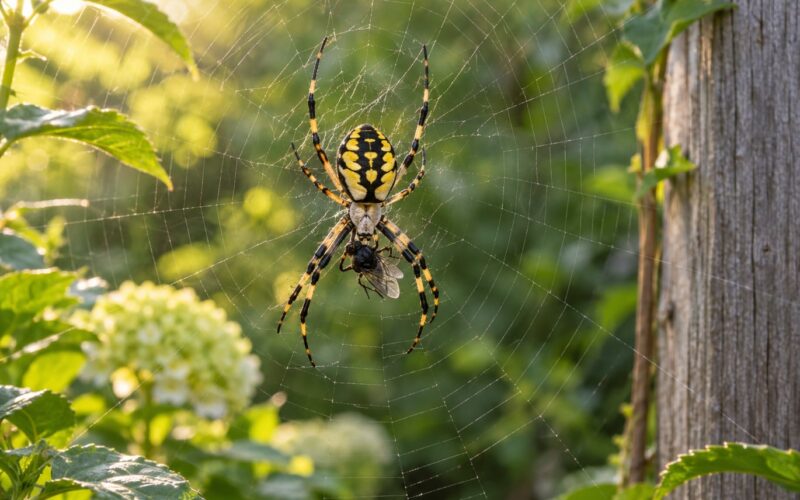
No. The common species you will meet in a garage, house spiders and cellar spiders among them, are not aggressive and they feed on the insects that make a garage unpleasant. Removing their shelter and food supply does more than killing ever will. Vacuum them out or carry them out in a jar. Handle differently only what you cannot identify.
How do I remove a spider egg sac from a garage safely?
Take the whole sac out rather than puncturing it. Put the vacuum crevice tool over it, seal the hose end with your hand, and empty the canister outdoors. Egg sacs are tough enough to survive being run over with a vacuum, which is why cleanup feels like it failed. Wear gloves, and do not shake out stored clothing or blankets in the garage until you are certain nothing else is in there.
What type of insecticide keeps spiders out of a garage?
If you use one at all, use a low-toxicity residual labeled for crack-and-crevice use, applied only inside gaps, joints and harborage areas, and only after you have sealed the entry points. Foggers are a poor choice because they do not reach spiders in their shelters and they leave a film on every surface. Always follow the label, keep children and pets out until it has dried, and check local restrictions.
Why do spiders keep coming back after I seal the garage door?
Usually the door was never the problem. The route in is often an unscreened vent, a weephole, a cable penetration, a damaged window screen, or a garage door panel gap that a sweep cannot cover. If fresh webs still appear, check for spiders arriving on the mower, a bicycle or a stack of boxes you carried in from outside, and check for an intact harborage against a wall.
Are garage spiders dangerous to people and pets?
Most are not. Cellar spiders, house spiders, wolf spiders and orb weavers all bite only when handled and their bites are minor. The two to treat differently are the black widow and the brown recluse, which are found in dark, sheltered, undisturbed spaces, exactly where garage storage creates them. Do not reach blindly into a bin or a corner, and if you find one, keep people and pets out of the area until it is identified.
When should I call a pest-control professional for garage spiders?
Call one when you cannot identify what is living there and it keeps reappearing, when a widow or recluse is involved, when you see activity deep inside wall voids or above the ceiling, or when the garage is structurally hard to work in. Professionals are also worth it for the sealing work if the gaps involve the roof, the siding or the foundation. If the problem is entry points and storage, you can handle that part yourself first.
Start This Weekend: The Order That Works
Do this in one Saturday, in this order. Walk the perimeter with a flashlight and tape up every gap you find. Vacuum the ceiling joints and corners, take out the egg sacs, and empty the canister outside. Pull storage six inches off the walls and move the cardboard into sealed bins. Then seal what you marked: sweeps, weather stripping, a new bottom seal, caulk on the joints, mesh on the vents and weepholes. Finally, change the exterior bulb.
That sequence is how to keep spiders out of a garage for good, because each step removes one of the three things a spider needs: a way in, a sheltered corner, and something to eat. Give it four weeks. If the webs that used to rebuild overnight now take a week to show up, the garage stopped working as habitat, and that is the whole game.