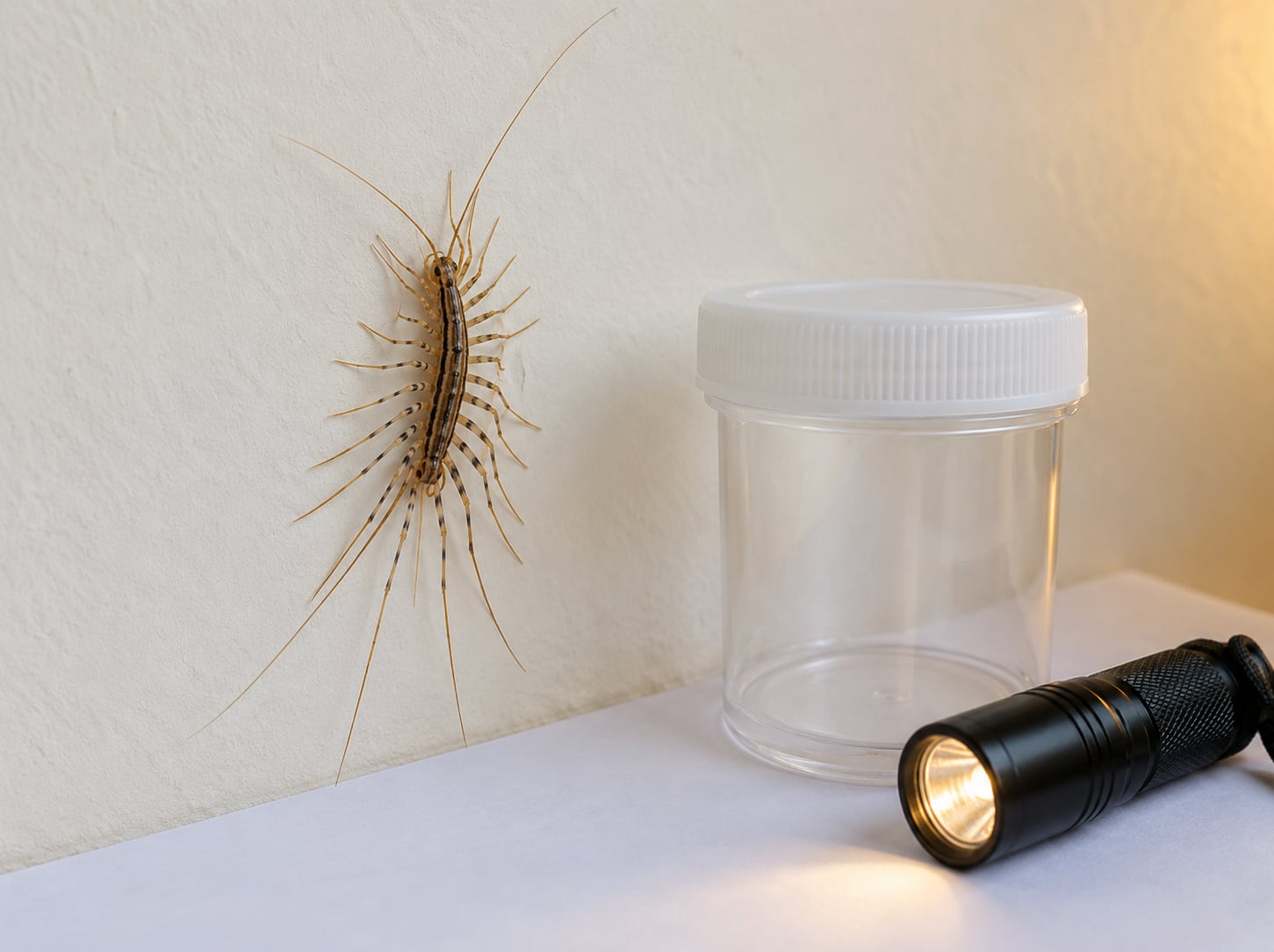
A house centipede is Scutigera coleoptrata: a fast, flat-bodied arthropod with a narrow yellowish-gray or brownish body, three dark stripes running head to tail, and 15 pairs of long banded legs. Its body is only 1 to 1.5 inches, but the legs stretch its outline out to 3 or 4 inches. If you know to count leg pairs and watch how it moves, you can confirm one in about two minutes without touching it.
That last part matters. Most long-legged things people carry into comments and forums turn out to be harmless, and the fastest way to calm yourself down is to identify it properly first. Here is how to identify a house centipede, in the order that avoids the usual mistakes.
Updated for October 2026.
Table of Contents
- What You Need
- Step-by-Step
- Common Mistakes
- Frequently Asked Questions
- Are house centipedes dangerous to people?
- Do house centipedes bite, and what does a bite feel like?
- Are house centipedes the same as outdoor centipedes?
- Does seeing a house centipede mean my home has an insect infestation?
- How can I confirm the identification if the insect moves too quickly for a photo?
- Conclusion
What You Need
You need very little, and none of it is expensive. All of it is about letting you look closely without handling something you have not identified yet.
- A clear container or specimen cup. A glass jar, a plastic deli container, or even a clear drinking glass with a flat bottom works. Sliding a container over a wall-trapped specimen picks it up without contact.
- A flashlight. Side lighting throws the leg pairs into relief so you can count them instead of guessing.
- A ruler or hand lens. A cheap 10x loupe off a craft drawer is enough to see the antennae and the banding on the legs. A ruler tells you whether you are looking at a 1.5-inch insect or a 5-inch one, which matters more than people expect.
- White paper or a white index card. A white background gives you a clean silhouette, and it prevents a busy countertop from making the shape look longer or narrower than it is.
- Tweezers. Only for moving a specimen into the container, and only after you have confirmed what it is. If you cannot reach it with a container, let it go.
- Your phone camera. Wide angle beats zoom for a fast subject, and burst mode beats a single shot.
A local extension office or a land-grant university insect identification service is worth having on hand if the specimen looks unusual. Many take photos by email and answer within a day or two.
One rule before you start: observe without handling, and never spray any household aerosol product on a captured specimen. Toxic spray contaminates the animal, kills it, and removes the traits you were trying to see. A specimen you cannot identify on its own terms is not a specimen you can identify at all.
Step-by-Step
Work through these in order. Each step has a clear positive sign and a clear negative one, and the negative sign is usually what rules a look-alike out faster than the positive.
How to identify a house centipede by its body shape
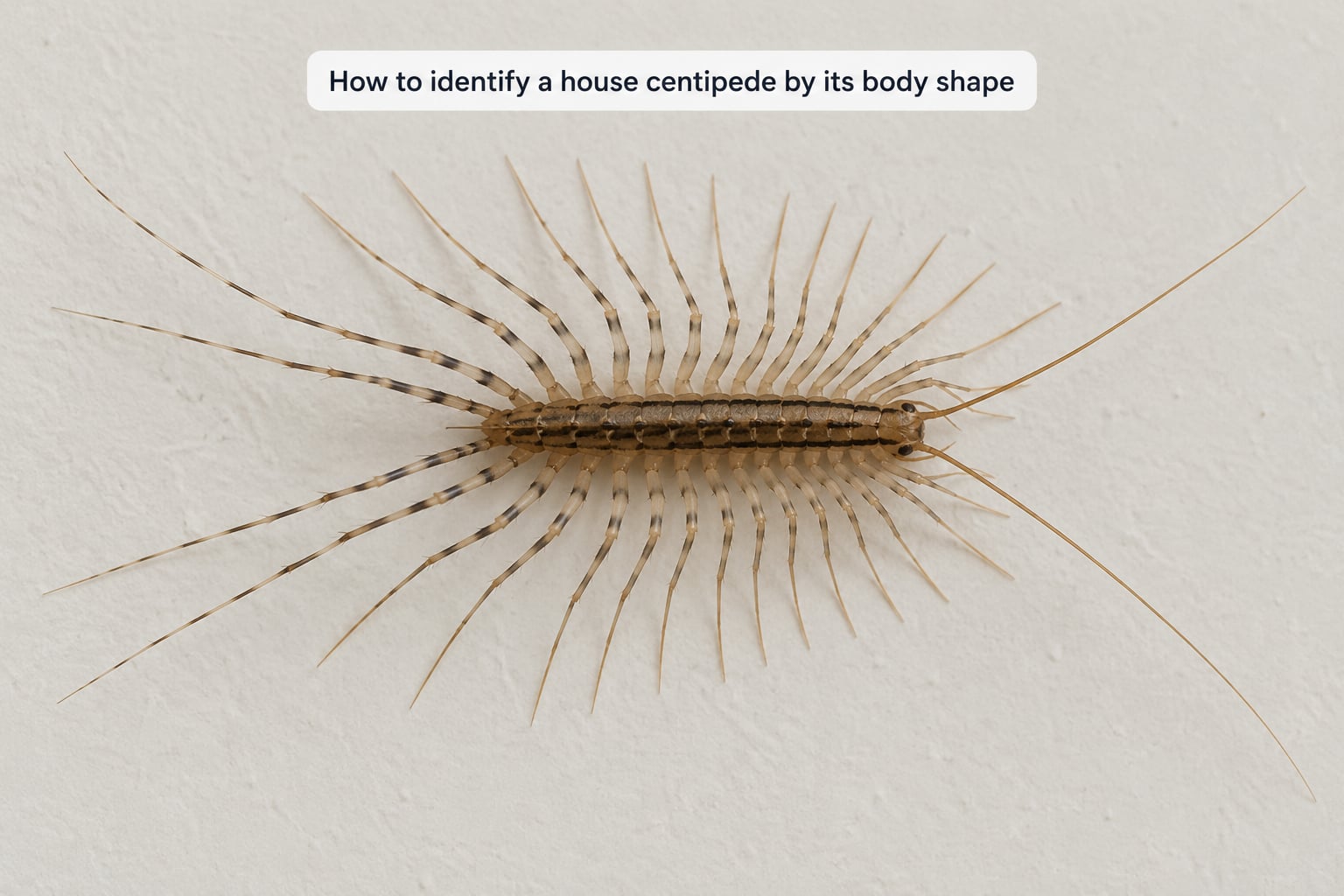
A confirmed house centipede has a flattened, elongated body with a distinct head that is slightly wider than the segments behind it. You can see the separate segments running down the length like a row of short plates, and every leg-bearing segment carries exactly one pair of legs.
That is the negative sign too. Insects have three pairs of legs total and no more, so if you count six legs and stop, it is not a centipede. Beetles add a hard, narrow wing case that covers the back and makes the body look armored and boxy. A millipede is rounder in cross-section and curls into a spiral when disturbed. A house centipede stays flat and linear.
Judge overall length with the legs, not the body. A body-only measurement of 1 to 1.5 inches becomes a 3-to-4-inch creature once you measure from the front antennae to the trailing tip of the rear legs, because the last pair can be nearly twice as long as the body itself. If what you found measures 4 inches of body with short legs, you are looking at a different centipede entirely.
Check the legs and antennae
This is the decisive check. An adult house centipede has 15 pairs of legs, one pair on each of 15 body segments, and each leg is extremely slender and nearly hairlike where it meets the body. Legs and antennae are faintly banded, which is one of the easiest details to pick out under a flashlight.
You do not have to count 30 legs one at a time. Count the pairs that touch the body and multiply by two, and count from the head backward, because the rear legs trail long and get in the way. Keep the specimen over white paper so the legs separate visually instead of blurring together.
There is a rule that catches people: centipedes never have an even number of leg pairs. Fifteen is odd, and so is every other count in the class. If you keep coming up even, something was hidden or doubled in your count, or you are not looking at a centipede.
Young centipedes break this expectation in a way that confuses parents and kids alike. A hatchling starts with far fewer leg pairs and adds segments as it molts, growing into the full adult count over successive molts. A small specimen with nine or thirteen pairs is a juvenile house centipede, not a different species, and it will reach 15 pairs.
The antennae are the other half of this step. A house centipede has two relatively short antennae at the front, which surprises people who expect them to match the leg length. Long, whip-thin antennae that are longer than the body belong to a cricket or a cockroach, and both of those have six legs.
Compare color, markings, and body texture
The typical house centipede is yellowish-gray to brownish, with three dark longitudinal stripes running the length of the body, one down the center and one down each side, plus a paler stripe between them. That pattern is genuinely useful, and it is also the trait people over-trust.
Color varies more than the identification guides admit. Brown, tan, and nearly black specimens all turn up in real identification requests, often photographed under warm indoor lighting that shifts everything warmer. Specimens with bluish or greenish legs get questioned for the same reason. If your centipede does not look gray, it does not stop being one.
Use texture as your tiebreaker instead. The body is soft, flexible, and matte, with visible segmentation you can see through when it moves. A beetle is shiny and hard-shelled. A silverfish is quick and silver-gray but has three tail filaments at the back and three long filaments at the front, plus six legs. Flies and mosquitoes have one pair of wings and a compact body shape that no centipede imitates.
One more thing the pictures rarely convey: house centipedes have faceted compound eyes, grouped into larger visual units, which is unusual among centipedes and part of what puts them in their own group. The eyes are small and dark and only visible under magnification.
Watch how it moves
Movement is the trait that settles arguments fastest, because a specimen only has to move for a few seconds. The legs on each side alternate in a coordinated ripple, and the body flexes side to side in the same rhythm, giving the flowing, wave-like gait most people remember.
Compare that with a six-legged insect. Insects move on a tripod gait: three legs planted at once, three swinging, alternating sides. The motion is choppy and stop-start rather than fluid.
Quick running or jumping usually points somewhere else entirely. A cricket or a cockroach bolts and hides; a house centipede darts in fast stops, changes direction, and keeps moving along the wall or ceiling. They are also nocturnal, so most sightings happen when a bathroom light or a hallway light comes on and something that had been on the ceiling drops to the floor.
If it flees toward a wall or a baseboard rather than toward you, that is consistent behavior and not a sign of aggression. They are running from the light, not charging.
Confirm it against similar insects
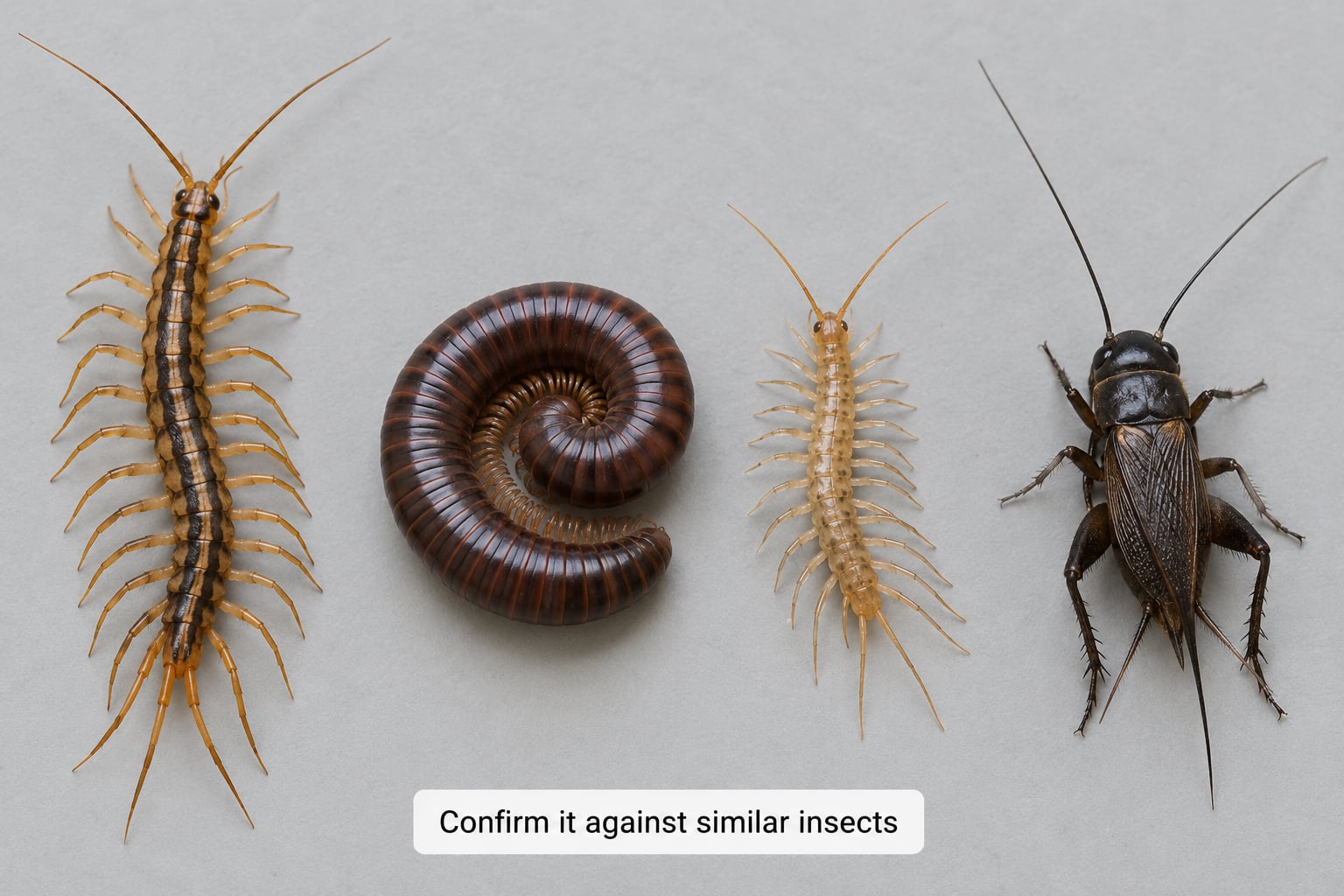
Once the five checks agree with each other, run the specimen against the common look-alikes. This table is the fast triage.
| Trait | House centipede | Millipede | Cellar centipede | Giant desert centipede | Cricket |
|---|---|---|---|---|---|
| Leg pairs | 15 in adults, always an odd number | Two pairs per visible segment, curving into a spiral | 15 pairs, much smaller body | 15 to 21 pairs, stockier | 3 pairs |
| Body shape | Flat, narrow, elongated | Cylindrical, rounded, curls up | Flatter, shorter, more uniform brown | Thick, segmented, heavy for a centipede | Compact oval body |
| Length | 1-1.5 inch body, 3-4 inches overall | Under 1 inch usually | About 0.7 inch | Up to 6 inches, body and legs | Under 1 inch |
| Color and markings | Yellowish-gray to brown with three dark stripes; wide color variation | Plain brown or black | Uniform pale brown | Dark reddish-brown with a yellow-orange stripe and yellow legs | Brown or black, sometimes striped |
| Antennae | Two, short relative to the legs | Short, bead-like | Two, short | Two, thicker and shorter | Two or four, very long |
| Movement | Fast, stop-and-go, fluid ripple | Slow, curling | Quick and twitchy, low to the floor | Fast but heavier | Jumping |
| Typical indoor spot | Walls, ceilings, basements, bathrooms, crawl spaces | Damp baseboards, planters, closets | Basements, garages, damp ground-floor rooms | Rarely indoors, mostly the Southwest | Kitchens, utility rooms |
| Risk to people | Harmless; rare bite if handled | Harmless; may release a mild irritant | Harmless, no venom | Venomous claws, painful bite, not a household pest | Not dangerous, but a nuisance |
The row that decides most cases is leg pairs combined with body shape. Regional look-alikes exist: the giant desert centipede (Scolopendra heros) reaches about 6 inches, has shorter legs relative to its body, and carries warning coloration that house centipedes never show. The Japanese house centipede, Thereuonema tuberculata, looks much like Scutigera coleoptrata and is indistinguishable in a photo for most purposes, which is why species-level claims from a phone picture are rarely worth making.
If you want a name that holds up, send in a clear top-down photo plus a side photo with something for scale, and note the state or province. Most IDs are settled by size plus leg pattern alone.
Common Mistakes
Trusting color alone. It is the most common error and the easiest to fix. Stripes help, but brown, tan, and near-black specimens are all in range, and indoor light changes color more than most people expect. Confirm with leg pairs and movement before you conclude anything.
Assuming many legs means centipede. A millipede has plenty of legs, a cellar centipede has plenty of legs, and a stone centipede crawling along a porch has plenty of legs. The body separates them: flat and linear for a house centipede, cylindrical and curling for a millipede.
Counting legs in the wrong order. People start at the tail, where the rear legs are longest and overlap, and lose track. Start behind the head and count pairs moving backward, and you will finish cleanly at 15.
Handling an unidentified arthropod. This one has a real medical edge. Every centipede has forcipules, the venom claws behind the head, and some regional species deliver a genuinely painful bite. House centipedes are quick and avoid people, but picking one up bare-handed is the only realistic way to get stung.
Reading one sighting as an infestation. A single house centipede is a stray that wandered in through a gap, a door, or a crawl space opening. Frequency across weeks matters far more than one find, and pest control professionals generally describe the species as beneficial rather than harmful because it hunts the pests people actually complain about.
Overcorrecting with spray. House centipedes eat cockroaches, silverfish, and small arthropods, so spraying kills the thing that was hunting your actual pests. It also does little, since they are fast and tend to avoid treated surfaces.
Photograph the specimen in place before you do anything else, and write down where and when you found it. Room, floor level, time of night, and whether it appeared near water or near a food source are all the context a later identification needs. A photo plus those four notes beats a bare “found this in my bathroom” every time.
Frequently Asked Questions
Are house centipedes dangerous to people?
No. The house centipede found in homes, Scutigera coleoptrata, is not dangerous. It has venom claws behind the head, but it uses them on the insects it eats and it actively avoids people. Bites happen almost only when someone picks one up bare-handed. Its real value is that it eats cockroaches, silverfish, and small spiders. The species worth keeping your distance from is the giant desert centipede, which is venomous and rarely lives indoors.
Do house centipedes bite, and what does a bite feel like?
They can bite, but rarely, and only when handled. The bite comes from the forcipules, the paired venom claws just behind the head. Expect a sharp local pain, redness, and swelling that fades over a few days. If you have a sting or bite reaction that spreads, or any facial swelling or difficulty breathing, seek medical care right away. Never use household insecticide on an unidentified arthropod, and never pick one up with bare fingers.
Are house centipedes the same as outdoor centipedes?
Largely, yes. The house centipede is a common outdoor species that happens to thrive around homes, where moisture and prey are plentiful. Centipedes found outside on soil, in leaf litter, or under stones are usually different species, usually paler, smaller, and slower. The exception in the United States is the giant desert centipede, which can reach about 6 inches, has shorter legs, and is venomous. Region matters as much as appearance.
Does seeing a house centipede mean my home has an insect infestation?
One sighting does not. A single house centipede usually came in through a gap, an exterior door, a window, or a crawl space opening and found its way back out. Watch for a pattern instead: multiple individuals, sightings in several rooms, or sightings near silverfish, cockroach droppings, or other prey. Sustained activity that follows heavy rain or a humid spell is also normal. Frequency across weeks, not a single find, is the signal worth acting on.
How can I confirm the identification if the insect moves too quickly for a photo?
Learn to identify a house centipede without the photo by checking five marks in order: a flat, elongated body with one leg pair per segment, 15 pairs of legs in an adult, short antennae, three dark lengthwise stripes on a yellowish-gray or brown body, and a fast stop-and-go ripple gait. To photograph one anyway, use burst mode at wide angle in dim light, prop the phone against a wall first, and slide a clear container over the specimen rather than chasing it. Then send the photo with a note on size and location.
Conclusion
Start with structure, not color. Confirm the flat, elongated body, the 15 pairs of legs in an adult, the two short antennae, and the flowing stop-and-go movement across a wall or ceiling, and you can call how to identify a house centipede a solved problem in a couple of minutes.
Observe rather than handle. A clear container and a burst-mode photo will get you a confirmed ID, and once you have one you can decide whether anything is worth doing at all, which for a single sighting is usually nothing.