Weevils in flour get there two ways. Either eggs were already inside the grain before it reached the mill and survived milling, or adult weevils walked into your pantry later and laid fresh eggs in your dry goods. The second route is the one most people never think about.
Finding a few tiny brown beetles in a bag of flour feels like a personal failure, especially if the bag was sealed. It usually is not. Stored-product insects are one of the most ordinary problems in home kitchens, and they are solved with a weekend of cleaning and some better storage habits. No chemical pesticide is needed, and in most cases you do not lose the whole pantry.
Here is what is actually happening, how to tell one pantry pest from another, and the order of operations that stops them coming back. Reviewed for 2026.
Table of Contents
- How Do Weevils Get Into Flour?
- Are They Weevils, Flour Moths, or Something Else?
- What Signs Show Flour Has Been Infested?
- Is Flour With Weevils Still Safe to Eat?
- How to Remove Weevils From the Pantry
- How to Prevent Weevils in Flour From Returning
- Frequently Asked Questions
- What to Do First When You Find Weevils in Flour
How Do Weevils Get Into Flour?
Weevils in flour arrive by one of two routes: they were already in the bag when you bought it, or they moved in afterwards. The first route starts in the field or the grain store, where a female bores a small hole in a kernel, lays one egg, and seals the hole with a gum-like secretion. The egg and the larva feeding inside that kernel can pass through screening and milling without being spotted, which is why some bags are infested from the first opening.
The second route is adults finding your pantry. Weevils climb, walk and, in some species, fly. They come in through a torn cardboard seam, a bag folded over instead of clipped, a gap under a shelf liner, an open window in summer, or a shared wall in a flat. Once inside, they move from product to product and lay eggs in whatever grain they find.
Route 1: eggs that shipped with the grain
Grain sits in farm storage or a mill silo long before you ever see it. Insects are screened out and aspirated during milling, and that removes a lot of them, but it is not a sterilization step. Any egg or larva already inside a kernel is protected from the process.
This is why infestations often appear weeks or months after purchase. Whole grain, rye and freshly milled flours carry more risk than refined flour, and bulk bins are harder to trace back to a single batch. Several bakers have traced their first infestation to a bag of whole grain kernels or a bulk scoop of rye rather than to their everyday flour.
Route 2: weevils that walked in from elsewhere
Adults arrive through gaps you would not notice. Chewed or split packaging, a lid that does not seat properly, torn screen mesh, cracks along a baseboard, groceries that sat on the counter for hours, or clothing that hung near the pantry after a trip to a farm shop or a bulk store.
The usual real source is not flour at all. Birdseed, pet food, dried fruit, nuts, seeds and bulk spices are all strong attractants, and a household that keeps any of those open is running an invitation. One reader on a baking forum traced a supposed flour infestation back to a bag of birdseed on the same shelf.
So how did they get into a sealed container?
Most “sealed” pantry storage is not sealed. Paper sacks, cardboard boxes and open-topped plastic tubs all pass a 3 mm insect. Rats and mice aside, a chewed corner, a slid lid and a worn rubber seal are enough. Hard plastic, glass and metal containers with intact gaskets are a different story: if insects appear inside one of those, the eggs most likely arrived with the contents rather than through the wall.
Why the flour looked fine when you bought it
Inside a sealed kernel nothing is visible. The egg hatches, the larva feeds internally and pupates within the grain, and only the adult beetle emerges and becomes something you can see. Warmer, more humid storage speeds this up noticeably, which is why a summer pantry or a garage shelf produces adults faster than a cool cupboard.
Are They Weevils, Flour Moths, or Something Else?
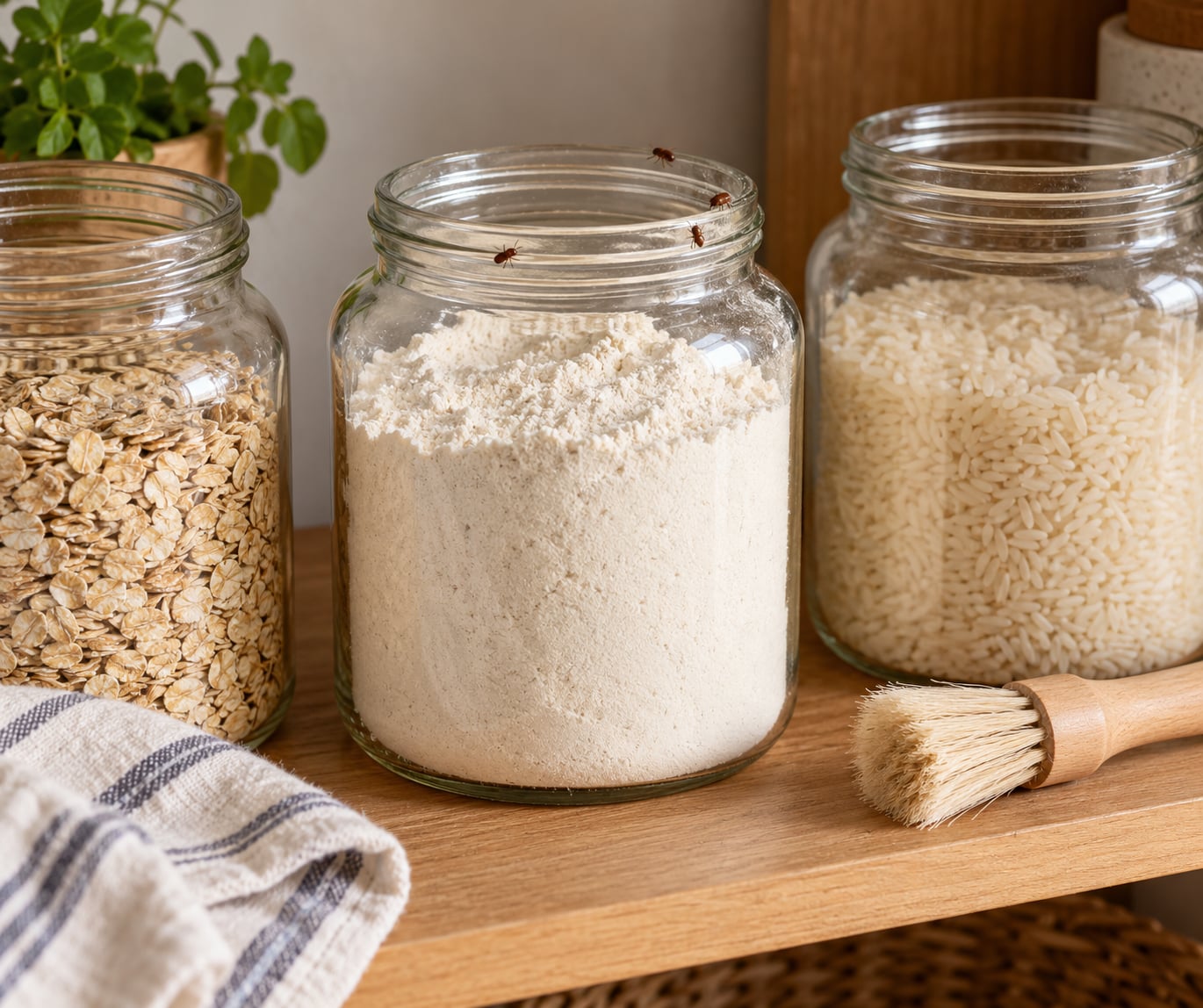
Weevils are small, reddish-brown beetles about 3 to 4 mm long with a distinct elongated snout. Pantry moths are larger, pale grey-brown, and are usually identified by their caterpillars and silken webbing rather than by the adults you may never catch. Flour mites are pale, soft-bodied and far tinier.
| Pest | Size | Colour and shape | Flight | Damage and where it hides |
|---|---|---|---|---|
| Grain weevil (Sitophilus granarius) | 3 to 4 mm | Reddish-brown, elongated snout, cannot fly | No | Larvae tunnel inside kernels; found in wheat, barley, pasta, flour |
| Rice weevil (Sitophilus oryzae) | 2 to 3.5 mm | Dark brown to black, snout, four light spots on the back | Yes | Same internal larval damage; spreads between bags in a pantry |
| Flour beetles (Tribolium species) | About 3 mm | Red-brown, rounded, no snout | Yes | Feed on flour dust and broken grain; live in the flour rather than inside kernels |
| Cigarette beetle (Lasioderma serricorne) | 2 to 3 mm | Pale brown, hump-backed, smooth oval shell | Yes | Thoroughly destroys spices and chilli powder, leaving only wing cases |
| Indianmeal moth (Plodia interpunctella) | Adult 8 to 10 mm, larva up to 15 mm | Adult two-tone copper and cream, larva cream with brown head | Yes | Larvae spin silken webbing that glues grains into clumps, usually near the container surface |
Moths change the cleanup. A moth infestation means larvae have been crawling through more than one product, so you widen the search. Weevils stay largely inside the grain they hatched in, so the problem is usually more contained.
What Signs Show Flour Has Been Infested?
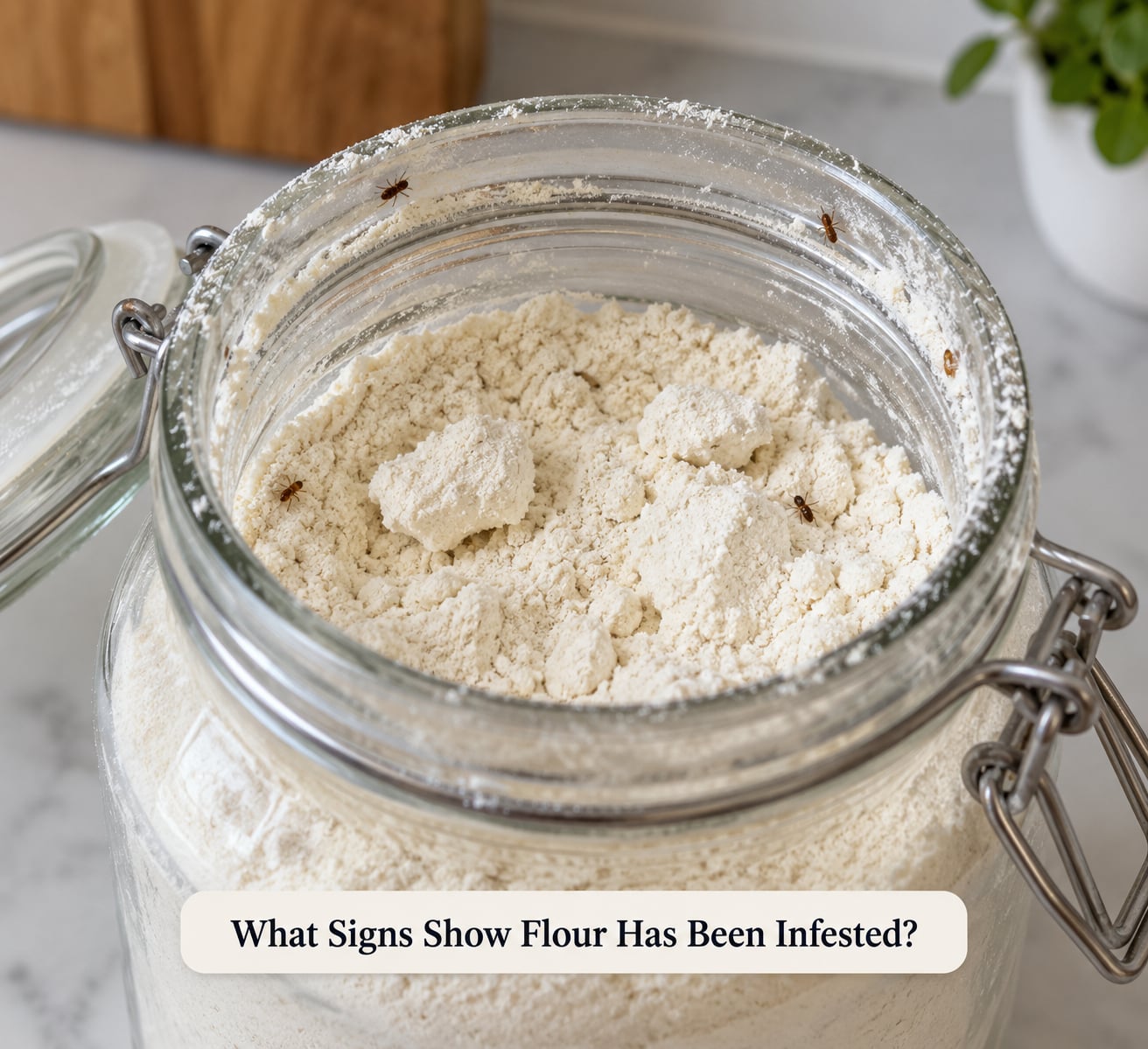
Live beetles moving in the flour are the obvious sign. The subtler one is a layer of dead adults sitting on the surface while the living larvae stay lower down in the bag, which is why shaking a bag can look harmless and the next scoop can look terrible.
Other things to look for:
- Web-like filaments and flour that has clumped or stuck to the sides of the container.
- A musty or stale smell when you open the bag, sometimes noticeable before you see anything.
- Small holes or ragged edges in paper packaging, or a bag that looks puffed or loosely sealed.
- Fine dust and powdery residue on the shelf, the wall behind the container, or neighbouring products.
- Insects appearing in a second, unrelated product weeks after you cleaned the first one.
Whole grain and rye are worth checking first. Insects are visible against dark flour and hidden against white, so an infestation can look worse in one bag than another with the same load.
Is Flour With Weevils Still Safe to Eat?
Lightly infested flour is not a health hazard. Grain weevils and flour beetles do not carry disease and do not bite, and food scientists quoted in the press have pointed out that a small amount of insect protein in a loaf is a rounding error compared with what already sits in ordinary food. The real problems are quality, odour, tainting and the spread to everything stored nearby.
Discard the flour when the infestation is heavy, when you see webbing or clumping that you cannot separate, when the bag smells musty, or when the flour has been somewhere damp. Moisture plus insects is a different situation from dry insects in dry flour, because mould and off odours follow moisture and no one wants that in bread.
Do not taste flour to test it. Use the package instructions and general food-safety guidance on storage instead, and keep raw flour away from ready-to-eat food. If a child or someone with a wheat allergy is in the house, throw heavily infested flour out without weighing the decision, since insect fragments sit in the flour and are hard to sieve out.
How to Remove Weevils From the Pantry
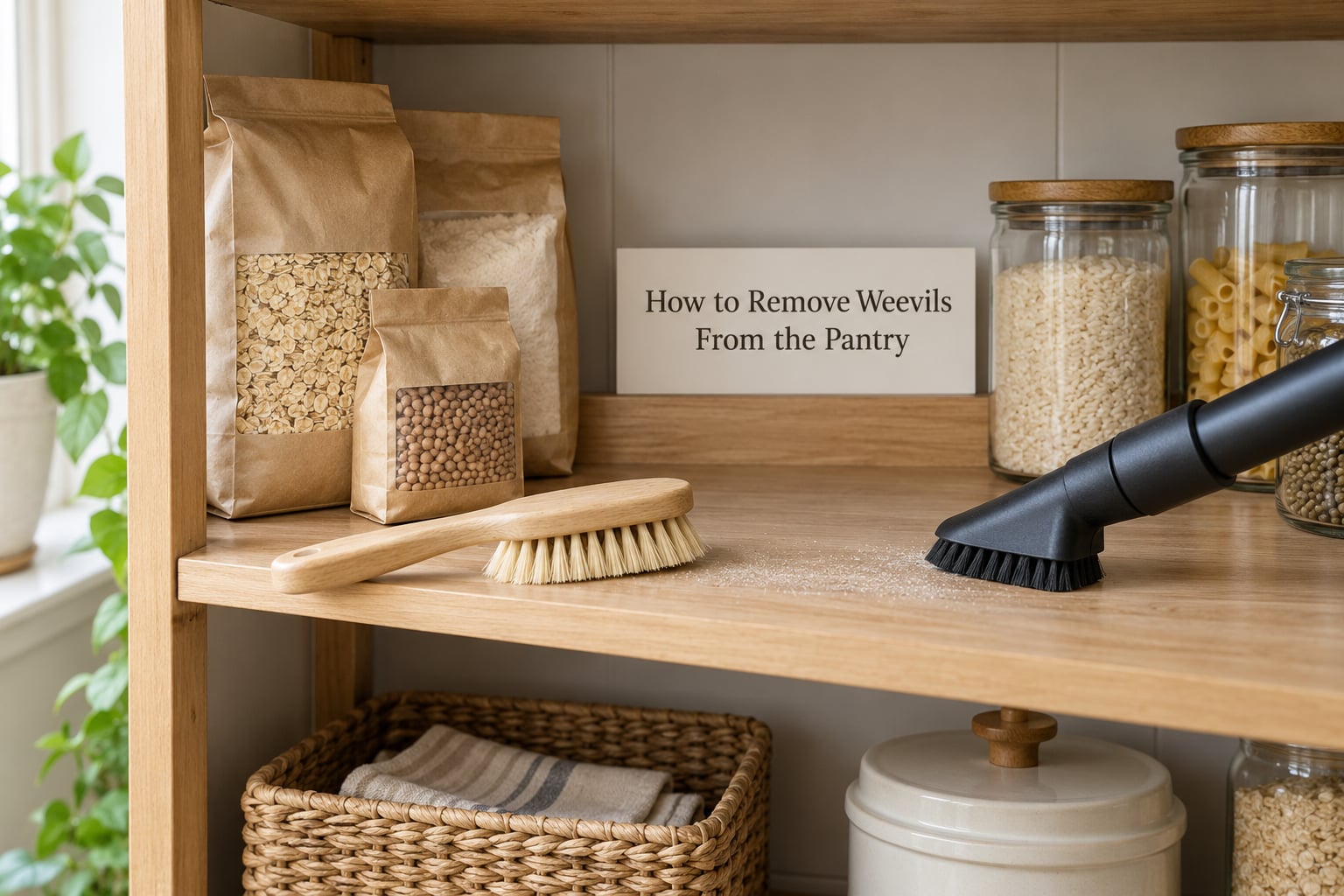
Work outside the room where you store food, in stages, and start by finding the source rather than by binning everything at once.
- Isolate. Take every bag and box out of the pantry, including unopened ones you would normally keep, and put suspect products in sealed bags or bins outdoors. Do not carry them through the house.
- Trace the source. Check birdseed, pet food, cereal, oats, rice, pasta, dried fruit, nuts, seeds and spices. The item at the back of the shelf or the one you opened recently is a common culprit.
- Freeze suspect dry goods. Seal what you want to save and freeze at -18 °C (0 °F). Advice ranges from three days to a full week depending on who you ask, so give it five days or more when eggs may be present, then let it come to room temperature sealed before opening.
- Heat what freezing misses. Spread flour on a baking tray and heat it at 120 °F (49 °C) for an hour, or use the oven at around 300 °F (150 °C) for 30 minutes. This works on adults and larvae but does not reliably destroy eggs.
- Clean empty. Vacuum the shelves, the back wall and the gaps with a hose attachment, then wash with hot soapy water and follow with a vinegar solution or other food-safe sanitiser. Clean containers the same way and dry them fully.
- Restock carefully. Bring in only what you will use in a few months. Glass, metal and hard plastic with a working seal beat paper sacks and thin tubs every time.
- Watch for two months. Check the pantry every week or two. Anything moving at that point came from a source you missed.
Freezing is the remedy most people report as actually working, and it costs nothing but shelf space and patience. Never spray insecticide, use a fogger or scatter diatomaceous earth near food; those products are not for stored food and can contaminate it.
How to Prevent Weevils in Flour From Returning
Prevention is mostly about closing the routes, in order of how often they cause trouble.
- Freeze new flour and grains on arrival. A bag in the freezer for a few days before you open it removes any eggs that came from the field.
- Use real airtight containers. Glass jars with clamping lids, metal tins or hard plastic tubs with intact gaskets. Paper bags, cardboard boxes and screw lids sitting loose are not enough.
- Buy small quantities. Weevils need time, and flour you finish in a month never gets the chance.
- Keep birdseed, pet food and dried fruit sealed, ideally in a separate container or a room you do not use as a pantry. They are the most common hidden source.
- Use a first-in, first-out system. Date new stock and move older to the front. Old grain at the back of a shelf is an infestation waiting to happen.
- Store cool and dry, away from sunlight, and clean up spills promptly since dust and crumbs feed everything.
- Check monthly. One bag, ten seconds, while you are putting the shopping away.
Bay leaves and whole cloves get recommended constantly. Some people swear by them and entomologists are openly split, so treat them as a pleasant extra rather than something to rely on.
If the same insects keep coming back after a full clean-out, look outside the pantry: neighbouring flats in a multi-unit building, a bird nest or feeder near a window, and cracks around utility penetrations. Recurring infestation in one wall of an apartment usually needs a pest professional, not another bag of flour.
Frequently Asked Questions
Can weevils in flour make someone sick?
No. Grain weevils and flour beetles do not carry disease, do not bite and do not sting. Eating a small amount of insect material is not dangerous to a healthy adult, which is why lightly infested flour is treated as a quality problem rather than a health one. Anyone pregnant, unwell or with an allergy should follow medical advice and discard it.
How long can flour sit in the pantry before weevils become a problem?
There is no safe shelf life, because the eggs may already be inside the grain. Flour kept in a cool cupboard usually stays clean for months, while a warm pantry can produce adult beetles within a few weeks of purchase. Freezing new flour on arrival for several days, then storing it sealed, removes the risk almost entirely.
Are pantry weevils the same as flour moths?
No. Weevils are small reddish-brown beetles with a long snout that develop inside individual grain kernels. Pantry moths are larger, and their pale caterpillars spin silken webbing that glues grains into clumps. Weevils tend to stay in the product they hatched in, while moth larvae wander through several packages and force a wider clean-out.
Can I save flour that contains weevils by sifting it?
Sifting removes visible insects but almost certainly not the eggs or the larvae developing inside kernels. For heavy infestations, webbing, clumping or a musty smell, discard the flour. If it is only lightly infested, freezing the sealed bag for five days or more and then sifting gives a reasonable chance of recovering it.
If I find pantry insects, should I use bug spray or fogger?
No. Aerosol sprays and foggers are not designed for stored food and can contaminate flour, cans and surfaces that are hard to clean properly. Vacuum, wash with hot soapy water, use a food-safe sanitiser, and freeze or discard affected products instead. If activity persists in an apartment building or near a bird nest, call a pest professional.
What to Do First When You Find Weevils in Flour
Stop using the open bag immediately and seal it. Take the rest of your dry goods out of the pantry so you can see what else is affected, then look hard at the birdseed, pet food, cereal and spices that sat nearby, since that is usually where the weevils in your flour actually came from.
Freeze what you want to keep for five days, discard anything heavily infested or musty, and vacuum and wash the empty shelf and every container before restocking with smaller amounts in genuinely airtight jars. If bugs are still moving in two months, the source is outside the pantry rather than in it.