Free insect identification apps are genuinely useful for narrowing a photo down to a likely group — a beetle, a wasp, a mosquito — but they are not reliable enough to base a decision on when the answer matters. Ask one about a housefly or an American robin and it will usually land in the right neighbourhood. Hand it a rare beetle, a tick, or anything that has been damaged, and it will still return a confident name, and that name can be wrong.
The honest summary for anyone asking about free insect identification apps and how accurate they are: accuracy depends less on the app brand than on how common your insect is, how good your photo is, and whether you tell the app where and when the photo was taken. Confidence comes from cross-checking, not from the first result.
Table of Contents
- How Accurate Are Free Insect Identification Apps?
- Free Insect Identification Apps at a Glance
- What Makes an Insect App Identification Right or Wrong?
- How to Get the Most Accurate App Result
- Free Insect Identification Apps vs. Expert Identification
- Where Free Insect Apps Usually Make Mistakes
- How to Verify an App’s Identification
- Frequently Asked Questions
- Are free insect identification apps accurate enough to trust?
- What is the best insect identification app for free?
- Is iNaturalist accurate?
- Why do different bug apps give different answers for the same photo?
- Do any bug identification apps work without internet?
- Can these apps identify spiders, ticks and other arachnids?
- Conclusion
How Accurate Are Free Insect Identification Apps?
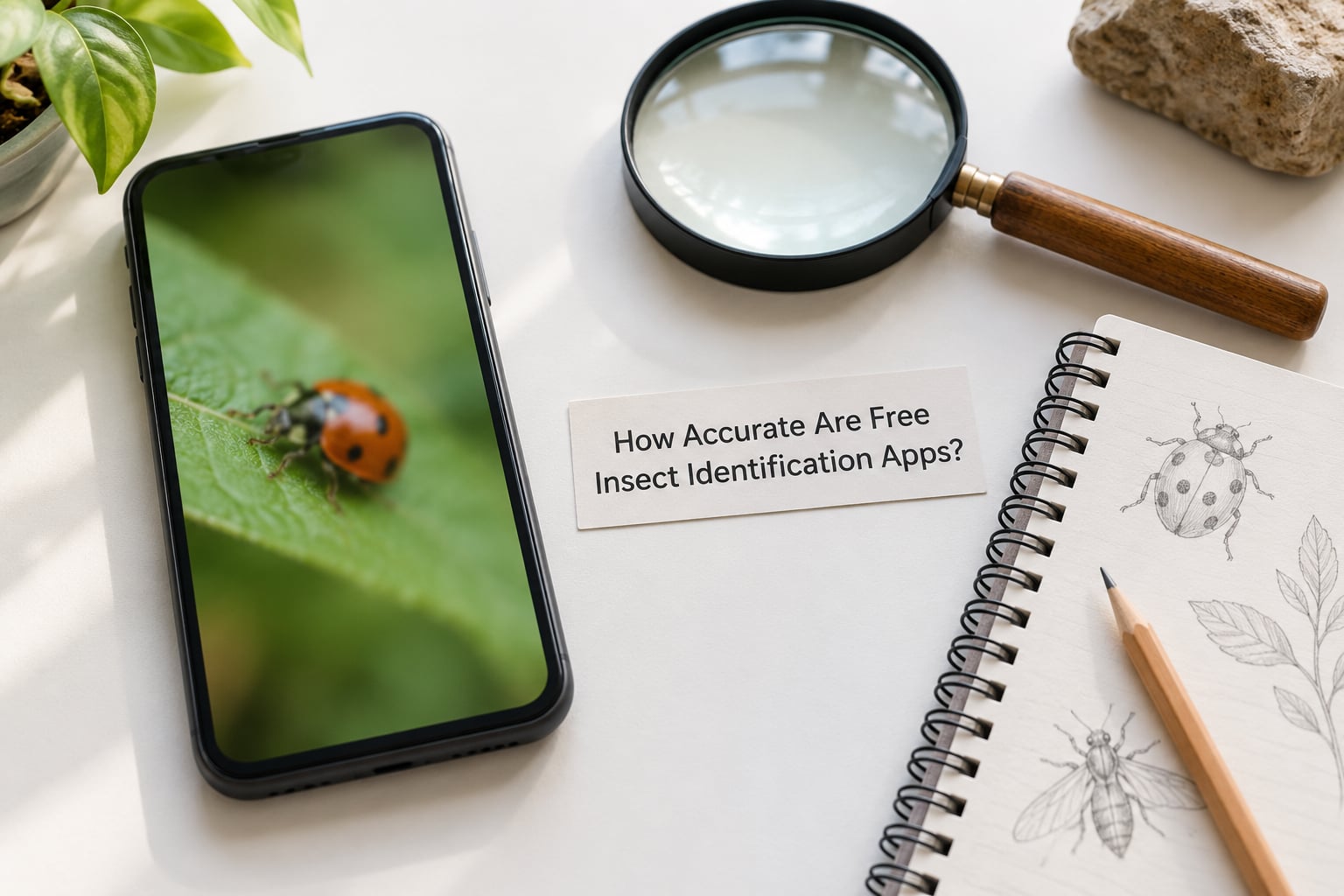
Accuracy is uneven across the insect world in a predictable way. Common, widespread species that fill millions of labelled training records get identified correctly most of the time. Rare species, regional variants, colour morphs and small specimens are where errors concentrate, and those are exactly the cases where people most want an answer.
There is also a difference between being right and being useful. A result that stops at “ground beetle” is not technically wrong, but it will not tell you whether that beetle is eating your roses or sleeping under the mulch. Raw accuracy and practical usefulness are two different things, and only one of them answers your question.
Why accuracy numbers are hard to trust
Most accuracy claims you will find for these apps come from the app’s own marketing or from an unsourced blog test. Roundups on the web quote figures like “correctly identified 46 of 50 test photos” without saying who took the photos, where they were taken, or who decided what the correct answer was. That kind of number tells you very little.
Peer-reviewed benchmarking of consumer insect apps is thin and much of the academic work sits behind paywalls. So treat every percentage you meet as a claim rather than a measurement, and judge the tool by behaviour you can observe: does it ask for location, does it tell you how sure it is, and does it let a human check the answer?
Free Insect Identification Apps at a Glance
Free insect identification apps sit in the middle of a three-column spectrum. Knowing what each column is good for stops you expecting a phone camera to do an entomologist’s job.
| Method | Typical accuracy | Best use | Cost | Speed | Main limitation |
|---|---|---|---|---|---|
| Free insect ID app | Good on common species, unreliable on rare ones | First guess, sorting what you found | Free core, paid extras on some apps | Seconds | Guessing confidently at broad groups |
| Community-verified observation | High once other people confirm or correct it | Anything you plan to act on | Free | Minutes to a few hours | Takes patience and a good photo |
| Expert identification | Highest available for difficult specimens | Stinging insects near kids, structural pests, medical worries | Free through many extension services and museums | Hours to days | Slower, may need a preserved specimen |
| Self-guided visual check | Variable, depends on your reference material | Learning the groups, spotting a lookalike | Free, plus field guide cost | As long as it takes | Reference books skip the exact species |
Results vary by app, region and insect, so treat the table as a shape, not a set of scores. Nothing here is a benchmark measurement.
What Makes an Insect App Identification Right or Wrong?
An app compares your photo against a large set of labelled records — often millions of citizen-science observations — and returns whatever the model thinks is closest. That means the answer is only ever as good as the training data and the image you gave it.
Location is the input people skip most. Experienced identifiers on r/insects and r/whatisthisbug ask for it constantly, and for good reason: a model that knows an insect was photographed in Ohio can rule out hundreds of species that only live in Brazil. Date does similar work, since many insects have a narrow adult season. Size and behaviour narrow it further, and a photo with a coin next to the specimen is worth more than a slightly sharper shot without one.
| Clue you give the app | How useful it is | Why |
|---|---|---|
| Clear dorsal photo, insect fills the frame | High | Wing shape, body outline and markings become visible |
| Location and date | High | Removes most impossible candidates immediately |
| Size, measured or against a coin | High | Separates species of wildly different scale |
| Behaviour, sound, where it was found | Medium to high | Often more diagnostic than colour |
| Colour alone | Low | Lookalikes share palettes; warning colours repeat across unrelated groups |
| A blurred photo from far away | Very low | Body detail is gone, so the model falls back on shape and colour |
| One photo, one angle | Low | The same insect from another angle can return a different species |
What a confidence score actually means
A percentage on screen is not a measurement of how likely you are to be right. It describes the model’s own certainty given the image it was handed, and models are often overconfident on inputs unlike their training data. A high score on a blurry photo of a rare beetle is not evidence; it is just a confident tone.
How to Get the Most Accurate App Result
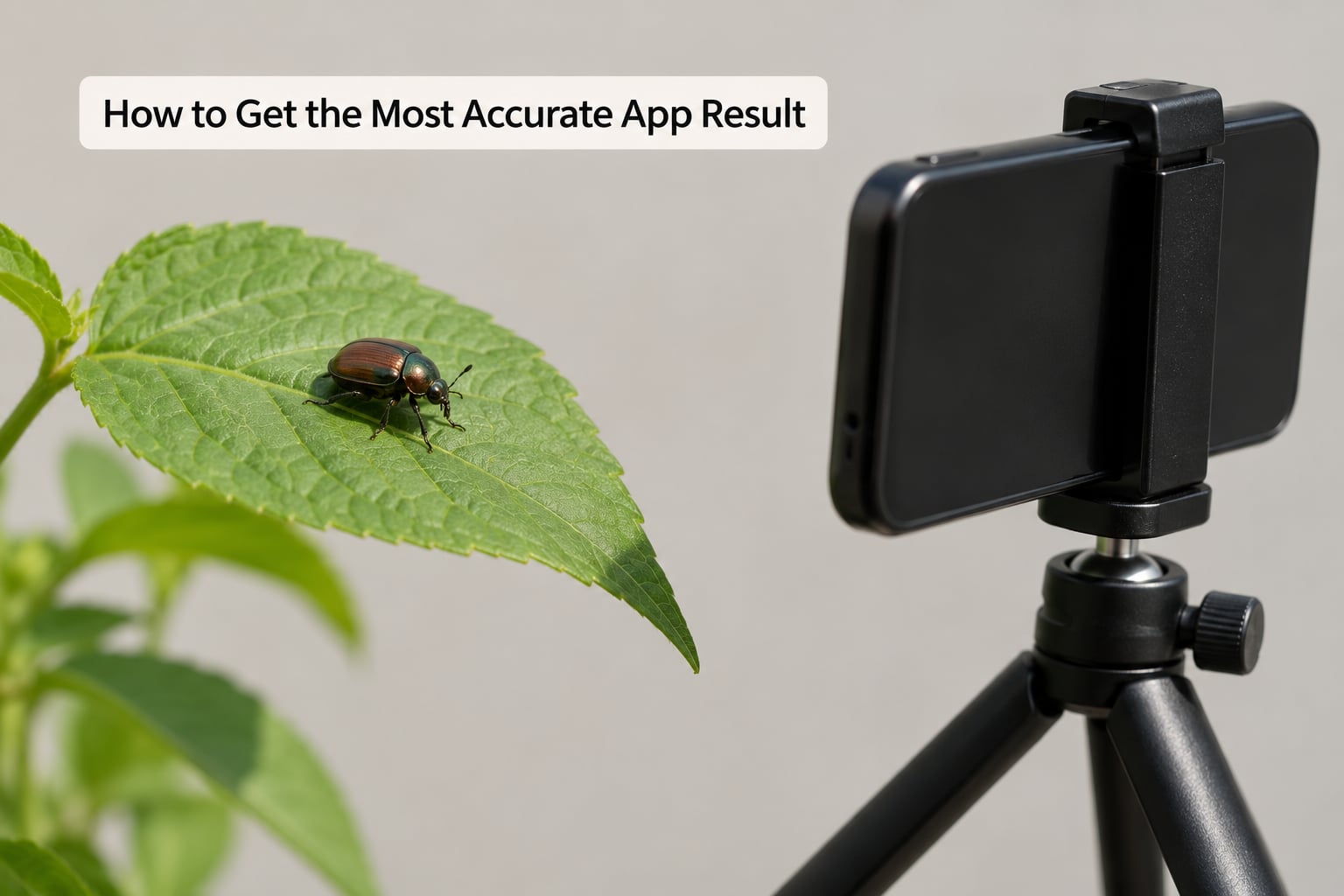
Most disappointing app results I have seen come down to a photo taken in two seconds from standing height. Give it five minutes instead and the first answer usually improves.
Photo protocol
- Fill the frame. Get close enough that the insect occupies most of the image, without losing the whole body.
- Use even light. Shade or indirect daylight beats a phone flash, which blows out reflective wing surfaces.
- Put something beside it. A coin or ruler in the same plane gives the model and you a scale reference.
- Shoot from above and from the side. Top-down shows markings; the side view shows body profile and leg and antenna structure.
- One insect per photo. Two specimens in frame split the model’s attention.
- Reshoot if it is moving. A still frame beats a blurred attempt at a fast subject.
Context to enter before you submit
- Where. City or region and even the habitat — indoors, garden, woods, on a wall or in a bed.
- When. Month and year. Several groups appear as adults for only a few weeks.
- How big. A measurement, not a guess of “about an inch”.
- What it was doing. Feeding, nesting, flying at lights, biting, resting on a specific plant.
- How many. One individual or dozens changes which answer is plausible.
If the app offers several suggested matches rather than one answer, look at all of them before picking. Then check the top matches against the features in the next section instead of accepting the first label.
Free Insect Identification Apps vs. Expert Identification
Apps win on speed and on volume. You can submit thirty photos from a weekend in ten minutes, and an app never minds a weird question at eleven at night.
They lose on the specimens that need a hand lens, a key, or someone who has keyed that family for twenty years. Tiny parasitoid wasps, damaged specimens, larval forms and anything requiring dissection are genuinely hard, and a photo simply does not carry enough information.
Expert routes are more available than most people assume. University extension offices answer insect questions from homeowners, state and local pest services handle structural pests, and natural history museums and insect collections often accept specimens or photographs. Identifiers in the iNaturalist community can also confirm or correct an observation, which is the middle rung between an instant answer and a specialist.
Worth an expert check: anything that stings and is near children or pets, a suspected termite or carpenter ant infestation, an unfamiliar bite with symptoms, a cluster of insects in a structure, or any species decision tied to spraying, spending money or reporting something.
Where Free Insect Apps Usually Make Mistakes
Matching a lookalike to a more famous species
Paper wasps get called yellowjackets and hoverflies get called bees, because those are the labels the model has seen most. Correction: check body shape, antennae length and the wing vein pattern rather than the colour, and remember that many bees and wasps cannot sting at all.
Reasoning from colour alone
Warning colours are a small palette reused across unrelated groups, and colour morphs exist within single species. Correction: use markings — stripes, spots, band width, edge shape — instead of hue.
Confusing life stages
Nymphs, larvae and adults of one species can look nothing like each other, and models trained mostly on adult photographs struggle. Correction: upload the adult if you can find one nearby, or tell the app what stage you found.
Missing geographic context
An unidentified insect is a species with no range restriction, which makes almost any label look plausible. Correction: always enter location, and discard any suggested species that does not live there.
Treating a single label as proof
An app returns a best guess with a clean interface, and that polish reads as authority. Correction: treat the output as a hypothesis, then test it against anatomy, range and season.
Telling you what to do
Even a correct species ID says nothing about whether it is a structural pest, a beneficial predator, or seasonal and harmless. A bite checker inside an app is not a diagnosis, and it is not a basis for treatment decisions.
How to Verify an App’s Identification
Verification is a short checklist, and it takes about the same time as making the second photo.
Check the body plan
Antennae shape, wing count and vein layout, number of body segments and the presence of a pinched waist all narrow things quickly. Field guides and university extension keys are built around exactly these characters.
Check the range and the season
Regional field guides list what occurs where and when. If the app’s answer is a species that has never been recorded in your state, keep looking.
Check a second source and a second app
Run the photo through another app. If two independent tools return the same family or genus, confidence rises; if they disagree completely, the photo is the usual weak link. Adding the observation to a community-science platform and waiting for identification is the cheapest way to get a human check.
Check against reputable references
Extension services, natural history museums and established field guides are better authorities than an app’s species profile. For structural pests, a local pest professional can confirm in person; for anything medical, ask a clinician rather than an app.
If you handle the specimen, do it safely. Keep children and pets away, wear gloves, avoid bare-handed contact with anything unknown, and never use an app result as a reason to pick up, kill or spray something you have not confirmed.
Frequently Asked Questions
Are free insect identification apps accurate enough to trust?
They are accurate enough to narrow an insect down and rule out impossible candidates, which is a real and useful job. They are not accurate enough to be the final word when the identification drives a decision such as treating a structural pest, spraying a garden, or worrying about a sting or a bite. For common species, a good photo plus location and date usually gets you a correct family-level answer. For anything consequential, verify with a second tool, a community identification, or an extension service.
What is the best insect identification app for free?
There is no single winner, because the apps suit different jobs. For getting a name and adding your observation to a real biodiversity database, iNaturalist is hard to beat. For a phone handed to a child with no account and no ads, Seek by iNaturalist is the usual pick. For a quick general-purpose visual lookup, Google Lens is already installed on most phones. ObsIdentify is popular in Europe and returns fewer options than its North American rivals. Try two and compare.
Is iNaturalist accurate?
The machine suggestions in iNaturalist are a starting point rather than an answer, and they are strongest on common, well-photographed species. The part most people value is the community layer: other observers and local experts confirm or correct an identification, and a community-confirmed observation is a much stronger result than an instant label. Treat the suggestion as a proposal and wait for confirmation before you act on it.
Why do different bug apps give different answers for the same photo?
Different apps were trained on different sets of labelled images, draw on different regional databases, and are built to return different levels of detail. One may stop at family, another may return a species. Regional bias matters too: a tool optimised for European species will produce weaker results on North American insects, and the reverse is also true. Conflicting answers usually mean one of the two apps saw a weak photo or a species outside its strong range.
Do any bug identification apps work without internet?
Partly. Some apps offer a downloaded offline reference set of species profiles that works without a signal, and a few run on-device models that can classify an image with no connection. Photo-based identification that needs a cloud model generally does not work offline, because the matching happens on a server. If you are hiking or camping, download the offline library before you leave and record location and notes manually for later upload.
Can these apps identify spiders, ticks and other arachnids?
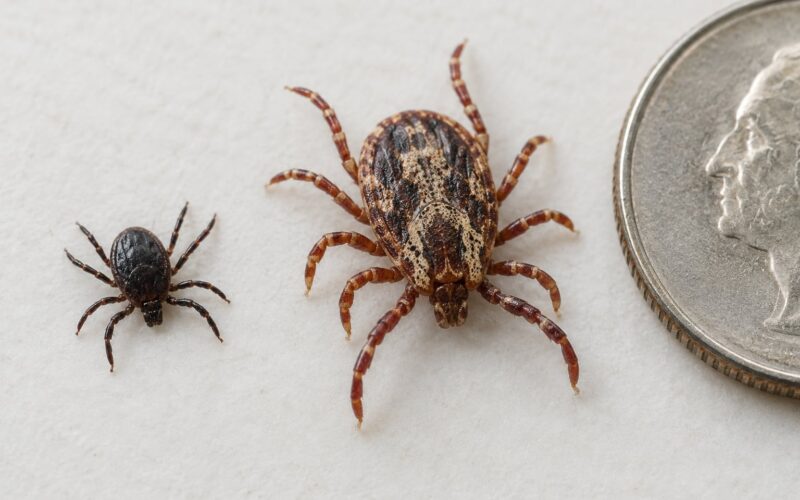
Most insect apps accept them and will return an identification, since arachnids are close relatives and many are easier to recognise than insects. Ticks in particular are usually handled well at the species or group level, and that matters if a bite follows. Spiders are more often confused with insects and mis-grouped at family level, so check the leg count and body segments yourself. Treat a tick result as a prompt to see a clinician, not as a diagnosis.
Conclusion
Free insect identification apps are good triage tools and poor witnesses. They narrow a photo to a likely family or species quickly, they are dependable on common insects, and they get weaker exactly where people most need certainty: rare species, damaged specimens and anything that matters.
Start with a sharp, evenly lit photo of a single insect filling the frame, with a coin for scale and a shot from above and from the side. Enter location, date, size and what it was doing, then compare two apps rather than trusting one. If the answer leads to treatment, a report, money or worry about a sting or a bite, have a human confirm it — a community identification, an extension office or a professional — before you act.