Wasps get aggressive in late summer for reasons that have nothing to do with temperament. By August a colony holds its biggest population of the year, the queen has wound down egg-laying, and the insects and flower nectar the workers have been foraging on all season are running out. Hungry workers end up at your drinks, your bins and your patio table, and a nest with brood to protect becomes a much more heavily guarded place.
Most of this shows up in August and September, though the timing shifts with climate. Warmer southern regions can peak in July, cooler northern ones hold on into October. If you want the mechanism rather than a sales pitch, here is what is actually happening inside the colony.
Table of Contents
- Why Wasps Get Aggressive in Late Summer
- What Changes in a Wasp Colony During Late Summer
- How Weather and Food Shortages Make Wasps Defensive
- Why Wasps Follow People and Challenge Them
- How to Tell Aggression From Nest Defensive Behavior
- How to Reduce Wasp Encounters Around Your Home
- When You Need a Professional Wasp Removal Service
- Frequently Asked Questions
- Conclusion: What to Do First
Why Wasps Get Aggressive in Late Summer
Late-summer wasp aggression comes down to three pressures stacking on top of each other: a colony at peak size, a food supply that is collapsing, and a nest that suddenly has fewer larvae worth defending. It is not a switch that flips in the wasp’s personality. Wasps defend a colony all season; what changes in late summer is how much food stress they are under and how little brood they have left.
The five causes, in plain terms:
- Peak colony population. A nest that held a few hundred workers in June may hold several thousand by August, all competing for the same shrinking food supply.
- The queen winds down. Late in the season she lays far fewer eggs, so the brood that workers were feeding disappears.
- The larval protein loop breaks. Normally larvae trade protein-rich secretions to the adults for food. Fewer larvae means the workers lose that free sugar and go looking for carbohydrates.
- Natural forage declines. Insect prey and flower nectar are both on the way down as daylight shortens and heat stress hits plants.
- Colony breakdown begins. Worker numbers fall, morale with them, and a shrinking colony defends what it has left more sharply.
Graham Parsons, a pollinator biosecurity specialist with Saskatchewan Agriculture, put the core of it simply: the main driver is forage resources, meaning food for the wasp. That is the thread running through everything below.
What Changes in a Wasp Colony During Late Summer
Social wasps run an annual cycle that starts with a single fertilised queen and ends with a handful of new queens looking for a place to overwinter. The middle of that cycle is what makes August so busy.
In spring, a queen that overwintered alone finds a sheltered spot, builds a small paper envelope nest, and starts laying the first worker eggs. Those workers forage for nectar to fuel egg production and, once the larvae appear, hunt insects to feed them. Larvae digest that protein and return a sugary liquid to the workers, who feed it to the next batch of larvae. That two-way trade is how a colony grows so fast.
The larval protein loop that keeps a colony running
Here is the part most people never hear about, and it explains the whole late-summer behaviour shift. Adult wasps are not strongly motivated by protein for themselves. They collect it because larvae need it, and the larvae give back sugar. When the brood declines, the adult side of that bargain evaporates overnight, and workers switch to hunting carbohydrates. That is why your soda can, your fruit bowl and your barbecue suddenly look like a buffet line.
Here is the same cycle as a month-by-month timeline. Nothing in this is fixed to a calendar; warmer springs pull it forward, cooler ones push it back.
| Period | What the colony is doing | What you notice |
|---|---|---|
| April to May | A single overwintered queen builds a starter nest and lays the first worker eggs | Almost nothing. One or two quiet wasps near a wall or shed |
| June to July | Brood grows, workers multiply, foraging range widens | Wasps on flowers and in the garden, still mostly docile |
| August | Peak population, larvae returning sugar, queen laying fewer eggs, forage declining | Wasps at food and drink, nest traffic heavy, defensive reaction faster |
| September | Colony declines, workers die off, new queens mate and leave | Fewer wasps overall, more of them near the nest, more grumpy |
| October to first frost | Colony collapses, new queens hibernate in sheltered ground or voids | Activity stops; the queens that survive are the ones you may meet next spring |
That last row is the reason the answer to “will they go away on their own” is usually yes, given time and one real cold night. Worker wasps are short-lived, and the colony is built around a brood cycle that cannot restart once the queen stops laying.
How Weather and Food Shortages Make Wasps Defensive
Weather sets the pace of the whole cycle, which is why some years feel relentless and other years barely register. Heat and drought extend foraging because insects are active longer and plants keep pumping nectar through warm afternoons. A hot, dry August is often the worst case: lots of wasps, fewer insects for them to hunt, less nectar in the garden.
A cold, wet stretch does the opposite. Cloudy days and rain cut foraging activity, and wasps that stay in with an empty crop get edgy fast. Storms matter too, because wind and heavy rain knock down the flying insects that normally form the protein half of the diet.
So a stressed colony does two things at once. It hunts harder for sugar, and it defends the nest harder, because a colony in trouble has more to lose from a breach.
What draws them to a patio or picnic table
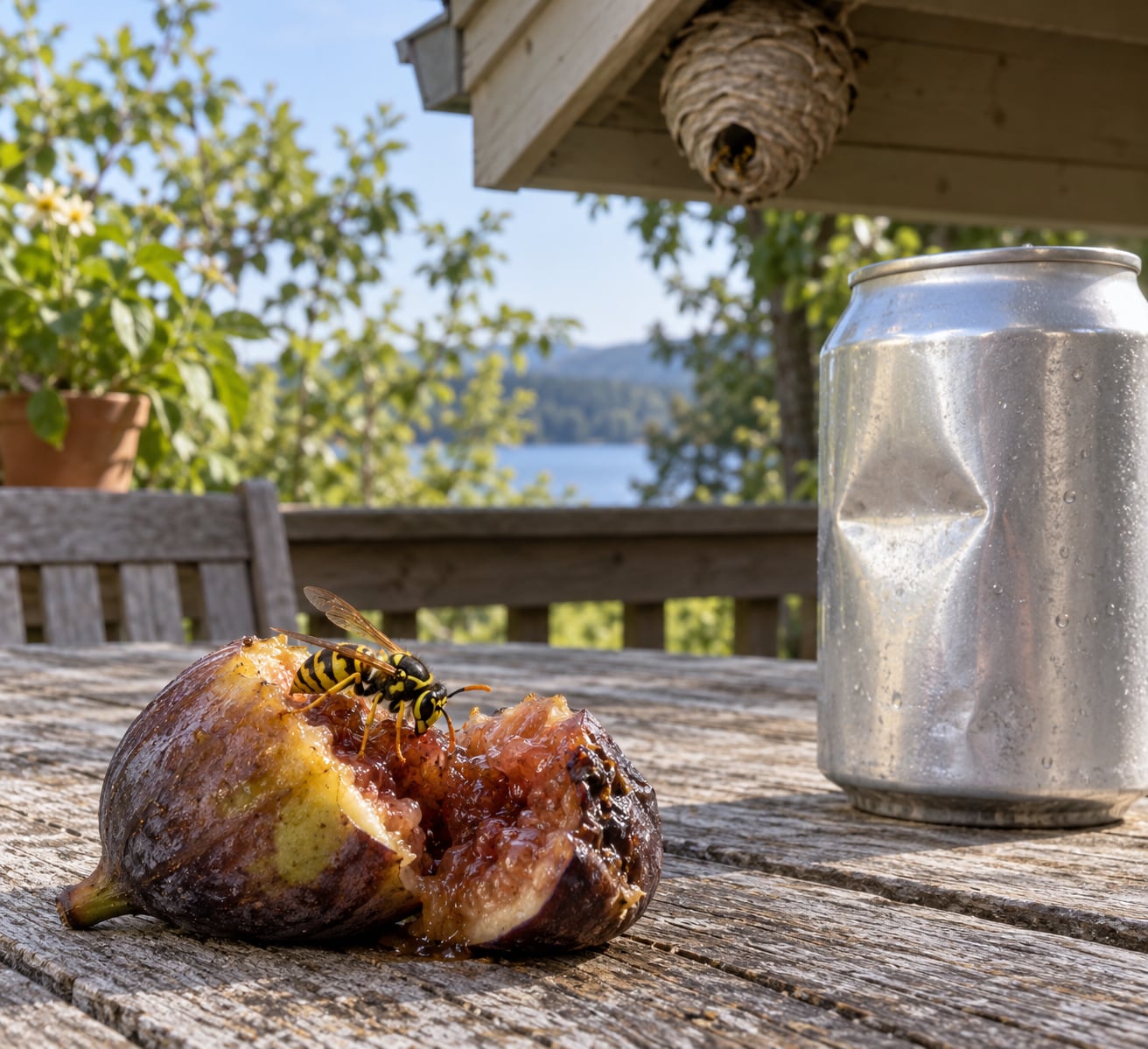
Anything sugary and uncovered is a target, and a drinking wasp following a person is following the scent and the visual target, not choosing them as a threat. Open cans and bottles, sweet tea, soda, juice, spilled sunscreen and scented lotions all read as a carbohydrate source. Musky perfumes and floral-patterned clothing draw attention without any wasp intending to.
The fix is unglamorous and works well: keep drinks covered and in the middle of the table rather than at the edge, wipe surfaces, and skip perfume outdoors during peak weeks.
What draws them to bins, fruit and pet food
Garbage and recycling bins are the single most complained-about attractant in late summer, and they are attractants because of what is in them. Sugary residues, meat scraps and fruit all do the work. Open bins also turn into a buffet with a strong scent trail, which is why a single uncovered bin can hold a steady stream of wasps for days.
Overripe fruit on a tree or in a bowl is a similar problem, and pet food bowls set down outdoors are protein, which is exactly what workers are no longer getting from larvae. Put food scraps straight into a lidded bin, rinse containers before they go out, and bring pet bowls in when the meal is finished.
Why Wasps Follow People and Challenge Them
Wasps are not hunting people. A worker in late summer is running a food errand, and a human standing near a soda can fits that errand perfectly. What reads as aggression is usually a foraging wasp doing its job with a limited brain and a strong scent.
Three things turn a foraging wasp into a stinging one: fast movement, being trapped, and threat to the nest. Swatting is the worst of the three, because it reads as all of them at once.
Why swatting makes it worse
Wasps release an alarm pheromone when they are attacked or killed, and it tells every nearby worker that a threat is at that exact spot. That is why one accidental swat can turn into five or six stings, and why a nest that is being disturbed produces a stream of attackers rather than a defensive circle. Experienced observers on r/WASPs put it plainly: wasps stay docile as long as you do not bump the nest.
People on r/NoStupidQuestions also note the sting difference that surprises newcomers. Wasps are not doing the single-sting deal honeybees do. A honeybee worker stings once and its barbed stinger tears free. A wasp has a smooth stinger and can sting repeatedly, which is a large part of why the same encounter feels so much worse than a bee sting.
What to do instead: stop moving, keep your arms down, and walk slowly away. If you have been stung, keep moving away from the area rather than running and waving, which recruits more wasps.
How to Tell Aggression From Nest Defensive Behavior
Foraging wasps and nest-guarding wasps behave differently enough that telling them apart saves a lot of worry. Experienced forum readers consistently report the same distinction: a wasp working a flower or a bin is focused on food and ignores you, while a wasp that hovers near a fixed point, walks on a surface in short loops, or turns to face you is a guard.
Warning signs that a nest is nearby:
- Steady traffic in and out of one gap, soffit, eave, or wall cavity
- Buzzing inside a wall, attic void, or under a deck when nothing is visible outside
- Wasps hovering in a fixed area rather than moving across the yard
- Ground activity around a burrow or a shaded wall base, which points to a ground-nesting species
- Several wasps that appear to come from nowhere and vanish when you approach
Which wasps are the most aggressive
Species matters more than most people expect. Yellowjackets nest in the ground or in wall voids and are the ones that make picnics miserable. Paper wasps build the open-comb nest you have probably seen hanging under an eave, and they are often more tolerant of people near a door. Bald-faced hornets look alarming and their nest is a closed paper ball, usually high in a tree or a soffit. European hornets are the large brown ones that stay near the ground around hollow trees.
| Type | Typical nest | Temperament around people | Stings |
|---|---|---|---|
| Yellowjacket | Ground level or inside wall voids and attics | Most likely to forage at food and sting repeatedly | Can sting many times |
| Paper wasp | Open comb under eaves, soffits, railings | Usually tolerant unless the nest is bumped | Can sting many times |
| Bald-faced hornet | Closed paper ball high in trees or a soffit | Defends the nest vigorously from a distance | Can sting many times |
| European hornet | Hollow trees and cavities, often low | Generally less bothered by people | Can sting many times |
| Honeybee | Hive in a box or wall cavity | Defends a hive persistently but does not forage at food | One sting per worker, then dies |
Wasps everywhere but no nest in sight
This one shows up constantly in pest forums and it usually has a boring explanation. Nearby colonies send workers across a wide foraging radius, a neighbour’s nest is out of sight above the fence line, or the nest is inside a wall where you only ever see the single entry gap. Rather than hunting for it during the day, watch a quiet spot for ten minutes and count the direction the wasps come from.
Users also ask why some years are worse than others, and the answer is forage plus weather: a mild spring followed by a hot dry summer produces more colonies, more workers per colony and less natural food at the same time.
How to Reduce Wasp Encounters Around Your Home
Prevention here is mostly food management, and it does more than anything else once the season turns.
- Keep garbage and recycling in lidded containers with working lids, and rinse food containers before they go in.
- Cover drinks, especially at the edge of an outdoor table, and take rubbish out before dusk.
- Pick up fallen and overripe fruit weekly, and check fruit trees for split fruit.
- Bring pet bowls in as soon as the meal is done.
- Wear light colours rather than dark, and skip strong perfume and floral prints outdoors.
- Do not swat, spray at, or swing near a wasp that is only foraging.
- Walk away slowly and calmly. Running and waving arms recruit more workers.
- Keep away from nests. If you find one, note its location and treat it as a hazard for children and pets.
Myths worth dropping: WD-40, fire and decoy nests
Advice online about wasps is mostly folklore, and people try several of these before they try anything that works.
- WD-40 does nothing useful on wasps. It is a lubricant and water displacer. It does not repel, kill or stun a wasp, and spraying one at close range just puts an agitated insect and its alarm pheromone into the air.
- Fire and boiling water mostly create a second problem. A burning wasp on a dry deck is a genuine fire risk, and boiling water aimed at a nest is dangerous to whoever holds it.
- Decoy nests do very little this late in the season. They rely on wasps being territorial about a site they are still scouting, and by August the colony already has a finished nest with brood in it.
- The revenge myth is not real. Wasps do not plan, remember a grudge, or come back to find you. What people experience as revenge is alarm pheromone and nest defence, both of which are local and short-lived.
- “They forget you in three days” is not accurate either. Individual worker wasps live only weeks, but the behaviour resets because the colony’s brood cycle ends, not because anyone forgot.
When You Need a Professional Wasp Removal Service
Most late-summer wasp activity does not need anyone professional. It needs you to remove the food and leave the wasps alone. There are situations where that is not realistic.
- The nest is inside an attic, a wall cavity, a soffit or a shed wall, where you cannot reach the entrance.
- Children, pets, or anyone in the house with a known sting allergy cannot be kept away from it.
- Nests are built on the house itself, in a frequently used doorway, or near a frequently used walkway.
- Traffic at the entrance is heavy enough that the area cannot be used at all.
- Anyone in the household reacts badly to stings, panic around insects, or has mobility limits that rule out moving away quickly.
Why sealing a nest makes it worse
Sealing an entrance is instinct, and it is the one move that reliably makes a problem larger. If you close the gap while the colony is alive and brood is present, you trap a colony inside your wall with no way out, and the agitated workers chew new exit points wherever they can find the weakest material, often drywall. The right sequence is to treat the colony and then seal, and the treatment needs proper protective equipment and timing that a homeowner at arm’s length with a hose does not have.
Wasps also do real work in a yard, eating caterpillars and flies and visiting flowers, so there is no ecological emergency if a nest ends up removed. For most people the practical issues are children, pets, allergies and repeated stings, not the wasp population.
Frequently Asked Questions
Why are wasps so angry in August?
August is when a wasp colony is at its largest, the queen has wound down egg-laying, and there are fewer larvae feeding workers. With larvae gone, workers lose the sugar the brood used to give them in exchange for hunted protein, so they switch to carbohydrate hunting. That puts them at your drinks, your bins and your fruit, and it is food pressure, not temper.
Why are wasps and hornets so aggressive?
Hornets are wasps, and most late-season aggression is a resource problem rather than a personality change. Colonies peak in size, insect prey and flower nectar decline as heat stress builds, and workers lose the sugary secretions larvae trade for protein. Starved and numerous, they forage harder at human food and guard what brood remains more sharply than they did in June.
Do wasps try to get revenge?
No. Wasps do not remember a grudge or plan a return visit. What feels like revenge is alarm pheromone released when a wasp is struck or killed, which calls nearby workers to that exact spot, plus ordinary nest defence. Both responses are local and short-lived, which is why staying still and moving away calmly ends an encounter quickly.
What to do if a wasp is angry at you
Stop moving, keep your arms down, and walk away slowly. Do not swat, spray, or wave your arms, because the alarm pheromone released when a wasp is struck brings in several more. If you have been stung, keep moving away calmly rather than running, and if someone reacts badly with swelling, wheezing or dizziness, seek medical care straight away.
Will wasps go away on their own?
Usually. Worker wasps live only weeks, the queen stops laying, and the first cold night of autumn ends the colony, leaving new queens overwintering alone. The exception is a nest inside a structure, where overwintering queens can survive the winter in a protected void and start a colony again in spring, which is the main reason people treat an indoor nest promptly.
Conclusion: What to Do First
Why wasps get aggressive in late summer comes down to arithmetic: a colony at its largest, a queen who has stopped laying, larvae that are no longer trading sugar for protein, and a natural food supply that is shrinking week by week. That combination puts hungry workers on your patio and turns your nest into something worth defending.
So the first thing to do is remove the reason they came. Lidded bins, covered drinks, fruit picked up, pet bowls brought in. Then leave the wasps alone, stay calm if one comes near, and give the nest a wide berth. When the first frost arrives, the colony is finished on its own.
The exception is a nest inside an attic, a wall, or a soffit near a doorway, especially with children or a sting allergy in the house. Have it treated properly before it is sealed, and never seal an active nest on your own.