A scorpion is an arachnid, not an insect, and you can confirm it in about thirty seconds from across the room. Look for five things together: two pincer-like claws at the front, eight walking legs, a long segmented tail curled over the back, a stinger at the tip of that tail, and a body length that is usually two to three inches.
All five have to be there. Plenty of harmless household creatures match one or two of those traits and none of the others, so a pincers-only or tail-only sighting is not a diagnosis. That is the trap most people fall into, usually at two in the morning with a phone flashlight and a photo full of shadow.
If you are trying to work out how to identify a scorpion in a house, this guide walks through the close inspection, the look-alikes that cause the most confusion, and what to do in the minute after you are sure. It applies mainly to the Southwest, Texas, Florida and the mid-South, where indoor scorpion sightings turn up every season, including 2026. Keep it simple, keep your distance, and never pick one up with bare hands.
What You Need
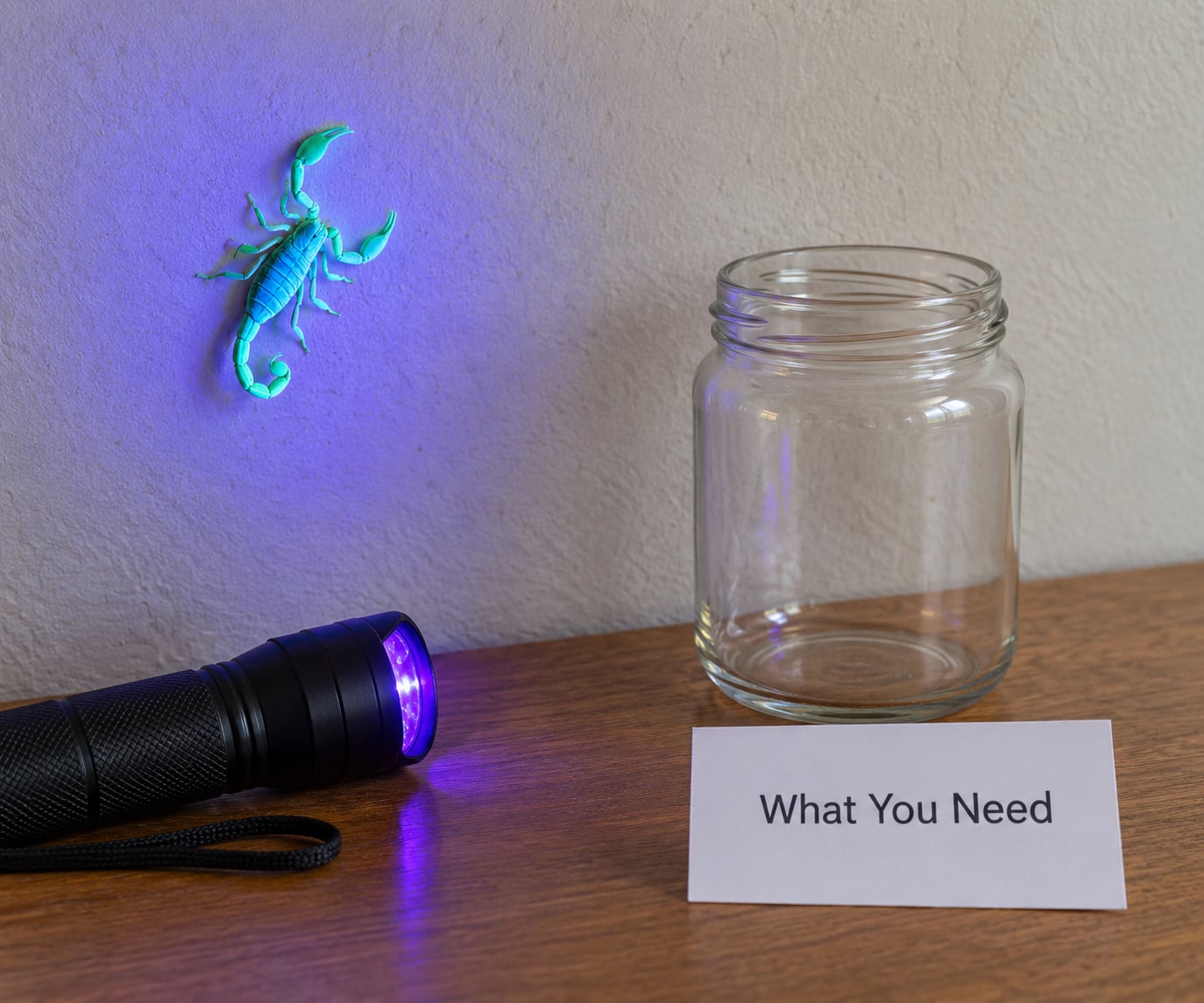
You need very little, and none of it requires going near the animal. Gather these before you walk into the room.
- A bright flashlight. A headlamp frees both hands. A phone light works in a pinch but it is harder to keep steady at the angle you want.
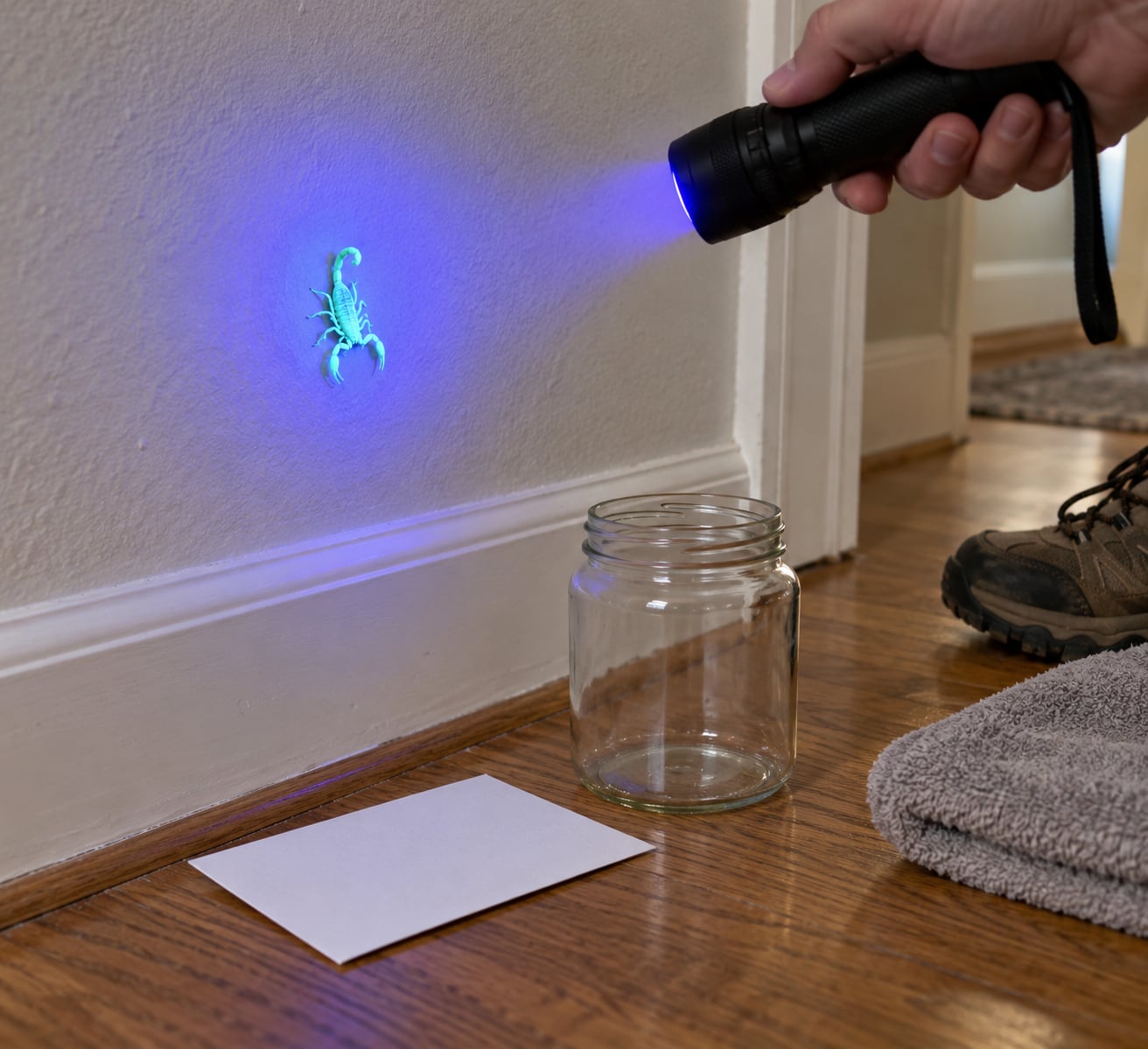
- A clear container or wide-mouth jar. Clear, not frosted, so you can see what is inside after it is covered.
- A stiff index card or piece of cardboard. Thin cardboard bends under the weight. You slide this under the container to close the gap.
- Masking tape or a rubber band. For sealing the container once the scorpion is inside.
- Gloves and long sleeves. For handling the container, laundry, shoes or debris around the sighting spot, not the animal.
- A magnifying glass, or your phone camera zoomed in. The tail tip is small. A close photo often settles the ID faster than squinting.
- A spoon, or a flat stick with a taped-on cardboard lid. The safest improvised capture tool if no container fits the spot.
What you do not need is a pesticide. Identification comes before treatment, always. If you cannot tell what you are looking at, spraying the room solves nothing and puts a chemical where a child or pet will be later.
Step-by-Step
Work through these five checks in order and stop as soon as you have a clear answer. Each one narrows the field, and together they separate a scorpion from every common look-alike in a US home.
1. Confirm the body shape and size
The quickest way to identify a scorpion in a house is to skip the color entirely and count the legs and follow the body. Scorpions are arachnids, so they carry eight walking legs, never six. Crickets, cockroaches, beetles and most other things people find indoors are insects with six legs and no tail, and they fall out of the running on that alone.
Check size against something you have in your hand. Most US household scorpions run about two to three inches from the front of the pincers to the tip of the tail, roughly the length of a pair of scissors. A spotted lanternfly or a large cricket is the same order of size, so length alone proves nothing, but it does give you a scale to mention when you describe the sighting.
A positive match at this stage means: flat, segmented body; eight legs clearly visible along the sides; two structures projecting forward from the head; and an abdomen that narrows into a distinct tail. Harmless look-alikes usually fail here. Some small tan arachnids have pincers but no real tail, and the ones that do have a tail-shaped rear rarely carry both pincers and eight legs in that arrangement.
Do not rely on movement. A scorpion that is alive and unmoved stays still, and one that is dead can twitch if you disturb it. Body plan is the reliable part.
2. Examine the tail and stinger
Look at the rear. A scorpion’s tail, called the metasoma, is a chain of five rigid segments that curves up and over the back. At the end sits a bulbous venom bulb called the telson, and out of that bulb comes the sting itself, a hard curved point called the aculeus.
Here is the correction that matters most: the stinger is at the tip of the tail, not on the pincers. The pincers are for grabbing and holding prey and carry no stinger, even though plenty of people assume otherwise from a distance. If someone describes pincers that can sting, the creature is almost certainly not a scorpion.
Magnification helps here more than anywhere else. A phone camera zoomed on the tail tip usually shows the bulb and the point clearly enough to confirm a scorpion. The pale tan color of the sting tip and the ring-like joint between the telson and the last tail segment are both visible when you get close, and neither is visible in a blurry night photo.
Some spiders carry a bulbous abdomen that reads as a tail at a distance, and some male long-bodied spiders stretch two back legs forward in a way that resembles a stinger. Those fake tails are not segmented, and the tip is a spinneret, not a curved point. Count the segments and check for the bulb.
3. Check the pincers and posture
The claws, properly called pedipalps, are thick and arm-like rather than spindly. On most US species the pincers are noticeably beefier than the walking legs, which is a good quick comparison. But pincers alone are not proof of identification, because a few insects hold their front legs forward in a way that looks claw-like from a distance.
What tips it is posture. A scorpion that feels threatened folds its tail forward over its back and holds its pincers open. That tail-over-back stance, combined with eight legs and a segmented tail, is close to conclusive. Do not test for it by waving a hand near the animal.
Also determine what state you have it in, because this is the single most common source of confusion in online identification threads:
| State | What you will see |
|---|---|
| Alive | Smooth, firm-looking exoskeleton; moves on its own; usually retreats from light rather than toward it |
| Dead | Same shape and color but limp; legs curl inward; no grip response when lifted with a card |
| Shed exoskeleton (exuvia) | Translucent, papery and hollow, often split along the back; brittle and light; usually found in a sheltered spot like a closet corner or under a box |
The shed skin is the one that fools people. A fresh molt looks like a pale ghost scorpion on the floor, and a light-colored one reads as a live animal until it collapses under a boot. Molting also means something important: an exuvia on your floor tells you an immature scorpion is living in the house right now.
A UV flashlight, sometimes sold as a blacklight, is the cheapest confirmation tool in this whole process. Scorpion exoskeletons fluoresce a blue-green color under ultraviolet light. Sweeping a dark closet or storage room with one turns a hidden animal into an obvious one without touching anything.
If you want the full comparison before you commit to an ID, this is where the look-alikes separate:
| Feature | Scorpion | House spider | Pseudoscorpion | Whip scorpion | Camel cricket |
|---|---|---|---|---|---|
| Walking legs | 8 | 8 | 8 | 8 | 6 |
| Tail with stinger | Yes, 5 segments | No | No | No, whip-like feeler only | No |
| Front pincers | Two thick pedipalps | No | Yes, but tiny | Spinning forelegs, not claws | No |
| Typical length | 2 to 3 inches | Under 1 inch indoors | Under 1/4 inch | 1.5 to 2.5 inches | 1.5 inches |
| Can sting a person | Yes, with venom | No, bite only | No, harmless to people | No, not venomous | No |
Two of these get misidentified constantly. The tailless whip scorpion is long, dark and fast, and people call it a spider or a scorpion depending on the day. The pseudoscorpion is tiny, has real pincers and no tail, and turns up in storage boxes and damp leaf litter; it cannot sting people at all.
4. Consider where it was found
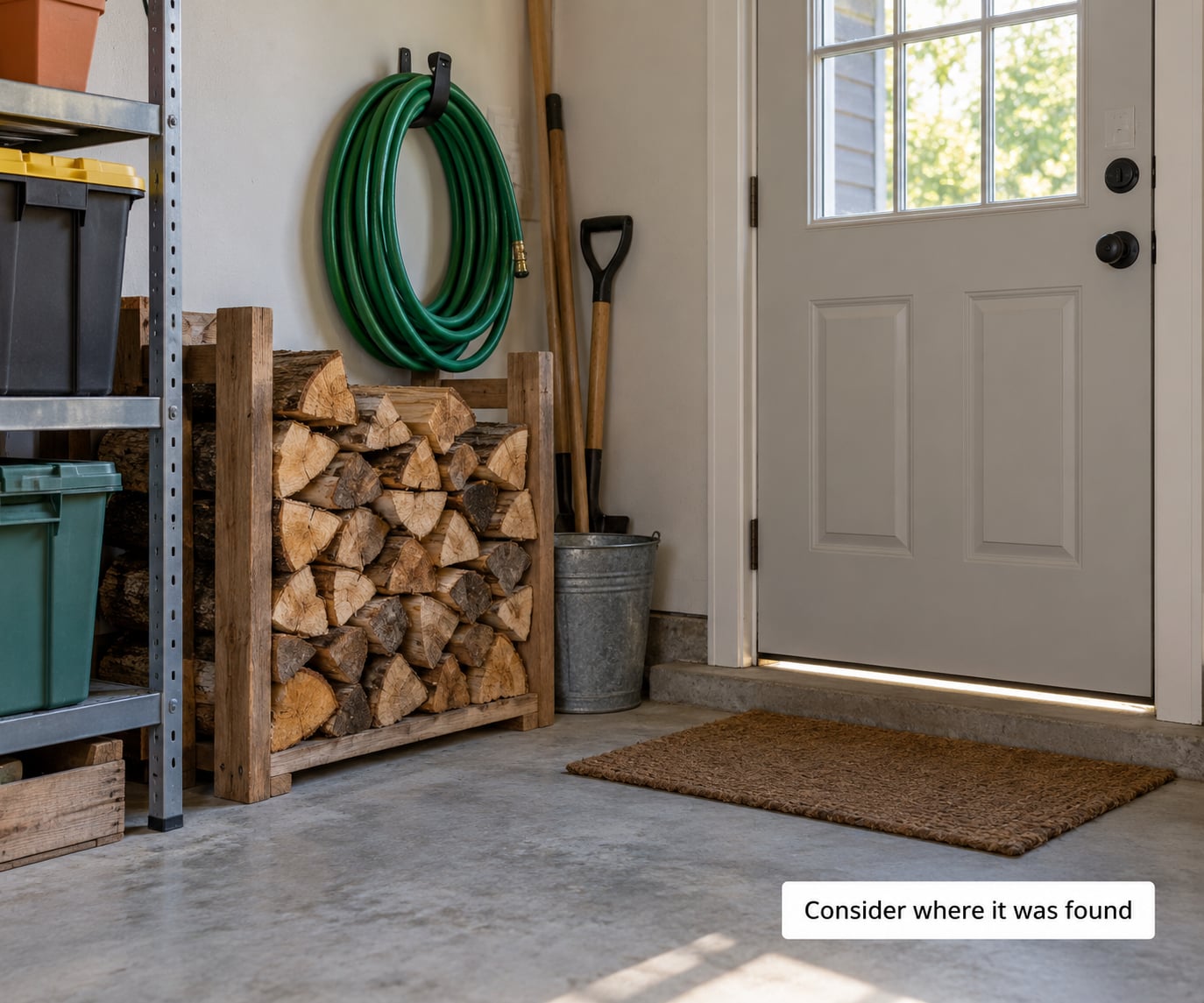
Location narrows the field faster than appearance. Scorpions are most often encountered in warm, dry parts of the United States, including Arizona, southern and western Texas, New Mexico, southern Nevada, southern California, Florida, and the mid-South states where winters stay mild. One indoors in a northern state usually means it hitchhiked in a moving box, a firewood bundle or a travel bag.
The places to check are the same ones the animal was probably hiding in. Outdoors, look at exterior doors and their thresholds, garage and shed doors, utility penetrations, weep holes, cracks in the foundation, mulch beds, rock piles, stacked firewood, storage boxes and clutter against the wall.
Indoors, the recurring hotspots are bathrooms and shower stalls, laundry rooms, under-sink cabinets, closets and storage rooms, basements, crawl spaces, and any dark undisturbed corner at floor level. Shoes and folded laundry on the floor draw the most online panic because that is where stings actually happen.
Where you found it also answers the infestation question. A single scorpion in a bedroom does not prove you have a problem in your house. Repeated sightings over several weeks in different rooms do point at an entry point and at a reason they keep coming in, and scorpions follow their insect prey. If you are also seeing crickets, roaches or silverfish indoors, treat that as the underlying issue rather than the scorpion.
5. Capture, contain, or seek professional help
Once the ID is solid, work in this order and keep kids and pets out of the room while you do it.
- Clear the area. Move people, pets, shoes, laundry and cardboard boxes away from the spot. Do not try to move the scorpion yourself at this stage.
- Contain, do not crush. Place the clear container over the animal with the opening facing down, then slide the stiff card into the gap between the container rim and the surface. Once the scorpion is inside, seal the container with tape or a rubber band.
- Release it outside. Take the container several yards away to a shaded, sheltered spot near rocks or vegetation and tip it out. Local rules may differ on relocation, and some places restrict it, so check before you release.
- Inspect the neighborhood of the sighting. Check the wall, baseboard, floor, door threshold or box it appeared near, and look for a shed exoskeleton nearby. That tells you which entry point to deal with.
- Seal what you find. Add a door sweep, seal gaps around pipes and conduits, screen weep holes, and remove or elevate firewood and stored boxes away from the wall.
- Escalate when the pattern repeats. Multiple scorpions over a few weeks, sightings in several rooms, or a sting in the family are the triggers for calling a licensed pest professional or your county extension service.
There is one situation where capture is the wrong move. If anyone has been stung, or you cannot keep children and pets out of the room safely, skip the container entirely and get the animal killed by a professional while someone takes the stung person to urgent care if symptoms are more than local pain.
A sting response for people is straightforward: wash the area with soap and water, apply a cold pack, and remove anything tight near the bite. Seek medical care right away for children, anyone over 60, pregnant people, and anyone who develops trouble breathing, swelling of the face or throat, vomiting, or symptoms that spread beyond the sting site. For pets, call a veterinarian, and keep other animals away from the animal itself.
Common Mistakes
Killing it bare-handed or stomping it. The reflex is to crush it, and that is exactly how stings happen. Reach for a container and a card, or let a professional handle it.
Assuming every eight-legged creature is a scorpion. Household spiders, pseudoscorpions and whip scorpions account for most misidentifications. Match the tail with a bulb and stinger, and only then call it a scorpion.
Pointing at the pincers as the stinger. Pincers grab prey; the venom is in the tail. If you want to check, look for the curved point on the underside of the bulb at the tail tip.
Spraying before identifying. Aerosols tell you nothing about what you were looking at, and they linger where kids and pets are later. Identify, seal entry points, deal with the insect prey, and use a product only when you know what you are treating.
Treating a shed exoskeleton as a live sighting. An empty translucent skin is good news in a sense: it proves the molting cycle is happening nearby, but it is not a scorpion you need to capture. Check for the live animal that produced it.
Ignoring repeated sightings. Two scorpions in different rooms over a month is a signal to inspect the structure, not bad luck. Keep a simple log of date, room and location so a pest professional has real data.
Trusting a blurry night photo, including an AI identification. Low light plus a phone flash gives you shadow and glare instead of anatomy. Photograph the whole animal first, then one close shot of the tail tip in better light. That is what makes an ID reliable.
Frequently Asked Questions
Can scorpions climb walls or ceilings in a house?
Yes, they can. Scorpions have flat bodies and hooked leg tips that let them climb smooth vertical surfaces and even ceilings, which is why they sometimes appear high on a wall in a bathroom or bedroom. They climb when they are washed out of hiding spots or seeking warmth, not as normal daily behavior. Seeing one on a ceiling does not mean it is a different kind of pest; confirm the ID using the five features and then contain it the same way.
Does finding one scorpion indoors mean I have an infestation?
Usually not. Most single indoor scorpions are wanderers that came in through one gap or rode in with firewood, boxes or laundry. Infestation is better described as repeated sightings in different rooms over weeks, plus a shed exoskeleton or signs of heavy insect prey activity such as crickets or roaches indoors. If you are seeing one every few days, log them and have a professional inspect the entry points rather than treating the room.
What should I do if a scorpion stings me or someone else?
Wash the sting area with soap and water, apply a cold pack, and remove anything tight near the site. Most stings in the United States cause localized pain, swelling and numbness that eases over hours to a couple of days. Get medical care promptly for young children, older adults, pregnant people, and anyone with trouble breathing, facial or throat swelling, vomiting, or symptoms spreading beyond the sting. This is general information, not medical advice.
Do vinegar or essential oils get rid of scorpions?
There is no good evidence for either one. Vinegar is a common household cleaner but it is not a scorpion treatment, and essential oils are not reliable against them and can irritate skin and be toxic to cats and dogs if the animal is still in the room. Sealing entry points, cutting insect prey and removing harborage are what actually reduce indoor sightings. If you want a product applied indoors, talk to a licensed pest professional first.
Are scorpions common inside homes in the United States?
In the Southwest, Texas, Florida and the mid-South, indoor scorpions are ordinary rather than alarming. Arizona homeowners treat them as a normal part of life, and the striped bark scorpion is widespread across the southern states. Elsewhere in the country they are rare indoors, so a sighting usually means travel, firewood or a moved box carried it in. Region does not change the identification steps, only how worried you need to be about repeats.
What to Do First
Keep your distance and get the room clear before anything else. Confirm the full checklist: two pincers, eight legs, a five-segment curved tail, a stinger at the tip of that tail, and a two-to-three-inch body. If all of that is present, contain the animal under a clear container with a stiff card, seal it, and release it outside or hand it to a professional.
Then look at where it was found and seal the gap it came through. One scorpion is a wanderer you can solve in ten minutes. Repeated sightings across rooms, a shed exoskeleton, or a sting in the family means it is time for a licensed pest professional or your county extension service.