Heavy thumping, dragging or someone-sounding footfalls overhead after dark almost always mean a raccoon. Lighter scratching and quick scurrying in the middle of the night point to a mouse, a rat or a flying squirrel, and high squeaks with fluttering point to bats. You can narrow it down tonight by timing, sound pattern and a little evidence from the hatch.
The single most useful trick is to stop guessing from one noise. Note when it happens and what it sounds like, then check what you can see without climbing into the attic. For anyone searching how to identify animal sounds in the attic at night, timing plus pattern plus physical evidence beats every recording app on the phone, and none of it costs a thing.
This guide is written for 2026 homeowners and renters, and it stops at identification. Anything involving wiring, structural repair or removing wildlife belongs with a licensed professional.
Table of Contents
- What You Need
- How to Identify Animal Sounds in the Attic at Night
- Step-by-Step
- Common Mistakes
- Frequently Asked Questions
- What animal sounds are most common in an attic at night?
- How do I tell the difference between scratching and tapping in an attic?
- Can I safely open my attic to find out what is making the noise?
- What does a scratching sound in the attic usually mean?
- Should I block the attic vent after hearing an animal at night?
- When should I call a pest or wildlife professional about attic sounds?
- Conclusion
What You Need
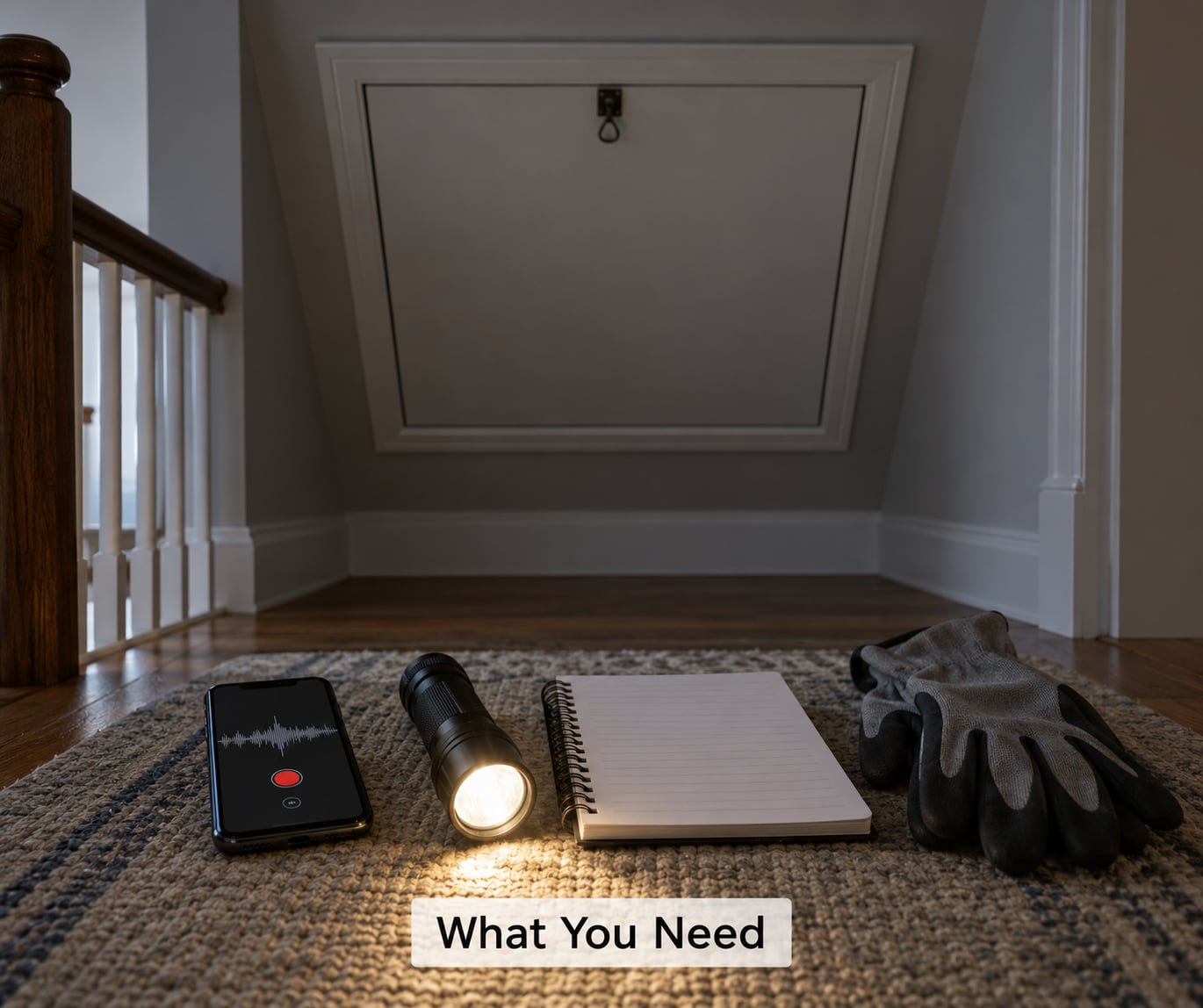
None of this is expensive. It is the difference between a two-minute check from the floor and a dangerous evening on unstable boards.
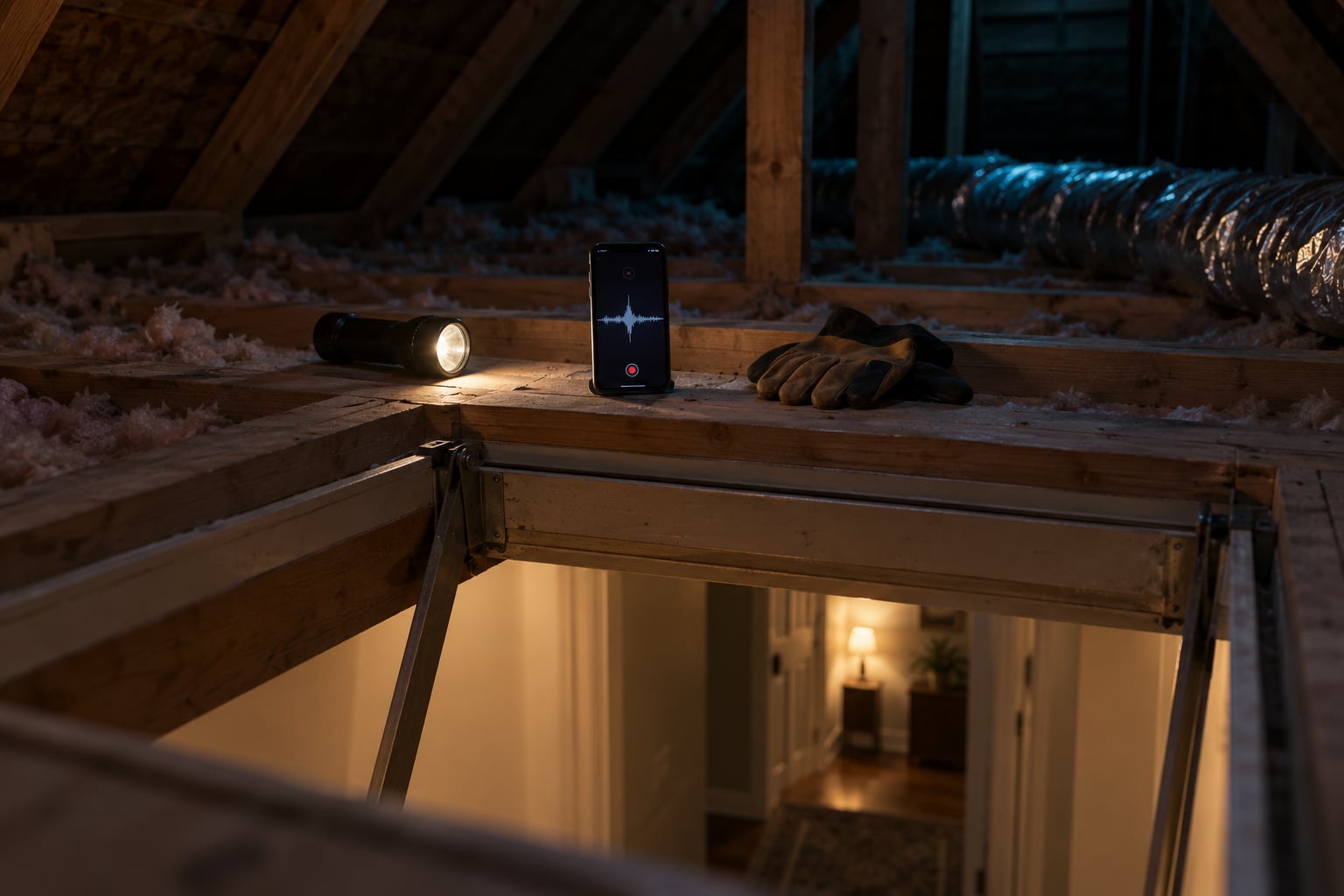
- Your phone with a voice-memo or audio-recording app. You will play the recording back at low volume later, when it is quiet and you can actually hear the pattern.
- A flashlight with fresh batteries. Daylight through the hatch is not enough, and your phone battery is better saved for recording.
- A notebook or your phone notes, for logging date, time, duration and location of each noise.
- Protective footwear and gloves with grip. Attic floors can be dusty, nail-studded or covered in loose insulation.
- Ear protection if you plan to spend more than a few minutes near the hatch while noise is active.
- A stable ladder and a second adult holding the base, if the hatch is above head height.
What you do not need is to go in. Most attics have no floor deck at all, just 2×4 joists spaced 16 or 24 inches apart with insulation between them. Standing on drywall is a fall waiting to happen, and a raccoon or mother squirrel with kits reacts badly to being cornered in a dark space.
How to Identify Animal Sounds in the Attic at Night
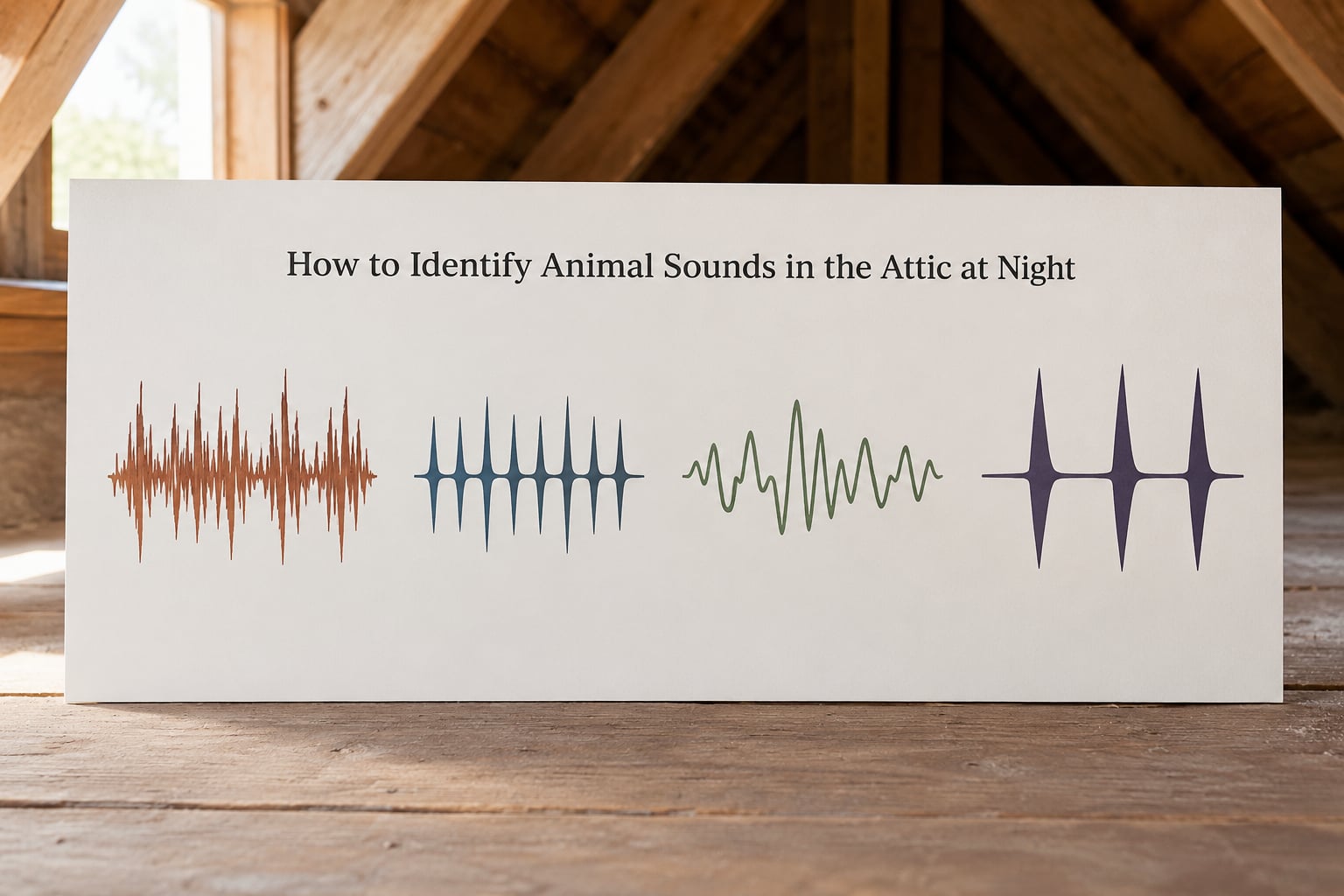
Match what you hear against the table below, then read the confirmation column before you commit to an answer. Timing matters as much as the sound itself: nocturnal animals move in the dead of night, crepuscular animals move around dawn and dusk, and diurnal animals sleep through it.
| Sound you hear | Most likely animal | When you hear it | How to confirm |
|---|---|---|---|
| Heavy thumping, walking-footfall thuds, dragging | Raccoon | After dark, often 10pm to 2am | Kitten-like mewing from young; large dark scat; heavy body weight |
| Rolling, bouncing or repeated hollow knocks | Gray squirrel | Dawn and dusk, sometimes daytime | Chewed acorn holes, fresh gnawing on beams, single-toenail prints |
| Fast scratching that stops, then running along a joist | Flying squirrel | Middle of the night, well after dark | A soft bark-like call; small scat; entry at tree limbs or roof edge |
| Light scratching, faint ticking inside a wall | Mouse | Through most of the night | Rice-grain droppings, gnawed wall access, shredded insulation |
| Scratching with steady gnawing and grinding | Rat | Dusk and pre-dawn | Greasy or paste-like droppings, chewed cable sheathing |
| High-pitched squeaks, chirps or singing | Bat | Late dusk and before sunrise | Brief fluttering, guano piles, entry gap no bigger than a dime |
| Flapping, fluttering, beak tapping at daybreak | Stuck bird or chimney swift | Daylight hours | Feathers, a visible bird in the chimney breast, droppings on the flue |
| Chittering, low growls, hiccup-style chatter | Opossum or raccoon kits | Night, often in pairs | Slow shuffling, hissing; babies audible after dark |
| Light scratching and thudding in a wall cavity | Skunk or woodpecker | Night or early morning | Strong musky smell, hollow drumming, fur or feathers in the wall |
Definitions worth keeping straight, because they carry most of the diagnosis:
- Nocturnal means active at night and asleep during the day. Raccoons, mice, rats, bats and flying squirrels all fall here.
- Crepuscular means active during twilight, in the hour before sunrise and the hour after sunset. Rats, and squirrels moving in and out, are most active at these times.
- Diurnal means active in daylight and asleep at night. If the noise fades completely once the sun is up, squirrels and birds become the prime suspects.
A raccoon mother with a litter of three to five kits is a different situation from a lone adult, and you will hear the difference. Kitten-style mewing means young are inside, which changes what you are allowed to do next.
Step-by-Step
Work from the safest observation to the most targeted follow-up. Do not open the roof, cut a hole in anything or spray anything until you know what you are dealing with.
1. Note the exact time and location
Write down the date, the approximate time, how long the noise lasted, and whether it came back on the same schedule. Then localise it: eaves near the roof edge, the peak, the attic floor underfoot, an interior wall, or the chimney.
Consistency is the useful part. A sound that always comes from above the bathroom ceiling at 1am is a very different problem from one that wanders around the whole house. Many homeowners describe hearing something overhead and being unable to pin down where it comes from, and that confusion is usually the reason a first guess fails.
2. Listen for rhythm, pitch, and pattern
Classify the noise before you name an animal. Scratching is a fine, irregular rasp. Gnawing is a slower grinding with pauses. Tapping is a distinct, repeated knock. Skittering is fast footfalls over a hard surface. Fluttering is a brief, papery flutter. Thumping is a heavy single impact that shakes weight in the floor.
Slow irregular scratching that stops dead and resumes in the same spot is typical of a squirrel or rat working. Rapid repeated tapping in the dead of night often means a woodpecker or a bird stuck in a chimney. A single thump followed by a rolling or dragging noise usually means a larger animal moving loose items, not a creature tapping at you.
3. Record the sound safely
Place your phone near the attic access or in the room directly below it, start a recording, and stay out of the space. Save several minutes of audio, note the timestamp on your log sheet, and stop. Do not follow the sound into the attic.
Recording from a safe distance is the simplest way to identify animal sounds in the attic at night without ever exposing yourself to the animal. Listening back at a fraction of the volume reveals detail that is impossible in real time. You will hear the difference between a squeak and a chirp, or a flutter and a drag, and you can compare two recordings a week apart to see whether a litter has grown. Keep the phone charged and run the recording longer than you think you need.
4. Check the attic from the access opening
With a flashlight, look from the hatch only. Shine the beam across the joists and look for droppings, gnaw marks on wood or wiring, feathers, displaced or matted insulation, nests, and cached food such as acorns or seeds. A flashlight-only inspection from the opening is enough for a first read.
Stop immediately if you see an animal, hear a baby, notice heat, smell a strong musky or ammonia odor, or spot damaged wiring. Do not step on the joists, do not walk on ceiling drywall, and do not push insulation aside to look further.
Droppings size is the second identification signal once sound has given you a candidate. Mouse droppings are about the size of a grain of rice and dark. Raccoon scat is much larger, tubular, and often has a strong smell. Bat guano is pale, powdery and crumbly, and it usually shows up below an entry point rather than spread across a joist.
5. Check exterior signs and entry points
From the ground and a stable ladder, inspect soffits, fascia boards, roof vents, the ridge vent, chimney flashing, and any damaged siding or loose shingle edge. Look for fresh rub marks, greasy streaks, gnawed wood, or fur caught on a nail head.
Match the gap size to the animal. A dime-sized opening is enough for a bat. A mouse needs roughly a quarter-inch. A juvenile squirrel or raccoon needs far more, and a mother carrying a litter will enlarge an entry as her babies grow. Bats commonly enter along the ridge and under shingles, while rodents work along the fascia and soffit line.
6. Identify the animal, then decide the next step
Put the four signals together: sound pattern, time of night, physical evidence, and season. Sound plus timing alone gets you close; droppings and entry points turn close into confirmed. Most nights the answer is a rodent or a squirrel, and you can keep watching from downstairs.
Monitoring at home is reasonable when you have small rodents or birds, no young present, no damaged wiring and no animal inside the living space. A licensed wildlife-control operator is the right call for bats, raccoons, opossums or anything with young. A licensed roofer should look at flashing, vents and roof structure if entry appears to be at the roofline. Rodents with chewed cable insulation in an attic are a fire risk worth raising immediately, and no sound identification changes that.
Common Mistakes
Almost every mistake here comes from acting before identifying. The fix in each case is the same: get the information first, then act.
- Entering an unsafe attic. Only 2x4s hold your weight, and joists near a gap are the weakest. Inspect from the hatch, or pay someone who does this work.
- Deciding from one short recording. A ten-second clip misses the pattern. Record several minutes at the time the noise usually happens, then compare.
- Opening the roof or soffits without checking for wildlife first. You can trap an adult inside away from its young, and a stuck bird or bat in a sealed cavity can die.
- Using poison before identifying the animal. Rodenticide kills slowly, may not reach the ones in the wall, and creates a carcass and disposal problem. It is also unlawful in some places for reasons exactly like this.
- Sealing entry points while animals are still active. This strands kits inside, and a raccoon mother will simply tear the repair back open. Exclude only after you are certain nothing is left in the space.
- Assuming every noise is an animal. Uninsulated attics and pole barns amplify ordinary movement into alarming sound, and branches, wasp nests and house settling are common culprits.
Not every noise is an animal. Pipe knocks happen when supply lines hammer as hot water stops flowing. Wood framing creaks and pops as it expands and contracts with temperature swings, often louder on a still cold night. A blower motor, a refrigerator compressor, or an attic fan starting on a thermostat produces a hum or a flutter that reads as wings. Tree limbs tapping siding in wind sound like heavy thumping. Insect colonies add to it: carpenter ants work in damp, softening wood and can sound like faint scratching, and a paper wasp nest inside a soffit buzzes in a way people often misread as movement.
For monitoring, keep the log going for two weeks. Consistent timing and a stable sound pattern point to an animal; a sound that shifts with the weather or the heating cycle usually points to the house. If the noise is a bird stuck in a chimney, leave the flue alone until a wildlife professional or the local fire department advises on it.
Frequently Asked Questions
What animal sounds are most common in an attic at night?
Raccoons are the most common, because they are nocturnal and heavy enough to produce unmistakable thumping and dragging overhead. Mice, rats, bats and flying squirrels follow, then squirrels and birds at dawn and dusk. If the sound is light scratching with fast scurrying, think rodent or flying squirrel; if it is heavy walking thuds, think raccoon.
How do I tell the difference between scratching and tapping in an attic?
Scratching is a fine, irregular rasp that drags across a surface and often pauses mid-stroke. Tapping is a distinct, evenly repeated knock with a clear gap between hits. Rapid tapping in the dead of night often means a woodpecker or a bird stuck in a chimney, while scratching with a pause-then-resume rhythm points to a squirrel or rat working on something.
Can I safely open my attic to find out what is making the noise?
Look from the hatch and do not step inside. Most attic floors are 2×4 joists spaced 16 or 24 inches apart with loose insulation between them, and ceiling drywall is not load-bearing. Shine a flashlight across the joists from the opening to check droppings, gnaw marks, nests and insulation damage, and stop if you see an animal, hear a baby, or spot chewed wiring.
What does a scratching sound in the attic usually mean?
Fine scratching that stops and resumes usually means a squirrel, mouse or rat working along a joist, in insulation or behind drywall. True nocturnal scratching, paired with running along a joist and a soft bark-like call, points to a flying squirrel. A faint tick-tick inside a wall cavity is most often a mouse moving along the top plate.
Should I block the attic vent after hearing an animal at night?
Not yet. Sealing a vent or entry point while an animal is still inside strands young in the space, and a raccoon mother will often tear a fresh repair back open within days. Confirm what is in the attic and whether babies are present first, then have entry points excluded once the space is empty, ideally with a one-way door rather than a permanent seal.
When should I call a pest or wildlife professional about attic sounds?
Call a wildlife professional for bats, raccoons, opossums, or any attic with babies or young inside. Call a roofer if entry looks like failed flashing, roof vents or damaged shingles. Call your fire department for a bird stuck in a chimney. Raise any chewed cable insulation immediately, since exposed wiring in an attic is a fire risk regardless of which animal did it.
Conclusion
Start with the cheapest step: put a phone near the attic access, record several minutes, and note the time and place you heard it. Compare the pattern against the table, then look from the hatch with a flashlight to cross-check droppings and entry marks.
How to identify animal sounds in the attic at night comes down to pattern plus timing plus evidence, in that order. And if the evidence points to a bat, raccoon, squirrel or any animal with young inside, keep out of the space and bring in someone who does this work for a living.