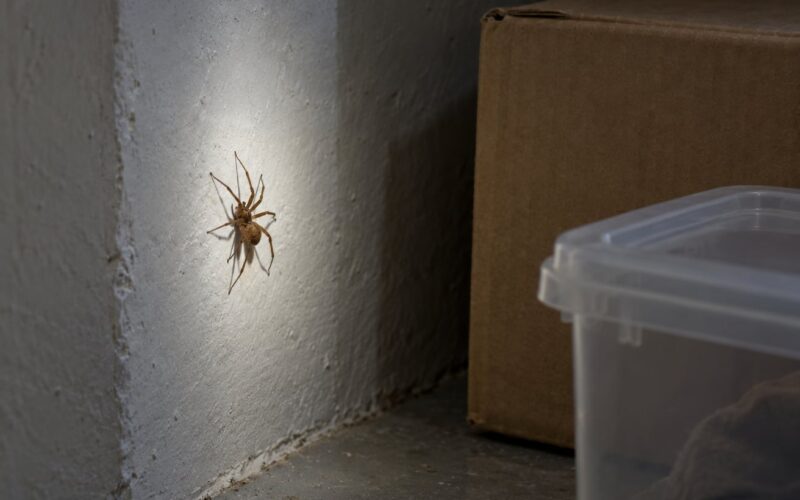
Spiders come inside in the fall because adults reach mating age and start hunting for egg-laying sites, cooler temperatures push cold-sensitive species toward shelter, outdoor insect activity drops and concentrates near houses, and a whole population already living in your walls, attic, and garage becomes visible at once. Four drivers, one season.
That last one surprises most people. When a house feels suddenly full of spiders in September, the usual assumption is that the whole invasion walked in through the front door. More often they never left. A gap-toothed entry point, a torn screen, and a mild fall are enough to change how noticeable they are, not how many there are.
Updated for October 2026. The advice below covers temperate US regions; species mix shifts a lot south and north of that band.
Table of Contents
- Why Spiders Come Inside in the Fall, and Why It Is Usually Normal
- What Changes When Fall Weather Arrives
- Which Spiders Are Most Likely to Enter Homes
- How Spiders Get Into Houses
- Do More Spiders Inside Mean an Infestation
- How to Prevent Spiders From Coming Indoors
- How to Handle a Spider You Find Indoors
- When a Spider Problem Needs Attention
- Frequently Asked Questions
- What to Do First
Why Spiders Come Inside in the Fall, and Why It Is Usually Normal
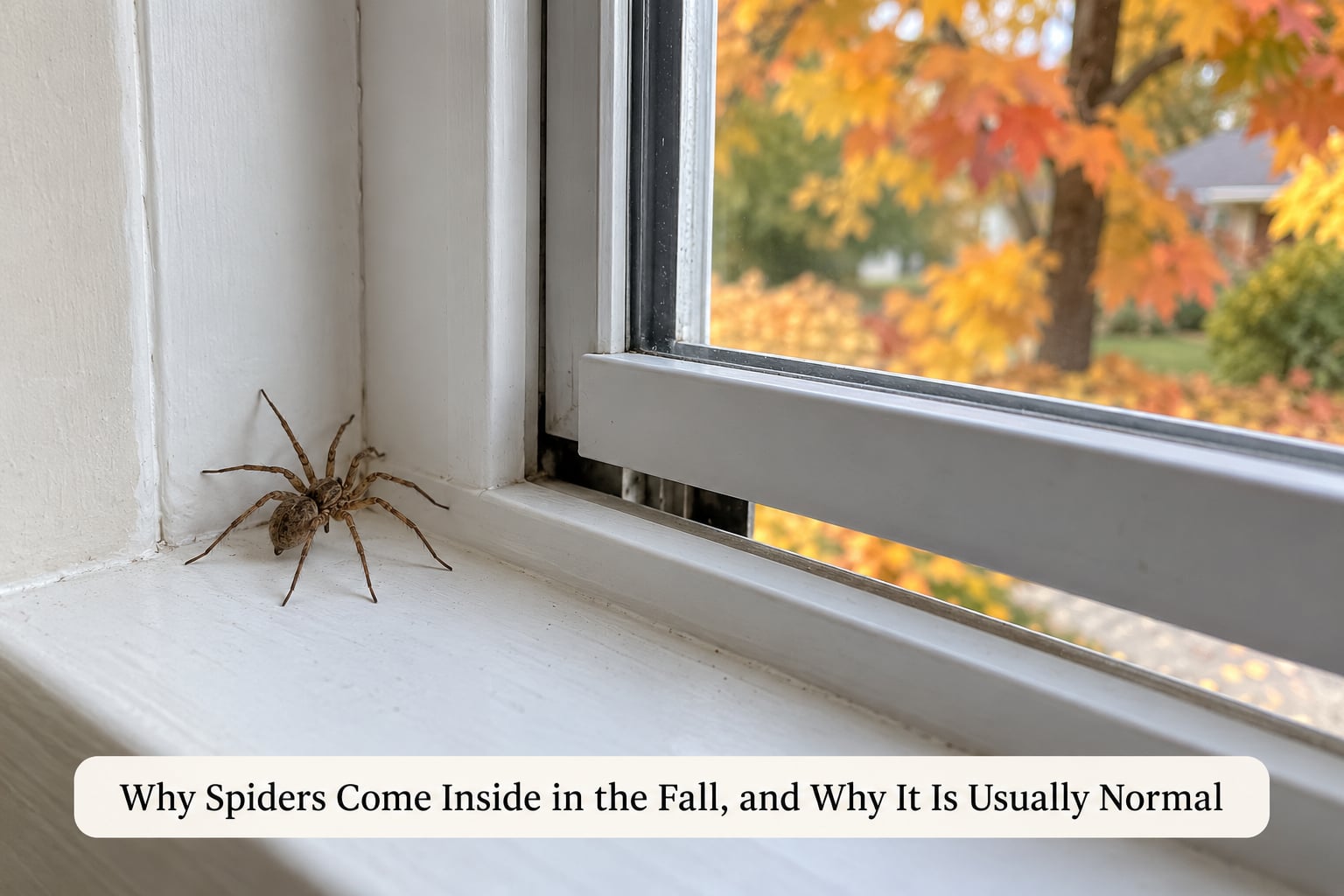
University extension entomologists describe the same pattern year after year, and Utah State University extension is one of the sources that has written publicly about it. Falling temperatures, shorter days, and the end of the growing season compress a lot of spider activity into a few weeks.
The four reasons show up in nearly every report:
- It is mating season. Males roam looking for females, which puts more bodies in open, visible places than at any other time of year.
- Cold drives shelter seeking. Below roughly 50F many species enter diapause, a dormant overwintering state, and start looking for any protected space with stable temperature.
- Prey moves indoors and near houses. Outdoor lights and swarming insects around entry doors pull small prey to the foundation, and spiders follow their food.
- Resident spiders become visible. Spiders in wall voids, ceiling voids, closets, and the crawlspace have been there for months. Fall heat and activity just draw them out.
None of that means your house is infested. One or two wanderers over a week is normal seasonal activity in most homes.
What Changes When Fall Weather Arrives
Temperature is the obvious factor and the least interesting one to watch. Spiders are not cold-blooded in the reptile sense, but their metabolism slows with temperature, and their tolerance varies enormously by species. Ground hunters in cold states tough it out outdoors; warm-climate species like black widows start moving at noticeably milder temperatures.
Daylight shrinking matters too, because it changes insect behavior. Insects hunker down and cluster, and the spiders that feed on them move to where the insects are. Rain does the opposite. After a wet spell you often see a spike indoors because ground hunters are pushed out of saturated soil, and because leaf litter and debris pile against foundation cracks and bridge them straight to a window well or siding gap.
None of this is a house targeting a home. Conditions shift, spider behavior follows the conditions, and a structure with warm, dry voids sits right in the path.
Which Spiders Are Most Likely to Enter Homes
Identification by color alone is unreliable, which is why the table below focuses on where each species tends to show up rather than on markings. When the identity actually matters for medical reasons, capture the spider rather than guessing.
| Spider | Where it usually turns up | Style | Medical concern | Typical in fall |
|---|---|---|---|---|
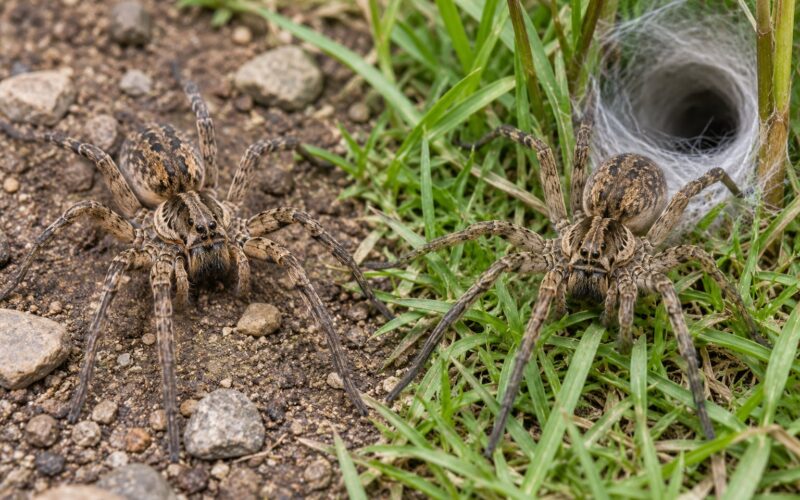
| Wolf spider | Garage, basement, patio edge, mudroom | Ground hunter, no capture web | Low, bite rare and mild | Yes, often the first one you see |
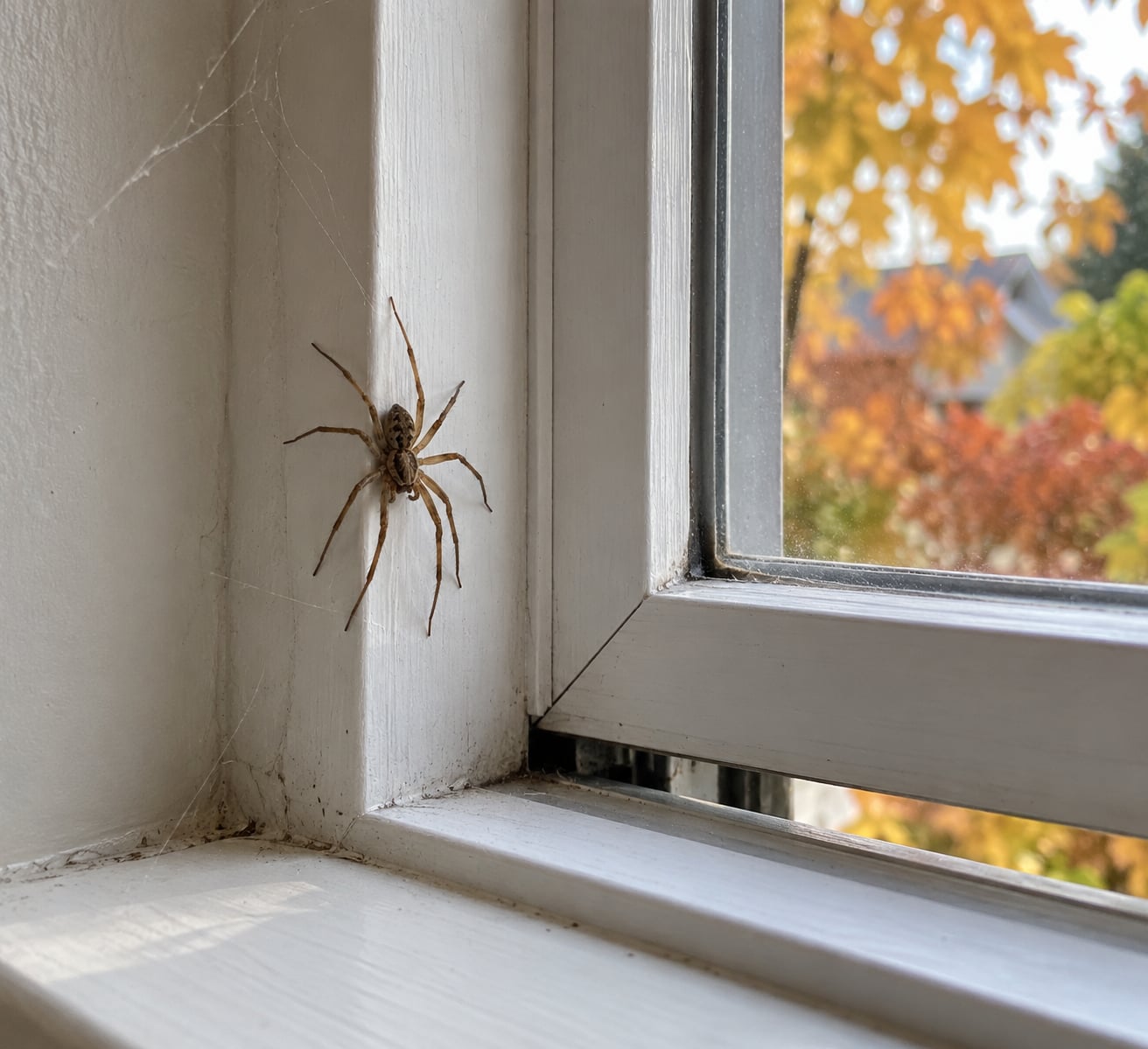
| Common house spider | Corners, ceiling voids, closets, window frames | Loose messy web | Low | Yes, commonly seen |
| Cellar spider | Basements, garages, storage areas | Loose web in a corner | Low | Yes |
| Orb-weaver | Porches, patios, window corners, garden lights | Large circular web | Bite uncommon | Yes, and visible outside |
| Hobo or funnel-web spider | Basements, entry-level rooms, utility areas | Funnel web behind clutter | Low to moderate, regional bites reported | Yes, common in the Northwest and Midwest |
| Black widow | Garage corners, sheds, vents, under outdoor furniture | Irregular tangle web | Significant, get medical advice after a bite | Yes, in the South and South Central states |
| Brown recluse | Basements, crawlspaces, storage, firewood | Loose web, avoids people | Significant, get medical advice after a bite | Yes, South Central and desert regions |
Regional baseline matters. Homeowners in the Midwest report a predictable small brown house spider showing up in basements every spring and fall, the same way residents in parts of the Midwest normalize a brown recluse or two per year. That is a regional norm, not an emergency.
How Spiders Get Into Houses
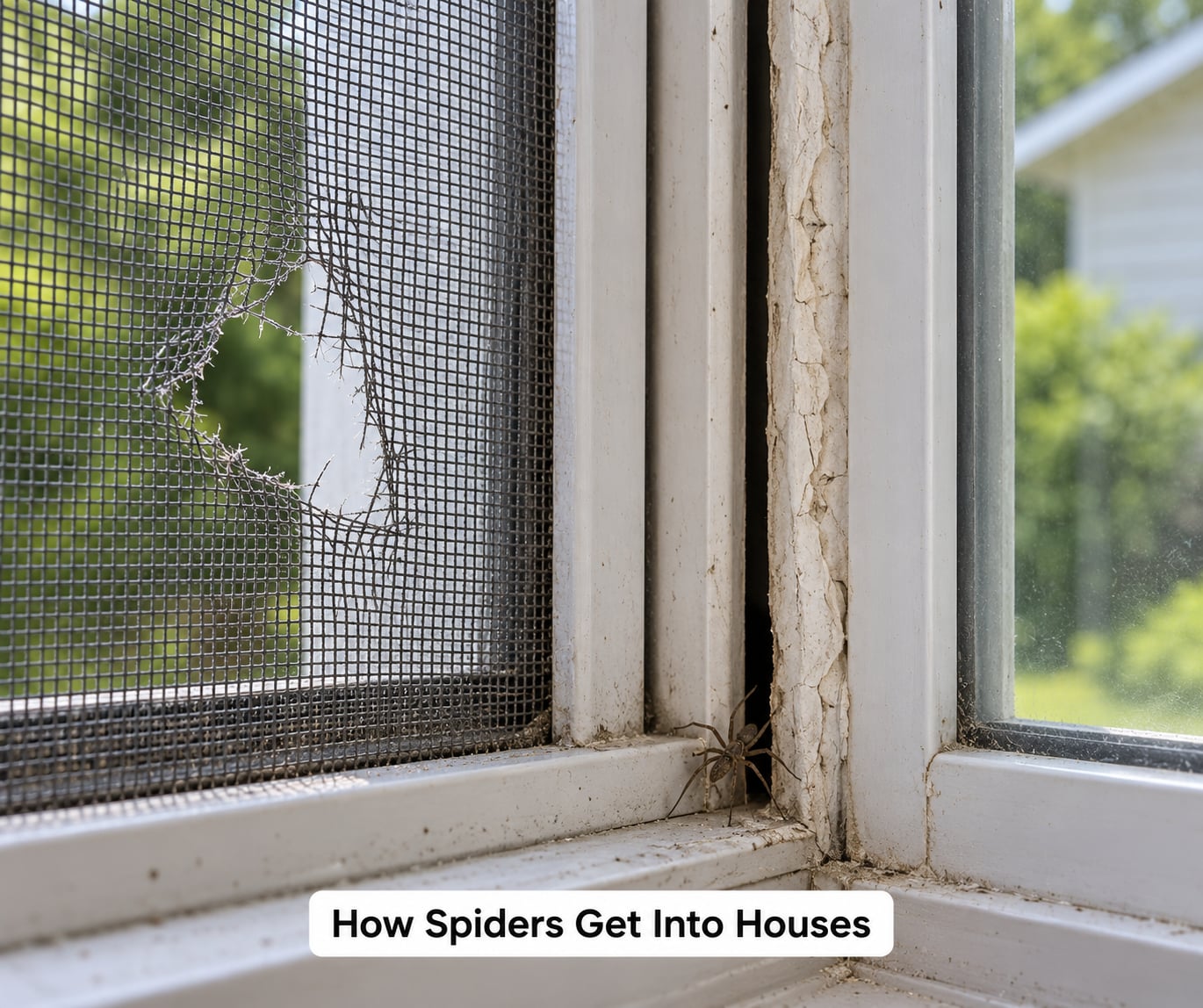
The routes are ordinary and mostly boring:
- Window and door gaps where the sash no longer closes tight, or where weather stripping has dried out and pulled loose.
- Torn or loose screens, which fail exactly when the windows behind them stay shut.
- Gaps under exterior doors without a door sweep.
- Utility penetrations around plumbing, electrical conduit, cable entry, and the dryer or water heater line.
- Vents, including foundation and attic vents that are open or unmeshed.
- Garage doors with a damaged bottom seal, plus the gap between the garage wall and the house.
- Cracks in flooring and masonry, including the classic hairline where a patio or driveway meets the foundation.
- Things you carry in: firewood, mulch, moving boxes, seasonal decorations, patio furniture stored in the garage.
Why spiders come inside in the fall through openings you cannot close
Sealing handles the crawling routes. It does nothing about ballooning, where a spiderling flicks out a bundle of silk, lets the wind carry it, and lands wherever it stops. That drifting silk is why fine strands show up on calm fall mornings and why a screened window does not stop a hatchling. One homeowner who fumigated a structure found thousands of dead spiders beneath it, which makes the point plainly: outdoor and substructure populations are much larger than anything indoors.
Ballooning also explains the “infested overnight” stories. You cannot seal the roof. You manage it instead by reducing what attracts spiders to the building, which is mostly lighting and insect traffic.
Do More Spiders Inside Mean an Infestation
For most homeowners, no. Spider population density inside a home is rarely the reason spiders appear, because a home with plenty of insects and undisturbed corners can hold residents year-round without anyone noticing.
Signs worth paying attention to:
- Regular sightings across several weeks, in several rooms, rather than one event.
- Spiders appearing from multiple hidden areas, such as several ceiling voids and the basement in the same week.
- Many tiny spiderlings together on one web, which usually means an egg sac hatched somewhere close.
- Fresh gaps in masonry, missing mortar, or a substructure opening that has widened.
- A sudden increase in other insects indoors, which gives the spiders a reason to stay.
A spider or two, once, in October, is seasonal traffic. Spiders indoors are almost never the reason spiders appear, so a single sighting is not a structural problem.
How to Prevent Spiders From Coming Indoors
Work outside in, and outside first, because that is where the entry points are.
- Inspect screens every fall. Look for tears, sagging corners, and frames that no longer seat flush. A screen patch kit costs less than one spider bite of anxiety.
- Fit door sweeps on exterior doors and check the weather stripping around windows.
- Seal gaps with appropriate materials. Use caulk for small joints around trim and pipe penetrations, and mortar or sealant for masonry cracks. Seal gaps only where it does not interfere with ventilation or drainage.
- Close or mesh vents that are not needed for the season.
- Trim vegetation back from the foundation and move firewood, mulch, and stored gear off the walls.
- Change exterior lighting. Yellow or sodium vapor bulbs attract fewer insects, and fewer insects means fewer spiders at the perimeter.
- Declutter the interior edge of closets, under bunk beds, along baseboards, and in garage corners so there is nowhere undisturbed to settle.
- Check what you bring in: give storage boxes and firewood a quick look before they cross the threshold.
- Vacuum webs and egg sacs from corners, ceiling voids, and behind appliances on a schedule. Dispose of the bag contents outdoors rather than into an indoor trash can.
On repellents: what spiders hate is a stronger claim than the evidence supports. Some homeowners use peppermint, spearmint, orange, or lemon essential oils in a diffuser and report reduced activity. That effect is unproven and unverified, so treat it as optional and never apply concentrated oils to surfaces where pets or children contact them.
On spraying: aerosol sprays give short-term knockdown and little more. Extension guidance favors sealing, vacuuming, and sticky traps in corners and along walls for the spider problem itself. Broad-spectrum spraying kills the beneficial predators and rarely changes the underlying pattern.
How to Handle a Spider You Find Indoors
Most of the time relocation beats removal, because house spiders and cellar spiders eat flies, mosquitoes, and other intruders that come in with you.
Put an upside-down cup over the spider, slide a stiff card or piece of cardboard underneath, carry it outside, and release it a few feet from the wall. No contact, no spray.
For a web full of spiders in a lived-in room, vacuum the web and its residents with an upholstery attachment and empty the canister or bag outside immediately. For high ceilings and vents you cannot reach, extending a broom handle or a duster works better than a ladder indoors.
When a Spider Problem Needs Attention
Seek medical care after a bite if you have trouble breathing, swelling of the face or throat, chest tightness, or rapidly spreading redness. Those are emergency signs. For anything less severe, capture the spider if you safely can, because symptoms alone cannot tell you what bit you, and let a clinician decide.
Call in professional help when you have dense recurring numbers, structural openings that are widening, venomous species confirmed in your region, or an insect population indoors that is feeding the spiders.
For identification help, your state land-grant university extension office will work from a photo or a specimen. That is a free, reliable route, and usually faster than a general pest question line.
Frequently Asked Questions
Why are more spiders coming inside in the fall?
Four things overlap in autumn: adults reach mating age and roam openly, temperatures dropping toward 50F push cold-sensitive species into diapause, insect activity shifts toward houses and their lights, and spiders already living in wall voids, attics, and crawlspaces become active where you can see them. Mostly it is a visibility change rather than a population explosion.
Do spiders hibernate in houses during winter?
They do not hibernate in the way mammals do. Many species enter diapause, a slowed, dormant state, and survive indoors through winter as long as a space stays unfrozen. Egg sacs deposited in fall often overwinter and hatch in spring, which is why spring sightings can seem to arrive from nowhere. Indoor moisture and a live insect supply let some species keep feeding all winter.
Are spiders more likely to bite in autumn?
Bite risk rises slightly in fall for a few reasons: more spiders are wandering and therefore more likely to be brushed or handled, and you are doing fall work such as moving firewood, storage boxes, and patio furniture. Spiders generally avoid people and bite only when trapped or handled. Sleeping peacefully in a room with spiders is fine; shakes out clothing before putting it on, especially in regions with recluse range.
How can I tell if spiders are living inside my home?
Look for webs in undisturbed corners, mudlines on webs, egg sacs, and repeated sightings from hidden spaces like ceiling voids, closets, and the crawlspace over several weeks. A sighting that repeats in the same low, quiet corner across the season suggests a resident population rather than a wandering invader. One or two spiders over a few days is not evidence of an infestation.
What is the safest way to remove a spider indoors?
Cup and card is the safest method: place an upside-down cup over the spider, slide stiff cardboard underneath, and carry it outside to release it a few feet from the wall. For webs you cannot reach, vacuum with an upholstery attachment and empty the contents outdoors. Avoid broad sprays, which kill useful predators and give only brief knockdown.
What to Do First
Walk the perimeter of the house once and check screens, door sweeps, utility penetrations, and vents. Repair whatever gaps you find, then declutter the interior edges of closets, baseboards, and the garage. Relocate the next wandering spider if you would rather it left than died.
A few seasonal visitors are normal for a house in most US regions. Repeated entry across the same openings is a maintenance problem, and it responds well to sealing rather than spraying.