To get rid of spiders in a basement, you remove their three supports at the same time: shelter, food and access. Sweep and vacuum away webs, egg sacs and corner clutter, pull stored boxes off the floor, seal the cracks they come in through, hold the room under 50% relative humidity, and get rid of the insects they feed on. A weekend of work on those five things handles most basements.
The part people skip is the food. A basement full of spiders is usually telling you something is feeding them, and killing the spiders without removing the roaches, flies and moths just means new ones show up from outside within a few weeks.
A note on timing before you start. Most of the visible work happens in an afternoon. The results show up over one to three weeks, because you are removing adults and hatchlings at once and cutting off the supply that replaces them.
Table of Contents
- What You Need
- Step-by-Step
- Common Mistakes When Getting Rid of Spiders in a Basement
- Frequently Asked Questions
- Should I kill every spider I find in my basement?
- How long does it take to clear spiders out of a basement?
- Do vinegar or bleach sprays work on spiders?
- Where should I place sticky traps in a basement?
- Will a dehumidifier get rid of spiders in my basement?
- When should I call a pest professional instead of doing it myself?
- Conclusion
What You Need

Most of this list costs less than a single pizza. The only item worth spending real money on is a dehumidifier, and even that is optional if your basement is already dry.
- Gloves – disposable nitrile or sturdy work gloves, because most people scratch themselves moving boxes they have not touched in years.
- A flashlight – a headlamp frees up both hands and is worth the small upgrade.
- A small container with a lid – a jam jar or deli tub for catching a spider alive so it can go outside.
- A vacuum with a hose attachment – crevices at the wall base and in corners need the narrow nozzle.
- A stiff broom or microfiber duster – ceilings, joists and shelf edges collect webbing the vacuum nozzle will not reach.
- Soapy water in a spray bottle – a tablespoon of dish soap in a quart of water, for contact spray.
- Sealed plastic bins – lidded totes to replace cardboard boxes, which spiders and their prey both love.
- Caulk, expanding foam and, for gaps in masonry, mortar or steel wool with sealant – only needed if you own the space.
- A dehumidifier – sized for the room if the basement reads above 50% on a hygrometer.
- Sticky traps – a handful, placed along walls to show you where the activity is.
- A labeled spider treatment – optional. You should only need one after the other steps are done.
Step-by-Step
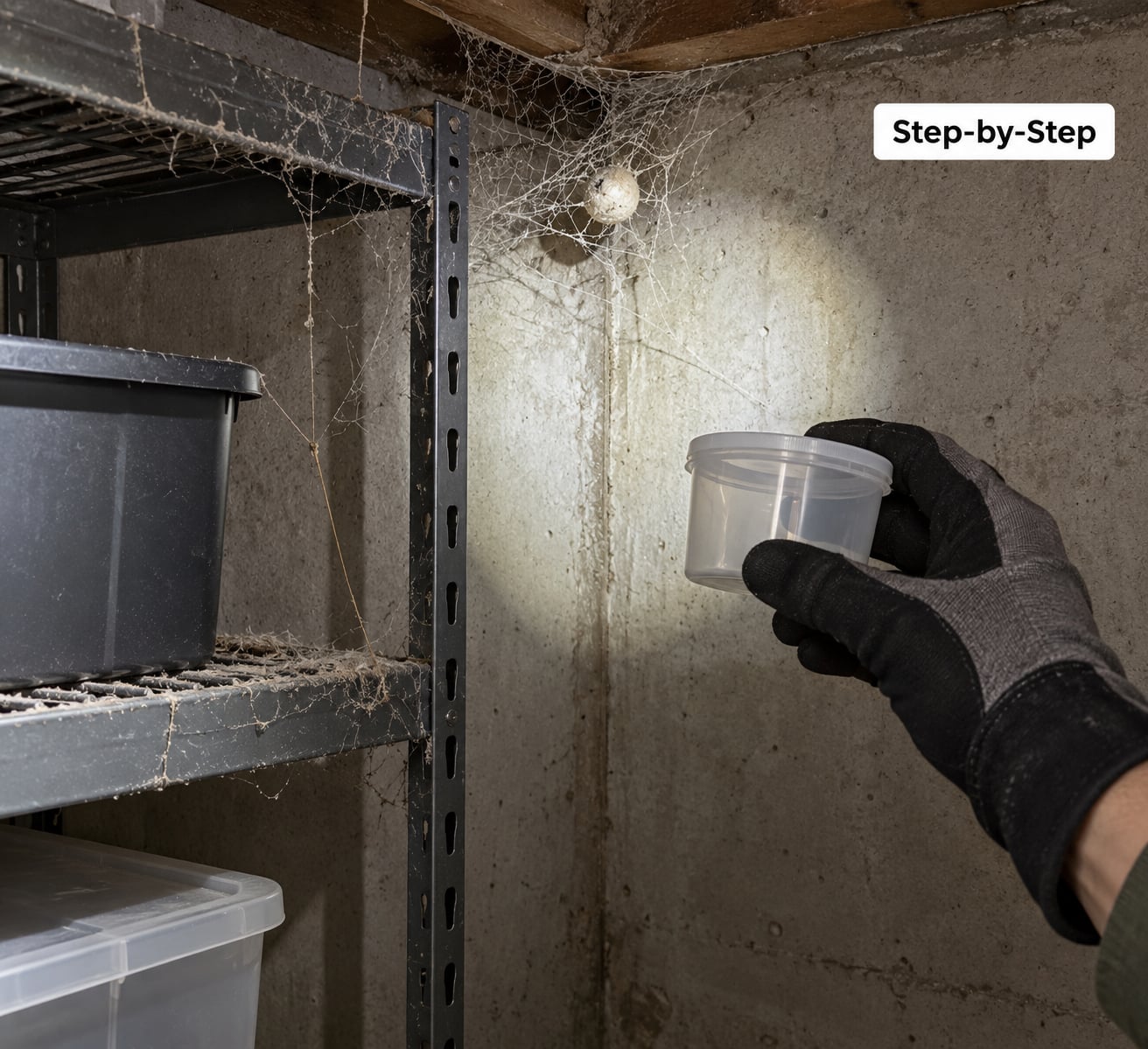
1. Inspect the Basement and Identify Where Spiders Hide
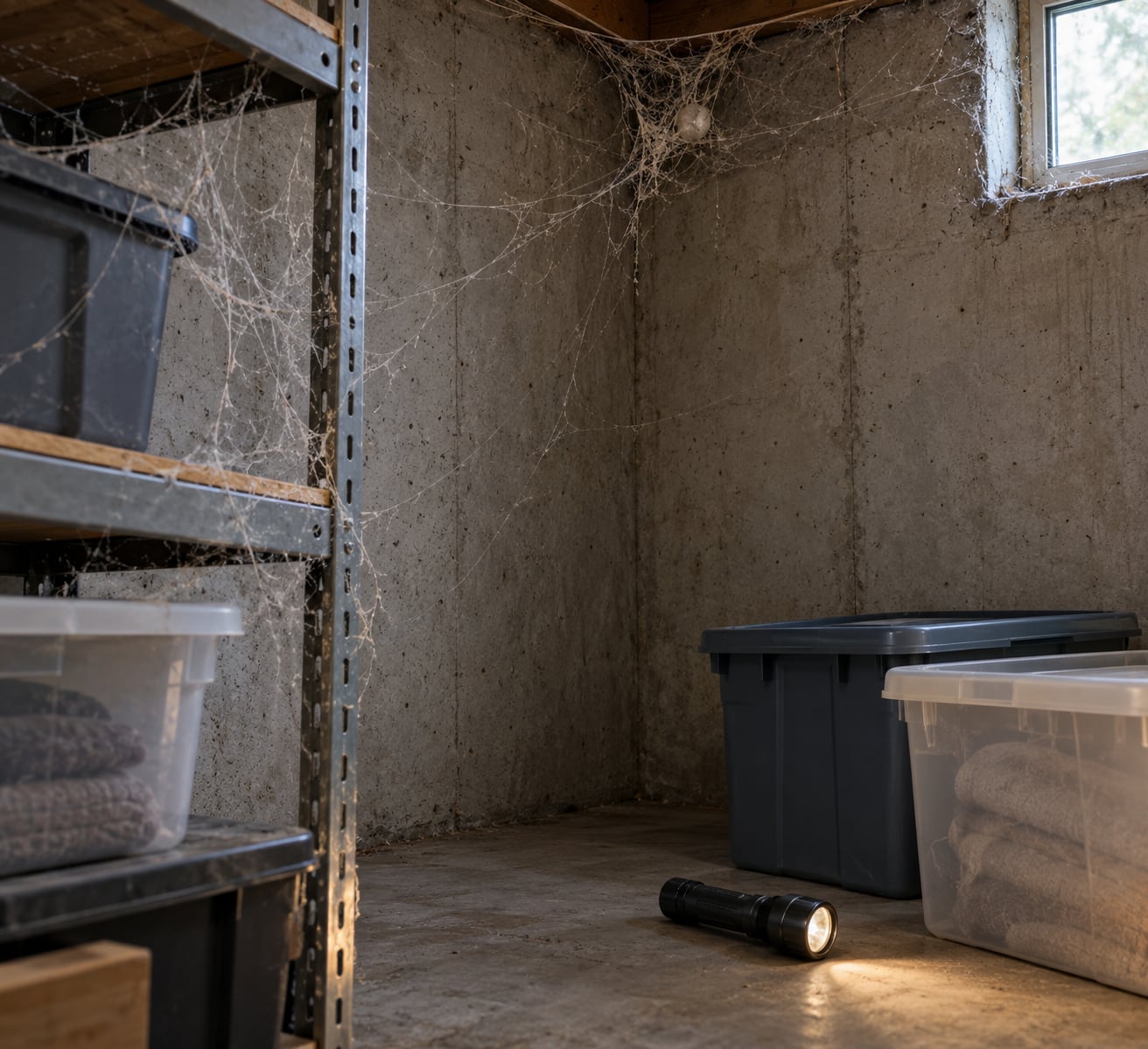
Walk the room before you touch anything, and look where spiders actually live rather than where you expect them. Start along the wall base where the floor meets the wall, then work up into the upper corners, behind stored furniture, along window sills, around floor drains, inside ceiling voids above dropped drywall, and inside any pile that has not moved in months.
You are looking for four things: dense webbing, silk egg sacs, droppings, and the spider itself. Egg sacs look like small off-white or tan balls, often with a silk collar, and they hide in the same tight corners as the webbing. They matter more than the adults, because a sac you leave behind is a fresh generation you will meet in a few weeks.
Identification is worth the extra five minutes even though most common house spiders are harmless. Cellar spiders and wolf spiders are the two most commonly reported basement residents. Black widow and brown recluse are rare but real, and both look different enough to flag if you know what to look for.
2. Remove Spiders and Their Webs
Take the spider outside rather than squashing it. Put the container over it, slide a card underneath, carry it to the door and release it a few feet from your foundation. Squashing one adult leaves its egg sacs untouched and does nothing for the dozens more you never saw.
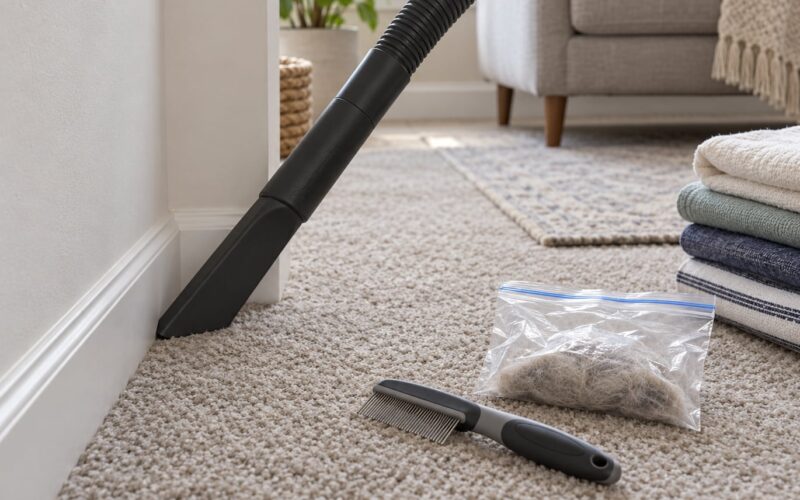
For corners and crevices, run the vacuum hose along the base of every wall and into each corner, then take the bag or empty the canister outside. Webs alone will not stop a spider from rebuilding, but clearing them removes the anchor lines it uses to navigate, and a visible drop in webs is the clearest sign your cleanup worked.
For what the nozzle misses, break up webs with a broom or duster and wipe surfaces with soapy water. Soap dissolves the silk and strips the outer coating spiders use to hold moisture, which kills on contact but does nothing at a distance.
Do not disturb a nest you cannot identify. A dense, tangled mass in a corner with a female guarding it is more likely a wolf spider with egg sacs than anything medically significant, but leave it alone and come back with identification help if you are unsure.
3. Seal Entry Points and Reduce Access
Spiders fit through gaps far smaller than you expect. A juvenile can pass through a hole about one sixteenth of an inch across, which is narrower than a pencil. That is why “seal the cracks” advice feels vague until you know the size you are chasing.
Work through this list with a flashlight and note anything that glows with daylight, moving air, or noise from the house:
- Basement windows and window wells – check the sash gap, the sill plate, and the gap between the frame and the foundation. Use window weatherstripping on the sash and a sealant on the frame joint. Cover a badly deteriorated well opening with 1/16-inch hardware cloth.
- Foundation cracks and mortar joints – use mortar or masonry caulk for structural cracks, not expanding foam. Foam is temporary on a foundation.
- Sill plates and where the wall meets the floor – a long gap along the base of a stud wall or where the sill meets the top of the foundation is a highway. Back it with steel wool and seal it.
- Pipe and cable penetrations – around plumbing lines, the furnace flue, water heater, dehumidifier drain, and any wire entering through the wall. Fill the gap with fire-rated sealant or foam, not packed newspaper.
- Vents and flues – cover dryer, bathroom and foundation vents with 1/16-inch screen or hardware cloth, fitted and screwed in place. Do not seal a combustion or dry vent airtight; that creates a carbon monoxide or condensation problem.
- Floor drains – a dry floor drain with no trap seal is an open route. Keep it filled with water, or fit a drain plug.
- Sump pump and pit – fit a screened lid, and check the pit for insects standing in residual water.
- Openings around bulkheads and crawl space hatches – the hatch gasket is the fix, and it is the piece most people skip.
- Garage or overhead door thresholds shared with the basement – weatherstrip the bottom of the door.
If you rent, everything on the exterior of that list belongs to your landlord. Put it in writing with photographs, because it is an ordinary maintenance request rather than a pest complaint.
4. Make the Basement Less Inviting
Spider habitat is any dark, still, undisturbed surface. Clearing a room changes more than the sight lines, and it is the single change people notice a month later.
- Move everything off the floor into lidded plastic bins, and leave about 12 inches of clearance from the walls so you can sweep and see.
- Get cardboard boxes out of the basement entirely if you can. They are shelter for spiders and for the insects that draw them in, and they collapse when damp.
- Vacuum or dust the ceiling, joists and the tops of shelves monthly, because webbing anchors build up there where you rarely look.
- Run a dehumidifier and hold the room under 50% relative humidity. Wet spider silk is heavier and damages the web, and many species do not thrive in dry rooms. Put the unit where air actually moves, not tucked against a cold wall.
- Fix the source of any dampness first: a leaking sill, a failed sump pump, a foundation crack, standing water in a window well. A dehumidifier working against a leak is an expensive fan.
- Remove the insects they eat. Crumbs in a storage room, pet food, bird seed and open trash all feed cockroaches, flies, moths and ants, and those are the actual target.
- Cut exterior lighting near the foundation, especially bright white bulbs, and keep firewood and stored items away from the wall outdoors.
5. Monitor and Use Safe Follow-Up Control
Put sticky traps along the wall base in the corners, behind storage and near doors, and check them weekly. Traps do not solve anything on their own, but they tell you where the remaining activity is. A trap with three spiders in it by the window well is a different problem from one catching a spider at the door.
If you do reach for a pesticide, read the label first and treat it as a label, not a suggestion. Foggers and total-release sprays work poorly against spiders, because spiders sit in corners and voids rather than drifting through the air. A crack-and-crevice product applied to corners, baseboards and entry points does more than a room fog.
Active ingredients fall into a few groups. Pyrethrins and pyrethroids kill on contact and break down fairly fast indoors. Neonicotinoids are slow-acting and better suited to crawling insects than to spiders. Essential-oil-based products sold as 25(b) exempt can irritate pets and people at close range, so they are a poor choice in a finished room where someone sits on the floor.
Two safety points matter here. Keep children and pets out of a treated room until the label drying time has passed and the surfaces are dry, and keep pets’ food and water bowls out of the basement entirely during any treatment. If a cat or dog spends time down there, that changes the method list more than anything else.
Call a pest professional when you keep finding new spiders after two to three weeks of real effort, when you have identified a black widow or brown recluse, or when the activity is coming from inside a wall void, a crawl space or the ceiling cavity above a finished ceiling, where you cannot reach it.
Common Mistakes When Getting Rid of Spiders in a Basement
Most failed spider cleanouts come down to one of six habits. Each has a simple correction.
Mistake one: spraying the whole room indiscriminately. Broad spraying kills a few wandering spiders, leaves the egg sacs and the food source untouched, and adds residue where a cat walks. Correction: remove and prevent first, then treat only the corners and voids where you have confirmed activity.
Mistake two: leaving the clutter where it is. You can seal every gap in the foundation and still have spiders if undisturbed corners and stacked boxes give them a safe place to sit. Correction: bins off the floor, 12 inches of wall clearance, and a vacuum pass under every piece.
Mistake three: sealing up the ventilation to “keep spiders out.” Blocking a dryer or combustion vent to close a gap creates a moisture or carbon monoxide problem that costs far more than spiders ever would. Correction: screen vents with 1/16-inch hardware cloth and leave the air path open.
Mistake four: using a product with no label, or off-label. Household aerosol leftovers, undiluted concentrate and homemade mixtures in a spray bottle are all poor ideas, and undiluted concentrate on a surface a pet walks on can be genuinely dangerous. Correction: use only a labeled product at the labeled rate, and never mix cleaning products together.
Mistake five: expecting the spiders to be gone the same evening. You will not see the adults you did not meet in the first pass, and a hatch cycle is not an hour. Correction: judge results in two to three weeks, and use traps to confirm activity is falling rather than counting sightings on day one.
Mistake six: killing everything without identifying it first. The instinct makes sense, but the ID takes minutes and it decides both the method and whether a professional is needed at all. Correction: photograph anything unusual in a jar and identify it before you act.
One more worth naming, because it comes up constantly online: chestnuts, cedar and hanging eucalyptus do not repel spiders. Where they seem to work, it is usually because the corner got cleaned at the same time.
Frequently Asked Questions
Should I kill every spider I find in my basement?
No, and taking them outside is better anyway. Most spiders in basements are harmless cellar spiders, wolf spiders or house spiders that eat the insects you want gone. If you have a genuine arachnophobia problem in a finished basement, live removal with a container and a card lets you keep the benefit without the daily dread. The only two worth a professional are black widow and brown recluse.
How long does it take to clear spiders out of a basement?
The work takes an afternoon. Results take two to three weeks, because spiders hide in voids and behind storage you did not move, and egg sacs you missed hatch on their own schedule. Judge progress with sticky traps along the walls rather than by how many spiders you saw. If traps in the same corner are still catching one or two a week after a month, there is a route you have not sealed yet.
Do vinegar or bleach sprays work on spiders?
White vinegar in a spray bottle is a contact treatment at best. It does nothing to webs, egg sacs or spiders in hiding places, and it stops working the moment it dries. Bleach is worse in a basement because it adds moisture and corrodes metal in the room, which works against your humidity goal. If you want a DIY spray, soapy water works better on contact, and cleanup is faster.
Where should I place sticky traps in a basement?
Along the wall base, not in the middle of the floor. Put them in corners, behind stored furniture, near the door, beside the sump pump, under window wells and next to any vent or pipe penetration you just sealed. Check them weekly and note where the catches are. Sticky traps are monitoring tools, not a control method, and they will not pull spiders out of a wall void.
Will a dehumidifier get rid of spiders in my basement?
It will not remove any, but it makes the room much harder for them. Hold the basement under 50% relative humidity and most common species do much better there, while wet silk weighs down webs and damages their anchors. Fix leaks and standing water first, because a dehumidifier working against a foundation crack runs constantly and does less than you expect. Then keep it running rather than cycling it on and off.
When should I call a pest professional instead of doing it myself?
Call one if you find a black widow or brown recluse, if you are seeing new spiders after two to three weeks of genuine cleanup, or if they are coming from inside a wall void, crawl space or the cavity above a finished ceiling where you cannot reach. Renters with a landlord who will not act, and any home where someone has a serious spider phobia or asthma that triggers around pesticides, are also good reasons to make the call.
Conclusion
Start tonight with three things. Walk the room with a flashlight and note where the webs and egg sacs are. Vacuum the wall bases, corners and ceilings, and take the bag outside. Then pull the boxes off the floor and start closing the gaps where you saw daylight or felt air.
From there it is humidity and food. Keep the room under 50%, fix the damp, and deal with the insects you find, because that is the part doing the actual work of keeping the population up. Identify anything that does not fit, and if activity keeps coming from inside the walls or you find a widow or recluse, that is the point to bring in a professional.
This guide is general information for US homeowners and renters. For a bite concern or an identification you are unsure about, contact your local extension office or a medical professional.